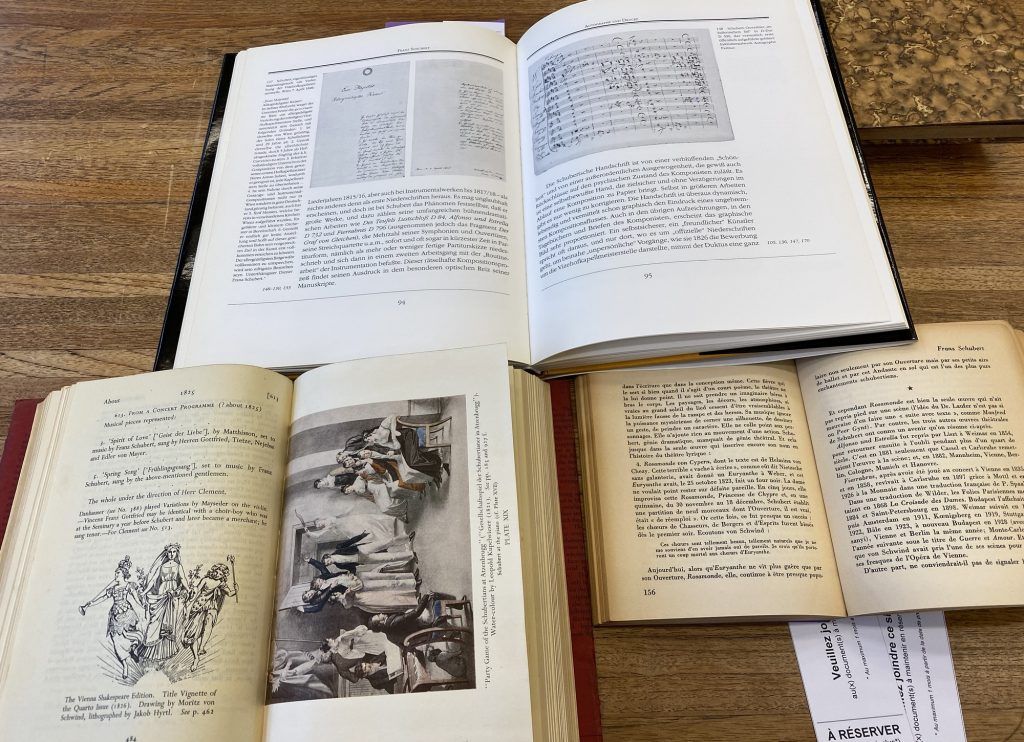
There is a plural form of Quartet. Philip Glass has composed a piece for 3 string quartets. Thanks to the Kronos Quartet performing and celebrating in Brussels, modern compositions are continuously added to the repertoire written for and performed by string quartets. Contrary to received wisdom the tradition of string quartets is still alive and kicking. At Bozar (Brussels) the marathon performance of 27 quartets, not all at once, but spread over a day and several locations, afforded a great free-of-charge opportunity to wipe off the dust from the sometimes rather introverted form of string quartets. Despite the high share of young musicians who performed well at the occasion, the afternoon focused more on new compositions. Concerning the audience, however, there is still an older age bias in listeners, more the standard Bozar clientele so far.
The afternoon reminded me on listening CDs entitled: “I don’t like classic music, but this one I do”. Many people came for art exhibitions at Bozar, but then (re-)discovered on the sideline the atmosphere of chamber music at this occasion. Closing the age and social gap in classical music is quite a challenge. It is surely more like a marathon than just a few sprints here and there. The new format at Bozar in cooperation with the Kronos Fifty for the Future Marathon will sooner or later find extended audiences beyond the happy few this time. I would recommend listening to string quartet music more often until the “Transcranial direct current stimulation (tDCS)” will be the new hype. 
Composing Assisted
Before the existence of digital composition tools composers were assisted by “Kopisten”. These persons rewrote the original draft of a composition into a “proper” version of the original document. Musicology has a tough time to deal with deviations from the original. It needs to be clarified which is the final and authorized version. In some instances this is far from evident. Just as an example Robert Schumann made ample use of the assistance of Kopist Otto Hermann Klausnitz (cf Nr 6), sometimes for the preparation of the composition, the finalized versions or the explicit drafting of different voices. Klausnitz himself was a flautist in Leipzig (Gewandhausorchester) and a conductor in Duesseldorf. Overall the debate is still going on, whether the composer’s draft or in many instances the Kopist’s version of the composition (authorized or not) prevails. In the age of AI, which is highly influential in modern music, such questions will most likely be intrinsic to the process of composition as well. AI is influential in evening out rough edges. Anette Mueller (2010) has done a great job to make this work of “Kopisten” much more transparent and her concluding chapter is programmatically entitled “Komponist und Kopist- Aspekte einer produktiven Kooperation”. (Image Mueller, A 2010 p. 340).

Schostakowitsch Revival
Je mehr Putin sich unablässig in seinem Angriffskrieg gegen die Ukraine und gegen seine eigenen Leute versteift, umso mehr werden die musikalischen Werke von Dmitri Schostakowitsch aktuell. Schostakowitsch hatte viel unter Stalin zu leiden. Sein Werk konnte kaum Gefallen bei der stalinistischen Führung finden, aber dennoch haben voele der Russen seine Werke geliebt. Insbesondere die sogenannte „Leningrader“ Symphonie, die das Volk einte vor den Radioempfängern, selbst mitten im Krieg gegen Nazi-Deutschland. Die Berliner Symphoniker haben diesem Werk eine neuere Ehre erwiesen mit einer Aufführung in Berlin 2024-5. Das Interview dazu mit dem Dirigenten Yannick Nézet-Séguin wurde geführt von Matthew Hunter, Bratschist der Berliner Philharmoniker. Es beschreibt diese eindrückliche Auswahl hervorragend. Die Berliner Philharmoniker haben eine lange Tradition, Werke von Schostakowitsch aufzuführen und einzuspielen. Die Digital Concerthall hat eine umfangreiche Sammlung mit Werken von Schostakowitsch. Oftmals etwas schwere Kost, aber durch das Ausspielen des ganzen dynamischen Spektrums von pp bis ff nie langweilig. Eine kleine Filmmusik „Volksfest“ (Sylvesterkonzert 2022) ist leicht beschwingt oder gar etwas beschwipst. Der musikalische Nachwuchs hat die Tiefe der Werke erkannt und gewinnt international anerkannte Preise mit Vorträgen von Werken Schostakowitschs. So geschehen zum Beispiel beim „Concours de la Reine Elisabeth in Brüssel 2024-5. Der Ukrainer Dmytro Udovychenko würdigte Schostakowitschs Leben und Werk inklusive des Existenzkampfes und gleichzeitig seine Heimat die Ukraine mit dem Belgischen Nationalorchester mitten in Europa.

Jury Competition

We can enjoy a lot of competitions in the field of the arts. In each of these competitions there is a different kind of rationale about how to judge the performances of candidates. The composition and competence of the members of the jury are of particular importance. We all tend to agree on this. However, the basic aim or direction of the competition needs to be defined or even redefined from time to time. Some perceive a competition useless if for example nobody takes notice of the results or the event. A good fight or drama within the jury helps to attract attention to it even if candidates suffer at times. The Belgian Music competition „Concour de la Reine Elisabeth“ has an annual major competition of young musicians competing for the beginning of a career as soloist. All phases of the competition are up for streaming so we all can watch and form our own opinions on the many candidates. It is not just the solo performance which counts but also the team performance with orchestra and the openness to new compositions in the realm of classical music. There is no vote of the public (yet?) like in the widely followed „European song contest“ but public acclaim does not leave a jury unmoved I believe. Tough work for jurors to single out small differences of fairly high standards to even enter the competition. The success of a jury has probably another evaluation criteria which consists in the follow up of candidates 5 or 10 years after the event or the awards. The making or destroying of careers as solo performers might hinge on very small differences on a single day. One competition with several prizes awarded is an encouraging way to promote musicians or other artists.

Puccini Media
In honor of Giacomo Puccini the Media enterprise Bertelsmann features one of its treasures. In cooperation with the “Archivio Storico Ricordi” of Milano, Italy, 100 years of Puccini’s oeuvre is celebrated with this exhibition. Fans of Puccini’s operas will have to visit the archives but the interest of this small exhibition lies in the impressive success story of Puccini and his publisher (part of Bertelsmann). Continuous innovation and adaptation to new media, like disks, accompanied an extraordinary marketing campaign throughout the 100 years. Even today there are cycling tours around Puccini’s hometown for the modern eco friendly tourists. We learn a lot about how the media industry functioned in the 20th century. It was absolutely vital to fighting for the rights of authors, composers and rights to receive royalties for performances as well as for the publishing on media. The exhibition in “Unter den Linden 1” is just next door to the Staatsoper which also gave honor to Puccini’s “Madame Butterfly” in 2024. His uncompleted Opera Turandot closes the exhibition with his rough sketches of the final scene. Merchandising is not an invention of the 21st century, but almost a century old tradition. This exhibition is a great testimony for this. It remains an important effort to allow authors and composers to gain a comfortable living during their lifetime. The gains for humanity as a whole are enormous.

Opera Politics
We know that sports and international politics have ample links. This holds true for Opera performances, either due to the way they are presented or due to the content of the libretto. The opera Jeanne d’Arc (Giovanna de Arco, Jungfrau von Orléans) by Guiseppe Verdi was composed in 1844 and had its Premiere at La Scala in Milano 1845. The libretto is based on the drama written by the playwriter Friedrich Schiller. Later in the 19th century musical pieces followed that dealt with the court judging Jeanne d’Arc. The opera by Verdi creates a strong female voice and character which outperforms men around her. Obviously, she was and remains for many a quasi-mythological heroine. In short, this constitutes great plots for drama and operas. This is centuries old despite the rare occasions of more recent performances of Jeanne d’Arc in form of Verdi’s opera or other forms.
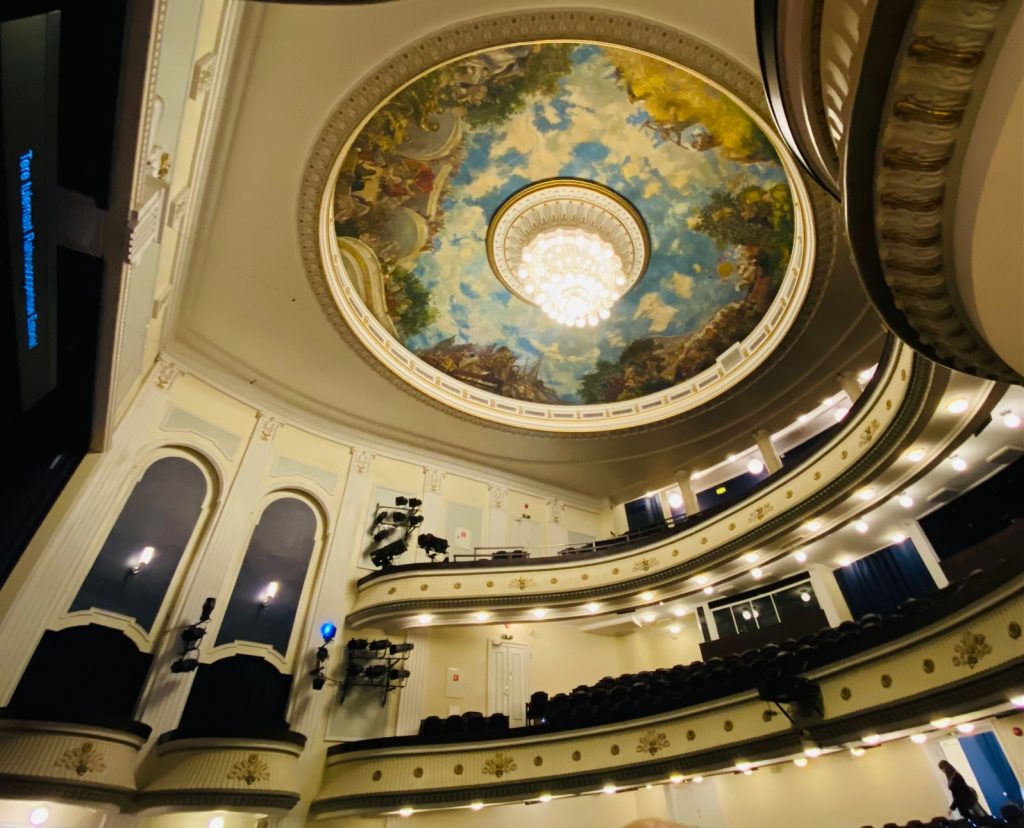
The Opera as arena of politics is currently tested in the Opera at Tallinn Estonia. Due to the aggression and occupation of Ukranian territory by Russia the plot of Jeanne d’Arc regained another European location of potential application. Ukraine pushed back the Russian invasion and struggles to win back its territory from the invaders. The performance of the Opera recreates an impressive Jeanne d’Arc in the person of Elena Brazhnyk who was trained at the National Tchaikovsky Music Academy of Ukraine. The evening inspired hope in many respects. Talents from Ukraine or trained in Ukraine reach out into to the world. Similarly, we have much reason to be inspired by courageous acts. Operas do politics. “Bravi”, as they say in Italian.
(Image: Opera Tallinn-Estonia2024-4-18)
Family Music Days
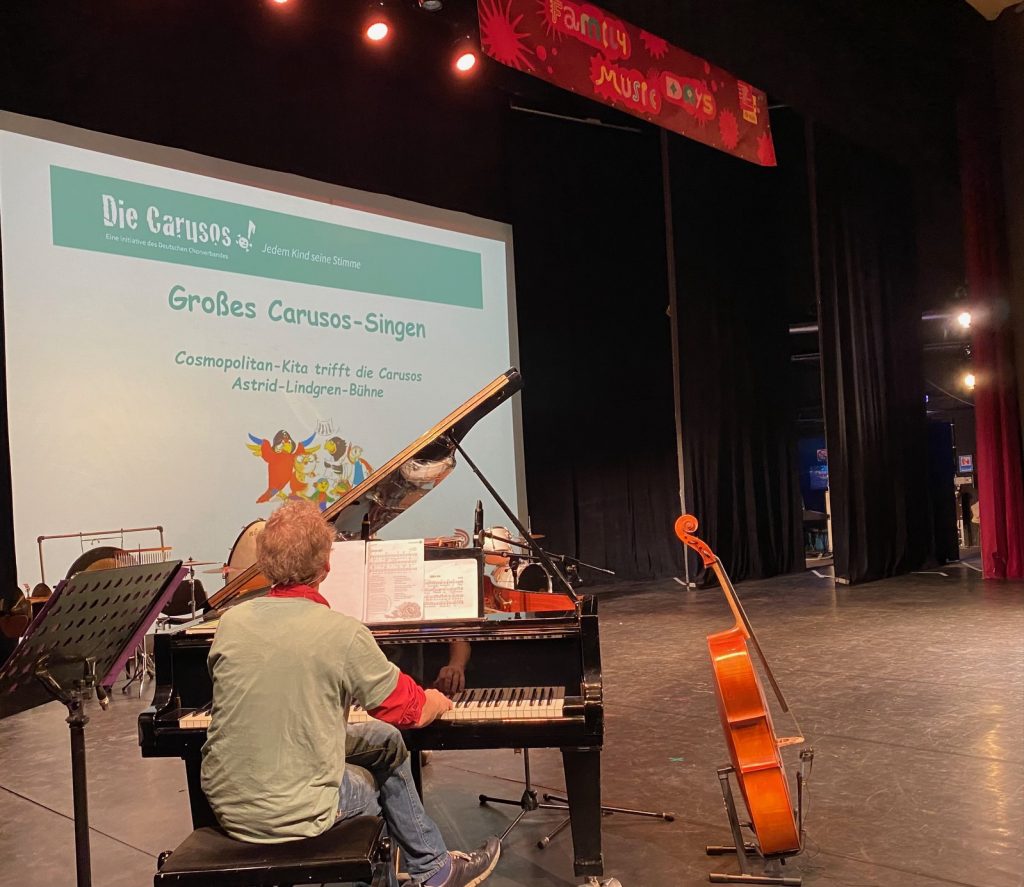
Kids are queens, kings and princesses as well as princes at the family music days in Berlin at the FEZ. Kids can enjoy the full spectrum of musical experiences from just listening to playing themselves, if they feel like it or dare to risk a sound. Just making noise is okay, too. Building your very own version of a musical instrument is a great learning experience for the young. To make music it doesn’t always have to be an expensive instrument. Your own imagination assisted by persons with patience and passion creates marvelous sound experiences. Initiating kids to the endless worlds of sound is having lasting effects on them. Great to see a concert hall full of young enthusiasts. Learning is so much fun, if taught in accessible and inclusive ways. Professional instructors joined by many volunteers make the world go round for kids. Wish you we here. Let’s spread the message.
Nocturnes
Contrary to some people’s belief “Nocturnes” is not only the denomination of the late opening of splendid shopping centres selling French fashion, but the name of music pieces. The origin of the Nocturnes as innovative form of composing is attributed to Irish born and bred John Field. The Polish born Frédérik Chopin developed the art form to perfection and he is the person who is also remembered for master pieces of this type of short romantic music pieces.
Mozart has left a famous piece entitled “Eine kleine Nachtmusik” and previous lesser known attempts of this kind were named Notturni, popular “Serenade” or “Pastoral”. All these Nocturnes shared the basic emotion, which we might call nowadays some kind of love-songs (Piggott, 1973, p.115). “Bel canto”, the tradition of emotional recitation of songs or arias, Paganini’s virtuous violine play were predecessors of the Nocturnes. 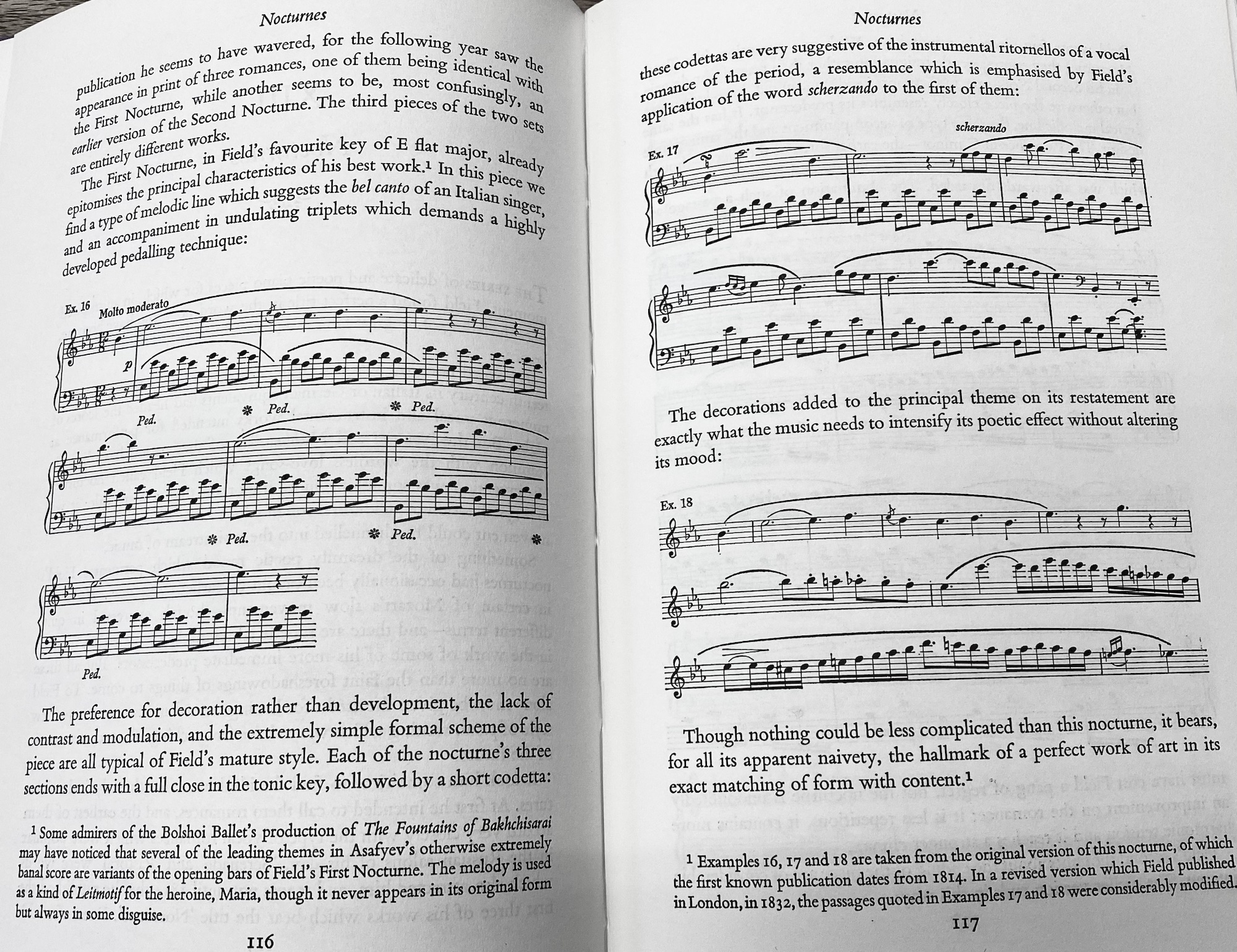
John Field published the first 3 pieces named “Nocturne” in 1814 and continued to produce new Nocturnes and revising former ones. These somehow more easy-going melodies or phrases often written in E or A flat major are technically less demanding for piano players than the later ones composed by Chopin, but their “charme” lies especially in their simplicity. Reducing complexity of sound rather than the virtuous effect seeking of a tune could attract large audiences. After the rebellion in France in 1830 and the foundation of independence of Belgium in the same year, so-called high culture had to address a lot widely differing emotions.
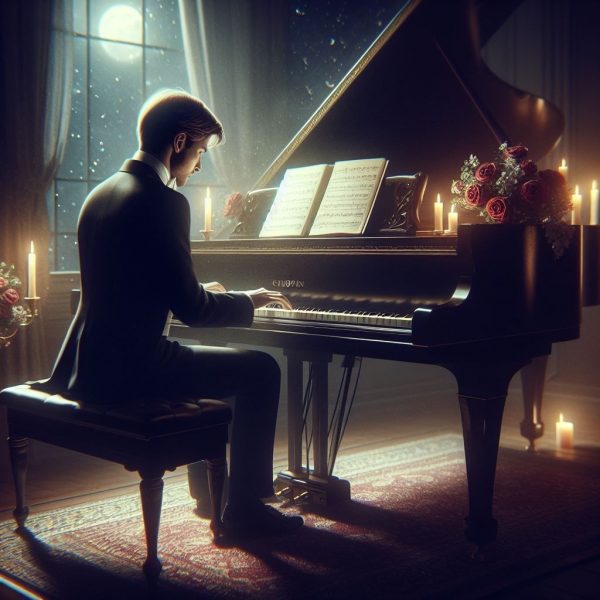
Maybe, in 2024 we are less surprised to rediscover the value of straightforward emotional tunes when even so-called high fashion shows in Paris return to more simplicity.(Image: KI Dall-E, Composer plays on grand piano Nocturnes by Chopin with romantic flair, photorealistic style on 2024-3-5).
Paris 1830s
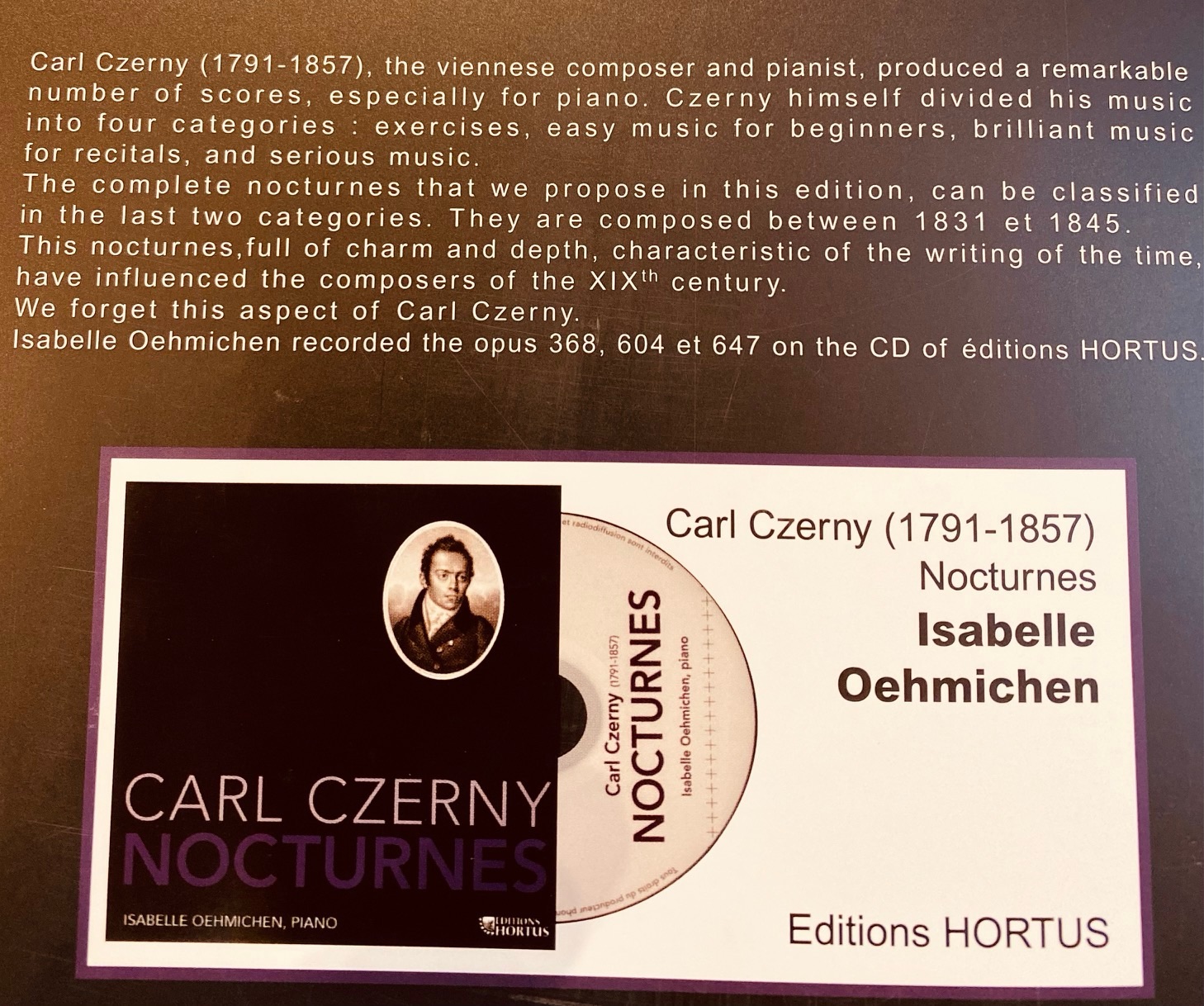
The music life in Paris in the early 19th century, almost 200 years before now, was incredibly rich. In 1828 the young Flotow arrived in Paris to receive lessons. The pianists Liszt, Chopin, Fields and Czerny passed or lived for longer times in Paris. The innovation in this period of romantic music and operas saw also a fierce competition among those talents. It was no easy task to find your niche to thrive in composition or in both performing and composing.
The 1830s had a rich urban bourgeoisie, which animated and indulged in festive events of live music and social life. Friendships of Chopin and Sand are a testimony for this. Similarly, the young Flotow and Offenbach paired to find their place in the Paris music salons and society of that time. The biography of John Field, written by Patrick Piggott (1973, p.73-81) supports this density of musical experience. The period is also characterized by the fast industrialization and the rise of the global trade. The musical life found refuge in the romantic period and more and more artistic performances by musicians. Theatres, opera houses, concert halls and private salons were meeting points of the upper social class which practices networking in rather closed circles with rather rigid routines and admission at the time.
In architecture the Operas became meeting points and a matter of national pride with National Operas contributing even to national identities. The opulent “Palais Garnier” in Paris was started in 1861 to become an iconic place in the new Paris with the huge boulevards à la Haussmann. The wealthy citizens cultivated a new lifestyle of a networked upper class that had the leisure to participate in the masses of modernity. Cultural events of all kinds filled newspapers and specialized editions. There were inner and outer circles of influence in the economic, military, political and cultural spheres.
Recommendation letters were a real currency for entry in each of these circles. Some of these social practices, have still a lot of currency even in 2024. In short, in the 1830s Paris was the place to be. Compositions of that time still fill concert halls today and their music is abundant on the new music platforms and streaming as well.
Schubert Franz
Franz Schubert hatte ein kurzes Leben. Geboren in 1797 verstarb er bereits mit 31 Jahren. Seine Lieder werden nach wie vor viel gehört und aufgeführt. Mit 10 Jahren wurde er vom Hofkapellmeister Salieri in Wien bereits als Sängerknabe in die Hofkapelle aufgenommen, was gleichzeitig die Aufnahme ins Stadtkonvikt bedeutete. Seine Lieder wie „Der Lindenbaum“, „Die Forelle“ oder „Die Rose“ blieben lange Standards in den Musiksalons und Konzerthallen. Beeindruckend bleibt auch die Schaffenskraft des jungen Schuberts der in seinem „Liederjahr“ 150 Lieder komponierte. Seine Versuche eine Oper zu schreiben waren weniger erfolgreich. Das hat dann fast 200 Jahre gebraucht bis die Pariser Opéra Comique diesen Traum Schuberts erfüllt hat. Vielleicht hatte es etwas mit seinem Lehrmeister Salieri zu tun oder den hohen Ansprüchen der Wiener Klassik in der damaligen Zeit. Friedrich von Flotow hatte den Weg nach Paris gefunden und war sich der Bedeutung des ausdrucksstarken Librettos bewusst. Orchestrierung zur Verpackung der Lieder wird dabei bedeutsam. Flotow sollte das Oeuvre Schuberts bekannt gewesen sein. Erfolge mit eingängigen Melodien haben beide feiern können. Jeder auf seine Weise.