Emotions in Politics

Rage or even hate count among the high emotional states in psychology. The presence in politics of these more extreme emotional states has been on the rise since the times of Covid-19 due to the necessary restrictions of the fundamental right of free mobility. A cost of living crisis might lead to similar emotional states as “Angst” about homes, commuting and heating put many people in existential crises. The rise of extreme right parties has gained on the basis of this basic social mechanism using hate speech and a continued rage as driving force. Established political parties across Europe and the Americas have been very slow to react to this. Just providing accurate information and correcting fake news is not enough. More emotions are called upon to counter such aggressive strategies used by political opponents, unfortunately. In the podcast “The 2nd thought” (Der zweite Gedanke in German!) Natscha Freundel together with Justus Bender and Heike Klüver we learn that an emotional response to rise of the extreme right is asked for. It is interesting to witness that 144 years after “Die fröhliche Wissenschaft” we still have not learned the lesson from Book 1 entry 38 by Friedrich Nietzsche: “with reason alone, thou shalt not convince those explosive minds” (own interpretative translation).
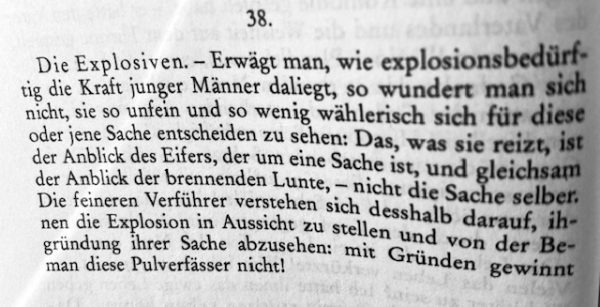

Quotation from Nietzsche Book1 Nr.38: Mit Gründen gewinnt man diese Pulverfässer nicht!

UN General Secretary

The questioning of candidates for the position of UN general secretary in 2026-7 has revealed  a fundamental difference in the understanding of the role to be played by any General Secretary. Do you want a SG to be more of a General or more like a Secretary? In other words, do you abide by the idea to have a person in leadership position to rely and lead in a strictly hierarchical manner or do you choose a person that understands leadership as a service to the constituent bodies or membership organizations. There seems to be a predilection for the former rather than the latter leadership profile. However, 21st century has a chance to break with the erroneous paths, choices and missed opportunities. … “when will we ever learn”.

Learning locations

We tend to associate schools as the primary learning locations. However, there is a multitude of additional locations that offer excellent learning locations like museums, libraries, churches, enterprises or various associations. Some of these learning locations have better equipped learning facilities and environments than many schools. It is about time to reckon with this and advocate stronger links between the often disconnected worlds of learning. Teacher training focuses on schools, curricula and teaching methods, but the systematic combination of all these „external“ learning locations with the full-time schooling world could stimulate so much more learning. Maybe, even the social selectivity of education could be reduced through the motivation and different entry points into learning by a diversity of learning locations. Lifewide and lifelong learning are likely to be motivated at an early age. (Image: Stabi West-Berlin 2026-7)

Learning moral sentiments

In school curricula and evaluations of pupils learning progress there has been little attention to pupils’ learning moral sentiments. Religion and comparisons of religious practices have entered educational programs, but even the big PISA studies have largely refrained from evaluations of learning achievements in ethical matters or moral sentiments. Adam Smith as proponent of the Scottish enlightenment had written about “The theory of moral sentiments” before embedding his market economy into the enlightened society. In the 2020s we realize that we have neglected this part of learning for far too long. This is the point where memorials can play a primordial role as a central part of learning not only about history, but moral sentiments in the broadest sense. Memorials “Gedenkstätten” operate as quasi-schools” in this respect for young and experienced learners at the same time considered that more than 50% of learners in memorials pupils, students or from teaching professions. However, outcomes of  learning in memorials could also be assessed in order to check what kind of learning goals and moral sentiments can be addressed in such historically charged learning environments. Such learning locations of moral sentiments have to balance the intended learning with the necessary decency of the commemoration in such learning environments. (Image: Topography of terror Berlin exhibitions) 

Repetition and Variations

Learning and, surprisingly, innovation or creativity build upon repetition as a method. You may just recall the content or repeat an exercise and this is an obvious form of learning by simple repetition. A bit  more challenging is active recall, which would take into consideration to ask (yourself) questions about the subject at hand. The time component is another form for effective or “spaced” repetition as time intervals and timing over a learning period are powerful mechanisms of learning strategies as well. Even visualizations of content in form of a mind map is a creative form of repetition. The basic content remains the same. You may also just use repetition in a form that you (imagine) teaching the same content to another person, which is also known as the Feynman method. Learning can consist in variations of repetitions. This works in many disciplines and the repertoire of repetitions is a part of any pedagogical toolbox and exercises. (Image: Extract from Horst Bartnig, Composition in ten colours 000-999, 1981, Neue Nationalgalerie Berlin) 

Gone Gliding

The seaside resorts offer additional experiences to people beyond swimming. Gliding on the water or in waves is an affordable exercise for everyone. It  just needs a small board and off you go. Falls are a usual part of the exercise. Beware of them if you have any prior conditions. For the 50+ generations some regular prior falling exercises are a must. Youth has the advantage of sufficient power per kg of body weight to afford repeated falls. Water and sand soften the falls. The gliding experience, however, is a great compensation for the risks taken. Not for everyone, but early experiences in or beyond schools give pupils a head start on how to balance out yourself in specific situations. Spectators and the experience to be under observation might influence your performance for the better or worse. Balance is a rather complex experience combining body and mind coordination for all ages. 

Exams time

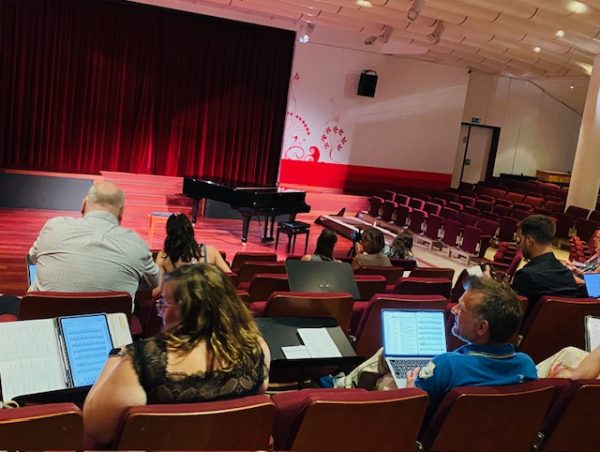
From time to time its exams time. Students of all ages have to face juries or standardized exams. For the credibility and for the sake of transparency, exams of higher grades invite the public to participate in these academic and learning rituals. For profs it is a moment to demonstrate the standards against which accomplishments and yearly progress is assessed. The level of instruction  is, however, still difficult to assess as the prior level, the year or years before is of course a quite influential intervening factor. Recruit the best and you are likely to have the best results after year after as well. The clarity about what is going to be assessed at the end of a Masters degree is essential as various target professional activities might determine a student’s orientation and ambition. Music is a great case to study as many students go into teaching professions afterwards and only a few shall aim for stage performance level or orchestra positions. Even within music exams time is not only just about music. 

École buissonnière

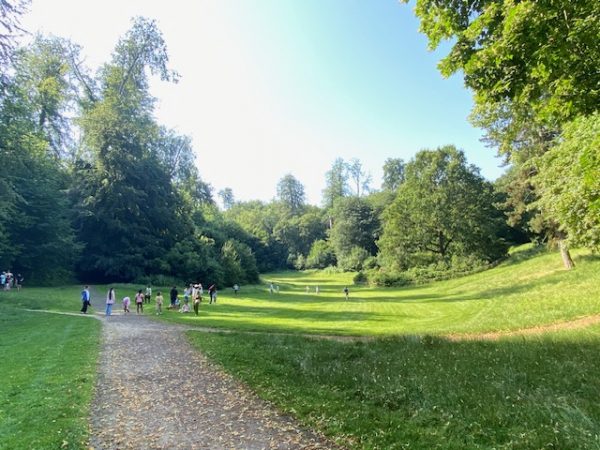
In 2026 the “École buissonnière“, the outdoor schooling has become a viable alternative to the schools that are overly hot during summer. But far beyond being an alternative out of necessity, schools as well as kindergardens adopt a form of schooling close to and in nature. It can be so much more than a simple interlude or excursion. Learning from nature is a precursor of bionics as well as compassion. After all nature offers ample examples of diversity and coping mechanisms. It is an option not only for learning purposes restricted to the young, but it is underexploited in continuous learning and lifewide experiences as well. There have been abuses also in history, most notably by Nazis in Germany for purposes of indoctrination. The learning opportunities to encourage a critical perspective of our modern, technology- and screen-dominated learning and life, are huge. They just need experienced guidance on the way of discovery, comparisons and collective experiences. Children open up and have fun, the more the pressure of classrooms is alleviated.  Learning about the importance of biodiversity from different angles is a very human value and includes our responsibility for other species.

Autonomy in swarm

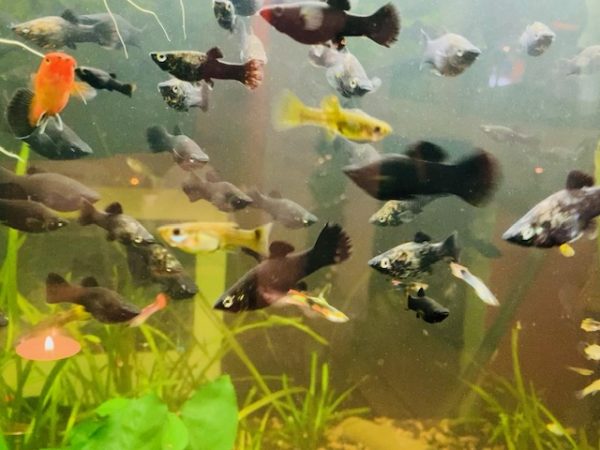
Swarm behavior is a fascinating research area. Almost all scientific disciplines feature some interest and publication in this area. The biological origins have been associated a lot with the marvelous behavior and patterns formed by fish moving about in swarms. Some species of birds show similar patterns of collective and somehow coordinated swarm movement. It appears to be tricky to safeguard some form of autonomy in the overriding mass behavior and mass movement.
Recent advances in this field by Li, Li & Zhao (2023) model such behavior within a predator-prey framework to explain the evolution of overall swarm behavior. Whereas “prey” strategies consist in “flocking” and “swirling” to irritate predator(s), the predators make use of “dispersion”, “confusion” as well as “marginal predation tactics”. Additionally, several assumptions go into the modeling of swarm behavioral evolution: agent observation, agent dynamics, and the environment. The mixed cooperative-competitive multi-agent setting applies reinforcement learning, additionally. The framework of evolution has 5 driving forces: (1) homogeneity of a swarm (parameter sharing); (2) actor with decentralized critic network; (3) replay buffer to enhance learning; (4) rewards for predator and loss for prey; (5) learning algorithm.
The modeling approach reveals the impact of an agent-critic network (potential of autonomous behavior) for protection of a swarm in a predator-prey scenario. (Image: fish in fish bowl 2024)

Autonomy in Behavior

The learning capacity of humans sets them on a path to acquire and extend their autonomy in behavior. At birth, physical and emotional dependence is highest. Soon learning to handle different nutrition sources and emotional stress allows to gain more autonomy in each of these components of autonomy. Throughout later childhood and adolescence we develop various additional domains as well as degrees of autonomy.
Role-playing, enhanced motor control and interaction with others define and redefine continuously the potentials and limits of autonomous behavior. Social norms start to play an even more important role as of adulthood, just consider financial autonomy as one of the dimensions. The most distinguishing factor from robots or animals until 2026 has been the human ability to form its own autonomous judgment, where value systems and legal norms co-determine or set limits to our autonomy or behavior. Some results from neuroscience have demonstrated that our readiness to act is prefigured in our brain and additional “intelligent” mechanisms are needed to suppress or guide the otherwise autonomous, spontaneous action or reaction.
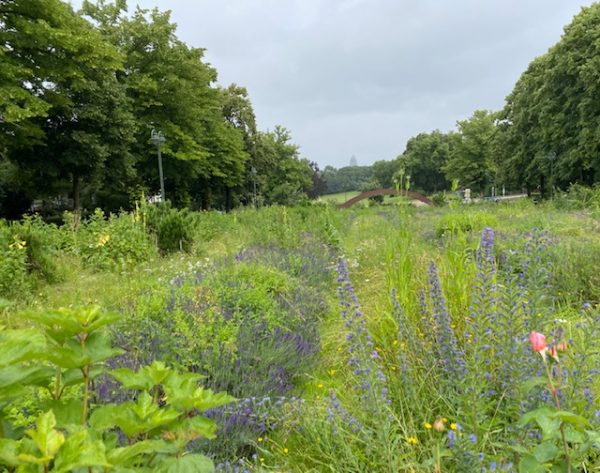
Our “free will” might not be as free as we wish it to be. Similarly our autonomy in behavior or decision-making might not be as autonomous as we tend to believe. (Image: Social cooperative gardening project, Brussels 2026-6)