
Taking positions

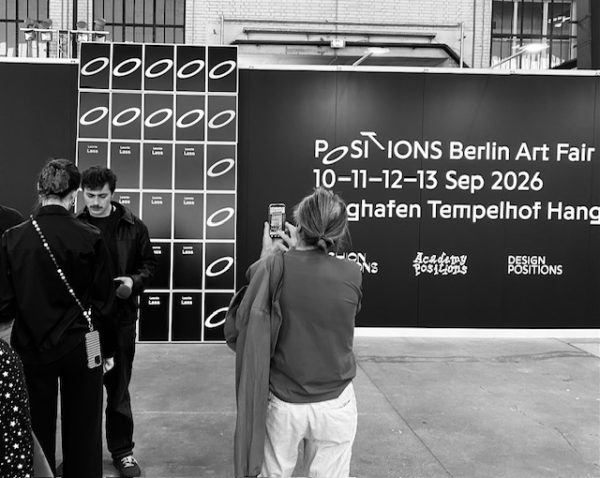
In the arts, positions are taken through the choice of topics, materials, an own perspective or approach. For the young artists, taking a position is quite a defining moment, usually after experimenting with several ones before. That point of view is probably a bit biased by a galerist’s perspective or when studying the market of art. Related to the Berlin Art Week, the Positions Berlin Art Fair offers an interesting overview of what is on the market. The section entitled Academy gives space and attention to young entrants into the art market.
The exchange of artists with the audience allows to understand in more detail what position is taken, how it is taken and worked out in detail. The  backgrounds of artists are quite broad compared to other metropolitan Art Fairs in this start-up atmosphere at the Hangar 5+6 of former Tempelhof Airport in Berlin. If we look at other perspectives, we shall not only get inspired, but we shall most likely question our own position(s) as well. Great learning experiences for all.

Culture goes Europe

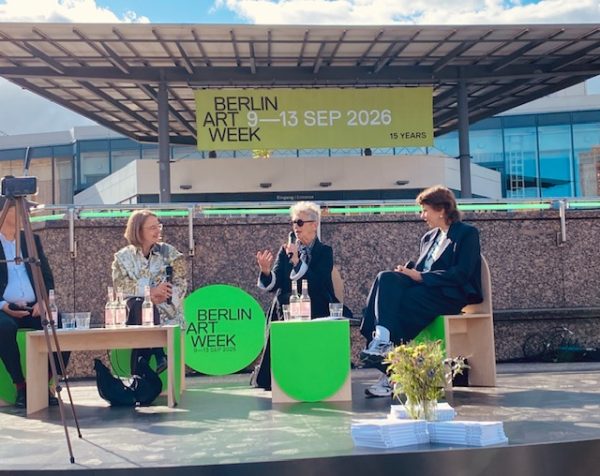
Culture has always travelled Europe. Not only the very famous artists have travelled themselves or their art has travelled, but students of art have joined masters in other countries to learn or become inspired. There are, of cause, some artists who paint themselves in their home and do not care much about the world around them. This is fine, too. The Berlin Art Week has taken a refreshing pro-European perspective in the talk entitled “Empowering Europe”. Culture can build many sustainable bridges across borders, which often start with language acquisition (Gitte Zschoch). Foundations assist with funding (Stephan Muschick). Curators initiate cooperations and lending across borders to challenge traditional cultures and practices (Anda Rottenberg). And the media ensure a wide distribution of cultural information and organise a society-wide discourse (Elke Buhr) about cultural diversity, heritage and innovation. All this is needed to avoid a self-referential cultural perspective of the MAGA-type in Europe. This is not a nice-to-have, but an essential part of the European power of resilience.

Monopol talk Berlin Art Week 2026-9

Human gravity

Long before the establishment of Newton’s theory of gravity, humans have been fascinated by gravity. Elevation from earth, after all, has figured prominently in religious imagery. Mankind’s dream to fly has become so popular that it contributes substantially to ruin the blue planet. Defying gravity as much as feeling the amplified force of it have become a continuous challenge. In sports we adore the bouncing on a trampoline and classical dance derives a lot of its charm from the suspended moments in air. Beware the landing and get accompanied in your first steps.
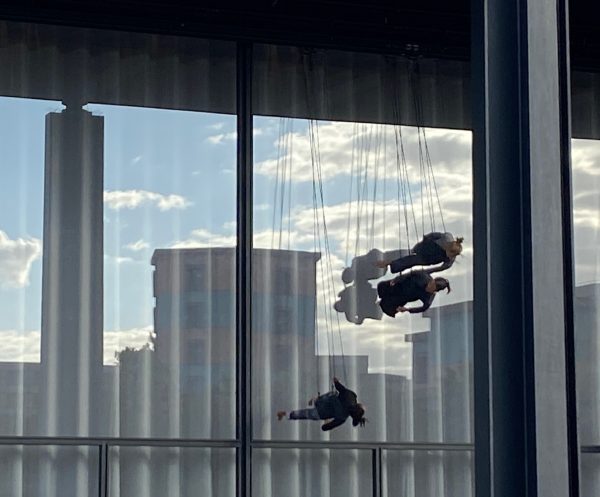
Modern Dance is equally creative in the challenge to defy human gravity. Trisha Brown (1971) suspended dancers horizontally so that they could walk in space at least along fixed lines and perpendicular to the surface. The physics of our body change in this bird-like position. Dancing in equilibrium on a horizontally suspended line leaves the audience amazed. The spectacular setting and performance at the “Neue Nationalgalerie” transforms the architecture again into a playing ground for choreographers. Suspension from human gravity is hard work, beyond “¾ Walzer” rhythm and, of course, it takes 2 to tango to feel the suspension.

Trisha Brown horizontal suspended Dance Berlin 2026-9

Glass wall

A glass wall remains a wall even if it is transparent. The glass and steel construction of the Neue Nationalgalerie by Mies van der Rohe has large windows which allow light to flow into the building and create an illusion of transparency as well as openness. However, for most exhibitions “paywalls” are erected to limit access. The Cattelan installation in the gallery erected another light barrier before the official opening in form of the ribbon barring entrance. For those who had experienced the real wall in front of or behind the Brandenburger Tor”, a certain allergy against walls is probably a leftover from those days or years. Hence, Klaus Biesenbach and Maurizio Cattelan tear that wall down!
Thanks go to the Volkswagen Group “Art-4-All” sponsorship which allows free entry on Thursday evenings already. Public-private partnerships are way forward and “Mäzene” can accompany such journeys in multiple ways. 

Cattelan Maurizio at Neue Nationalgalerie Berlin 2026-9

Modern Cathedral

For a long time we have argued here that museums are the cathedrals of modernity. Maurizio Cattelan has taken this claim literally. In a bit of a cheeky way, he turned the “Neue Nationalgalerie” into a cathedral of German modernity. Who are the Gods then? Our cultural heritage comprises beyond our German language classics, the novel “Die Blechtrommel” by praised and then disgraced Günter Grass. The figure serves as the “campanile” sitting above the entry. Well, the small scale “Brandenburger Tor” serves as the entry portal into a wide open space, with past pieces of adoration in a transfigured sense. This modern cathedral holds pieces of art similar to small chapels in a cathedral dealing or inviting to remember historic events or eminent persons. The modern aspect consists in its temporality. The show must not go on forever. Like surrounding every cathedral, lots of immortalised pigeons accompany our visit, just sitting around. There is no longer just one “holy spirit” or “peace dove” but so many. Welcome to the temporary modern cathedral in Berlin.

Cattelan-Berlin-2026-9-Neue-Nationalgalerie

Fleeting memories

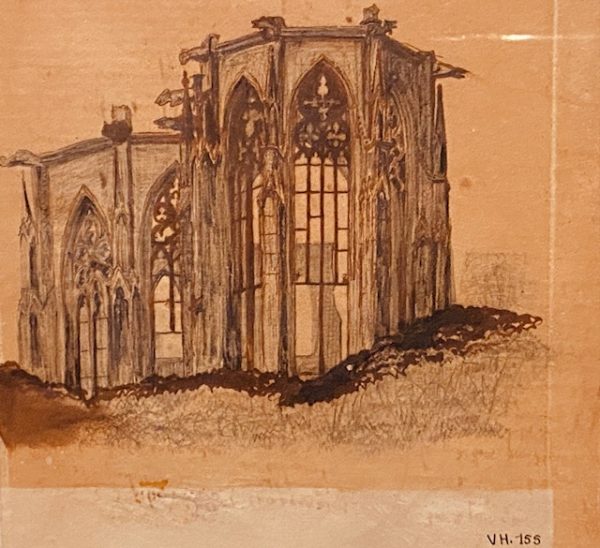
Our memory function is challenged once we travel. There are so many new impressions that ask for prime time in memory, but our capacities to safely store every detail of it is rather limited. On his voluntary travels, less when going into exile, Victor Hugo drew places with astonishing architectural detail and made literary descriptions on the back of the copy. The ruins of a gothic church in Bacharach (Germany) on the banks of the Rhine are a great example of his attempts to beat the fleeting memory. The ink and graphite pencil drawing date back to 1840. The imagery of the abandoned church, itself rich in memories of conflict by way of drawing details inscribes deeply into his own memory. A description in words on the back of this piece reinforces this effect beyond the mental exercise of precision versus dramatic blurriness. Repeating this exercise months later would reveal our fleeting memories when traveling. A great technique which is still valuable 186 years later. 

Church ruins at Bacharach by Victor Hugo 1840 exhibt at Maison de Victor Hugo Paris

Splendid networks

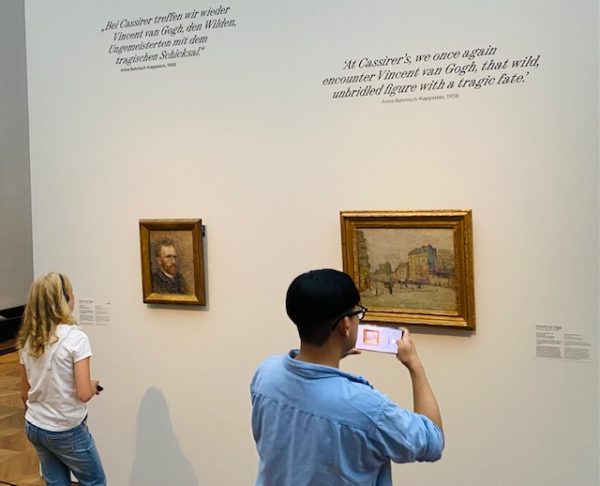
The art of gallerists is to blend networks. Some of them manage to create splendid networks that make history in the best sense of the words. The exhibition on the gallerist Cassirer made this argument in a forceful manner. He had a large network of persons interested in art and modern ideas as well as access to a network of artists who challenged the conventional arts of the time, later coined as the impressionists. The overlap of interests created a special market of art which met in his gallery in Berlin Tiergarten. Lots of take home lessons for us. 

Cassirer exhibition Neue Nationalgalerie Berlin 2026-8

Healing in museum

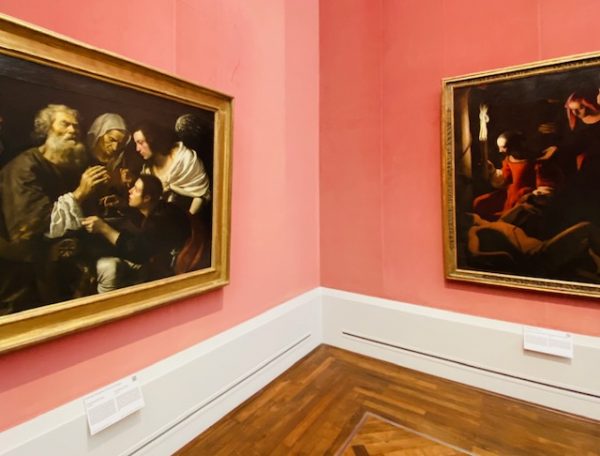
The topic of healing has a long tradition in museums. For example, in the Paintings Gallery (Gemäldegalerie) in Berlin “The healing of Tobit” (1630) by a follower of Caravaggio depicts the healing of eyesight with the aid of angel Raphael (extract of image below). The Bode museum also in Berlin in the vicinity of the Charité hospital proposed workshops to test or experience the healing through meditation techniques in the museum sitting on cushions while focusing on a statue for a while. Guided mindfulness workshops or own meditation sessions could be held during the visit. Museums can work as healing places to calm anxiety or release from stress.

Gone birding

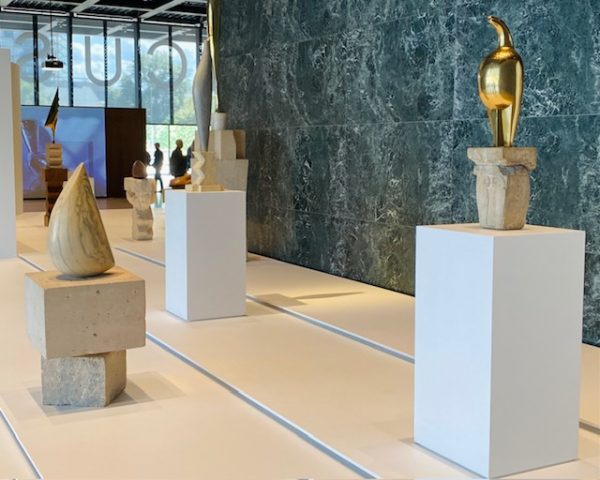
Birding is fascinating science and hobby. The recent advances in bird song recognition allow to compare the sometimes complex melodies across species. The support by many citizen scientists who collect data on sound, images and environment, made it possible to identify 8 major types of sound snippets. These constitute the basis from which to study or imitate the major bird songs, if you like. The scientific paper by Bacquele et al. (2026) shows that in dense forests the songs are more complex, whereas in open space simple tunes allow to travel far across space. Mating potentials seem to play an interesting role as well. But birding does not stop there. The Brancusi exhibits in the „Neue Nationalgalerie“ in Berlin deal also with the fascination about birds by the artist (image below). We also find depictions of the „bird-man“ in mythology more than 3000 years before our time and ever since. Flying probably brings together our science and dreams about birds and mankind. Science fiction is full of examples of that kind.

Rare instruments

The museum of musical instruments in Brussels features many rare instruments. The collection of grand pianos is a bit hidden on the top floor of the splendid Old England building in the concert hall. The lack of explanations allows you to discover the collection yourself if you happen to be early for a concert for example. Varieties of special features for grand pianos, you might not even have dreamed about, are up there. It would just need a few demonstrations of the technical features to reach larger audiences for these marvelous pieces. The combination of grand piano and harpsichord features has not made it into many concert halls, but special appearances could find their audiences. Maintenance, however, is a costly issue, whiich might have to rely on devoted sponsors in the cultural treasures of rare instruments. 

Ensor Home

There are few artists who stayed in their home for almost all their life. James Ensor was a personality who was profoundly attached and continually attracted to his native city of Ostend. After a short and unsuccessful spell at the Brussels art academy, he returned to his parents’ home and due to a heritage from an uncle, he could live in a nearby house, which also served him as his atelier. Although I did not come across documents that showed he had traveled a lot, nowadays his art work is spread across the globe. The seaside resort of Ostend was a real tourist destination and, therefore, many famous people of the 1st half of the century passed by and met with Ensor there. Not only fellow artists, but also scientists like Albert Einstein. Critical minds and people searching beyond the trodden paths must have been attracted to him, a personality who dared to challenge conventional painting and techniques of his time. A reconstruction of his atelier and several animations give a lively modern touch to his work and living style. My take home message from the Ensor Home: The search for inspiration might be just around the corner. 

Hybrid art

Bringing together 2 kinds of art makes hybrid art. Just as other fields of art have combined for example music with text to create the art form of songs as of the medieval ages, for example, the emancipation of another form of hybrid art is gaining prominence, text incorporated into or in cooperation with painting. The incorporation of text into paintings, sculptures or installations represents a drive to ise multiple channels of communication with an audience. Each might be sensitive to a specific word or sound, which creates an entry to gain attention or enlarge awareness for some cause. The “Palais Populaire” in Berlin displays the combination of the collection of the Deutsche Bank Art collection and the “Written Art Collection” to make this point with some forceful pieces of hybrid art focusing on text in art. (Image: Extract from “Map of utopia” by Qiu Zhijie, shown at “Seeing words, reading imagesSeeing words, reading images” at the Palais Populaire” in Berlin 2026-5). 

Valuable Donations

The of a donation to a national gallery is often a curse but may reveal only much later as a blessing. More galleries across the world give due credit to their generous donors. The collection of impressionist paintings by Caillebotte figures today very promising in the Musée d’Orsay in Paris. The fine collection by Chistoph Müller endowed to today‘s “Kupferstichkabinett” exposed in the Gemäldegalerie in Berlin has been on display in a small room. The „Kräuterblätter” (herbes on paper) by Kolbe 1815/1824 are fine pieces of etching with a focus on what might get lost in our biodiversity in coming years. Old trees were surely on his list (Oak trees 500+ years old). A collection of depictions of herbs and flowers a part of an ecological treasure which the generations after the painter and eventually the collector Christoph Müller began to value a lot. Some collectors are far ahead of their time by treasuring the past. (Image: Extract of „Kräuterblatt mit Schnitterin“ Kolbe 1815/24 Donation Christoph Müller shown in Gemäldegalerie Berlin 2026-5)

Portrait of or about

In some galleries or for curators of an exhibition, the crucial question is not only the overall message, but the best positioning of artworks in the available space. In many national galleries what hangs next to another piece is rarely seen as an opportunity for exploration and experimentation. A recent visit to the “Gemäldegalerie“ in Berlin allowed to explore the vicinity of 2 paintings, which are very different in appearance. The one (by Pierre Subleyras 1740) is just entitled “Portrait of a woman”, the other one next to it, “Virgin and Child Enthroned, with Angels and Two Saints, Domenico Mondo 1773). The former portrait has almost a modern touch to it as the beauty consists in the simplicity of the person depicted, whereas the latter painting portrays a rather empty message of splendor and power. The conscious confrontation of portraits or paintings with each other is the high art of curatorship. It is even more pointed than a guided tour of a gallery as the simultaneous rather than the sequential confrontation is the issue. 

Woman artist scandal

The painter Hermine Schmidt-von Preuschen, little known today, had to face strong forces in the established art community of her time. The skills and audacity she displayed at an early stage of her career as painter is epitomized in her work “Imperator Mors”. This painting dates back to 1887 and was rejected by the art academy in Berlin for their official exhibition. The woman artist was already at that time confident enough that her painting was of sufficient quality to deserve to be not only considered in the exhibition, but also to be seen by larger audiences. Similar to the refused painters of the impressionist movement, she decided to mount her own exhibition. The turnout to this proved to be quite a success according to the press cuttings presented as part of the exhibition in Berlin at the “Alte Nationalgalerie” 2026-5. Maybe it was the intended philosophical topic or message that killed the chances to be part of the art academy exhibition. “Imperator Mors” shows death or a skeleton to be the ultimate ruler of our fate. For all those who believe in some sort of life after death, this can be viewed as a “Scandal” in itself. The scandal created with such a depiction probably overshadowed the fact that the provocation came from a woman artist. Still very avantgarde for the end of the 19th century. (Image: Hermine Schmidt-von Preuschen and her painting Imperator Mors 1887)

Brancusi polyartist

The joint exhibition by the “Neue Nationalgalerie” Berlin and the “Centre Pompidou” Paris has the simple title “Brancusi”. The name of the artist Brancusi stands for a very singular approach to take sculpture into the 20th century by way of abstraction. Brancusi used all sorts of materials like lime stone, bronze, wood and marble. Additionally, he was very conscious of the fact that especially for sculptures the “mise en scène” plays a vital role. Brancusi excelled in this in a rather unique way, mostly by confronting different materials with each other. Sculptures, for him, were architecture in miniature. Such a polyartist approach to sculpture pushed him to use photography and video to not only promote his own work, but to exploit these relatively new techniques to enhance the effect of his sculptures.
Maybe it took almost 100 years that by means of the “not-so-social media” not-instant, anytube and tikytok, this “modus operandi” would capture a whole generation of youth to follow in his footsteps without knowing it. The polyartist Brancusi is a unique milestone, not only using lime stone, on the trajectory of sculpture beyond the early 20th century. The links to other innovative artists chosing abstraction, Picasso or Modigliani, as well as musicians like Eric Satie, reflect the importance of social networks for mutual encouragement when treading new paths in art.

Random randomness

In textbooks or courses of statistics, just as ordinary experiences with throwing a dice, we assume the perfect dice. This means the dice is assumed to have equal probabilities to roll on each side. Further, each throw of the dice of a sequence has an independent equal chance for each number to come up. To determine a “fair” dice we would throw the dice a thousand times to check, whether the probability of each side is about equal. However, the world of dices is not perfect and temporary or persistent margins of deviation are part of the real world. The weekly lotteries demonstrate this over and over again. Playing around with different shapes of dices makes the issue of probability tangible. Well worth to explore further empirically as well as a topic for inspiration of new approaches to learning about statistics. (Image: Dices produced by “devinsdice” Berlin 2026-5-5)

Forgotten but Unforgettable

Many women painters and artists who worked during the 17th and first half of the 18th century have been forgotten until recently. The galleries of the time and many years later gave little attention to the women artists of that time. Most of them were relegated to be of minor importance in the course of art history. The exhibition of the Museum of the Fine Arts Ghent in Belgium has accomplished to rectify this place of women painters in art history. The fine pieces of art, ranging from painting to sculptures, were frequently signed by men, probably to achieve higher market values and become visible in the public sphere at all at their time.
The exhibition is a kind of a revelation of how difficult it was for women to move from an “object of art” to be the subject painting including painting themselves. This also dealt with the view or regard of others towards women. Additionally, the exhibition features a section on “Social Expectations”, which deals with the expectations of the Flemish and Dutch societies towards women. Family values, marriage, wealth and social status were of utmost importance.
These women painters were forgotten far too long, but have staged their comeback as “Unforgettable” in the 21st century.
(Image: “Pictura at an exhibition” taken in the MSK Ghent 2026-4)

Before and After

It is not always easy to precisely identify the state of before a transformation from the state of after a transformation. In human developments we can observe lengthy periods of for example puberty. Other transformations of biological changes might be more obvious to identify like a broken bone, but a broken heart transformation might be less obvious as it might occur gradually and progressively rather than abruptly. Much the same can be said about illnesses like diabetes or cancer. The task of science is to study the whole process and this includes the theoretical model of such transformations. The arts have dealt with this complexity before and many artifacts take care to show or make explicit the kind of transformation they have undergone. The woodwork by Birkenmaier (before 1687, in catalog of Metamorphosis exhibition, Amsterdam 2026. Image below) is an early example of being honest about original piece and the evolution of the piece of art into the transformed “oeuvre”.

Metamorphosis

In the antique writings of Ovid “Metamorphosis” there is an extensive description and mystery about the metamorphosis of several characters. The narrative about various forms of metamorphosis has influenced our perception of change as having a mystic component. The arts before the enlightenment have drawn lots of sceneries of metamorphoses across the centuries. Maybe in form of sculpture this narrative has continued to be present even into the 20th century. The exhibition at the Rijksmuseum in Amsterdam and the essays in the catalog testify to this long shadow of Ovid’s original narrative. No need to mention Kafka as another adept of “Verwandlung” or Rodin, who reveals persons as semi-detached from stone. Wood and the return to ashes shows us the come and go of metamorphosis of human beings. Imagining mankind as a sequence of metamorphoses is a metaphysical as well as sociological perspective of our presence on our planet. (Image: Daphne transformed into a Laurel tree, Bernard Salomon, 1557). 

AI Motion Sculpture

At the Festival Noûs in Paris, the collaboration of AI with artists was a major event. Based on the huge collections of the BNF in form of data bases it is possible to join the 3 worlds of library conservation, technological innovation like AI and the imagery of artists. In the preparation of the exhibits and the parallel documentation of the genesis of the exhibits of the artists, the creative potential and process becomes more evident and understandable to broader audiences. The exhibit by Tobias Gremmler, Anatomy of Motion (2026 see below), captures the motion of a dancing body in a sculpture based on a 3D printing of a series of images blended into each other. with a fast photography camera, known from sports images previously, the dynamics of a motion become a tangible sculpture. The intriguing new form is in fact a motion that has been captured or has cristalized or materialized in a permanent fashion. New technologies and materials enter into art as they offer new ways of expression as well. The collection of art and documentation centers shall enter into new phases as well. (Image: Tobias Gremmler, Anatomy of Motion (2026) at BNF 2026-4).

Failure as criticism

The production of an object, which does not abide by the norms and conventions of its designated use, can either be considered a failure, a commercial flop or a critical comment on consumerism. In some instances it may even have the intention to produce art rather than a useful product. A tea or coffee pot may serve as such an example of it (see image below). It is designed not to serve tea or coffee in a conventional way. Such an object invites us to think around the corner,  whether we could still use it in the “normal” way. We are forced to innovate as user or we just leave the object aside. The Flops exhibition also included early car examples which used a “Wankel car engine” and the aerodynamic adjusted car model (shape of a peach) of the R14 in its flops collection which were early precursors of a, later on widely followed, car design principle. Such an aerodynamic car design saves energy and therefore increases the reach of the car without refueling or battery charging.

Overall, some supposed failures are more indications that we are not easily prepared to accept behavioral changes or alternative visions of products.

Myths debunked

There has been careful research on the use, or not, of color in classical Greek sculpture. More than 40 years of research have documented that what was long believed as monochrome sculptures, have in fact been very colorful specimen. The collection and researchers linked to the “Liebieghaus Sculpture Collection” can be inspected with experimental versions of the colors of the classical Greek time. “Gods in Color”, an exhibition by the Liebieghaus, provides a view of the rich colors of classic statues like the “archer” using the chemicals of the time to produce more or less durable or resistant colors. See also the archaic Greek Sphinks at The Met Museum.
Brinkmann and Koch-Brinkmann have spent close to 50 years on this research and attempts to convince the public of the “monochrome myth” of Greek sculptures. Research alone did not convince people, they seemed to need to see the colorful versions eye to eye to believe. The broader social science interest is to realise how much time it can take to re-establish scientific facts once they have been “eradicated” previously. (Image: Statuettes of classic Greek actors, lower row, BNF Paris)  

Art and fashion

There is fashionable art and arty-ish fashion. The links between art and fashion are manifold and new explorations of the link are always an interesting variation of the original theme. The Berlin “Gemäldegalerie“ has added a contemporary perspective in connection with Berlin fashion week 2026 to the already rich collection on the topic. The exhibition confronts the craft of the world of fashion represented by the dresses on actual display with photographs of those dressed worn by models against the backdrop of the historic inspiration. Add sound and video to this format and you will be close to total immersion into the world of art and fashion yourself. Art and fashion may be a part of all us, not only the privileged few in society. It is most of all a question of crafts related to art, design and fashion, which dominates the creative process. A strong message from all involved in the project to the visitors.

Paper and Scissors

In order to produce art it is not always necessary to have expensive materials at your disposal. Henri Matisse has demonstrated that paper and scissors can go a long way. With this in mind, the work by Johanna Beckmann, shown in the upper hall of the “Kulturforum” in Berlin, is quite astonishing. Beckmann relied on just paper and scissors, in addition to her paper and pencil work, to illustrate her own texts as well as collections of fairy tales. Her paper cuts of some hobbit stories might be remembered by a whole generation of children and even some of today’s world. Paper cuts and theatre based on such figures have been a cross-cultural treasure. The illustration of stories, but also the creation of own characters might be derived from such cuts using just paper and scissors. The “Kunstbibliothek” and the “Lette-Verein”-academy in Berlin joined forces for this exhibition and they both continue to transmit this creative craft to students actively involved in this “intergenerational exhibition”. Please bring your (grand 😉 children.
All those who travelled to Paris recently will be well aware that at “Montmartre” you can still have your profile cut these days. At this exhibition there is a “do-it-yourself” section, not only reserved to children.

Timely timeless

It is very timely to discuss timelessness. Some inventions or artwork appear to have a timeless value. The creation of books has this feature as we have known also a lot about the conservation and restoration of books across centuries. Timelessness is about an open-ended vision of time. In mathematics it is a usual part of the differential equations‘ calculus to handle infinity as an operationalisation or a form of a projection of time into timelessness. Humans have made considerable efforts to create material and, most of all, immaterial goods which try to exist independently from time. Geek or Roman philosophy are with us for more than 2000 years and we still benefit from returning to this original concepts. Egyptian culture and the wall paintings in caves still speak to us, thousands of years afterwards. Each clock suggests that time is advancing, but some treasures achieve the level of a timeless beauty, art or conceptual masterpiece. The more we talk about time, the more we shall cherish timelessness. (Image: Neue Nationalgalerie, Berlin 2026-1, The clock screening)


Art Utopia

Not all art is utopia, but a lot of it. A series of talks on the issue of utopia in art  (BNF) reminds us on the utopian projects many artists have pursued in the history of art. From a non-believer’s point of view, religious depictions belong to some form of utopian art. Much later art movements proposed to bring art closer to people’s lives by spreading decorative art to objects of the daily lives, like furniture, dresses, jewelry. Different forms of experimentation with materials or art styles reveal a taste for freedom of expression, sometimes of a utopian kind, at least at the time of experimenting. Abstract art opens up thought spaces which may appear like verylong shots into a very distant future. Science-fiction is of course a well known form of dealing with and representing utopian ideas to larger audiences. Maybe it is this curated space of utopia which many people seek when going to exhibitions and galleries. (Image: Giovanni Bellini, Resurrection of Christ, Gemäldegalerie Berlin). 

Bodies in motion

Since more than 2.000 years the art of movement and dance has fascinated people and artists. Early statues from Italy, which are exposed in the museum of the Bibliothèque nationale de France (BNF, see image below) testify to this. This form of art has been practiced within Europe and much beyond Europe as well. The human body in motion needs specific preparations and training to reach the levels of artistic performance. Similar to other art forms the skills have to be experienced and learned before you start to play with movements as a form of freedom of expression. Dance is not only a form of expression and identification of groups or generations, but also a discipline of rigor and body care. The fascination of human bodies in motion rather than the ballet of robots or drones, catches our emotions. Even recent songs do not hesitate to make this the central topic of a chanson. (J’aime comment tu bouge, by Claude Bégin) 

Headless Saint Dionysius

Denis of Paris stands for the Saint Dionysius, who is reported to have walked after being decapitated as martyr for his christian beliefs by the Romans in the 3rd century, all the way from Paris to St Denis in the suburb of Paris. We do not only find such a statue at Notre Dame in Paris, but also a medieval version in the Bode museum in Berlin. The cathedral of St Denis in Paris became subsequently the place for the coronation and burial of many French kings. The last king who lost his head through the guillotines was Louis XVI. It took almost another 200 years to abolish capital punishment altogether in France. Robert Badinter devoted his career to fight for this appeacement within the nation. (Image: Statue St Denis in Bode museum Berlin).  

Freedom of art

Some depictions or statues of the 16th century quite expressive and average expressions of their time. An angel who is playing the lute in a rather extroverted way is amongst the remarkable artifacts we can discover in the Berlin Bode Museum. The Angel playing the lute is an oeuvre by Hans Brüggemann from 1520 in Husum. The angel certainly performed holy music with interesting postures, which resemble more rock stars of the 20th century or youth performing an act of “air guitar”. Artists always tested the limits of the freedom of art and expression. (Image from Brüggemann Angel playing the lute, Bode museum Berlin, 1520)