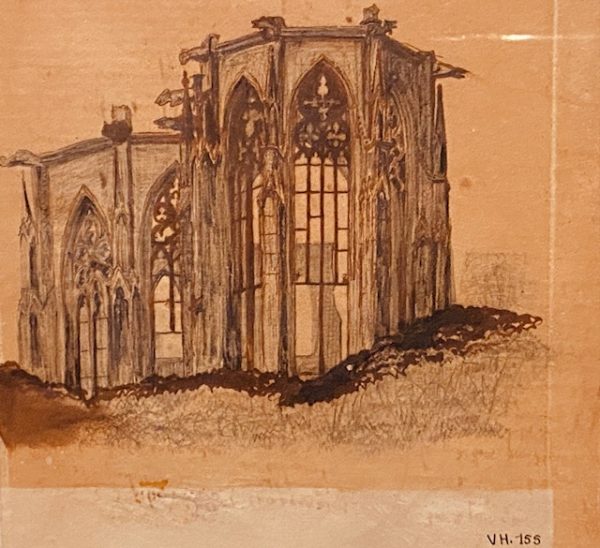

Our memory function is challenged once we travel. There are so many new impressions that ask for prime time in memory, but our capacities to safely store every detail of it is rather limited. On his voluntary travels, less when going into exile, Victor Hugo drew places with astonishing architectural detail and made literary descriptions on the back of the copy. The ruins of a gothic church in Bacharach (Germany) on the banks of the Rhine are a great example of his attempts to beat the fleeting memory. The ink and graphite pencil drawing date back to 1840. The imagery of the abandoned church, itself rich in memories of conflict by way of drawing details inscribes deeply into his own memory. A description in words on the back of this piece reinforces this effect beyond the mental exercise of precision versus dramatic blurriness. Repeating this exercise months later would reveal our fleeting memories when traveling. A great technique which is still valuable 186 years later.