Czechia coast

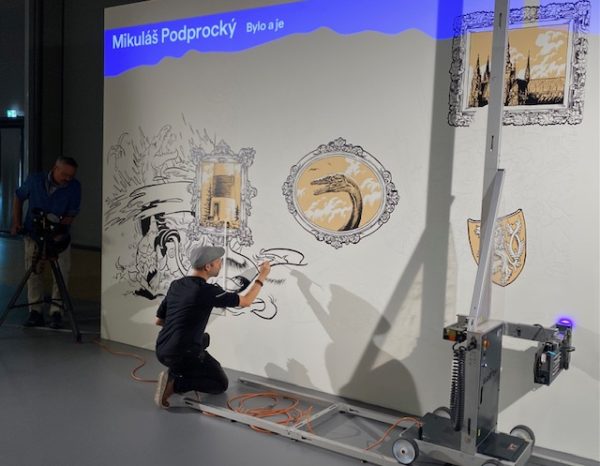
At the Frankfurt book fair we dream ourselves into the imagery of Czechia as a country with beaches and sand castles. The country pavilion of the partnerland of #fbm26 takes us to the ephemeral aspects of literature. While reading we deep dive into uncharted territories and discover unknown landscapes, sometimes even fees. These worlds of imagination become part of us or enlighten sequences of our life course. Taking the perspective of an external viewer widens cognitive and emotional predispositions. There are remarkable ol and new light houses to discover, too. Drawing as performative art, washed away every day like dreams, acknowledges the ephemeral nature of our reading or listening experiences. This message is going to stick with us. 

Scroll or stop

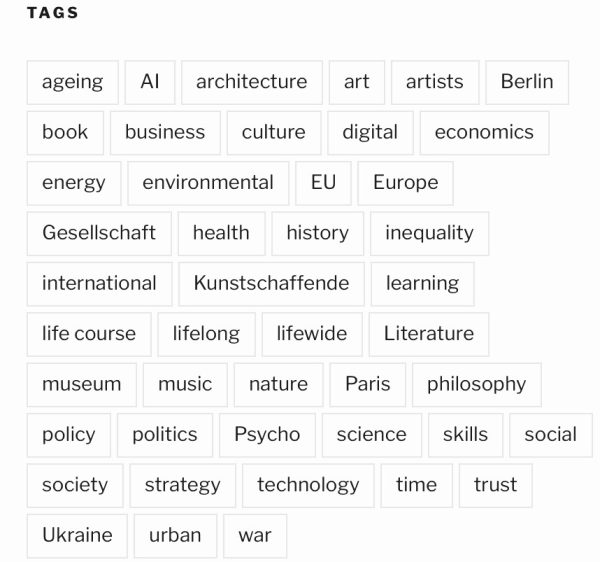
In 2026-10 the fundamental question is: to scroll or not to scroll? As we have moved into the individualistic society with omnipresence of the not-so-social media we keep scrolling through online content. Our attention habits are subject to so-called cliffhangers which aim to direct our attention on specific topics, surprising images or just steering us to more-of-the-same content. The social media ban for children fights against the addiction to endless scrolling. In most cases, what is good for children is also beneficial for adults. Hence, the “endless scrolling” (which I increased on this blog at several occasions, currently = 30 max entries) is from now on reduced to 10. After those 10 entries, you are invited to read more on one of those entries or use one-click proposed keywords or categories. The search of topics or names is another more specific entry into a social science perspective. Maybe, the invitation to scroll less, but stop more often and read or follow proposed links is a beginning to detox our online habits. 

Tags on www.schoemann.org 2026-10
Screenshot

Images about facts

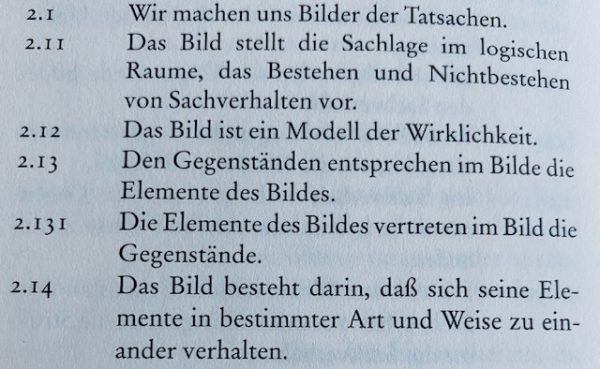
The philosophical writings of Ludwig Wittgenstein are a bit sturdy and and rather complex. 100 years after the first publication we realize that the meticulous order of the “Tractatus logico-philosophicus” follows a logical order of top-down and horizontal lines, which almost resemble algorithmic thinking. In section (1) he defines the smallest unit of analysis, a case, and (2) the existence of settings, which constitute such cases with almost mathematical precision. Already in 2.1 he states “we construct images out of facts” (own translations). In a kind of inductive approach we tend to generalize based on (single) cases or realizations in form of an image of facts. At the same time we have to be aware that an image makes a statement about the relationship of objects contained in the image. But it is just one possible option out of a whole group of potential relationships. Based on this reasoning a true as well as false realization of facts are possible.
In the 21st century the technological possibilities have grown rather exponentially (use of AI) allowing to give false testimony of facts and relationships of objects to each other. Wittgenstein challenges my own versions and daily combinations of text and images as approaches towards reality. (Image: excerpt from Ludwig Wittgenstein Tractatus logico-philosophicus, p. 14 edition suhrkamp)

Fleeting memories

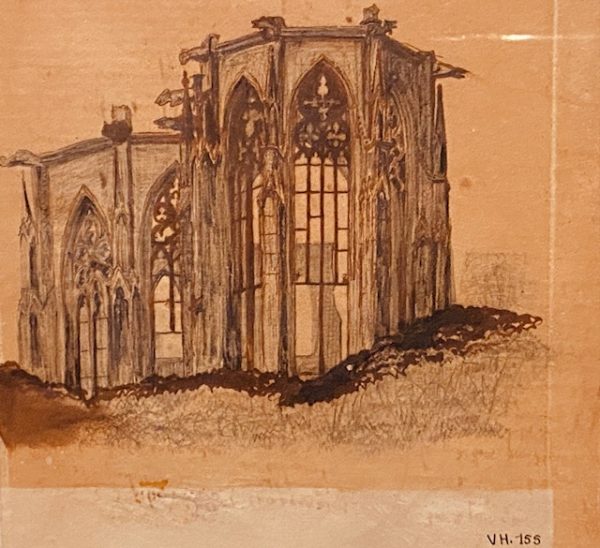
Our memory function is challenged once we travel. There are so many new impressions that ask for prime time in memory, but our capacities to safely store every detail of it is rather limited. On his voluntary travels, less when going into exile, Victor Hugo drew places with astonishing architectural detail and made literary descriptions on the back of the copy. The ruins of a gothic church in Bacharach (Germany) on the banks of the Rhine are a great example of his attempts to beat the fleeting memory. The ink and graphite pencil drawing date back to 1840. The imagery of the abandoned church, itself rich in memories of conflict by way of drawing details inscribes deeply into his own memory. A description in words on the back of this piece reinforces this effect beyond the mental exercise of precision versus dramatic blurriness. Repeating this exercise months later would reveal our fleeting memories when traveling. A great technique which is still valuable 186 years later. 

Church ruins at Bacharach by Victor Hugo 1840 exhibt at Maison de Victor Hugo Paris

Marilyn Monroe TM

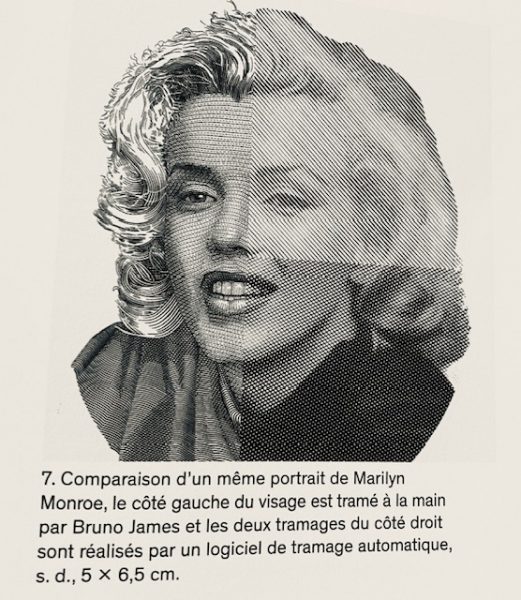
The image and probably even the person of Marilyn Monroe has become a trademark of its own. Since the choice to change her name and outlook to become or be created as the objectified trademark of Marilyn Monroe, the financial interests to gain money using every image, sound or video have reached above average returns. The profits mostly accrue to those owning the commercial rights. At the occasion of her 100th birthday, this continued rent seeking keeps spinning.
It has been well documented that the early death at just 36 years of age is linked to her exploitation or “commodification” as a trademark rather than a person able to cope with the overloaded imagery of herself. Bookshops, even in 2026-6, decorate their windows with books with her image on the cover as eye catcher. As with few other persons, Marilyn Monroe stands for an objectified person where the property rights of the image keep being exploited long after her tragic death. (Image: Marilyn Monroe, tramage by Bruno James BdF, left and algorithmic on the right. Transbordeur 2026).


Mind mapping

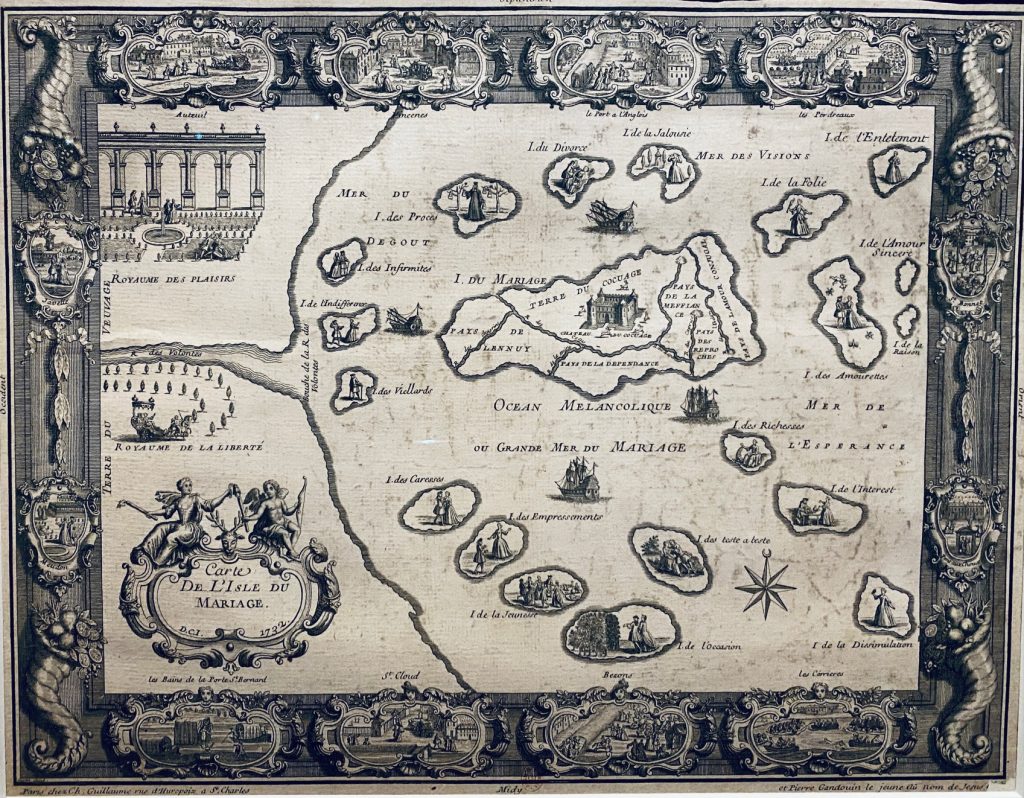
The exhibition in Paris on “Cartes imaginaires” at the BNF regroups treasures of maps across centuries in an interesting way. The technique of putting together elements in a map has been developed and refined over long time spans. Map are mostly in our minds as  depictions of geographical details allowing a broader overview amidst lots of detail. The mind mapping of today as a managerial or pedagogical tool is not much different even if AI might make is believe that it is a modern tool. The exhibit of “The island of Marriage” (image below BNF, “Cartes imaginaires”) in the middle of lots of distractions and potential distractions has a particular charm to it as it tells many tales and storylines for writing lives and novels. Our own lives or the depiction of life courses might be represented in a single map, maybe even comparable to a sequence analysis of events. The history and potential of maps and lives as mind maps is going to accompany us for quite some time as it already did for centuries. 

Critique of Maps

From a sociological perspective on maps we learn for example, that maps are also instruments to reflect property rights. This can be past claims of imperialism or recent claims of independence. A depiction as a map has historical and societal implications. Superposition of maps according to political, cultural or linguistic communities often reveal contested areas of domination and liberation movements. The specialized field of the history of maps can sharpen the senses for a critical view of maps in the 21st century. (Image:  Brankiza Zilovic, Nusquama 1984 exhibition “Cartes imaginaires’ BNF Paris).

Master AI

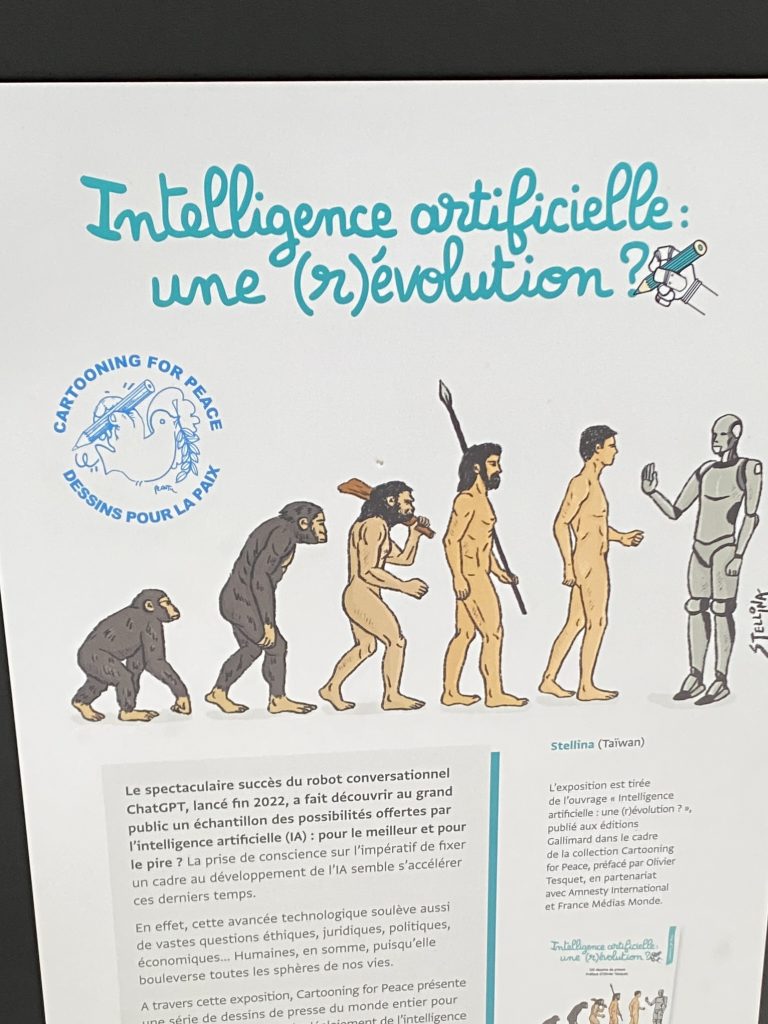
In 2025 the exhibition “Cartooning for Peace” at the BNF in Paris had already an exhibit authored by Stellina Chen from Taiwan, which summarized the evolution and projected the consequences of an all encompassing AI revolution (Image below taken at exhibition 2025 BNF). Currently we exercise ourselves in using various forms of AI or learn how to program them ourselves. It is our aim to master the new technology so it becomes a helpful tool. However, there are already many instances where it is no longer us mastering AI, but the AI has turned around the table and has started to master us. The applications of AI have entered our work tasks, tries and frequently succeeds in improvements of our routines and processes.
In private life a similar revolution is happening, when AI offers advice, which is hard not to follow and very convincing most of the time. Since getting involved in a conversion with AI tests your logic and debating competences, we find ourselves more and more in situations where AI is telling us what to do in the best of a convincing manner. After centuries of humanity to find freedom from oppression and the freedom to what we want ourselves, we seem to be ready to hand over control to AI. We are just like toddlers in this respect, willing or obliged to follow our master.

Inclusive images

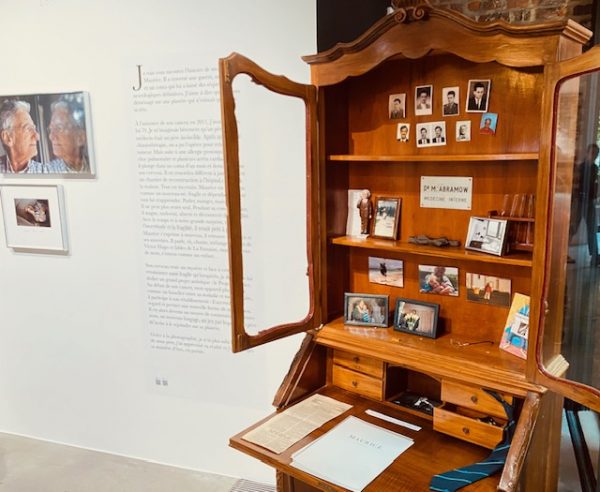
In the last 2 decades we can observe a strong concern among photographers to broaden the spectrum covered by images beyond well established imagery of non-binary gender. Diversity in imagery has taken a broader scope to extend, for example, the age range of people who are portrayed as central topic of exhibitions. The topic of mental diversity is more recent and needs a similar or even increased sensitivity to do justice to the whole spectrum of people. The photography of people with mental challenges necessitates a much more careful approach to the persons and complex personalities the photographer intends to portray. Trust and the development of trust of more vulnerable persons is a time sensitive process. The work by Charlotte Abramow “Maurice, Tristesse et rigolade” is a fine example of a photographer who portrayed over a long time of taking care of her father, previously a medical doctor, The years of the final stages of the life course of her father have been the subject over many years as the survivor of an extended medical coma had to struggle with the tough challenge of re-learning basic life skills again.
Abramow portrays her father as an actor of his “second life”, where the borders between reality, reconfigurations of his memories,   and “mise en scene” to co-produce the images. The images go far beyond the portrayal of aging and mental challenges as a deficit of persons. Yes, it is an integral part of these persons, but there is so much fun and positive emotions that derive from the intensive collaboration of actor, father and photographer that the images stick with us for a longer time. The presentation of props along with the photos creates an immersive installation, which strengthens the emotional bonding with the inclusive images of the later phase of the life course of Maurice.

Ethics in Photography

Yes, you read this correctly. This entry is about the ethics in photography, not about the much more popular discussion about the aesthetics in photography, which fills thousands of books on fashion, architecture, minerals, flowers, animals, landscapes and … you name it. Sensationalism works in photography. The more spectacular an image, the more likes you’ll get in any media, social or so-called social as well as traditional ones. Sex and crime are popular subjects, better framed as objects, as well. The basic idea of what constitutes unethical imagery or photography is broadly defined by the principle of exclusion, i.e. what is not ethical in photography. Let’s add to this inventory the conditions of production: exploitation of the subjects, be they persons or animals or even authorship like violations of intellectual property rights by AI.
Regulations and legal frameworks clarify many of those issues, enforcement of these rules are yet another element related to the ethics in photography. Global warming and the loss of biodiversity has made us aware that the respect of natural resources is also an aspect in the ethics in photography. Travelling long distances by plane just to get a few shots in the Himalaya region, if there have been thousands of (better?) images produced, printed, distributed before, is not sustainable for our planet as a whole. Invading protected areas, like natural bio-reservoirs, to take a few shots especially of rare plants and flowers maybe nice to look at, but the longer-term consequences add up to a loss of biodiversity for us all, in particular for later generations.
These considerations are different from “aniconism”, because they originate in a humanist foundation of ethics not concerned with any depiction or idolatry of images. The historical roots of any ethics in photography have long shadow into today’s practice of photography as well.
(Image: The framing of ethics of photography with reference to John Cage “Silence“)