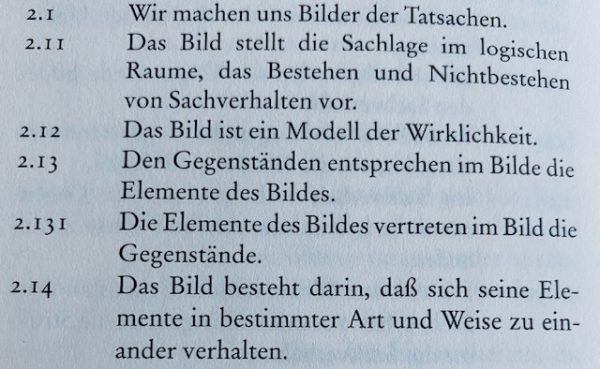
The philosophical writings of Ludwig Wittgenstein are a bit sturdy and and rather complex. 100 years after the first publication we realize that the meticulous order of the “Tractatus logico-philosophicus” follows a logical order of top-down and horizontal lines, which almost resemble algorithmic thinking. In section (1) he defines the smallest unit of analysis, a case, and (2) the existence of settings, which constitute such cases with almost mathematical precision. Already in 2.1 he states “we construct images out of facts” (own translations). In a kind of inductive approach we tend to generalize based on (single) cases or realizations in form of an image of facts. At the same time we have to be aware that an image makes a statement about the relationship of objects contained in the image. But it is just one possible option out of a whole group of potential relationships. Based on this reasoning a true as well as false realization of facts are possible.
In the 21st century the technological possibilities have grown rather exponentially (use of AI) allowing to give false testimony of facts and relationships of objects to each other. Wittgenstein challenges my own versions and daily combinations of text and images as approaches towards reality. (Image: excerpt from Ludwig Wittgenstein Tractatus logico-philosophicus, p. 14 edition suhrkamp)