Gone Home

There are at least 2 perspectives on going home. For the person away from home, it could be understood in the sense of returning home. For the community still living at a place associated or idealised as home, it is often interpreted as a home coming. In view of the powerful global social trend of urbanization, many people associate with “going home” as if migrated persons from rural areas would return home to the countryside, maybe just for a short visit. However, a home is to be interpreted much larger than just being a place, a location or a regional idiosyncratic feature, like the sea, the river, the banks or mountains. You might go home to a familiar sounding dialect or language. For some it is the idea of freedom or liberal values which they have moved to, that became their home. For others it might just be the possibility to practice a rather unique sport, which determines where they would feel at home. Home could just be a “state of mind” rather than a location.
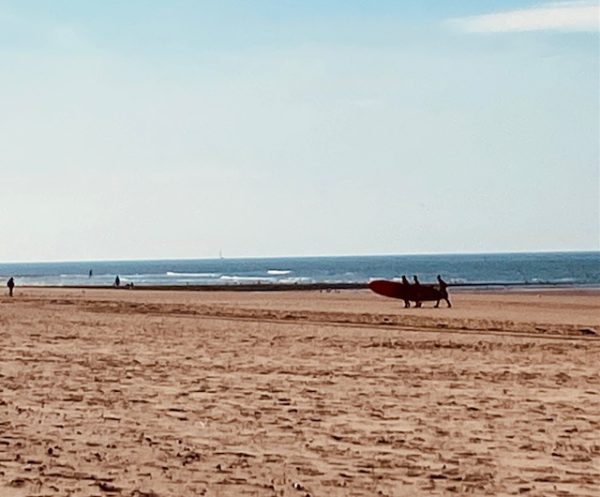
Ostend-SUP-paddle-board-on-beach-2026-9 e persons walking with board after practice

Presentation of thought

The introduction of the Venice exhibition catalog summarizes the artistic approach by Joseph Kosuth as a form of presentation of thought. The title of the exhibition “The-exchange-value-of-language-has-fallen-to-zero” is a provocative critic of the use of language. The experience of AI’s use of language as data points and machine-human interface in form of chatbots makes any topic related to language even more interesting. The embeddedness of language and the context of content become intelligible through visualization(s). We owe to Kosuth the view that the modus operandi of art is to raise questions and enter into meaningful debates with people. Site-specific installations and the uniqueness of the conceptual idea distinguish his works of art. Language and image enter into a kind of symbiosis embedded into a local context. This is taking Wittgenstein’s philosophy seriously. 

Kosuth inspired Where do you stand? (2026-9)

Images about facts

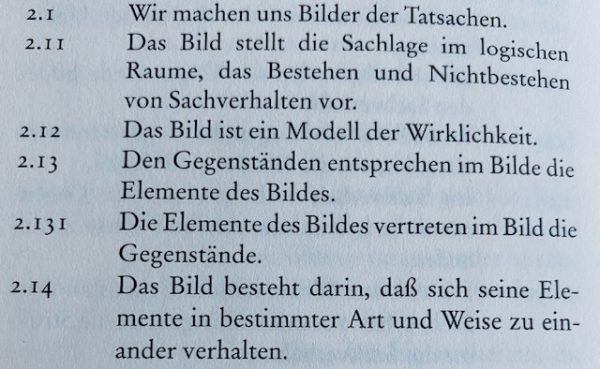
The philosophical writings of Ludwig Wittgenstein are a bit sturdy and and rather complex. 100 years after the first publication we realize that the meticulous order of the “Tractatus logico-philosophicus” follows a logical order of top-down and horizontal lines, which almost resemble algorithmic thinking. In section (1) he defines the smallest unit of analysis, a case, and (2) the existence of settings, which constitute such cases with almost mathematical precision. Already in 2.1 he states “we construct images out of facts” (own translations). In a kind of inductive approach we tend to generalize based on (single) cases or realizations in form of an image of facts. At the same time we have to be aware that an image makes a statement about the relationship of objects contained in the image. But it is just one possible option out of a whole group of potential relationships. Based on this reasoning a true as well as false realization of facts are possible.
In the 21st century the technological possibilities have grown rather exponentially (use of AI) allowing to give false testimony of facts and relationships of objects to each other. Wittgenstein challenges my own versions and daily combinations of text and images as approaches towards reality. (Image: excerpt from Ludwig Wittgenstein Tractatus logico-philosophicus, p. 14 edition suhrkamp)

Vaim and the sea

Vaim is not a person, it is an imaginary place, somewhere next to the sea, rather small in size, and in conventional terms nothing much is happening there, aging persons go about their daily routines in their more or less splendid isolation, speaking to someone is a rare act of achievement, most of the talk is speaking to yourself not even really thinking aloud, just ruminating on and on for days, sometimes weeks or maybe years in a person’s life 

Okay, my exercise in “slow writing”, a wee bit attempting to copy Jon Fosse, kept me going for 10 lines before the end of my paragraph. Jon Fosse keeps going without the end of a sentence  punctuation for 66 pages in the German translation by Hinrich Schmidt-Henkel. Reading the three phrases of Vaim, each as an extended poem and an “homage” to life from three intertwined perspectives, resembles a cubist painting and, maybe, at least for me, each one like the novella “The old man and the sea” by Ernest Hemingway. It is also a triptych in the religious tradition of paintings, just as much as “Vaim” follows in the footsteps of “Waiting for Godot” by Samuel Beckett. For all those who don’t care about any previous literature just read Jon Fosse as an endless love story of platonic relationships, silence and romance,  next to the sea. Please, don’t pass on your copy of Vaim to school-aged children as they might become very creative about punctuation. The only allowed end of a sentence are occasional question marks, which is a nice philosophical twist in Jon Fosse‘s literal exploration of time and love. 


AI-assisted

We used to create and use an artificial word to shorten explications in conversations. It is easy to understand for everyone nowadays to describe an online search as “I googled something” without further concerns about the sources used in answering a question. Apple just announced that its search engine Safari was used less than expected recently. The reason might be that more and more people search online by using AI tools or Apps that directly provide answers to their queries. ChatGTP and Perplexity are 2 AI-programs that might replace the other search engines we have gotten used to over the last decades. Particularly “how to …” queries offer reasonable instructions. In Perplexity you get an answer after you specified a little bit your query and, therefore, the answer is more likely to be right to the point offering text, images and sources. In ChatGPT you enter into a dialogue to further specify your query if unsatisfied with the first response. The judgement of an authoritative response is up to you if you want to follow up. The assistance of an AI-system cares less about the source but about the speed of response that it can provide. For sensitive questions or queries with less obvious or clear answers more interactions with the tools is necessary. The pricing and our willingness or ability to pay in cash rather than through the selling of our data for advertising will determine whether we shall “chat-it” or “plex-it” in future.

Bilingual Plus not WEIRD

The scientific literature on bilingual learning and living experience is abundant. Positive cognitive and social inclusion effects dominate the results. The scientific research has moved on to more tricky questions of bilingualism which shifts gear to multilingual learning. Many people and children are bilingual plus additional contacts to another or several other languages. Multilinguism has been of interest for several scientific disciplines. The effects on cognitive development have received a lot of attention. In order to achieve further progress in the study of multilingual development, it is instructive to move beyond bilingualism and the WEIRD particiants in most psychological studies (WEIRD = Western, Educated, Industrialized, Rich and Democratic). The paper by Omane, Benders & Boll-Avetisyan (DOI) takes this as a starting point and investigates the experience of infants with 2-6 languages.
They establish a protocol how to record the surrounding languages in a structured way. A major distinction into direct and indirect exposure to languages is a major finding. The example from Ghana provides a useful basis for other studies of multilingual experiences. A correct recording of different language inputs in time and of the sources is at the basis for later measurements of effects of different kinds of exposure and intensity of exposure.
(Image: Children’s room in Berlin Museum Martin Gropius Bau 2025)

Degré zéro

As all of us use GPS systems to navigate across the world or just in your city, “degré zéro” might nowadays be associated first of all with the prime meridian 0° longitude, which runs through Greenwich near London and around the globe.
In « Le degré zéro de l’écriture », Roland Barthes (1953) challenges the bourgeois kind of writing of literature. He introduced the pertinent distinction of the verticality of writing styles in the sense of social classes as well as the horizontal form of spoken language He further distinguished écriture as a person’s style which is embedded into the historical and social context of her/his time. As a radical change, Barthes proposed to use scriptor instead of writer as the latter expression is too much loaded with the historical package of the person. Barthes inserts the scriptor as écrivain into her/his time and insists on the intellectual and social context of writing or the author.
As the scriptor (p. 26) does not escape to become a writer « écrivain «, the degree zero de l’écriture postulates a homogeneous society, which obviously is an ill-conceived vision of reality. Language and texts, therefore, are not universal in kind, but bound to situations, which are defined in historical time and space (p. 67). Semiotics was a major field of his analyses of literature and language.
Whereas in a talk you might focus on the person you are talking to, in a written text the other person is « the many » readers, wherever they are and maybe at a much later time as well. There is a qualitative difference and yet modern “voice to text” transcription makes all spoken words immediately available as written document or “compte rendu”. (Source: Roland Barthes: De la parole à l’écriture. in Le grain de la voix, Entretien 1962-1980. p. 12).
Let’s watch our language as we follow the longitude or latitude around the globe and even small deviations from degree zero matter a lot.

Language Tech

Inclusive societies can build on many tools including AI to lower language barriers. It is not only a question of translation, but many other forms of language come to mind. Sign language or easy language are necessary to facilitate broader access to public services. Reading out texts on webpages or Braille translation for the blind to interact through keyboards are additional forms that are available in digital communication as well. The audio description of videos and images is well advanced (reverse engineered through AI) and allows people with limited vision to fully participate in society. Audio messaging and transcription are used by almost everyone by now. Public services will open up to these channels of communication as well. The technology around languages is much more than just translation and AI-assisted learning of languages (talkpal for example). The new lingua franca is language technology, because it enables us to speak many languages at the same time even dialects or lost languages and in many voices. (Image: Extract of Josef Scharl, the newspaper reader, 1935, Neue Nationalgalerie Berlin)

Segregated Estonia

In cities of Estonia the segregation between the majority of Estonian speaking persons and Russian speaking persons has a long tradition. The Russians built new housing as part of their occupation of Estonia and housed their own persons there and sent their children to Russian speaking schools in these neighborhoods. The paper by Kadi Kalm et al. (ESR, 2024, 208ff) demonstrates the persistence of this “colonial” segregation over generations. However the authors show that desegregation of schools is a remedy to such previous housing and education policies. Learning the majority language is a definite step towards later integration into society just as (marital or household) union formation or labor market success do. The Baltic states have managed to escape from the Russian occupation but the Russian neo-imperialism is not entirely tamed. This explains a great deal of the anxiety of Estonia and other previously Russian occupied Eastern European states of a Russian backlash. Military commitment and a strengthening of the European Defence Union is a consequence. (Image Medieval Town Hall Tallinn Estonia 2024)

Ne pas rire

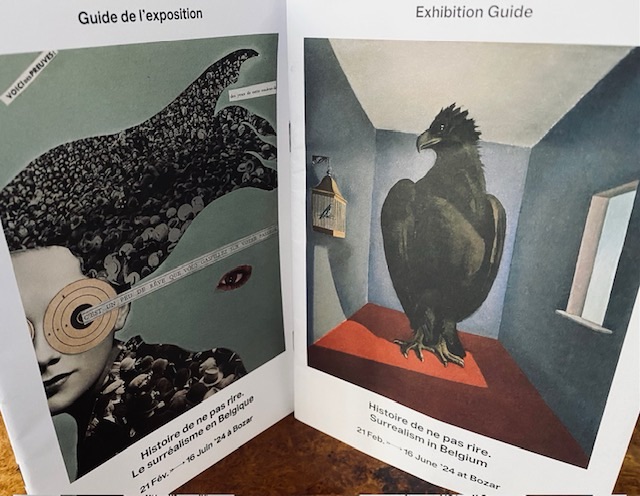
The exhibition of surrealism in Belgium at Bozar has the inviting title “Histoire de ne pas rire”. Even the booklet of the exhibition guide does not translate this into English assuming everybody has at least that much of interest in French and the willingness to learn about these 5 words that are a reference to the understanding of the surrealist art movement. You are explicitly invited to allow yourself to laugh when looking at the images. Reflection comes second. Caught by surprise and making new connections of seemingly unrelated images and words, that’s the essence of it. The comparison of the 2 versions of the exhibition guide teaches language and translations beyond the simple words. Sometimes it is best to not translate the text as in the title of the exhibition guide.