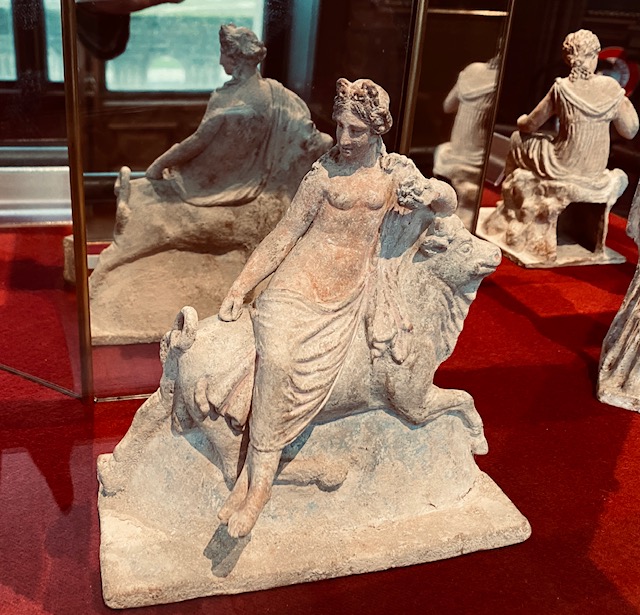
Abduction of Europa

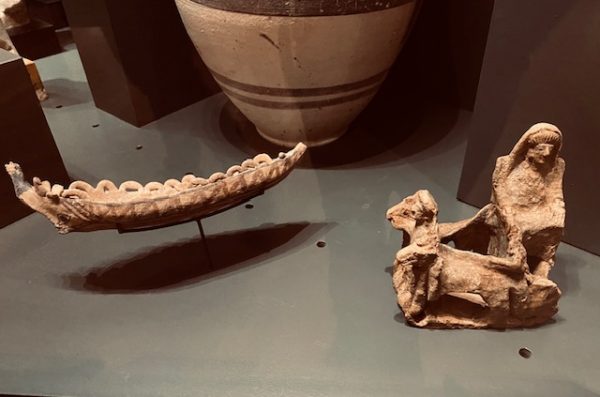
In reading Ovid’s metamorphoses we learn about all those mythical transformations of persons into animals (Jupiter into a bull) or persons into plants (Narcissus into a flower carrying his name). Maybe even today we have Europa being captured again by a bull or bulls that try to take away the freedom of movement and expression from her. The threats have multiplied, but the defensive forces of Europe have risen as well. The power of Europe might simply consist in the charming nature, which outlasts brutal force of the bulls, at least in the long run. A ride on the bull, however, can be tough at times and preparing for a tough ride should start as early as possible. Currently there are too many bulls around to feel safe otherwise. (Image: Europa sculpture on display at Chateau Chantilly). 
EU Presidencies Review

There is a turnover at the EU presidency every 6 months. A full cycle of all presidencies takes 13 and a half years as each presidency lasts the same length irrespective of country size. CY 2026 is the current one, where CY does not only stand for “see you” in smartphone slang, but for Cyprus in 2026. The procedure to determine a working program for the Council presidency is well established and unresolved matters keep coming back in regular time intervals. The big overarching topic in 2026 is EU autonomy facing up to new challenges of the multilateral world. In the EU presidencies small countries can showcase their concerns and demonstrate what their preferred topics and proposals of solutions are. It is also a chance to make people aware of why they have been eager to join a political, cultural and economic union in the first place. Already in the founding documents the issue of security and defense were addressed. They are again on the top of the agenda in the enlarged EU. The multi-ethnic and multi- religious experience of Cyprus, a country that has lived through multiple strategic dominations over centuries, can probably teach us a lot about how difficult it is to be autonomous if other more powerful countries have put an eye on your territory. Choose your allies wisely. (Image: exhibits Cyprus at BNF 2026, CY2026EU) 

Generation Hope

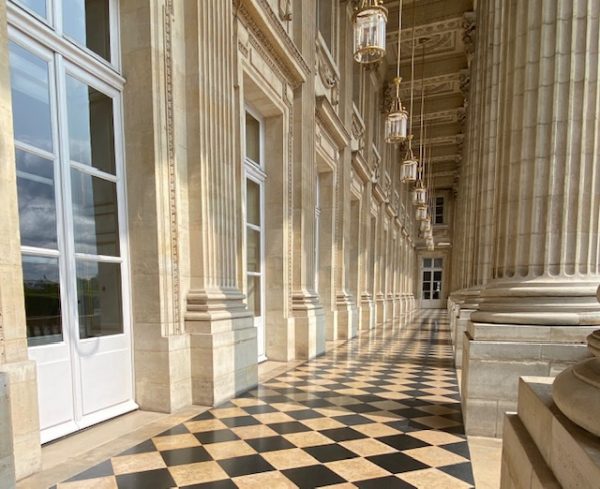
The whole of Europe has good reasons to take a careful look at the stunning protests organized by the young generation in Bulgaria (Le Monde, 2025-12-13). With spectacular repeated demonstrations in the center of Sophia, the young people attempted to stop a government that is likely to sink further into corruption. It is this generation of young people that have experienced and/or lived in other European countries or in other Western-style democracies around the globe that have enough of corruption in politics and social systems more generally. The well-educated Bulgarian youth has managed to overthrow a government that had been subject to pressure from corrupt forced. It is not easy to get rid of corrupt politicians and powerful business interests as a system based on merits rather than ability to pay remain fragile in the first few years of such a transition. It needs a sizable “Generation Hope” as I would like to call these young enthusiasts of democracies. The message reaches well beyond Bulgaria and gives hope to all those whose political systems deteriorate into authoritarianism across the globe. It took 20 years to build this “Generation Hope” and mobile youth that takes home the messages and learnings from other democracies. Based on statistics from Eurostat we know about the strong in-migration from Turkey and Russia into Bulgaria. Youth is particularly likely to leave authoritarian regimes to seek a better future in democracies, for example as part of the Generation Hope” in Bulgaria. (Image: Cour constitutionel Paris) 

БЪЛГАРИЯ Bulgaria

The expectations of the entry of Bulgaria into the EURO-Zone are high towards the end of 2025. On the 1st of January 2026 we have new coins circulating in the Euro-countries. The addition of a country to the European currency yields insights into this country’s own cultural heritage. Piece by piece we learn, if we want to, to take a closer look into the more and more obsolete practice to handle currency in form of coins.
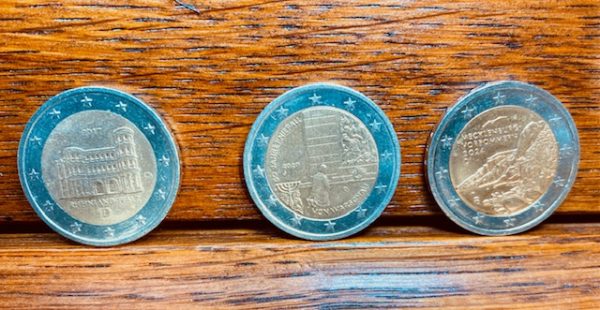
I cherish some of the coins with specific meaning to me (see image below, city of Trier, Willy Brandt, Chalk coast on Baltic sea). My small collection of coins from Greece allow me to refresh my Greek alphabet, words and historical landmarks of democracy. The circulation of Euro-coins with Bulgarian inscriptions in the Cyrillic alphabet will broaden our horizon again. Beyond the national features, we cherish the regional or federal organization in some countries, that feature their regional hotspots within this European cultural heritage. With a highly mobile Bulgarian population, not only within the EU, we shall soon see more Eastern Euro-coins with Cyrillic letters in our pockets and collections. … can’t wait for it … Ukraine in 202x, maybe 203x. 

Europe x.0

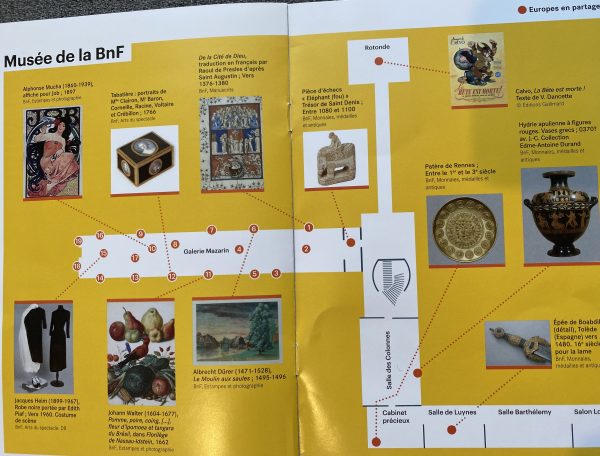
There are many places to ponder, think or dream about Europe. The centre of Paris is certainly a great place for this. More precisely, the “Galerie Mazarin” invites us to pass the centuries looking and reading about artefacts that made Europe or all different versions of it across history and geographic spaces. The short extracts of chansons that we share and shared across Europe are presented in their original language, which highlights the multilingual heritage of the different versions of Europe. There are parts of the heritage, which have fallen into oblivion like the customary use of tobacco exposed with a “tabatière” and a poster advertising paper for your cigarettes. Of course, the “Robe noire portée par Edith Piaf” on a stage is another highlight of the visual and audio joint European heritage.
Where do we go from here? Image Europe with an emphasis on its shared culture. There is so much diversity to be found in each country and regions within countries, but a shared appreciation of the valuable contributions to the whole. This builds a shared European strength, which has proven to overcome several fierce wars. This is the future-oriented version of Europe xx.0. (Image: BNF Musée Europe en partage, 2025)

Sustainability in computing

As the huge size of data centres become visible for everybody we begin to question the sustainability of computing infrastructures as well. The need for energy and water resources (for cooling) grow in line with the growth of data centers, the whole issue of input of resources and global trade has to be re-assessed. Based on European trade data, we know that computer software is heavily imported from the US, whereas we import the hardware to run the software in even higher shares from China. In view of the AI boom, this risks to worsen the European trade balance in the coming years. European digital sovereignty suffers as well, if we do not act upon it (compare Figure 8 in Eurostat report).
An easy fix is the shift to more computing-efficient software, which does not need or rely on more processor and memory imports from China for the hardware and imports of services like operating systems or office software from the US.
Just changing to Linux and OpenOffice lets you keep your hardware for several more years. Sustainability in computing isn’t hard to do. It is just a matter of determination. We can do it, if we really want to do it. The more rare earths become rare and more expensive, the larger the amount of people and businesses, who shall think twice about this.
European Digital sovereignty can work as a driver of sustainability in computing as well.

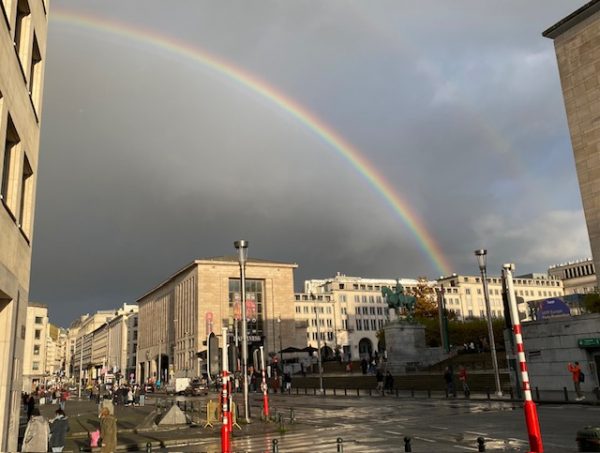
rainbow in front of clouds Brussels Central 2025

VLOPs flopped

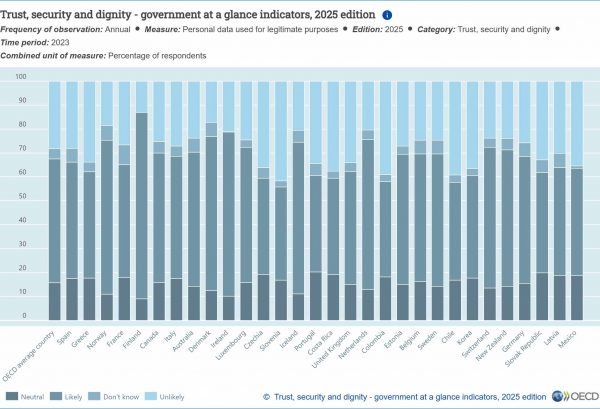
Well, not quite. This is wishful thinking. Let’s start slowly. Very Large Online Platforms (VLOPs), the platforms we all use on our smartphones, are subject to the European Digital Services Act (DSA). As of the year of its adoption in 2022 by the European Parliament, the European Union has a mandate to act, for example, against fraudulent websites that attempt to steel money from customers with fake content on VLOPs and, of course, on smaller platforms as well. To put it bluntly, the European Union has to defend its population from mainly American VLOPs massively exploited by Russian criminals to impinge on our European digital sovereignty. These external threats have to be taken very seriously as they touch upon the satisfaction and dissatisfaction with the European democratic political system and trust-based societies. The level of trust in Europe, particularly with respect to “Personal data used for legitimate purposes” is high in the Nordic countries and Ireland, but much lower in the UK, most Eastern, Central and Southern European countries. (Data retrieval from OECD on 2025-12-1, compare figure below, figure build Link).
VLOPs might be important drivers of eroding trust not only in data security, but also how democratic institutions are able to protect its citizens, youth and children. About time to act accordingly.

EU Digital Sovereignty

If we try to search for digital solutions, we shall encounter a whole lot of American and Chinese products, but very few European companies that are able or willing to compete. Hardware mainly comes from China, software from the US, at least until AI was not working in the background. If we add Russian interference to destabilize our digital infrastructure to the scenario, we are not really fit for the challenges of the 21st century. The very definition of a country or political union is the affirmation and competence to assure its sovereignty, particularly in cases of territorial conflicts with neighboring countries. My health or mobility data are a rather private affair, however, our state governments in EU-Europe have done little to ensure our data integrity. Business is also at a loss, if they do not spend heavily on data security themselves, usually relying on external cooperation. 

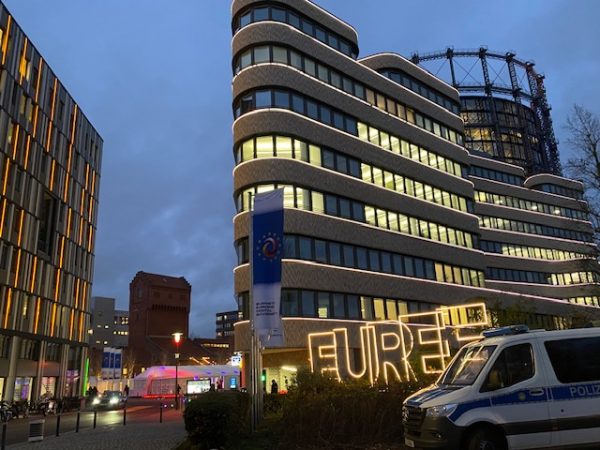
The EU digital sovereignty summit took place in Berlin on the EUREF campus in 2025. It can only constitute a beginning for intensified cooperation in  this long overlooked policy area. It will be tough to catch up where production has been abandoned for decades.  

Archi Geometry

Architecture has an obvious and visible link with geometry. Clear lines, rectangular or triangular shapes have dominated for centuries since the Greek temples. Geometry was a discipline that has attracted many scholars and particularly architects. Nowadays the shapes are much more diversified and sometimes complex. The calculation of surfaces, curved lines and shapes have become an issue of more complicated mathematics. Volumes of irregular shapes are a challenge for most people to calculate and heating or cooling sich buildings adds considerable complexity. It is, however, rather relaxing and fascinating to look at the marvels of modern shapes in architecture. Technology and material science have allowed us spectacular progress and designs in recent years. Paris offers a splendid perspective on such developments. 

Health Systems

Comparing health systems across the EU can be complex at times. However, there seems to be a consensus that the Irish health system is an oddity within the European health systems. On the one hand Ireland is a rather wealthy country in terms of GDP, but the primary care system excludes a high percentage of people from access to it. The scientific journal “The Lancet Regional Health” published a paper and comment on this rather unique exception to the rule to offer a universal health care system to its citizens. The controversy is about the coverage of costs of a visit to a general practitioner. More and probably earlier visits to a GP reduce the (over)burdening of
hospitals later during the life course. Prevention helps a great deal to lower overall costs of a health system.
The roots of the Irish health system have been built upon “subsidiarity”, which means that the public support system should only step in, if the individuals or families are unable to cover costs by themselves. Poor households had to apply for a card giving them access to medical care free of charge. Building hospitals was the next challenge and local communities managed to raise funds in support of such additional structures. In 2025 it can be very costly to enlarge the coverage to a universal access to primary care and the challenge to attract sufficient numbers of general practitioners is a very European one. In this respect Ireland is just like any other European country again.
The question of how to best achieve a universal health care system remains an important one. Apparently, you can be rather “health poor” in an otherwise “economically rich” country.