Liszt home

In Budapest we can visit one of the longer living places of Franz Liszt or Ferenc Liszt as some Hungarians would insist to call him. The Beethoven trained Carl Czerny offered piano and music classes free of charge to the young Franz Liszt in Vienna at the age of 11. In the biography by Klára Hamburger she describes the Paris years of Liszt from 1823 until 1839 as the most important ones for the pianist and particularly for his later compositions. Born in Hungary, the son of 2 Austrian parents he was trained in Paris by amongst others the Czech professor of the Conservatoire de Paris Antonin Reicha just like Chopin, Flotow or Offenbach. Writing an opera was the “must do” for a composer who aimed for the highest possible career at the time. In a letter to George Sand, Liszt (published 1937) complained already about the social status of musicians in society as servants to the higher ranks of society. Similar to Ravel many years later Liszt was rejected as official scholar by the Conservatoire de Musique and his wish to marry a daughter of noble decent was rejected early in his career. Such experiences probably contributed to his leaning towards the romantic form of expressions in music during most of his compositions. Literature, paintings of the French romantic period and the traveling artist “voyages et pèlerinages” became influential in his creative process. The competition between composers must have been fierce at the time and despite ample opportunities to perform in public and private venues making a living from music wasn’t always easy at the beginning. More than 100 years after his death his compositions are still a challenge for all pianists and the Hungarian Rhapsodies probably his greatest homage to his early childhood.

Democracy ART

The European Parliament co-sponsored a remarkable art exhibition in 2023 entitled „Art in Democracy“ The catalogue of the exhibition offers insights into the many preconditions of art. A democratic environment constitutes a non-negligible precondition for most of the works of art. Artists thrive within democracies. Many artists flee authoritarian regimes as their work environments rely on a real freedom of expression irrespective of the will and belief of ruling politicians.
Artists who do not flee in time for whatever reasons have suffered tremendously under Nazi terror in Germany. Authoritarian leaders don’t respect the various forms of expression by artists. Europe and the European Union provide safe havens for many artists to continue their careers in art. This has become a real value of our way of life. Many countries envy us in this respect. We take this for granted in the EU, but 70% of the world population endures authoritarian control. A reminder of this, from time to time, justifies a lot of expenses to support art and artists even beyond our borders.

The romantic setting of the image below is set against the surrealist open window (of opportunities) in an almost Magritte-style dreamland.
(Image: Rafal Olbinski, La Pologne dans l’UE, created for the occasion of adhesion to the EU)

United by travel

The economic rationale of profit maximization privileges the construction and management of profitable connections. For train transportation this has spurred over decades the construction of new train lines between metropolitan cities or regions. Whereas connections between Paris and Brussels are abundant and expensive from central stations those living somewhere in between the 2 cities, for example in Mons, have had little chance of access to reasonably priced and fast train connections. This neglect of the in between cities is slowly changing. Sufficiently fast and reasonably priced connections allow Europe to grow together also at the margins. Public transport as alternative to car traffic across borders for „in-between cities“ will bridge the gap between the ease of travel between metropolitan an more remote areas. There is economic growth to be reaped as connected infrastructures allow for economic as well as social mobility and joint development. This is the real European challenge ahead of us and not the numerous summits without tangible results for rural and urban populations beyond metropolitan regions. For regions spanning countries, some will be finally reunited by better public transport a kind of ecological unification.

EU Georgia

It is a moving image to see a hundred demonstrators at „Unter den Linden“ in Berlin just next to the Russian Embassy. The Georgian flag and Georgian people actively seek the association with the European Union and the values it stands for. Irrespective of a large majority of the people of Georgia‘s wish to become part of the EU they have to fight hard to be heard. Next to the Ukranian protests in Berlin it becomes very evident that these two nations fight for living standards and values which are so „self-evident“ for us European citizens that it is all to easy to forget about our neighbors who have to endure hardships with uncertain outcomes. The experience of having lived together under one roof with people from other countries allows to realize that we have so much more in common than what separates us. Our house and home of the EU has much to offer, more than we tend to believe in our daily routine.

Sunny Trade

Some countries or regions struggle with trade deficits or trade surpluses, which cause worries to their partners. Eurostat publishes regularly the latest trade figures for the EU with external partners. The EU as a whole has a trade surplus in September in 2024 of € 12 billion. From January to September in 2024 the surplus accrues to 140 billion already. Overall, this is a rather sunny picture of EU trade. As we import raw materials and fossil energy mainly, the rest of the world is largely appreciating what we do with the imports, at least in an economic sense, environmental concerns tend to be neglected in such considerations.
The import statistics and figures do not capture the contribution of the sun to our energy balance sheets. We import energy from the sun almost on a daily basis and our trade statistics to not capture this, despite their huge impact on production and the fossil energy trade imbalance we report each month. Imported energy, the largest negative position in our sunny trade balance, in the EU amounts to € 20 billion per month. Harvesting more wind and solar energy as well as geothermal sources and energy storage require huge investments, but millions of Europeans are willing to contribute to this effort. With rising protectionism we should act now to avoid years of structural trade deficits in the coming years. There should already be more sun in the still sunny trade balance. To keep it that way more sunny trade will do the trick.
(Image from Eurostat, 2024-11-18, Euro area trade balance by product group in billions of €, original states in %, retrieved 2024-11-29)

Comprehensive Conflict

In a recent paper Mara Karlin (2024 Foreign Affairs LINK) has stated the need for the Western World to understand and even prepare for comprehensive conflict. Particularly in response to Putin‘s war on Ukraine’s territory and the threats and potential use of the full range of weapons including cyber warfare, destruction of energy resources and military production sites the current war comes close to total war. Several European countries have made significant steps to increase budgets for the new forms of comprehensive conflict management. This starts with adequate discussion in public on the dramatically changed security situation after the „Zeitenwende“ caused by Putin. The forceful Ukrainian response with much financial assistance from the West has pioneered drone counter strikes and by this put an end to the Russian progression into its territory. In order to match the total war ideology Putin is implementing in Russian society the Western world will have to rethink production models and strategic defense capabilities in all areas to match the rather real threats by Russia. The prevention of the spreading of comprehensive conflict is of utmost importance since the risk of an expansion of Russian influence and suppression of any internal resistance in Russia has devastating consequences. The 2024 book by Tatjana Tönsmeyer „Under German Occupation, Europe 1939-1945“ (own translation of German title) demonstrates what it meant to live under the domination of an inhuman dictatorship which is ready to use all out war and violence at any occasion. We have to confront this, even if we don’t want to face it. Nevertheless, the Russian aggression is also strongly targeted on its own people not to take risks of separation from Russia as this would mean devastating destruction to those regions and people who dare to do so. External explosions are therefore for Putin a prevention of implosion of the Russian Federation similar to the Soviet Union previously. Comprehensive Conflict extinguishes any remaining internal opposition as intended collateral damage. In Western countries, however, we shall have to argue with opponents and build majorities through understanding the issues at stake not through silencing opponents and opposition. The debate about comprehensive conflict is only about to start, but it is likely to last for several election cycles. (own image, Contemplation on infinite landscapes, Berlin 2024)

Fiscal Union

European Integration is slow and hard to come by. For others it is moving too fast (Brexit). Cultural diversity is a real asset of the EU. The economy or the economies are powerful on an international scale. Nevertheless, the diversity concerning the tolerance of fiscal deficits is still widely spread across the Member States of the EU (see image below). Some states seem to play it cool and run relatively high deficits compared to the EU averages. In OECD comparisons most of the above average fiscal deficits are closer to or even below OECD averages over time (link to pdf-file OECD, 2024). Within the EU differences in government expenditure as % of GDP or the indicator of Gross public debt according to the Maastricht Criteria range from 20% to 160% as percentage of GDP. This entails a different level of resilience to future crises. After we managed to leave the previous 3 crises (financial, Covid-19, energy) it is time to prepare for what might come next in terms of challenges. Preparing public deficits to be able to soften economic shocks is essential to be able to sustain yourself and support others. We seem to be a bit off-target to coordinate fiscal deficits across the Union. Eastern and Northern countries have suffienct scope to support expansionist fiscal policies, be it in the realm of a defence union or to address climate change. Southern Europe will find it more difficult to raise additional funds to prepare now for future challenges. Fiscal deficits might even be not only an economic phenomenon, but a cultural one as well. If we compare Japan with a deficit running at 240% with South Korea with 50% Asia is showing even larger diversity in terms of fiscal preparedness.
An economist’s stance on fiscal policy and fiscal union might depend much more on her/his region or country of origin than economists might want to believe.
Images: OECD Economic Surveys: Belgium 2024, OECD Publishing, Paris, https://doi.org/10.1787/c671124e-en. p.17.

International Geometry

Geometric forms sometimes serve to make international affairs more transparent or descriptive. The Weimar triangle is such a formula, which helps to show the links between states. In the journal “Le Monde” of 2024-9-13 an interview with Radoslaw Sikorski reflects the shifting side lengths and military weights within this triangle. The Polish Minister of foreign affairs points at the threats from Russia to violate the air space of Poland and the legitimacy of Poland and the Ukraine, of course, to defend its air space and territorial sovereignty. The guarantee of international law, however, is heavily dependent upon adequate international geometry beyond the Weimar triangle. The meeting with a representative of the Pentagon (US) enlarges the scope of the triangle.

Talking about the reach of missiles in defense is yet another exercise in geometry as this depends on starting and supposed, or reachable, end points. The use of GPS-signals in civilian and military applications is another example of how geometry is ruling our modern lives. Let’s embrace it, rather than shun away from the geometry behind it. (Image Exhibition room at Wiels Art Centre, Brussels 2023).

Plastic wasted

The amount of plastic that is wasted exceeds our imagination. Even in the most distant islands we find remaining pieces of plastic from our careless consumption. The European Directive 2019/904 has set the limit on detached bottle tops to July 2024. The industry waited until the last few months to implement the old directive. Great that there is hope to find less detached plastic in oceans across the world in some years at least. The behavioral change to move beyond plastics everywhere in our nutrition delivery system is long overdue. We shall get used to bring our own bottles for a refill or other devices to reduce plastic waste further. The change begins with thinking about the topic and finding suitable reusable packaging solutions for yourself. Children learn in art projects about the importance and creativity potential to reuse otherwise wasted materials. Reduce and re-use can be turned into an own competence. Competence in sustainability has been neglected for decades in school curricula, despite its importance for our own health and survival. (Image James Ensor exhibition and competition KBR, Brussels 2024-7)

Digital Estonia

The progress of Estonia in going digital is quite advanced. The electronic identity card which allows data to be linked to health data and accounts or banking gives an impression of how far-reaching digitalization may go. Great steps have been taken to guide the population on the way to move towards the digital (only) world. Learning and coaching of a huge amount need to take place so that people do not abandon or get lost on the path towards “everything digital”. For the so-called digital natives, who have grown up with the sound of their smartphone at the bedside all the time, this move feels “natural”. Some experienced or silver workers got on track, if they were accompanied in suitable forms. The 65+ population might find it harder to adapt to the permanent use of digital devices for not only getting around in your city, but also to do your tax declaration, pay your dues and vote in elections.
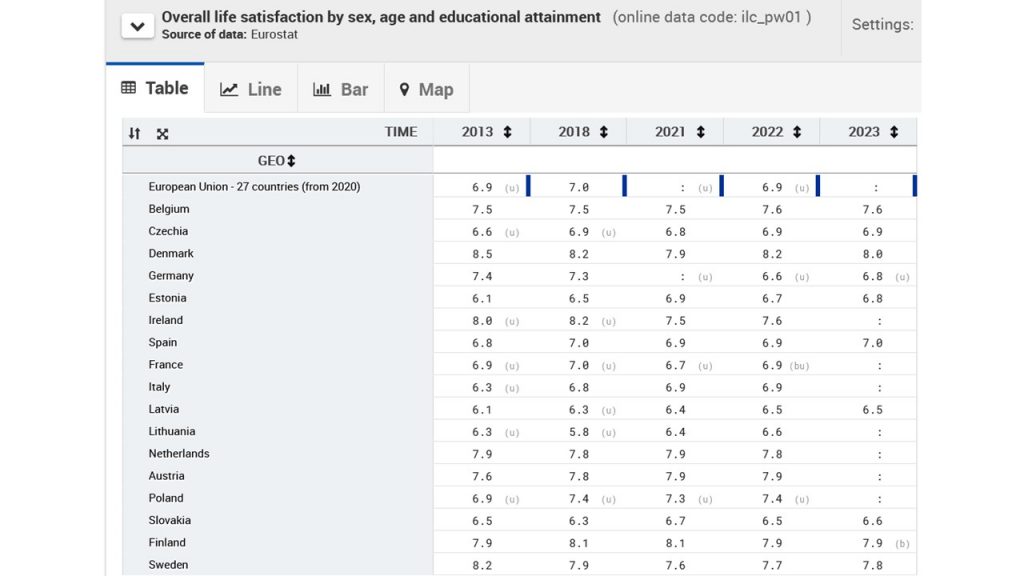
Digitalization is not a goal in itself. It has advantages to reach communities in remote places or islands, but it might alienate older persons that have no other person around to assist them in the digital only world. An easy way to get some social science data to inform the debate is to refer to Eurostat and the surveys with information about the “overall life satisfaction” of people (EU-SILC). Checking for some major countries of the EU and neighbours of Estonia with less digitalization the differences are rather small. In terms of overall life satisfaction (16+ years old) Estonia has been catching up to the EU-average mainly between 2013 and 2021. Since then, stagnation at the EU-average is what the data tell. A quick testing of the hypothesis that the older persons (65+) might not see the past evolution as rosy is reflected in the EU-data as well. Good pensions seem to drive the “happiness” of older persons in the EU more than good digitalization. Eventually the two features of a society will have to go hand in hand to improve life satisfaction to higher levels. (Image: Data Eurostat EU-SILC Life satisfaction 65+, selected countries 2013-2023, retrieved on 2024-4-23, comparison with table all ages here, Data source)