Berlin Futures

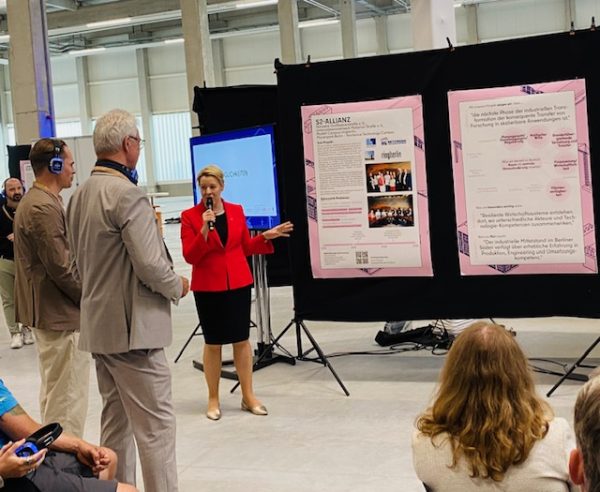
The city of Berlin is projecting itself into the future. Two long-term goals, Olympic Games 2036 or an Expo organization 2035, are potentially looming and all actors have to project themselves as to what role they want to play in such processes. Trades and industries have an essential role to play to realize any vision of the future, at the same time, local trades and industries ask for amenable conditions to do business in the necessarily restricted city space.
There is competition between housing projects and business parks across each metropolitan area as any form of growth needs space to grow in. The “1. Berlin Future Day of business parks” highlighted this potential source of conflict and business leaders exchanged their experiences and strategies how to arrive at manageable comprises.
There are several Win-Win constellations in which for example an additional stop on a metropolitan “S-Bahn” line benefits the business area and all those (future) employees going to and back from work. Infrastructure like transport, mobility, energy, internet speed and security, all play key roles in such visions of future. If networks of organizations address policy makers with well-defined requirements, politicians can act as facilitators to ease sometimes lengthy bureaucratic impediments. The call for public infrastructure investments by private business initiatives is a reminder of the need for public-private partnerships to create promising Berlin Futures. (Image: 1. Future Day of Business areas in Berlin, Senator Franziska Giffey 2026-7-15)

Spring in Autumn

Can we have spring in autumn? Of course not, most people would answer. The definitions of spring and autumn are clearly defined as separate seasons. Depictions of the seasons in paintings in the Romantic or Impressionist periods are hard to imagine with somewhat blurred distinctions between seasons. And yet, climate change in the 21st century show surprising spring flowers in autumn across Europe. This leads to lots of confusion in nature’s time table.
From a life course perspective, we may ask, whether it is possible to experience a 2nd spring in the season’s view of the life course. More healthy years and spring feelings in the autumn of live have propelled a whole new industry around longevity and the mantra to “stay healthy for the wealthy”. The growing health inequality over the extended life course is a silent killer. The experience of spring in autumn remains a distant dream for most people with multi-morbidity.
Our experience of sequential or linear time, where one season follows the other, gets disturbed or at least blurred. The “Gleichzeitigkeit des Ungleichzeitigen” in English the “simultaneity of the non-simultaneous“ can be observed in the macro-world of everyday experience, albeit in a different way than Ernst Bloch defined the concept. On the other hand, it is no longer necessary to invoke Einstein’s theory of relativity or quantum physics to come up with apparently strange phenomena, but empirical facts allow us to question received wisdom, evidence based.

Marx Home

The home of an influential philosopher, economist and political scientist is not easily presented like a home of a musician, a composer or an author. However, the home of Karl Marx in Trier on the Moselle river succeeds to present the biographical links of growing up in a historic city, the bourgeois upbringing of the young Marx and his formation as an independent and even revolutionary thinker of the economy and society. In 2025 the home is a museum supported by the Friedrich Ebert Foudation with a great online guide and access to additional scientific material. For authors like Karl Marx it is always of interest to follow not only the origin and evolution of the thought process, but also the shifts in the reception of his writings by subsequent generations. This part of the exhibition and an audio guide (downloadable as App).

In 2025 with an apparently ruthless capitalism at work in the biggest economy of the globe, the reminder that the economy is best to be understood as a political economy, which focuses on self-interest and profitable business deals, we find in Karl Marx still a worthwhile reminder of economic development even in the 21st century. The note-taking and studies in Exile in London are well documented in the tiny home and museum. Studying the misery of exploitation in supply chains and international commerce remains a topic of continuing interest as well. 

Cupid at Work

The last 11 entries in this blog focus on  conceptual thoughts as a contribution to the history of ideas with an extension to modern concepts. Our societies, management of companies and personal  development are conceived under the conceptual framework of these concepts. Take the 1st letter of each term and it reads like “cupid at work“, easy to remember and enumerate.
Take each term as  a prism through which you frame your life course, an enterprise or a society. The 3 levels by 11 concepts matrix is a starting point to scan empirical examples for substance.
Complexity, Uncertainty, Plurality, Intersectionality, Dosage.

Ambiguity, Temporality,

Woke-ability, Organics, Resilience, Keys,
(Image: Peter van Lint, Jupiter embraces Cupid, 1636, MRBAB 2024)

Of or about

There exists a fundamental difference between taking a picture of something or someone as opposed to taking a picture about someone or something. With the term about we denote or refer to a more abstract category of trees, animals or human beings. The use of of, however, refers to a specific realization within a specific category. Painters or photographers have applied this distinction for a long time. It is similar to social scientists who consider persons or relationships as belonging to more general categories. Gender is such a category which has preoccupied us for years before concluding that just 2 gender categories are not enough to come up with reasonable descriptions and predictions of behavior. The realizations of gender are manifold and not necessarily or only binary in nature as well appearances. Eventually social categories are enlarged to fit empirical patterns in more adequate ways. The image of someone/something therefore is something very different from an image about someone/something. (Image of: Children’s corner at Musée Rodin Paris. Image about: Pedagogic approaches to art, here sculptures « Le penseur », Rodin 19th century)

Less is better

There is an interesting psychological phenomenon which is called the less-is-better effect. First research on this phenomenon dates back to marketing research more than 25 years ago. The Olympic games have even a mention on the English Wikipedia page on this less-is-better effect. The winner of a bronze medal at the Olympics might feel more happy than the winner of a silver medal. Why? Viewed as separate events winning a bronze medal makes can make you so much happier, because you are among the famous group of medallists in your discipline or with your team, whereas as a silver medallist you might be so disappointed that you did not reach the gold medal that this overrides the joy to come 2nd instead of 3rd. Several interviews of athletes during the Paris 2024 Games gave evidence of the pertinence of this less-is-better effect.
There are other forms of application of this rationale as well. A more sociological perspective highlights the potential change of category from less is more to the less-is-better rationale. One variable assessed in less and more frequency or value maybe better or worse in another category. Less pollution leads to better health. It is like a shift from a quantitative variable to a qualitative assessment of the same situation. Olympic Games are full of useful lessons from a social science point of view. Although, more can be worse.

Artist Intuition

Artists have a specific kind of intuition. Many artists build their artwork on the competence to sense interesting deviations from standard representations of persons, landscapes, architecture or societal structures. In 2024 the Paris Olympics have demonstrated again the particular strength of American athletes in the competitions. As a renowned sculptor Auguste Rodin had the incontestable intuition that the American athletes had a physiognomy of impressive dimensions. Well worth a sculpture of its own kind. Rodin realised the first bronze statue of the “American Athlete” as early as 1901. In 2024 American athletes are much more diverse, but the impressive strength is documented in the USA still leading the list of countries in terms of gold medals. Rodin’ sculpture of the American athletes is focused on the muscular strength in contrast to most of his other work where gestures, clothing or emotions were immortalized. (Expo: En jeu ! Les artistes et le sport. Musée Marmottan Monet photo below) There is also a stark contrast to Rodin’s famous “ Le Penseur”. The dialectic vision or just visualizing both artworks next to each other reveals the difference to represent simply an athlete or the abstract concept of a thinking person.

American Athlete, by Auguste Rodin 1901

Women Advisors

Contrary to many men and clergy advising noble governors, many of them famous as womanizers, there is a long tradition of women as advisors as well. The first woman that received high reputation as advisor is “Christine de Pizan“. She was born in Italy and migrated to France with her father who was a scientist and advisor to  “Charles V” as medical doctor and astrologist, but who died soon after the move to the French court. With the access to a unique library at the time Christine de Pizan benefited from the best of knowledge and her literary and scientific competences made her famous later on. She could even be compared to Clausewitz as a well known writer on war strategies, but has a much broader literary reach compared over centuries.
Christine de Pizan became a writer in her own right, publishing under her own name in the late 14th century already and not only in literary work, but in fields previously thought to be domains of male writers only. One of her writings “Livre des fais d’armes et de chevalerie” is a testimony of her political and strategic thinking and advice. It remains a unique piece of a woman as advisor in military affairs published in 1410. The translation into “Alemannisch” (1460) highlights the importance of her strategic advice beyond France.
Her literary excellence has been widely appreciated not the least in her praise of Jeanne d’Arc in her “Ditiè”, the poem in honor of Jeanne d’Arc. (source with translation). Christine de Pizan also wrote on peace (Le livre de la paix” 1412 and the “Livre du chemin de longue étude“, today we would translate it as a book on lifelong learning.
(Source: Zimmermann, Margarete, 2005: Minervas jüngere Schwester: Die politische Schrifstellerin Christine de Pizan, Stabi Berlin, KulturStiftung der Länder Patrimonia 265 und SPK.
(Image: Extrait Christine de Pizan im Gespräch mit Minerva. BNF, Paris, Ms. fr 603, fol.21r)

Competence Handwriting

The acquisition of handwriting as a competence has been important for centuries. In primary schools this technique is exercised as a foundation for the performance in other cultural techniques like language writing and even calculus. Therefore, it has been beneficial to make sure children acquire basic competences in handwriting. This has not changed much, although the time devoted to perfection of the technique has been reduced over generations. We still have some memories of people who have made the handwriting or the pencils used a case of distinction. At the enlightenment period a lot of authors drafted their thoughts and manuscripts in handwriting and our museums or biographies are proud to show off handwriting of authors, artists or composers. In some of those we are able to retrieve the thought process behind the writing. The editing, crossing out, adding sentences or correcting words are traces to dive deeper into these creative processes.
Currently, we are less sure, whether in the age of AI we should still rely much on this old technique of handwriting. If we just treat it as one of many competences to be or become creative yourself, we are on the right track. The PISA studies by OECD include problem-solving as a crucial competence. Handwriting or drafting first steps of a solution might still be useful. A handwritten sketch of a solution might guide the elaboration of the more encompassing solution.
Another interesting feature of handwriting is the cross-cultural element of it. We feel easily compassion for a handwritten document. The psychomotor competence of handwriting is fascinating across continents. It has distinguished us from other species as well. The evolutionary steps are important elements of a learning process. Nostalgic feelings about handwriting do not help anybody, but children are well-advised to still keep an eye on their handwriting competence as part of or first step in problem solving, even if it is just to formulate the question they are interested in.

Schachliteratur

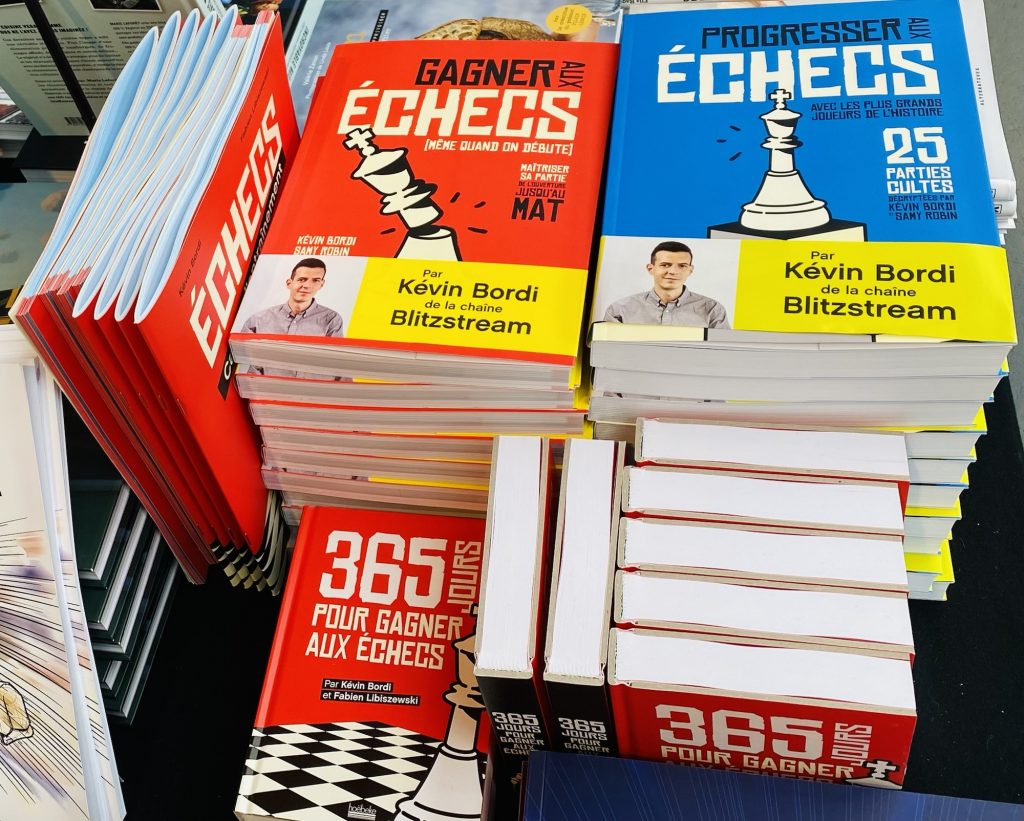
Es gibt sie noch, die Personen, die Schachbücher lesen und kaufen. In vielen Sprachen existiert die Niche der heimlichen Strategen. „Teaching old dogs new tricks“ oder ist es eher „teaching young dogs old tricks“. Das ist eine empirische Frage. Nicht nur Zeitungen für sogenannte BildungsbürgerInnen haben noch kleine Spalten zumeist mit Schachproblemen. Manchmal findet sich Schachspielen sogar als Schulfach. Lesestoff zum Schachspiel findet sich reichlich. Schach in der Literatur ist jedoch verschieden von der Schachliteratur, die sich mit Strategien und Tempi befasst.

Das Lesen von Schachliteratur mit Meisterpartien hervorragender Spielenden ist vergleichbar dem Lesen einer Partitur einer Symphonie oder Oper. Das Kino spielt sich dabei überwiegend im Kopf ab. Gelegentliche unvermittelte Gesten oder Ah-laute sollten den Spielenden ihrer Verzückung wegen entschuldigt werden. Vielleicht sollten die Schulen diese Kulturtechniken mehr vermitteln. Macron‘s Vorschlag Theaterspielen mehr in den Schulen zu vermitteln erscheint in diesem Vergleich als ein Entgegenkommen an die „Generation der sich ständig selbst inszenierenden“. Mehr Spielen ist aber schon mal ein wegweisender Vorschlag.

Schachbücher 2024