AI and languages

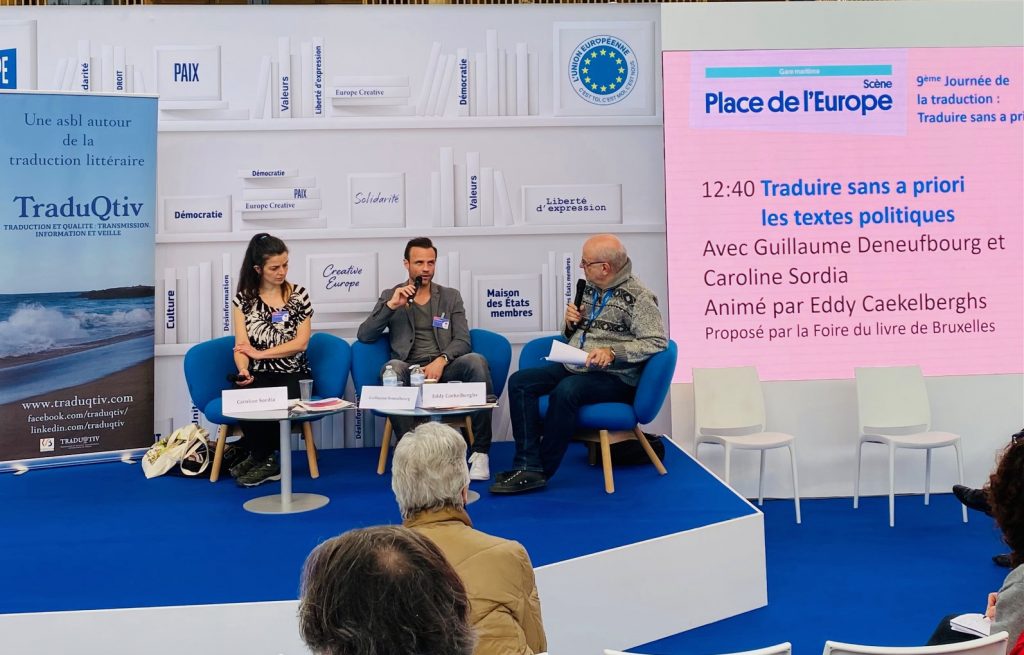
A big potential of AI is in the field of languages. Translations have been an expert domain and a pain for pupils at school. In professional settings translations are an expensive extra service for some or a good source of revenue. AI has shifted the translation game to a new level. In terms of speed of translating large amounts of written text AI is hard to beat. In terms of quality the battle of translaters against AI is still on. For chess players the battle against AI has been lost some years ago already. It remains an open question whether translators can still outperform AI or just adapt to using the technology themselves to improve both speed and quality of translations. The European Union with its many languages and commitment to cultural diversity can serve even more language communities with documents in their own language than before at marginally higher costs. A panel on the 9th day of translations at the „foire du livre de Bruxelles” 2024 expressed their reservations with regard to the use of AI in translation of political text or speech. Misunderstanding and misinterpretation will be the rule rather than the exception with potentially harmful consequences. Checking the correctness of translations is a permanent challenge for translators and can be very time consuming. There is room for an AI-assisted translation, but similar to other fields of application of AI, relying exclusively on AI bears high risks as well. We should not underestimate the creative part of translators to do full justice to a text or speech.

www.flb.be 2024 Translation

Gas Reduction

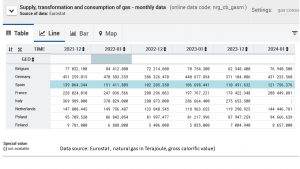
Gas consumption in the EU has been reduced by about 20% since the beginning of Russia’s war on Ukraine. This is a considerable accomplishment and has been sustained for 2 years now. The major element in this has been the reduction of gas consumption in industry, but also households have successfully managed to reduce heating of rooms and water with gas.
Diversification of provision with sizable increases in the provision by the U.S.A is another element in the beginning of a trajectory of gas reduction in Europe. Germany as a major consumer of this type of energy supply is also making strides in shifting consumption. This is my short summary of the report by IEEFA.org in 2024-1. All electric devices like heat pumps could speed up the gas reduction further according to the policy recommendation by IEEFA in 2024-2 reducing costs of living and CO2 emissions further.
Data from Eurostat allow to compare monthly data across Member States. The overall trend is a market decrease with differential patterns of refilling supply capacities. Big countries in the EU made and continue to make a real difference compared to previous years (see table below). The comparison of December and January figures across years reflect the months with high sensitivity of the public for heat and cold. Further reductions of gas consumption is feasible due to the mild winter months of 23/24 which allow to reduce heating costs for many households and offices. Good news for the planet and hopefully a move in the right direction to shift away from heating with gas.
Wage indexation

Currently inflation increases rapidly in many countries. Yes, Argentine. The Euro-zone and EEA have mastered the peak of inflation due to shifting away from Russian dependency and cheap prices for energy and dealt with carry-on effects related to high energy inputs. The annual rate of inflation calculated for January 2024 has returned in the Euro-area to 2.8 % close to the European Central Bank target of 2% (compare figure below).  Inflation puts wages under pressure, because household with little savings have a very hard time to cope with sudden price increases. For society as a whole, inflation raises many questions of differential impact of inflation on different parts of society. Savings become devalued, but debt might become easier to be repaid in so-called real terms.
Wage earners suffer in terms of lower purchasing power unless in subsequent wage negotiations pay rises can be achieved. This then depends of negotiation power of groups or sectors of the economy. Trade unions have to enter into tough negotiations and conflicts to even regain the same status quo previously achieved in wage negotiations. A series of conflicts and economic readjustments by more or less powerful sectors or representation comes into play.
All this is happening in a year of a series of national and regional elections as well as the European Parliament election in June. Political turbulance and the rise of extremists might be a result of a lack of taking into account the needs of lower wage groups who are likely to feel the full blast of the high inflation previously still today. Wage indexation as in Belgium, which fixes wages to the rise in inflation previously takes out most of the explosive power of a sudden rise in inflation at the risk of an upward wage-price spiral. The recent inflation figures for Belgium, however, show that this is not the case. An overshooting has been followed by an undershooting of the Euro-zone inflation. The political disturbance and risk of redistribution to more powerful groups in society can be limited through general wage indexation or indexation of for example just minimum wages.
The Russian caused spike in inflation has been successfully mastered in the EU. The political economy of redistribution through inflation will remain an important element unless wage indexation is used in more countries to escape populists’ and extremists’ voices. (Image Eurostat data and ESTATEC app)

Georgia

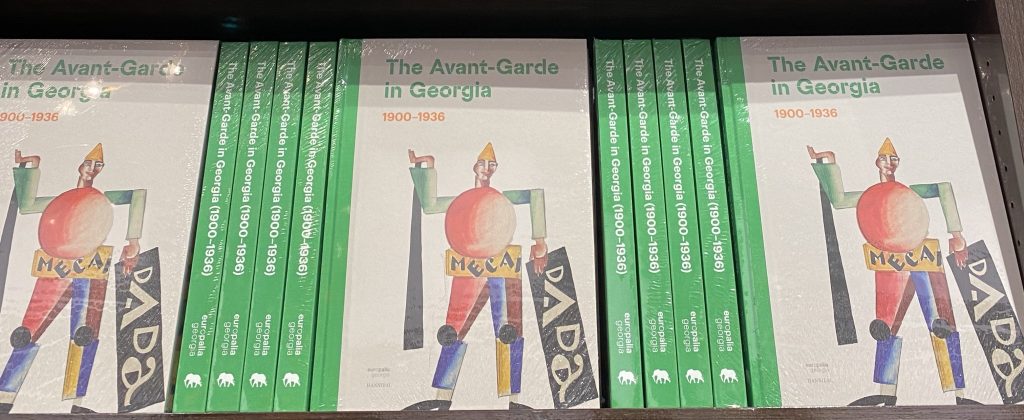
The Republic of Georgia is honored with a wide ranging program in Brussels in the series of countries presented as part of the”Europalia” events and exhibitions. The exhibition at Bozar in the center of Brussels has a focus on the years between 1900-1936. It is astonishing to look at the creative examples of adaptations from western modern art with cubism and expressionist resemblance. Many artists had travelled to western parts of Europe or trained at well-known art schools there. Own adaptations to paintings, theatre and cinema yielded a unique style of Georgian modernism before Stalinism put an end to independent artists and their creative work.

During the short spells of political independence Georgia managed to re-establish each time a remarkable will to its own culture. Unity with artistic pluralism is a core value of the European unity and union as well. We are many and happy to have a chance with Georgian people to celebrate their artistic past and future.

catalog of exhibition Brussels 2023

Taxing Europe

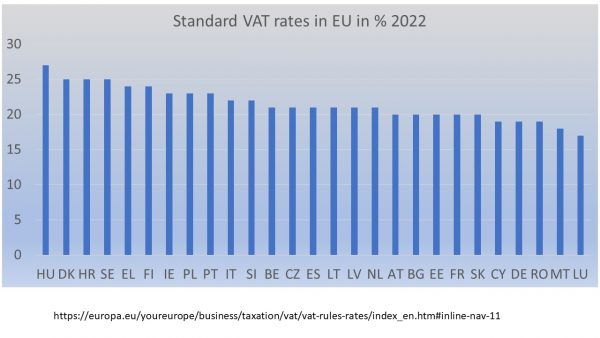
From time to time it is helpful to compare basic tax rates, for example value added tax, across the EU to understand the different economic and social policy approaches. The range of VAT from Hungary 27% to Luxembourg 17% is astonishing and it does not really feel like we are together in a common market. Okay, the illiberal, authoritarian state of Hungary is taxing the most, a clear message to visitors from another European country that this authoritarian state is relying on tax on consumption of its own people and visitors to foot the bill of state expenditure.
It is also interesting to realise that some countries with lower VAT rates have disproportionate public debates about supposed tax burdens. Tax levels are a political choice and much depends on redistributive appropriate use of tax receipts to the benefit of all or specifically those most in need. The potential for redistribution to parents, children, pensions, the poor or green investments also relies to some extent on the overall budget. The most surprising thing is the absence of a debate about tax rates, the size of the tax base and the ample exemptions or reduced rates. Of course, most of us complain about income taxes, but we all agree that it is nice to see that someone is taking care of the abundant autumn leaves or lighting of streets in the darker seasons. Even Adam Smith wrote in favour of the “night-watch state” that assures sufficient security levels. Taxing Europe to ensure that this role of the state can be taken seriously is still a common denominator across Europe.
Image: own presentation based on EU-data from 2022 LINK.

Nations Fail

Ever since Adam Smith wrote on the “Wealth of Nations” the topic concerns social scientists. The discourse around the wealth of nations has become even more fundamental these days. Beyond wealth calculated in economic terms we are convinced to add well-being of the population as well as the state of the environment into the accounting procedures like national accounts. But wait a second. Similar to the term wealth we have to widen our perspective in what is considered to be a nation. Shifting borders through wars (Russia aggression on Ukraine) or separatist tendencies of regions, (re-)unification of Germany or Korea (eventually) show that the nation is a concept in flux. Considering migrants from former colonies still as having residential rights in the colonising country shows, there is more to nations than a one size fits all nation concept.
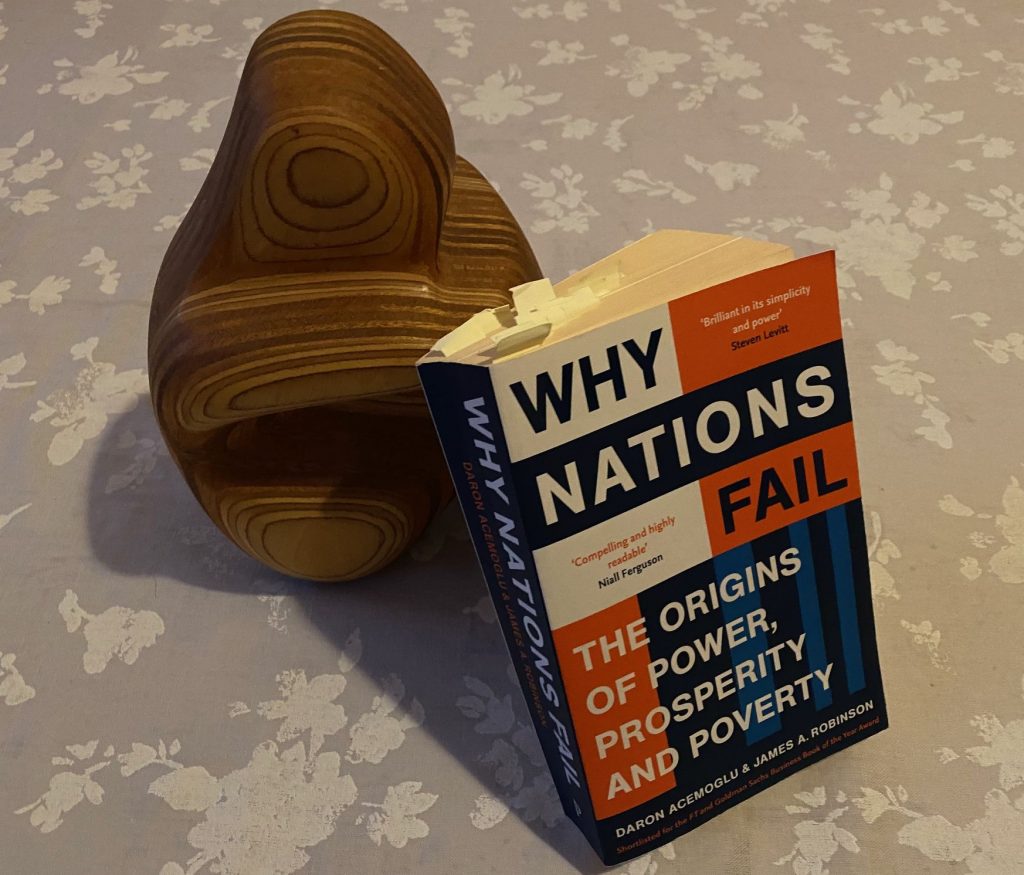
Daron Acemoglu and James A. Robinson had published the book on “Why nations fail. The origins of power, prosperity and poverty” already in 2012. On the 3rd of October Germany celebrates its re-unification only because the Russian dominated German Democratic Republic (and the other Eastern European satellite states under Russian control) can be considered as a failed state. These Russian dominated states crushed private initiatives and build corrupt systems where party allegiance and hierarchical structures were overemphasised. Following Acemoglu and Robinson (chapter 10) the lack of diffusion of prosperity is likely to be the root cause. Even similar to the French revolution, which brought about tough measures of redistribution, the external threats to the post-revolution France demanded subscription of masses into armies to defend the young republic against aristocratic rulers in the surroundings. If monarchy in France is a failed state, the post-revolution France survives due to high identification with the republican idea. The Soviet dominated Ukraine is a failed state, but the Ukraine of today resists due to its willingness to defend its own republican ideals. To get virtuous circles of development started, inclusiveness across the board is necessary. Leave nobody behind, seems to be a shortcut summary. It is much easier said than done. Loosing younger generations in the sense that they no longer subscribe or feel part of an inclusive wealth of the nation is a highly dangerous path. Failed states have a history in failed inclusive social and economic practices. Democracies are at risks just as much as authoritarian nations. However, democracies have better institutional settings to address the lack of inclusion and in multiple ways.
When I celebrate the 3rd of October in the Federal Republic of Germany I celebrate (1) the accomplished failure of the GDR, its undemocratically elected elites, corrupt institutions and the failure of the thousands of willing collaborators of the Russia-backed regime; (2) the peaceful resistance movement, (3) the relatively short-lived humanitarian focus of the Russian leadership at the time to not send in the tanks and (4) the willingness of the FRG to support 20 million new citizens for many years to come (5) the allies of the FRG to accept the potential security threat of a strengthened Federal Republic of Germany, which might entail a shift in the balance of power in Europe.
And yet, even in 2023 we pose questions on what is the concept of failure, when authoritarian regime can still survive for sooo long and some still accomplish extensions. We keep questioning the sense of the term “nation” in modern times and across the globe. Too many wars are still fought in the name of a “nation” even if only a handful of military-supported leaders and single autocrats try to impose wars in the name of some rather vague or plainly mistaken claim of nationhood.
On the 3rd of October we celebrate that “nations can fail” opening a path into a more prosperous and inclusive society. Some nations fail, just because they were no nation in the first place. The GDR was such an artefact of international compromise as part of the overall “balance of power” and the Cold War. The result of this process gives so much hope to other divided nations (Korea) or nations under authoritarian oppressive rule.

Corrupt-2

New scientific evidence on corruption and stereotypes about corruption reveals surprising behavioural responses. Social psychologist classified corruption as a behavioural trait of a person. The new evidence of a study that includes country-specific stereotypes into a corruption experiment shows there are always two sides to consider: the corrupted as well as the corrupting person. Both hold stereotypes about the likelihood another person (from a specific country background) is likely to accept a bribe.
Using a widely accepted index from Transparency International on corruption in countries the experiment uses real payouts to test the probability that a person from country X is trying to bribe a person from country Y. Rather than a personal trait, the study finds that many persons become “conditionally corrupt”. This describes the behaviour to offer a bribe to a person occurs more often if you believe the probability that the person accepts corruption is high. Dorrough, Köbis et al. (Link publication) is cited in “nautilus” explaining this by, quote, “when in Rome, do as the Romans do”. Additionally, the stereotypes on corruption prevalence leads people to act more on what they believe is common practice rather than what is the basic legal or ethical standard.
From behavioural ethics we know the urge of people to find justifications for their unethical behaviour to themselves or to others. This is called “justified ethicality”.
Following this rationale, it will be easier to accept a bribe, if the person originates from a high reputation of corruption. In order to correct for such bias due to stereotypes it is important to pursue corruption vigorously and, just as important, communicate a lot about this behavioural change so that stereotypes begin to change in the mindsets of other persons as well. There are many ways to Rome and some turn out to be quite long.

Calendar Time

We all use calendars to organize our time almost unconsciously. This is helpful to organize and synchronize our time together. Working time, family and individual time tend to use the same time structure to facilitate community. Work arrangements depend a lot on a common method to structure time. The work-life balance hinges a lot on synchronization of calendars and joint time slots. Towards the end of the annual vacation period in Europe the annualized change of calendars is still common practice despite most people going digital. Annual overviews allow to allocate and potentially synchronize calendars for major events or periods (next break, period devoted to learning, family planning etc.). A cleavage that differentiated Europe in the analogous times was that some countries like Germany use(d) chronological calendars running from 1st of January until 31st of December and counting calendar weeks (1-52). Many other countries have long ago moved on to “functionalist” calendars running based on the school year from 1st of September to 31st of August each year. Different planning horizons appear to be the obvious outcome. Whereas the former might focus on the planning of the end of the calendar year 2023, the latter functionalist calendars begin to structure the new year-long period 2023-24 including the next summer break towards the end of the next schooling year.
In France you start end of August 2023 to plan ahead until end of August 2024. This comprises the Olympic games in Paris 2024. Don’t worry, most tickets are sold out already and attributed through lotteries. When people in Germany start to buy calendars for 2024 and organize a printed calendar, this occurs traditionally around Christmas time and New Year’s celebrations.
Specific professions follow their own calendar time. Academic years or accounting years may well differ from the other annualised organisation of time through calendars. Of course, religions have established their own calendars just as migrating birds or French revolutionaries in the 18th century. Meteorological calendars or sensor-based structuring of annual sequences of seasons like in trees, plants or insects add to the impression of the existence of multiple clocks.
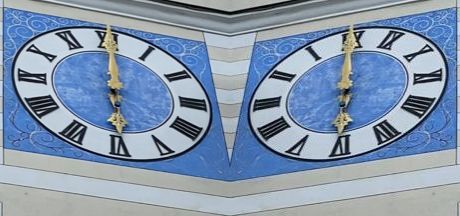
A de-synchronisation of these multiple calendars increases the need to coordinate societies within or society and the economy, religion or ecology. I liked my printed calendars over the years. Now I shall print different versions for different countries and functions. I still wonder, if my life got easier or more complex. Probably, it has only become easier to organise complexity and diversity. Clock 6 video

Hunger

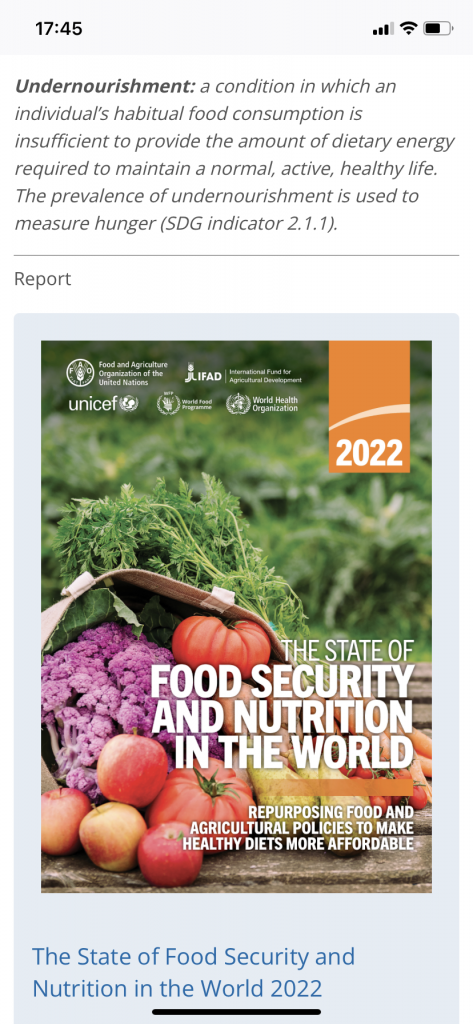
The UN strategic development goals (SDGs) list after the eradication of hunger as number 2 no hunger by the year 2030. Following the report of FAO, the UN 🇺🇳 organization in charge of nutrition in a larger sense, the world is moving further away from reaching this goal in the 4 last years. The Covid-19 pandemic had disrupted supply chains and caused higher prices for basic ingredients. The poorest countries were most vulnerable to such price increases when even in the rich world government deficits were rising sharply. Before sufficient relief arrived Russia’s war in Ukraine destroyed crops, interrupted again supply chains from Ukraine to many of the poorest nations. Energy prices are a substantial part in the production of fertilizers for agricultural products. Same story Russia disrupted the whole supply chains for food production at affordable prices for the poorest parts of the world. Additionally, Indian food production was lower due to the drought, Pakistan had extreme flooding. Both countries are important export nations for feeding the world. Continuing climate change is likely to put global food production under additional pressure. Price rises will hit the poorest again and again. Feeding animals with crops that could otherwise alleviate hunger in other parts of the world puts the rich world’s consumption patterns also into the spotlight. Fighting global hunger is largely a question of how wealthy nations deal with nutrition. The struggle to fight obesity and hunger under the joint concern of malnutrition unites all parts of the world. Time to act together on both topics.

Crises

Crises, yes crises, we have seen a few in recent years. After the first financial crisis, 2009, the COVID-19 crisis and now the energy crisis, , they all have cost us respectively 1.6%, 2.5% and lately a whopping  7.8% of GDP loss according to Tom Krebs (Uni Mannheim and FNE) in his assessment of lessons from these crises. Also Philip Lane (ECB) showed the lower GDP growth rates due to the crises.
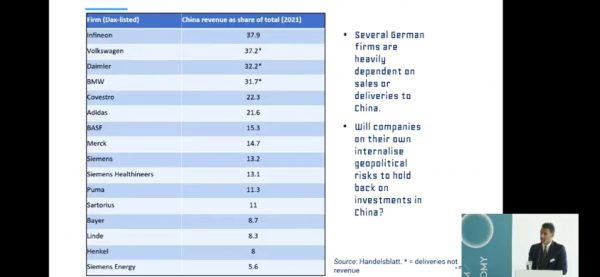
We lost out on the wealth of our nations and face mounting difficulties for the distribution of this wealth. As firms cashed in on profit margins lately, workers risk even more to fall behind significantly. At the same time, it is high time to prepare for the next winter season now, to ensure the same risks as the dependency on energy resources from outside Europe, especially Russia, can be maintained. The conference of the Forum New Economy from the 8th of May 2023 discussed several ways forward to learn our lessons from these crises. Strategic independence needs to be properly defined for Europe as a whole, not just in each individual state. Implementation has to be rapid as well. Geopolitical challenges will not wait for us to finish discussions. Germany and minister Robert Habeck has received some acclaim from the economists for a fast and rather successful reaction to safe us from an energy crisis last winter. Massive increases in renewables (+20% solar energy) has helped a lot to ensure sufficent energy supply when France suffered heavy reductions from its nuclear energy power plants. “Let the sun shine … in”, I would sing. However, we have to think even further ahead build our resilience based on improved energy efficiency and may rethink the risks and vulnerabilities of our economic model of production and consumption. Diversifying imports from Russia with imports from other countries and other (green) forms energy is part of the solution. A heavy reliance on China as buyer of our products is good for trade balance, but some sectors (automotive) are nowadays critically dependent on selling in China. Some of our partners are very anxious about this new dependency on Asia for our economic growth model (see figure below from conference). Market based economies suffer more openly from huge economic swings than more secret-based autocratic economies. Our state agencies have to keep that in mind and state intervention seems to become more likely options in future as we have already witnessed in the past crises. We had to rely on running higher state deficits to cover the losses incurred from the crises. The EU, the larger Europe in combination with the transatlantic and pacific alliances has a lot of resources to address these strategic interdependencies. Being prepared, in strategic thinking and potential implementation procedures is a major part of building capacities that ensure resilience and strategic independence. As in a game of chess, you have to think ahead a couple of steps to frighten off some potentially dangerous moves of other players.
In terms of a planetary concern we still have to address the major climate crisis and the last 3 crises have largely contributed to reduce the resources we have available to address climate change. Smart crisis management succeded to ask for emission reductions in return for subsidies from firms and private households. This might be the “best practice examples” worthy to learn from. There are still huge evaluation tasks for analysts of these crises.