Notre-Dame Organ

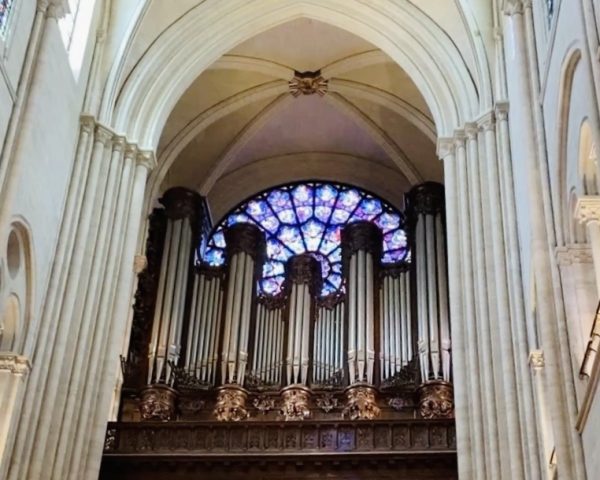
Paris, particularly Notre-Dame de Paris, is a great place to listen to pipe organs. It just needs a little preparation to find out time and place of a concerts. There are actually surprisingly many. At times of official services you might also get an impression of the capacity of organs and organists knowing how to make the pipes sound from soft, melodic to broad, majestic, even overwhelming. In Notre-Dame de Paris the original organ was built by Aristide Cavaillé-Coll and accomplished in 1868. An “electric blower” (1924) certainly enhanced and prolonged the sound capacities of the already rich orchestration features. Despite the electric enhancement the mechanics remain the primary features of the sound of pipe organs. Olivier Latry at Notre-Dame manages to the audiences into the 21st century’s sound spectrum based on traditional, but adapted variations of classical compositions. Bringing in new talent, like at the “Konzerthaus“, will guarantee that future generations can still enjoy the many worlds of sound that organs open up for us. Short sound impression Notre-Dame de Paris organ play 2026-8.
Paris Room with a view

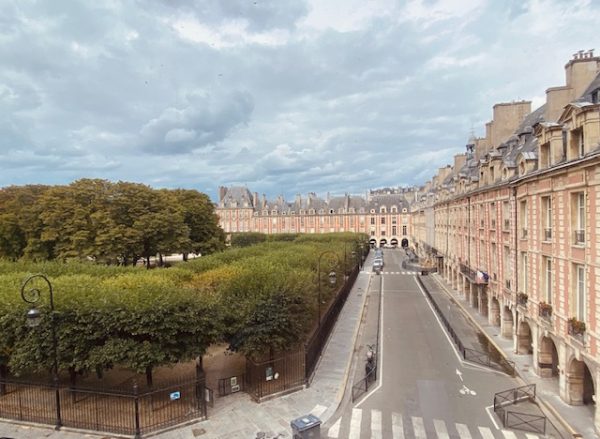
The home of Victor Hugo in Paris offers a splendid view of the Place des Vosges. The image taken from the 1st floor of the building and his living room allows to see a bit like what Hugo saw every day for some time. A small park, probably a lively street with arcades full of shops and people. Lots of inspiration and observation which may come from actual life. The actual time of writing, however, needs also retreat from the busy daily surroundings to focus one’s mind. All this hasn’t changed since Hugo lived in Paris at this address. Writer in residence programs of today allow authors to focus on their work beyond daily tasks. Cultural advances heavily rely on such programs nowadays to be able to have at least temporarily “A room with a view”. 

Hugo home Paris room view through window

Fleeting memories

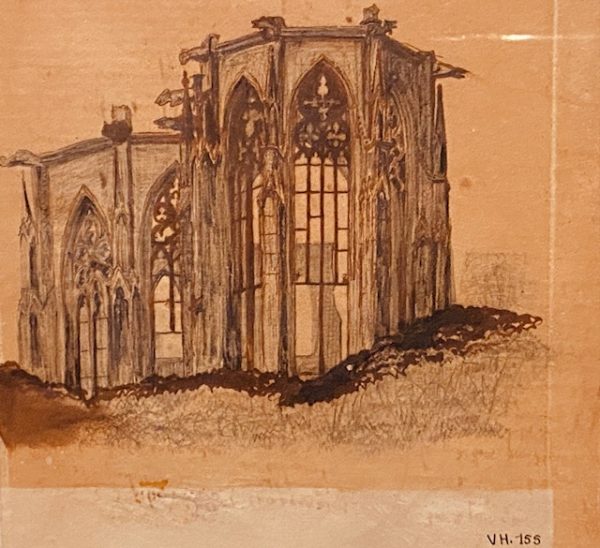
Our memory function is challenged once we travel. There are so many new impressions that ask for prime time in memory, but our capacities to safely store every detail of it is rather limited. On his voluntary travels, less when going into exile, Victor Hugo drew places with astonishing architectural detail and made literary descriptions on the back of the copy. The ruins of a gothic church in Bacharach (Germany) on the banks of the Rhine are a great example of his attempts to beat the fleeting memory. The ink and graphite pencil drawing date back to 1840. The imagery of the abandoned church, itself rich in memories of conflict by way of drawing details inscribes deeply into his own memory. A description in words on the back of this piece reinforces this effect beyond the mental exercise of precision versus dramatic blurriness. Repeating this exercise months later would reveal our fleeting memories when traveling. A great technique which is still valuable 186 years later. 

Church ruins at Bacharach by Victor Hugo 1840 exhibt at Maison de Victor Hugo Paris

Hugo voyage

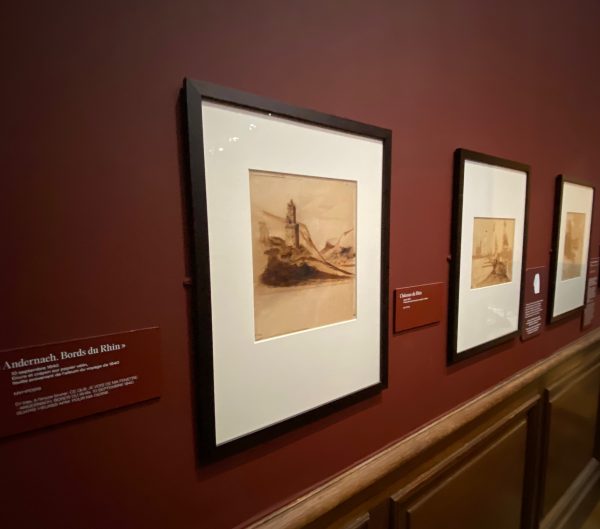
Victor Hugo traveled for inspiration to neighboring countries. He has been attracted to o mysterious places and its people. In his booklets of such inspirational journeys he drew images of several architecturally interesting places. “Burg” meaning castle was a recurrent subject trying to capture the mysteries about such medieval places and their surroundings. The rivers “Rhein”,”Nahe” and “Mosel” in Germany were a great source of inspiration for him. The images drawn of “Burg Eltz” as well as others (Andernach from 1840, image below left) testify to this. The Home of Victor Hugo in Paris, Place des Vosges features in 2026-8 his drawings which seem to have served him as studies in architecture and sometimes as idea of maybe a scenery for his theatre pieces. Of course, his drawings of cathedrals similar to “Notre Dame” in Paris are also among those ink sketches. To get scared a bit, traveling might suffice and then write it down and sketch it. Franco-German influences can be found in many European artists of the 19th century as well as today.  

Victor Hugo home in Paris exhibition on his drawings of architecture 2026-8

Painter influencer

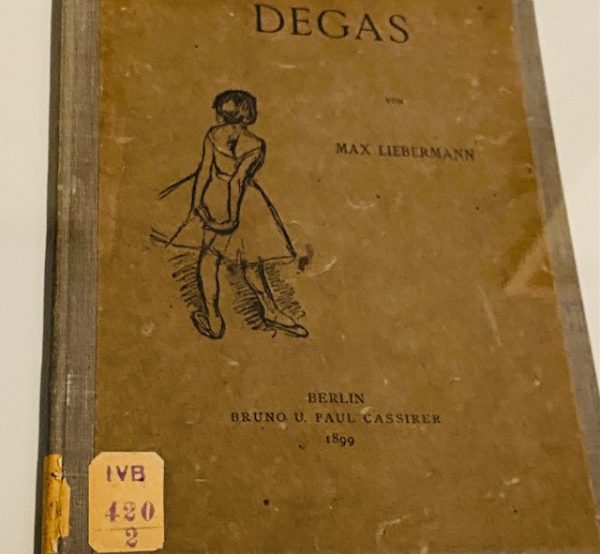
In modern terminology we could say Edgar Degas has been an influencer for many other painters, gallerists, art collectors and our way to look and interpret paintings or drawings. Max Liebermann wrote an appreciation of the work of Degas for a German audience in an attempt to bridge the gaps in the understanding of modern art between France and Germany towards the end of the 19th century. Cassirer as editors facilitated the publication and jointly they achieved to build a remarkable collection of impressionism before the atrocities of war took over in the first half of the 20th century. Fates can change quickly and painter influencer may become discredited due to more forceful political influences. (Image: Booklet by Max Liebermann 1898 on Degas in Cassirer exhibition in Berlin) 

Max Liebermann on Edgar Degas published by Cassirer

Splendid networks

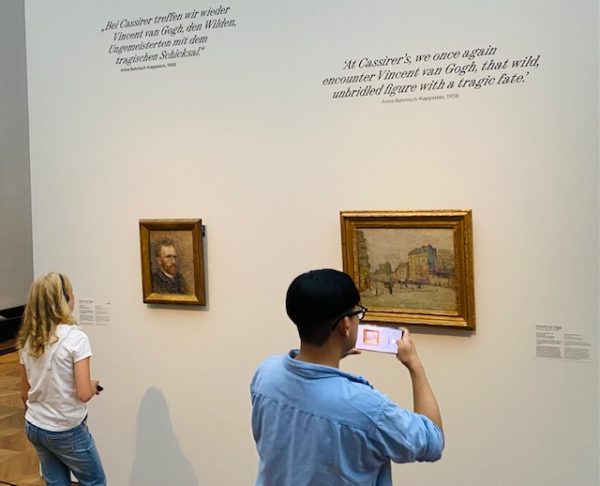
The art of gallerists is to blend networks. Some of them manage to create splendid networks that make history in the best sense of the words. The exhibition on the gallerist Cassirer made this argument in a forceful manner. He had a large network of persons interested in art and modern ideas as well as access to a network of artists who challenged the conventional arts of the time, later coined as the impressionists. The overlap of interests created a special market of art which met in his gallery in Berlin Tiergarten. Lots of take home lessons for us. 

Cassirer exhibition Neue Nationalgalerie Berlin 2026-8

Park Impressions

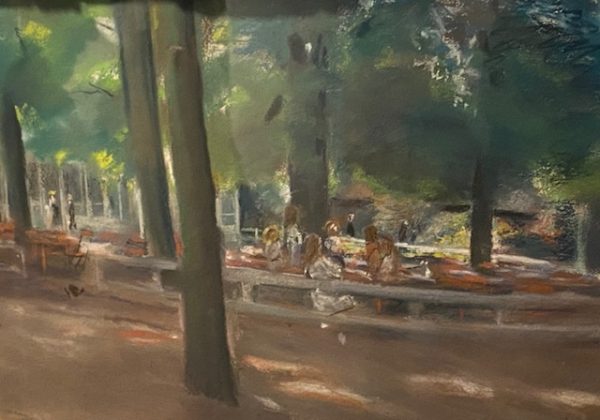
Parks and gardens have been among the preferred items of impressionist painters. In Berlin it is possible to visit the Villa of Max Liebermann and the splendid garden next to the Wannsee. The 3 years Liebermann spent in Paris as well as his friendship with Cezanne “converted the young painter to impressionist’s painting style. The subjects of his paintings became similar as well. Splendid gardens and people working or going about their daily routine inspired him. The visits to the Netherlands (image below) inspired him to paint the joyful and relaxed atmosphere during summer. Sunlight and shadow outside an atelier became the fascinating moment he captured so well. Enjoy the summer and take a break. (Image: extract from Max Liebermann: Park in Laren).

La gaya sienza

Nietzsche published his 1st version of “Die fröhliche Wissenschaft“ in1882. Ever since a controversy over the translation and interpretation of the title broke out. The publication in English referred to the title as “Joyful Wisdom”. A major question remains: is the opus a piece about science in the sense of philosophy, or less rigorous in method and therefore more a kind of general contribution to a perspective on wisdom? 12 x 12 years later of the 1st publication the “Motto” on the opening page should be taken more seriously. “Dem Dichter und Weisen sind alle Dinge befreundet und geweiht, alle Erlebnisse nützlich, alle Tage heilig, alle Menschen göttlich.“ Such a  radical Version of enlightenment as scientific method announced his attempts to demystify everything from religious beliefs to also science as well. The Motto of the 2nd edition in 1887 goes beyond the original one to include himself into this demystification. “Ich wohne in meinem eigenen Haus, Hab Niemanden nie nichts nachgemacht Und – lachte noch jeden Meister aus, Der nicht sich selbst ausgelacht. In a nutshell, mock yourself as much as you mock about anyone else. Can this science be science, intelligence, artificial intelligence or is this already the precursor of „super intelligence“ of the 21st century AI hype? 

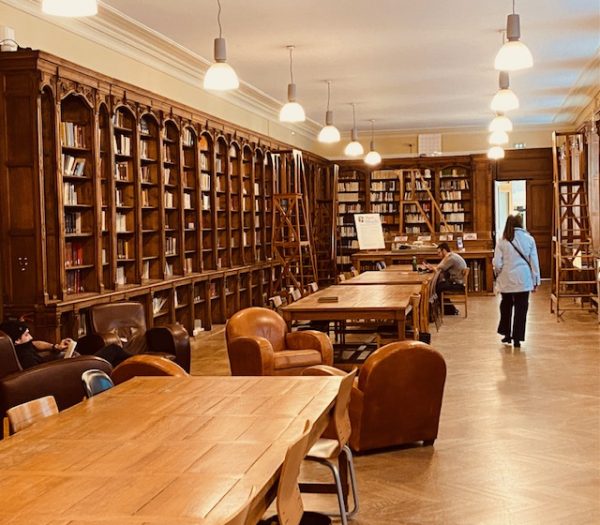
Marc Bloch Library ENS Paris

Litfaß Advertisement Column

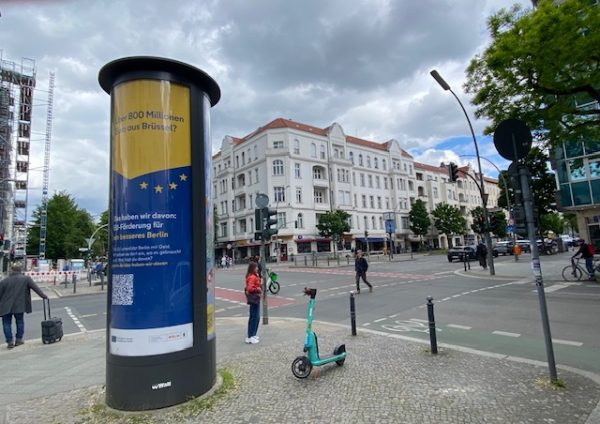
Berlin has renovated some of its early say notice boards and advertising columns. The original „Litfaßsäule“ has already the round column shape where you clued a poster on the sirface so that it was visible to several persons interested to look and read. After more than 150 years after its invention, Berlin has digital advertising columns which resemble the original Litfaß design. Rather than the spectator walking around the column, the column now turns around in a steady manner so that nearby you can see the whole advertising content from all points in the neighborhood. Simple change, but a remarkable improvement in the reach of the advertisement. Retro-lighting increases the duration of the effects as well. Mass communication and commercial innovation can sometimes just improve on an existing marketing channel, and still reach a specifically targeted audience.  

Post-sacred architecture

As with our human bodies, and in many instances already, sacred architecture follows a life course pattern. The thriving religious communities build and expand their faith to larger audiences. In these expansionary phases of the faith many monumental buildings, known as sacred architecture, as well as splendid interiors or artefacts enter the “built faith”. After the peak of membership and in periods of contraction, the question of how to scale down the splendors starts to arise.
Eventually, the ceding of the sacred architecture to the non-believing communities comes into consideration. The sacred architecture needs to find its place in the evolution of societies as well as urban and rural local space. Depending on the intentions and resources of communities, post-sacred architecture has to redefine its purpose for its own survival.
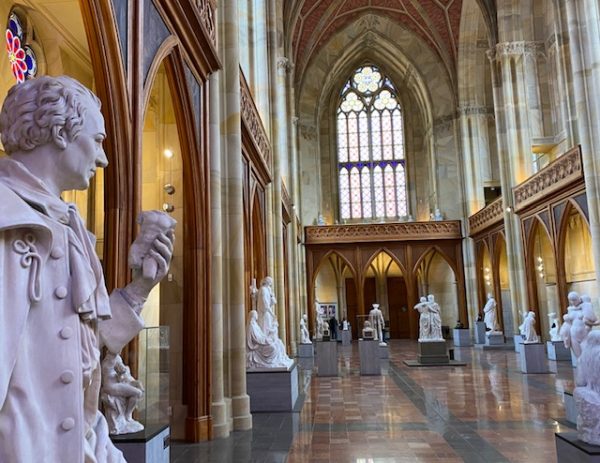
An interesting example of post-sacred architecture constitutes the “Friedrichswerdersche Kirche” in Berlin. The use as a historic exhibition space for sculptures of the 19th century works particularly well in combination with an active program on art, architecture and history. The statue by Ludwig Winckelmann (image below) depicts the reflection on and about a miniature sculpture in space. The post-sacred use of this fine and luminous architecture continues to reach an enlightened audience.