Fleeting memories

Our memory function is challenged once we travel. There are so many new impressions that ask for prime time in memory, but our capacities to safely store every detail of it is rather limited. On his voluntary travels, less when going into exile, Victor Hugo drew places with astonishing architectural detail and made literary descriptions on the back of the copy. The ruins of a gothic church in Bacharach (Germany) on the banks of the Rhine are a great example of his attempts to beat the fleeting memory. The ink and graphite pencil drawing date back to 1840. The imagery of the abandoned church, itself rich in memories of conflict by way of drawing details inscribes deeply into his own memory. A description in words on the back of this piece reinforces this effect beyond the mental exercise of precision versus dramatic blurriness. Repeating this exercise months later would reveal our fleeting memories when traveling. A great technique which is still valuable 186 years later. 
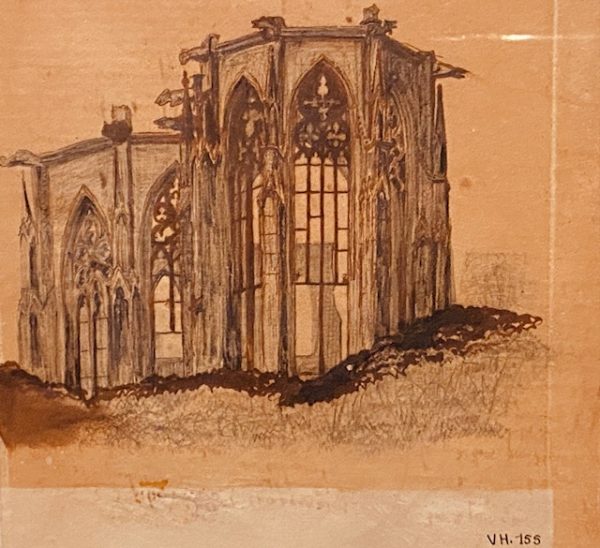
Church ruins at Bacharach by Victor Hugo 1840 exhibt at Maison de Victor Hugo Paris

Activity and dementia

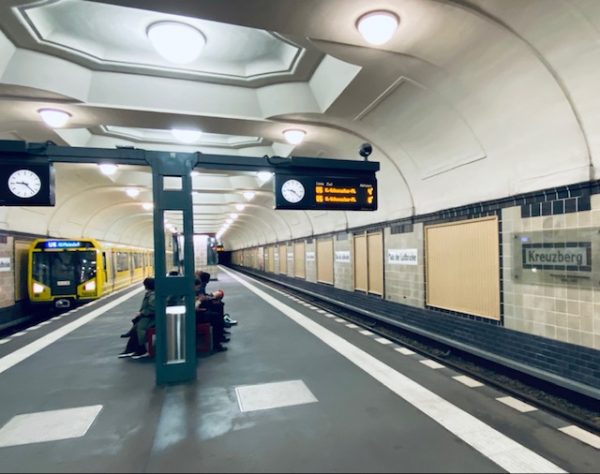
In view of the huge challenge of dementia to people and the public health systems, it is primordial to test potential remedies with high precision. So far general measures of just any physical activity like walking were considered beneficial. Recent and more comprehensive data on domain-specific physical activities by Feter et al. (2026) emphasize the importance to differentiate between walking for leisure or walking rather stressed to work. The former contributes to a delay of the onset of dementia, whereas the latter bears higher risks of dementia due to the “negative” stress involved. However, as Kivimäki and Hamer (2026) point out dementia itself has a long gestation period in which persons might reduce physical activities because a “silent” onset of dementia is not yet diagnosed but inhibits already more activities. Commuting to work or leisure might already be a challenge in early dementia particularly if public transport has to be organized independently. 

Commute in Berlin by underground U-Bahn

Repetition and Variations

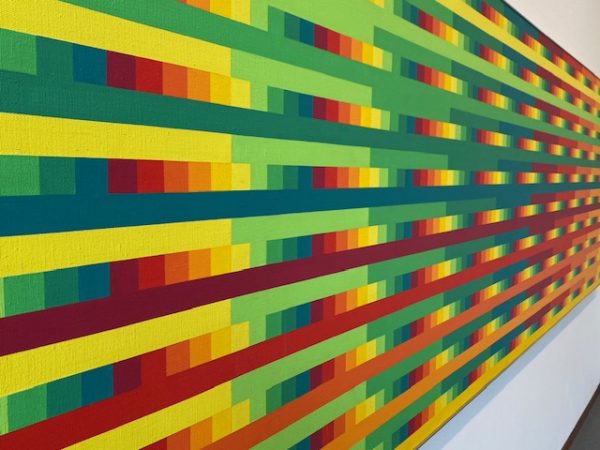
Learning and, surprisingly, innovation or creativity build upon repetition as a method. You may just recall the content or repeat an exercise and this is an obvious form of learning by simple repetition. A bit  more challenging is active recall, which would take into consideration to ask (yourself) questions about the subject at hand. The time component is another form for effective or “spaced” repetition as time intervals and timing over a learning period are powerful mechanisms of learning strategies as well. Even visualizations of content in form of a mind map is a creative form of repetition. The basic content remains the same. You may also just use repetition in a form that you (imagine) teaching the same content to another person, which is also known as the Feynman method. Learning can consist in variations of repetitions. This works in many disciplines and the repertoire of repetitions is a part of any pedagogical toolbox and exercises. (Image: Extract from Horst Bartnig, Composition in ten colours 000-999, 1981, Neue Nationalgalerie Berlin) 

Time in poetry

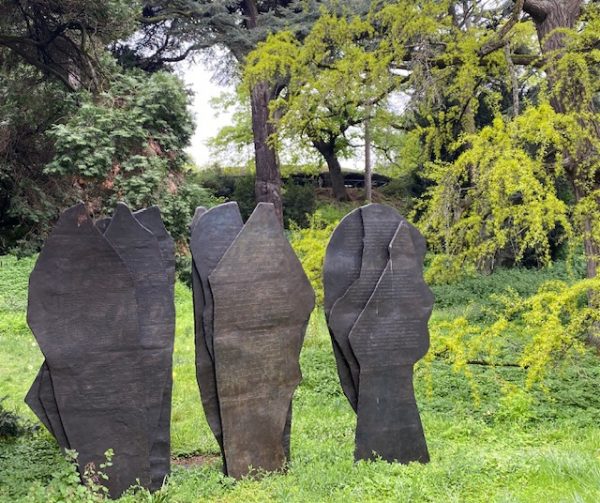
Some might argue poetry is all about time. It is a perfect way to “decelerate”. Reading pace, in most instances, slows down considerably. At least the first time reading is frequently a stop and go process. A few examples of poetry may hit personal trigger points. The random collection of poems I consulted in the “Lese lounge” in 2026-5 contained each the topic of time in one or the other form. Renate Schmidgall (2025) carries time indirectly in her title “Kein Verlass auf Uhren und Gestirne” (Don’t depend on clocks and stars, own translation). She creates new metaphors like “Am Kirchturm rostet die Zeit” (p. 12 On the church tower time rusts). This sentence precedes the sentence which became the book title. Time is also envisioned a bit like an onion in another metaphor “die Uhr schält rückwärts die Stunden“ (the clock peels backwards the hours). So much to gain with so little time spent with poetry.  (Image: Bronse in Jardin des Plantes, Paris, homage to Saint-John Perse 2026). 

Holocaust commemoration

The commemoration of the Shoa or the Holocaust is part of an international remembrance of atrocities against humanity. It needs to be present in countries beyond Germany, even if Germany under Hitler’s rule caries the sole responsibility for the ruthless execution of a plan and the murder of 4 million of its own people of Jewish decent and additional 2 million Jewish people of neighboring countries. In the speech by Tova Friedman, a Shoa survivor, she pointed to the perceived threat which children posed to the Nazi-regime as witnesses of mass murders. There she is. In front of the whole nation she testifies for what seems like a distant past, but for many this past is still not over. Responsibility of Germany does not stop after a certain number of years, maybe in judicial terms, but a moral obligation to act against denial of these atrocities is primordial. 20 years after the inauguration of the memorial of the holocaust in the center of Berlin and the exhibition center “topography of terror” (image below, 2026-1-27) we should start an initiative to make the International Day of the commemoration of the holocaust a national day, of commemoration, where all daily routines are paused in Germany to give people time to act and reflect on what can be done that such atrocities will never happen again.

Time reference

Times serves as a point of reference. We often refer to precise points in time, like dates 1st of May Labour Day, or a specific hour as a reference point. If we talk about 5 minutes before 12 o’clock, we convey a kind of urgency – before it is, presumably – too late. In the arts, particularly poetry, prose or drama, and even beyond the romantic period, the reference to seasons as “emotionally loaded” terms is widely used. Subsequently, there are many compositions in music, which make use of such references as programmatic titles. Through the reference to a specific duration, the scene appears to be set and the reader or listener prepared for a less surprising experience. You might even go full circle like in Vivaldi’s composition of “The 4 seasons”.
The writer, poet and Shakespeare translator Thomas Brasch (Link to publications) has written the poem “Der schöne 27. September” (1980) with an exact reference to a point in time, but reporting in 10 lines, what he didn’t do on that date (own translation).
“I didn’t read a newspaper.
…
I didn’t write a single line of text.
I didn’t set something in motion.”
(Extract from Thomas Brasch poem see above;
image below, Global stones project)

Time as surprise

Sometimes, time comes as surprise. Time seems to run faster as we perceive it, or time might pass more slowly in actual terms than we perceive or think it does. What makes the difference? There is the objective measure of time with various types of clocks and watches versus the subjective or perceived lapse of time. The discrepancy between the two constitutes an interesting case for further study. Marketing strategies will try to make us believe that a specific kind of product will shorten or lengthen the difference between objective and subjective time. The entertainment industry works very hard on our perception of time relative to one or the other form of entertainment. The best result seems to be that objective time has been much longer than perceived time so that we “lost” our reference to time while being entertained. The so-called social media interaction is rather successful in this form of entertainment, infotainment or edutainment. The moments in life when time comes as a surprise might be great ones in our lives. Particular deviations between objective and subjective time make strong impressions on our memories, too. 

Reverse causality

Reverse causality is a beast, which empirically minded scientist fear almost like death. However, many processes we study are running not only in one direction. In most cases, causality is tested with, or assuming, a unidirectional model of causality in mind. But some processes have not only a set of multiple causes to take into consideration, but some processes might be reversible or run in a rather complex manner, which are difficult to quantify. Mind captioning is a technique in neuroscience, where easy language is used to describe an image perceived in a person’s mind. Such thinking aloud data is based on thousands of brain scans, where people watched videos or images (study link).
In my own journey into the working of my mind I play around with different directions of causality. Sometimes the text is the origin and the image follows in a selection of a telling illustrations, but occasionally the reverse causality is at work. The image is the starting point and gets the mental process going. It is a rather complex process which is not easy to approximate with the help of algorithmic thinking. Reverse causality has many surprises to offer. As scientists we have a hard time to come to grips with it. (Inspiration Link) 

Memory design

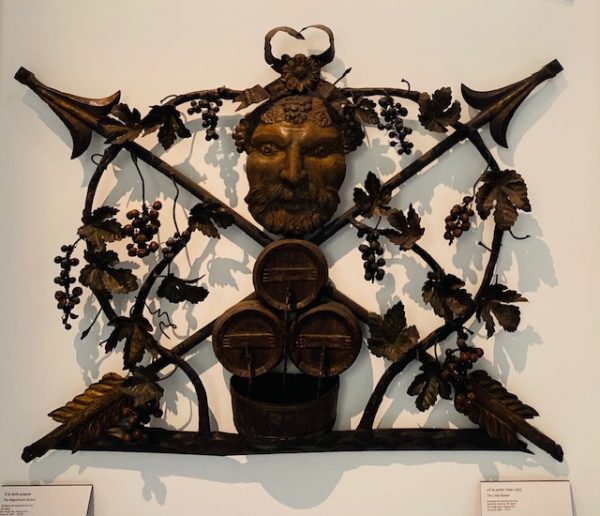
The progress in the field of genetic editing and design is astonishing. The research group of Johannes Graeff tested the “behavioral consequences of epigenetically editing the Arc promoter within engram cells”. Plasticity is a key feature of memory formation and the experimental evidence shows that this plasticity can also be interrupted. Moreover, the scientists were able to demonstrate a reversibility of retention or un unlearning of manifestations in memory of mice. The bidirectional reversibility of memory expression has potentially therapeutic value for traumatized humans eventually. However, if memory becomes part of a design feature of human species, the risks involved are just as important as the potentials. In totalitarian political systems techniques of “memory design” might be able to adapt such influences on memory, which used to be called brainwashing. Ethics commissions could get ready already to define safeguarding of human memory.  (Image: The fountain of Bacchus, Museum of Paris, 18th century wine merchant entry)


Marc Aurel Memorials

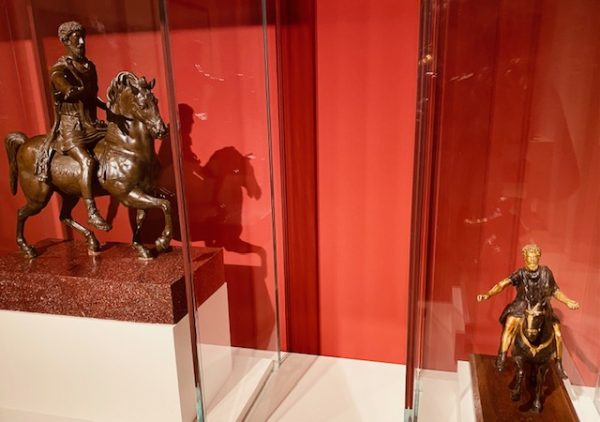
The depiction of Marc Aurel as Emperor has become a trade mark in the history of art and politics. As an emperor with good horse riding skills, Marc Aurel was the first emperor to be portrayed as riding on a horse without saddle whilst, of course, in perfect skill to master the horse and give orders or strategic commands. Many subsequent emperors, Napoleon or Friedrich have had their power positions “immortalised” as such, which served at the same time to make them appear taller and “in command” of something.
Travelling by horse has  also been for a long time the fastest mode of transport, yet another symbol of social status used in media campaigns of those times. The memorials in honour of Marc Aurel had already during the ancient time the function to transmit an image, the emperor wanted history to keep in mind, rather than the view of ordinary people in the Roman empire. Memorials of political leaders have been a demonstration of power for centuries before and for centuries to come.
(Image: Trier Marc Aurel exhibitions 2025-9)