liberté urbanité

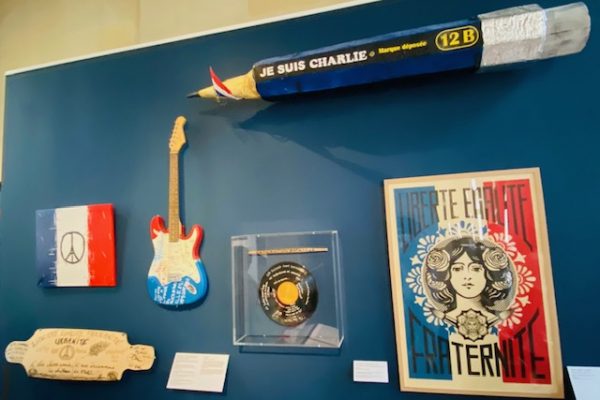
In the museum of the history of Paris “Musée Histoire de Paris Carnavalet” we find a special place devoted to the commemoration of the terror attacks in Paris in the Bataclan event location and the office of the journal “Charlie Hebdo” (see image below”. The skateboard on the bottom left of the wall raises the value of “urbanité” next to liberté, égalité, fraternité. The attack of an urban living style with youth going out as they like and journalists and caricaturists speaking their minds freely had been attacked, but continues nevertheless. This statement is part of the Paris state of mind. 

Erik Satie Satisfied

The collection of letters from Erik Satie contains more than 1000 letters amongst them some in exchange with the best artists of his time. The range is largely due to the circle of artists who met at Montmartre in Paris before and during the Great War. We discover letters to Maurice Ravel, Claude Debussy, Pablo Picasso or Henri Matisse. For some artists there are 100+ letters preserved like to Jean Cocteau. In the 1920s he composed music for shows at Montmartre, where the scenario was painted by Pablo Picasso and costumes designed by Coco Chanel. The sculpture by Brancusi must have been familiar to him, just as much as the cubist paintings by Georges Braques, as there are also letters or references to such letters in the impressive 1000+ pages collection. Like Ravel he was rejected by the Conservatoire de Musique de Paris in his early days as student. Montmartre allowed to live and create at the same time while living on a minimal budget. Erik Satie signed his letters with ES. In German this denotes a “neutrum”, maybe, beyond male or female differentiation, but also a tonality in music (E flat). There is no trace that this was a conscious choice. It is just another unresolved puzzle about the self-declared “Gymnopédiste” and composer of the “Parade” and the popular piano music the “Gnossienne”. 100 years after his death on 1925-7-1 he (ES) could be rather satisfied with his impact on the course of music in the 20th century and beyond.


Musician Historian

Musicians are usually perceived as “part of history” rather than being historians themselves. However, recent research on Bob Dylan has extended that view to portray Dylan in his role as historian as well. The issue here is more with the historical periods and references the musician, composer and song writer builds on and interprets historical events. Thereby, his thoughts and impressions on living through historical events enter into his work as an artist. Dylan is literally “doing history”. He puts events of past and present into perspective of his own making and reached authority through the non-conformist perspective, which connected him to as a performer to his various audiences. His approach to doing history consists in the re-presentation and re-creation of historical narratives. Nina Goss (2024) in her book review highlights the “irruptions of the past into the present unique in popular culture”. The re-arrangement of fact and fiction encourages us “to inhabit, question, and revise historical narratives and tropes” (p.399). Several musicians have specific ways of reflecting, sometimes critically, on history in their artistic work. Bob Dylan certainly is a very prominent example of this an has been honoured for this by the Nobel Prize for literature. It remains an interesting perspective to review composers and their choice of libretti for operas as a way of doing history. The shifts from royal drama to revolutions and popular scenes are in this line of interpreting musicians also as historians.

Memories updated

In Berlin and many other German cities it is a regular practice to scrutinize the memory inscribed into street names. In order to correct the honors given to persons with a past as fascist or responsible for mass killings street names were changed at several points in the history of the city. Streets named after battle fields, for example, are a continuous point of discussion. It is important to keep the perspectives of victims in mind. Therefore, changing street names is a little contribution to rethink the role of places and persons. Such changes are sometimes very controversial as people become accustomed to names, some might even not care much at all. Recognition and responsibility, however, have a lot of currency in historical perspective. Overpainting like in the paintings from Gerhard Richter has an important function in society and can be one way of coping with the demons of the past.

Margot Friedländer memorial

Berlin has been honored by the return of Margot Friedländer who had survived the Shoa in 2010 at the age of 88. Her whole family was murdered in concentration camps by the Nazis. Ever since her return and especially after her biography had been published she was a restless ambassador in the fight against hate, exclusion and the neo-fascist movements. She has been engaged in interreligious dialogue and even through the ceremony after her death, she tried to bring together different Jewish communities in Berlin.
Irrespective of a person’s background she met everybody on an equal level.
A great example to thousands of people, she managed to meet in her life. Each time she met with pupils or students to speak about her horrific experiences she lived through the same traumatic experiences again and again, but turning this into the strength to “vaccinate” people against the deadly virus of fascism.
The day after she had been buried in her family’s grave in Berlin Weißensee people still had to queue to sign the book in her memory in the Berlin town hall. She will be remembered and missed for her unrivalled humanity and generosity. She became engaged to fight for humanity and remained an activist until her very last day at 103 years of age.

Leber JA

In Berlin Schoeneberg there is a memorial in preparation for the courageous couple of Julius and Annedore Leber. Julius Leber has been incarcerated several times by the Nazi officials, tortured and finally executed in Berlin. A link to the group of people trying to overthrow the NS regime (1944-7-20) caused his arrest and execution in January 1945. His wife Annedore published several accounts of the resistance movements, which existed during the NS regime. These people were aware of the fact that they were risking their life with such activities, but persisted nevertheless. We owe Julius and Annedore Leber a decent commemoration as we need to remember that such courageous examples existed even until the last few months of the NS dictatorship. The site allows for a building and learning center which could serve as an archive and encouragement to fight for democracy. It is less obvious than we thought it would be.

Local history

In Berlin and many other big cities in Germany like Munich and Hamburg there are local history projects which tell the stories of specific places or a house linked to liberation day or deportation or courageous acts during the Nazi  grip on Germany and terror across Europe. The initiative « Denkmal am Ort » has become a kind of citizen science project which brings people together to raise awareness again for the cruelties committed under the dictatorship of Hitler and the fascist political movements. Remembrance is not a passive form it can take many active forms as well by simply trying to find an answer to the question what happened during the 30s, 40 and 1950s in the house you are currently living in? Access to archives of cities and small towns can tell very surprising stories about local history. It is a great inter generational experience as well and sometimes the unspoken history turns into a great conversation about history and responsibilities. History is everywhere you just need to keep your eyes and mind open.

Gedächtniskirche Berlin

The church of commemoration „Gedächtniskirche“ in German has been chosen as the central place of commemoration on Liberation Day in Germany for the ceremony of all religions. All institutions of democracy were represented in addition to the president of the FRG. The church was destroyed, but not completely and the decision to keep the remainders as a permanent warning is visited by thousands of people each year. The public television broadcasts live from the ceremony and some regions of Germany have chosen Liberation Day as a bank holiday following many other European countries. The official end of fighting of the 2nd World War 80 years ago has spurred many events. The need to understand how this could happen and how to guard against extremism to take hold of a country and start a war have preoccupied following generations. The task is not accomplished yet as many people still deny the facts or try to rewrite historical facts with misleading interpretations. The commemoration is well worth a pause to reflect, for example, what were my grandparents doing during these years. Beyond the speeches on this day there are many ways to get involved in carrying the memories to the ones born later.

Liberation Day

In Germany the celebration of the liberation day 2025-5-8 change years of mixed feelings about what happened during the 2nd world war. In Berlin this day is a bank holiday now and more and more people subscribe to the view that the liberation from Nazi-terror was a blessing for German people. The “Neue Wache” is the room of silence in honor of all victims. We shall always remember. Fighting the early tendencies remains the most effective strategy to avoid extremism of fascist groups. It is the task of Germans born also long after the war to keep the memory of the atrocities alive and to care about prevention of new ones.

Paris libéré

It is with great pleasure to follow how Paris commemorates the liberation of Paris from Nazi-Germany 80 years ago. (Quote from De Gaulle “Paris libéré”.) On the 25th of August 1944 the city of Paris was finally liberated by French armies and the support of the local resistance movement. Similar to the journey of the Olympic flame on the way to Paris, we can follow each city celebrating the liberation from the occupants. Beginning with the landing in the Normandy of the Allied troops, the chasing of the enemy has been a matter of time, but still incurred huge human losses. More than 4 years of Nazi symbols in Paris were finally brought to an end and celebrations on the streets became a symbol for the enormous relief this liberation has meant to the population of Paris, France and hope to many neighbouring, but still occupied territories.
Several documentaries on television and radio allow to empathize with the joy of this time. Enduring the hardships imposed and, for many, risking their lives in clandestine networks of the resistance were honoured by the success of the liberation of the city without the massive destruction, which was to be expected.
A book edited by Ulla Plener (2007) highlights the supporting role played by some women originally from Germany to support the French Resistance movement. It still is not common to understand the retreat of Nazi-Germany also in Germany as the progressive liberation of the country from the terrors of a dictatorship.