Ocean Acidification

No, the abbreviation of acidification is not AC/DC. Acidification stands for the process that our oceans turn more acid due to the absorption of CO2 from the atmosphere. This has several harmful consequences. Lower calcification, slower growth of corals and mollusks (oysters and mussels) for example, shall reduce biodiversity in the medium term of species with calcium-based skeletons. The UN highlights this in several reports, but action upon this evidence (Ifremer 2026) is slow or even absent. Besides the acidification, the oceans have increasing temperatures. Some researchers frame this process already as the “tropicalisation”, the warming of sea water and migration of fish according depending on their preferred or necessary temperatures of sea water. Some move to cooler water, other species move into or “invade” due to higher temperatures.
This can be observed and studied in citizen science projects across the globe and by tourists with a little interests in what is happening near the beaches. Just take a litmus-strip with you to test the basic or alkaline pH-value of the sea water in a glass of sea water. Then add a bit of soda water and test again. That’s a bit exaggerating, what acidification of oceans is about, but the underlying mechanisms is the same.


asidification-of-ocean-skeleton-Ostende-2026-beach

Outdoor Pleasures

Summertime surely is time for outdoor activities and pleasures. Besides the broad spectrum of more or less strenuous activities, summer is perfect for socializing in parks, restaurants, cafes or beer gardens. We might think of this as more recent inventions, but in historical depictions by Bruegel or Jan Steen (1661 in Gemäldegalerie Berlin, extract below) we find evidence that socializing in a restaurant or beer garden has been around for more than 460  years. Monks were brewing beer and the consumption was reserved to a more elitist group of people. The concept is quite old. Fortunately, we have managed to democratize the joyful and socializing part of being together.  Places where people from different social classes come together have always been rare and this, additionally, varies across regions, countries and often social strata.

Jan Steen 1661 Gemäldegalerie Berlin beer garden

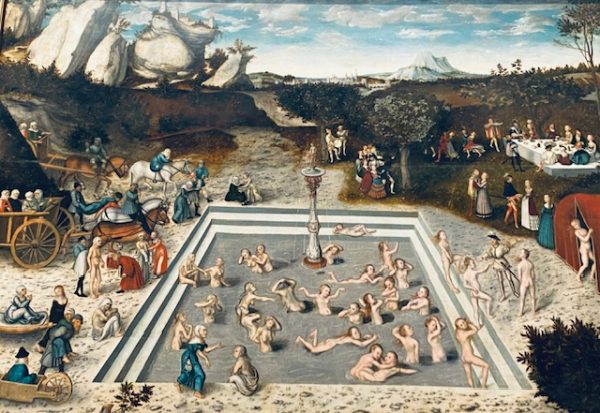
Fountain of youth

The fountain of youth is such an old dream of humans that we are no longer surprised to witness perpetual reincarnations of the same theme again and again. The painting by Cranach the elder (1646) “Fountain of youth” (image below, Gemäldegalerie Berlin) sets the scene for what has become a billion dollar business nowadays. Whereas the old dream was about rejuvenation and cure from disabling diseases, we have become a bit more moderate in ambition to be happy about a halt to aging. Promises are reiterated and made in building on an army of influencers who push many remedies that lack rigorous scientific tests. Two studies published open access in “The Lancet Healthy Longevity” (Witham, McDonald 2026 and Duremdes Nava et al. 2026) provide evidence that in case of obesity and diabetes there are no easy or quick fixes available yet. Healthy longevity still relies mainly on lifestyle (changes), more exercise and careful nutrition rather than additional medication. Medium and long-term consequences of inactivity and unhealthy diets are to easily disregarded or their value discounted. How much are you willing to pay for an additional year of healthy living at age 30 or 70? Simple economics, but quite a successful business model as well.

Medication adherence

In the broad range of medico-pharmaceutical science the topic of medication adherence is an uncomfortable issue. In the ideal scenario people would adhere 100% to the prescription. In the real world of not-optimal behavior and circumstances, people deviate substantially from what is best for or even good for them. Even in the tax-based health system of Denmark with relatively easy access to medication, a long-term study revealed the difficulties encountered to adhere to essential medications for persons with Type 2 diabetes. Nielsen et al. (2026) analyzed a cohort of 80.000 persons who newly acquired Type 2 diabetes of which about 25% showed a low adherence to medication plans with hazard rate of 1,27 to suffer a cardiovascular event. High adherence persons did not suffer such an event in the following 220 days over the 10 years of observation. A sedentary lifestyle or obesity increase the risk of type 2 diabetes and beyond medical treatments additional behavioral challenges like medication adherence make it clear, we do not live in the best scenario to fight type 2 diabetes.

Fuel fertilizer food

The state of world affairs can be summarized in relation to these 3 factors. Fuel, fertilizer and food are the subjects of the hotly debated or even contested resources. From a United Nations perspective the progress in human and economic development hinges on these 3 key issues. The logical order of the Fuel, fertilizer food triad starts with the costs of fuels or energy more generally and leads to the production and distribution of fertilizer across energythe world. This chain of supply determines the quantity of food available to feed the world. Russia‘s war on Ukraine territory has made this logical sequence obvious again. Millions of people were suffering due to the fuel, fertilizer and food shortages due to excessive price hikes. If we add speculatove rent seeking to this we have a scenario where the global South is suffering due to political contests and wars in the North including the Middle East. The current governance structure of the United Nations is largely unable to address this triad adequately. Fair processes of decision-making, control and implementation are crucial in this respect to ensure that all regions independent of economic spending power at sufficiently represented at the international negotiations about fundamental resources. Minimum levels of provision are necessary, even if not sufficient, conditions for our humanitarian responsibilities.  

Birds nutrition

The winter diet for birds is less varied than during the other seasons. Human assistance seems to be appreciated as well even if food supply in inner cities appears to be abundant with huge amounts of wasted food in streets ans backyards. The different diets of different species are not easy to cater for. It is a two way learning and adaptation process. With a narrower range of birds feeding in cities, the task is easier than it used to be. Bringing back more diversity of birds in general starts with offering different nutrients as well. A long way to go.

Less but better

There are many examples where a new mantra for the 21st century emerges from recent scientific evidence: “Less, but better” (Lbb). In studies of nutrition and human dietary requirements, the importance to eat less has been demonstrated on a regular basis. And this is even more important than to do more exercise if weight loss is the target or the attempt to explain obesity across the globe (McGrosky et al. 2025). The case for eating less is strong. Eating better refers to the need to avoid unhealthy, toxic or cancerous food or the way to prepare food. “Less but better” could become the new mantra or “categorical imperative” if you like it more philosophical in tone. We, the people gain, and the planet will gain as well. It is an easy win-win case, albeit with some behavioral implications.

Sustainable Food

Climate change has a severe impact on sustainable food production. The OECD reports annually on the evolution of volumes of production and monitors the resources and subsidies allocated to the agricultural sector of the economy. The sector and the whole nutrition chain are frequently perceived as a major driver of shrinkflation, greedflation and cheatflation.
Changes need to be introduced with a medium and long-term perspective in order to allow for smooth adaptations of the sectors involved and to avoid so-called hog cycles.
Most economic debate is focused on the quantity of production. The loss of production due to climate change and Russia’s war in Ukraine has been and continues to be substantial causing starvation and premature deaths. Another issue is the lower quality of food due to droughts. Repeated events call for adaptations. Certainly the adaptation of more resistant crops is part of the answer. However, the other side of the same coin consists in the consumer’s readiness to buy products that suffered during a drought. Just as the reduction of fertilizers and less water in the production of droughts reduces the size of fruit, for example, we, the consumers will be systematically challenged in our purchasing habits of fresh food.
Price-sensitive consumers will have to choose the products that have reduced prices due to drought quality loss. Other consumers may choose the drought affected product if a “resilience message” is attached to such products. Solidarity with climate affected farmers, just like bio-farmers’ products in ecological production, opens up another perspective to more sustainable consumption and farming.

Own Insulin

People who suffer from type 1 diabetes do not produce enough insulin themselves. The World Health organization estimated that „in 2017 there were 9 million people with type 1 diabetes; the majority of them live in high-income countries“ (WHO 2023). The report on successful reprogramming of stem cells of a person to produce insulin again and subsequently transplanting these cells into the same person allowed to produce own insulin again for that same person (Mallapaty, 2024). The hope for millions of people with type 1 diabetes is high that eventually there will be a cure to the disease. Scientists caution that there are no data yet for how long the transplanted own stem cells will produce insulin. Hence, the hope is driving research forward on a promising way forward. The case of type 2 diabetes is very different as additionally the absorption of insulin in the body causes problems. We keep walking and building muscles to facilitate the insulin absorption in the body to guard against the onset of type 2 diabetes. Interaction of diabetes and aging is another topic that needs our attention as rapidly aging societies are at higher risks to face many more people with various forms of diabetes.

Live longer

It is an old dream of mankind to live longer and longer. The Covid-19 pandemic has taught us many lessons that there are powerfully viruses and their continued mutations which threaten this. Life expectancy declined slightly during the pandemic and we learned that long Covid is yet another threat to our life expectancy. Scientists have found other sources that are crucial for survival. Like sepsis, it is the constant inflammation processes in our bodies. Long working times, stressful commute to work and interrupted or shortened vacations all contribute to keep inflammation at higher levels than is healthy from a longevity perspective. The research note published in Nature on the inflammation enhancing protein IL-11 highlights the chain reaction process of inflammation causing cancer and autoimmune disorders and diseases. Hence, it is essential to watch the biomarkers of inflammation and probably adjust our lifestyles accordingly. The sources of inflammation are manifold, but the potential rewards to address the issue are huge as well. Among the easy to address sources is nutrition, exercise and working life. Changing just a little bit here and there can make already a change. Monitoring how you feel about such changes puts you on a learning curve for your own inflammation levels. Vacation times are also perfect for adaptive behavioral changes. We just need to keep trying.