Learning and authenticity

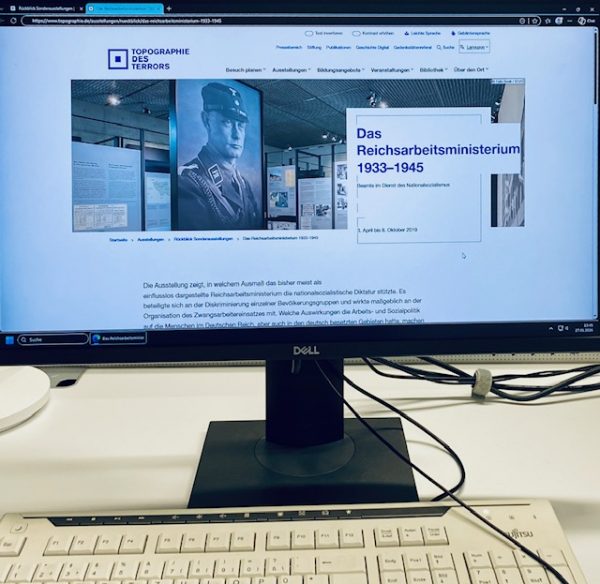
For historical, philosophical, social and many other domains, learning in authentic locations moves learners particularly. This can consist in reinforcement learning of an otherwise abstract event or process. The neuroscience of learning has demonstrated that both parts the rational mind and the emotional relatedness contribute to learning success. Memorials are such places where persons get involved with all their brain and senses. Robert Sigel (2015 pp.50-53) described the wealth of pedagogic approaches that has entered memorials. They range from flyers, guided tours to geo-caching, digital apps and continuous involvement in social media related to on-site visits. Memorials are no social-pedagogic institutions either. They cannot guard or even correct more or less likely antisocial social behavior of visitors. Additionally, they have to strike a balance between 360 degrees, engaged learning and decent commemoration. Authentic objects and information, like biographical accounts, original voices, videos or handwriting reinforce the lasting memory in and of  a memorable location ( Koessler, 2025 p. 79). School curricula make far too little use of this well implemented combination of learning and authenticity so far. Great potentials are ahead of us building on the specificity of each memorial. (Image: topography of terror, webpage access on site 2026).
Realist Democracy

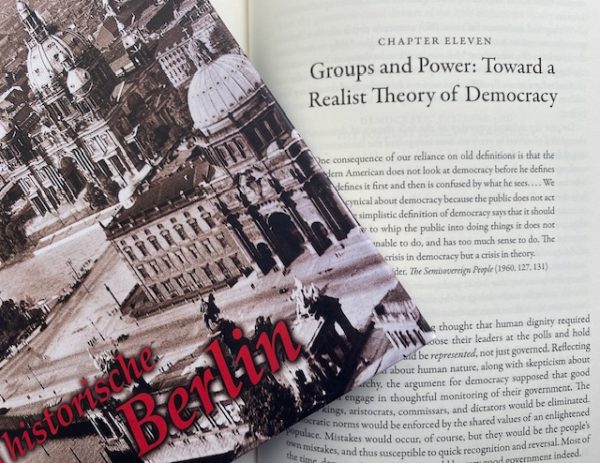
2000 years after the “invention” of and first attempts to develop a theory of democracy, we have come round to seriously think about “a realist theory of democracy” (Achen & Bartels, 2016). The ideals formulated in constitutions deviate sometimes substantially from the practice. Therefore, we have courts, (ideally) independent judiciaries, journalists and scientists. All these well-established safe-guards to ensure well-functioning democratic structures continue to be challenged. In each democratic country we can cite “derailing” of political leaders that try to bypass democratic institutions. The latest example in 2026 is the Mayor of Berlin Kai Wegner. He deceived, some claim he lied, repeatedly before his own party base refuted him as their representative when lies were uncovered. There have been several other politicians who have covered up his misinformation of the public about his handling of an urgency, which affected 100.000 people sitting without electricity during winter days. It took 6 months to uncover the truth about the handling of the crisis. However, eventually the truth and the lying to the media and the public became uncovered. The merit of this occurrence in Berlin is the hope that democratic ideals can be upheld even in rather hierarchic organizations and so-called head-fast leadership.

Internet pain or gain

Billions of people are forced to lose time when clicking through webpages. Instead of the default  to deny cookies, we are forced to “opt out” in most instances to a collection of random data-hungry, largely in-transparent and more or less risky cookies. It could be simple. It just needs a consensus to make the no-cookies rule the default. By such a simple measure the open information part of the internet is strengthened again. All for pay or “pay-with-your-data” offers on the internet would have to make you to confirm your “opt in”, thereby alleviating the burden for search of information. Huge corporate interests that rely on advertising profiles are, of course, an obstacle to such changes, but search engines of the internet would gain importance again before generative AI and AI-agents shall make own search and clicking on cookies denial a different routine again. For the time being we keep wasting our precious time to deny cookies. Just changing the default shall bring back a better internet and the focus on ease of access, diversity of information and better privacy. Make the internet fun again! Choose your browser consciously as well. 

Autonomy in Behavior

The learning capacity of humans sets them on a path to acquire and extend their autonomy in behavior. At birth, physical and emotional dependence is highest. Soon learning to handle different nutrition sources and emotional stress allows to gain more autonomy in each of these components of autonomy. Throughout later childhood and adolescence we develop various additional domains as well as degrees of autonomy.
Role-playing, enhanced motor control and interaction with others define and redefine continuously the potentials and limits of autonomous behavior. Social norms start to play an even more important role as of adulthood, just consider financial autonomy as one of the dimensions. The most distinguishing factor from robots or animals until 2026 has been the human ability to form its own autonomous judgment, where value systems and legal norms co-determine or set limits to our autonomy or behavior. Some results from neuroscience have demonstrated that our readiness to act is prefigured in our brain and additional “intelligent” mechanisms are needed to suppress or guide the otherwise autonomous, spontaneous action or reaction.
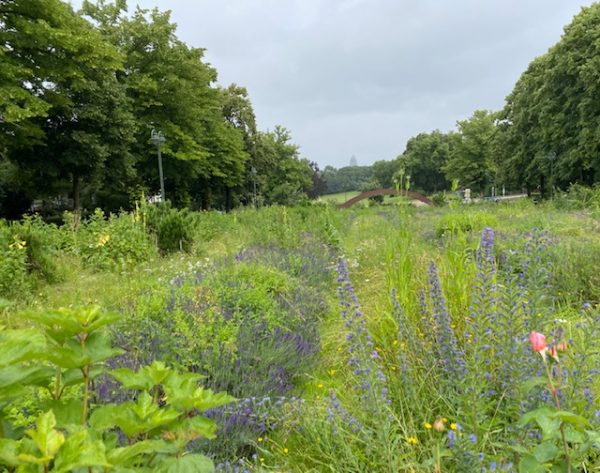
Our “free will” might not be as free as we wish it to be. Similarly our autonomy in behavior or decision-making might not be as autonomous as we tend to believe. (Image: Social cooperative gardening project, Brussels 2026-6)

Autonomy as Happiness

The French philosopher Émile-Auguste Chartier, better known as Alain, is a proponent of a rational approach towards fundamental issues. Therefore, we should expect from the reading of “Propos sur le bonheur” a thought-based conception of happiness. In his propositions on happiness, autonomous decision-making and autonomous actions play a decisive role. Rather than writing a voluminous “treatise” on happiness, he had chosen in the 1920s, the form of 93 about 2-page long propositions about happiness. These propositions are a bit more explicit than, for example, Nietzsche’s aphorisms, but they remain short without much literary context to the kind of rational analysis based on observations and anecdotal supporting evidence.
In propositions 42 “Agir” and 44 “Diogène” he deals with autonomy as subject. “on veut agir, on ne veut pas subir” (in short, “act, not endure”, own translation), that is his quintessence. “Tous les métiers plaisent autant que l’on y gouverne, et déplaisent autant que l’on y obéit.” (44). (All professions are pleasant if you govern, and are unpleasant if you have to obey). More than 100 years later, empirical studies on job quality, job satisfaction and happiness still build on this rationale.

Autonomous regions

In political science, autonomous regions have a hybrid legal form. Autonomous regions are a part of nation state, but have rights of own administration beyond what other regions have. The status quo of an autonomous region is more defined by the historical evolution than current political controversies. The hybrid state as being part of a larger nation on the one hand, but giving the impression of enjoying more autonomous decision making. The actual test of autonomy is in day-to-day decisions, particularly those that have cultural or financial implications. In order to preserve an own language and folk traditions the status as autonomous region is quite helpful. Whereas an own television channel or decisions about school curricula were essential for autonomous regions, the access to the internet and, for example, AI-assisted translations have made the preservation of cultural autonomy a bit easier in the 21st century. In view of a pervasive globalization we witness at the same time an increasing local attachment of people. The “glocalism”, which combines global humanitarian values with a locally routed personal identity. This mechanism seems to be on the rise and continues to pose a threat to an outdated vision of a nation state. Beyond hybrid cars and hybrid war, we live more and more in hybrid nation states.

Democracy or Democrisis

Measured on a global scale, democracy is in retreat. The report by the “Varieties of Democracy Institute” indicates that there are fewer people on the globe who enjoy the freedom and benefits of democracy overall. This is measured in domains like freedom of expression and the democratic quality of elections. The prevalence of democratic decision-making in opposition to autocratic ruling is closely related to the possibility to freely elect a new government in regular time intervals. The V-Dem Report 2026 indicates that 18 countries are on a favourable democratic development trajectory, whereas democracy is on the retreat in 44 countries. The freedom of expression suffered most (44 countries) and the quality of elections suffered in 22 countries. The positive developments (11 for freedom of expression, 7 for quality of elections) were outnumbered by negative ones. The cases of big countries with negative trends towards or tightening of autocratic ruling deteriorates the overall number of countries and specifically the number of people living in democracies in 2025 on the globe.
For all those living in lively democracies this should be a warning message (South Korea), that democracy is not a given. The enemies of democracy are working continuously from external territories to undermine a country’s democratic structures and decision-making. It is urgent to raise the quotas and limits by which fundamental democratic rules can be abandoned before it is too late. Let’s prepare a “defensive democracy doctrine” in Europe and the EU to signal more forcefully our willingness to stand up for freedom and democracy as fundamental values of humanity rather than an “Animal Farm“.

Press in the 1970s

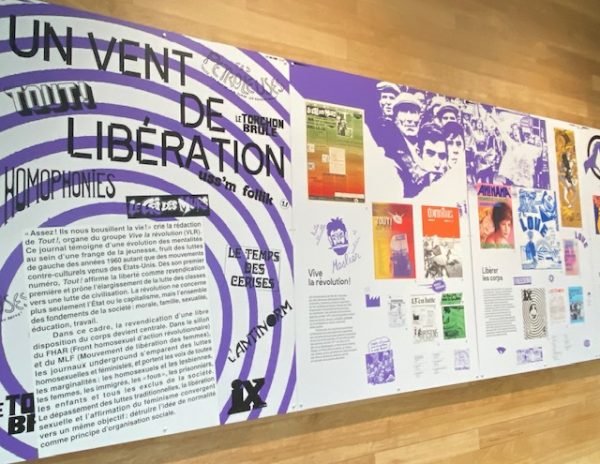
In the 70s there were many so-called underground or alternative papers printed. For people in bigger cities or in cities with universities, the 70s flourished with independent journalism which addressed small audiences. Each access to printing materials and paper allowed to go it alone for groups of society that did not feel they were adequately represented by established media. Some of these “underground” papers published texts that could be considered going against the dominant legal principles. Topics like feminism, birth control, abortion or more left wing political statements against private property had to fight to reach their audiences. The cold war period created another overarching threat to the representation of all opinions. Hence some groups we t underground to function as they wanted and how they interpreted the freedom of expression and being published. (Image: BNF Exhibition Underground 2026-6). 

History as Science

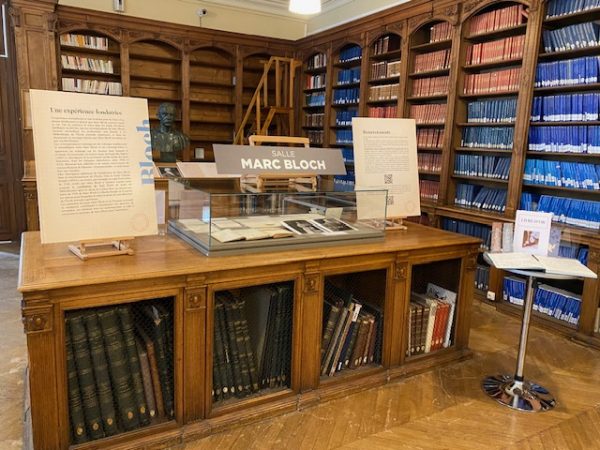
There are persons entering history and there is the science of history. Whereas the former persons may sometimes enter for very dubious reasons into history, responsible for killing people, the science of history draws on a whole lot of evidence, social, economic or demographic, to evaluate a person’s legacy or the merits of an epochal change. In the development of this scientific approach towards history, rather than a purely chronological, family structure or narrative-oriented approach, Marc Bloch has been a central figure. His research and exemplary own biography as student of history at the ENS in Paris, teacher and later Member of “La Résistance” is honored by an exhibition on his life and time at this formidable French institution of teacher training. In an exhibition in the ENS library you can even inspect a list of the books taken out by Marc Bloch as a student as well as his experiences as a student in London or Berlin before the 1st World War. A strictly science-based approach to history made him an influential historian and social scientist beyond his lifetime. (Image: Salle Marc Bloch at ENS Library Paris 2026-5) 

Post-sacred architecture

As with our human bodies, and in many instances already, sacred architecture follows a life course pattern. The thriving religious communities build and expand their faith to larger audiences. In these expansionary phases of the faith many monumental buildings, known as sacred architecture, as well as splendid interiors or artefacts enter the “built faith”. After the peak of membership and in periods of contraction, the question of how to scale down the splendors starts to arise.
Eventually, the ceding of the sacred architecture to the non-believing communities comes into consideration. The sacred architecture needs to find its place in the evolution of societies as well as urban and rural local space. Depending on the intentions and resources of communities, post-sacred architecture has to redefine its purpose for its own survival.
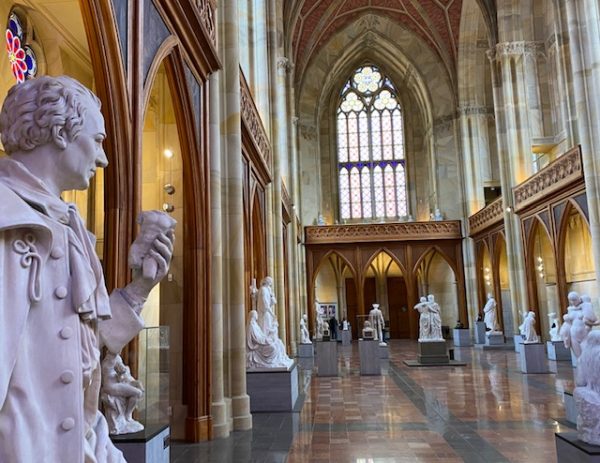
An interesting example of post-sacred architecture constitutes the “Friedrichswerdersche Kirche” in Berlin. The use as a historic exhibition space for sculptures of the 19th century works particularly well in combination with an active program on art, architecture and history. The statue by Ludwig Winckelmann (image below) depicts the reflection on and about a miniature sculpture in space. The post-sacred use of this fine and luminous architecture continues to reach an enlightened audience.