Given then Chosen

Family is first given and only later in life family becomes a matter of choice. This is a rather sequential perspective on family matters. A lot of ethnological as well as sociological research shows that the shadow of the given family can reach long into an individual’s later life. It is essential to be or become aware of the mutability of what constitutes a family. The ethnological variability across the globe of the norms and legislation that govern families is amazingly broad. The interference of religious beliefs and practices have always attempted to gain access to the nucleus of family life as an attempt to influence the “given part” of family.
It is a much more complex issue to understand and research the “chosen part” of partnership trajectories in a broader sense and from a life course perspective (Fasang et al. 2024). The social background and upbringing in a broad sense have a lasting impact on most people. However, there are enormous degrees of freedom to later on choose your friends, family or families. Societies across continents have chosen and invented particular rites of transitions between families and how to bridge networks. It is amazing that we tend to devote so little thought to this nucleus of our societies. 
Jobs First

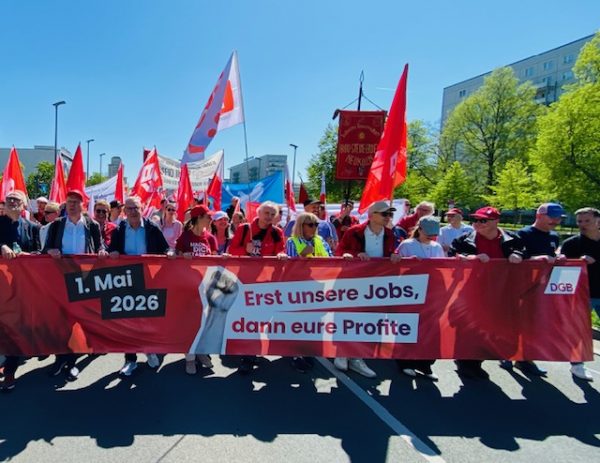
The Berlin demonstration of the 1st of May has chosen to put „Jobs First“. Jobs before profits is a widely accepted claim by trade unions to highlight the importance of work in our societies. Particularly in times of robots and AI taking jobs away, this motto is well chosen as a principal risk in 2026. The current technological innovations seem to aim primarily at the maximization of profits for companies rather than the benefits for society as a whole.  The Berlin parade on the 1st of May managed to achieve a great mobilization, which is a great success for the labor movement and a demonstration of power and solidarity when in many countries basic employment rights and even the 1st of May as a social tradition is attacked.

Mobile Web Search

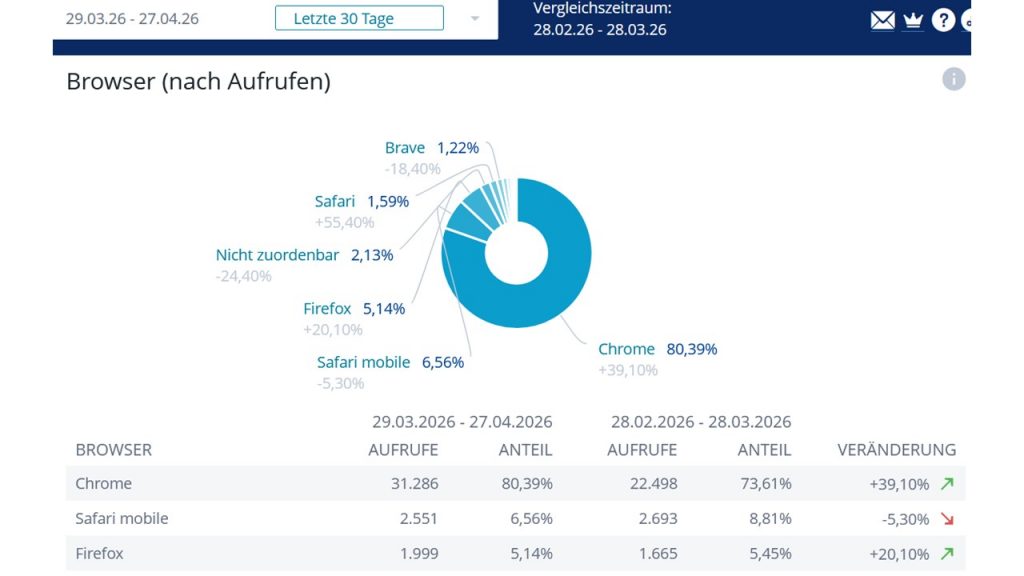
The smartphone is ruling the internet. This is probably a well-known wisdom in 2026. Just looking at the basic statistics of which browser people use to contact this webpage, it is evident that Chrome is vastly dominating search on the internet. Even the mobile version of Safari outnumbers the desktop browser access. Information gathering, viewing and reading have all moved from the desktop to the handheld smartphone, and maybe our glasses or wristwatches in the near future. For those still programming or designing webpages, the choice of “mobile access and functionality first” is an obvious choice for business, and even more so, for leisure purposes, like it or not.
Some parts of this evolution of search behavior are quite obvious, as we are more erring around cities like Paris, Berlin or Brussels than searching in front of our desktops or notebooks.

Learning through Confessions

In the original text of the Confessions by Saint Augustine there is an interesting testimony to his personal learning style. He hated learning Ancient Greek as child, apparently mainly due to the strict teaching style, which obliged him to learn Greek and punishment for being less interested as a child (Book 1 Chapter 13). However, he explains the predilection for Latin in language and grammar in later childhood and adolescence through the encouraging teaching style. Saint Augustine has reflected on his own learning style, put it in words in order to answer primarily to himself on what made him learn. The rhetoric style, which he applied rather consistently throughout his confessions, is build around the continuous questioning of his own past behavior and convictions. This is a kind of internalised conversation, which in the Greek tradition, was centered around dialogues with other persons as in the Socratic dialogues. The questions beyond the rhetoric style are also the beginning of a learning process even if the outcome might be open and in modern times a lot of new answers have been contributed through scientific methods and continuous discourse. Multilingualism was already a practice more than 2000 years ago for the young Augustine of Hippo.

Abduction of Europa

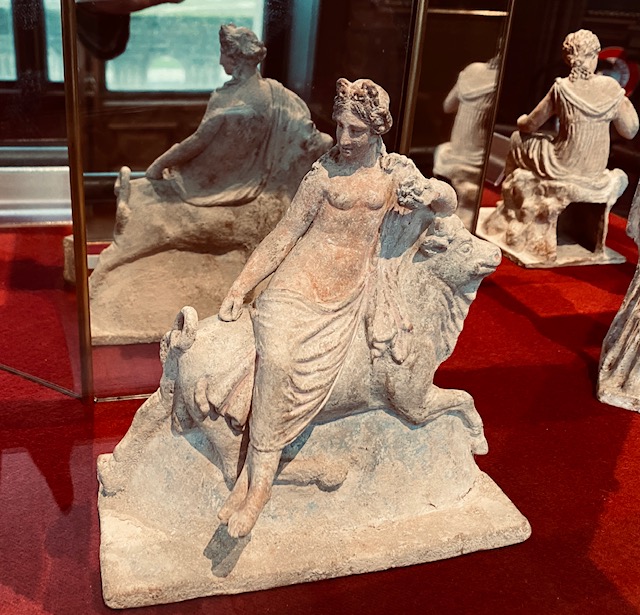
In reading Ovid’s metamorphoses we learn about all those mythical transformations of persons into animals (Jupiter into a bull) or persons into plants (Narcissus into a flower carrying his name). Maybe even today we have Europa being captured again by a bull or bulls that try to take away the freedom of movement and expression from her. The threats have multiplied, but the defensive forces of Europe have risen as well. The power of Europe might simply consist in the charming nature, which outlasts brutal force of the bulls, at least in the long run. A ride on the bull, however, can be tough at times and preparing for a tough ride should start as early as possible. Currently there are too many bulls around to feel safe otherwise. (Image: Europa sculpture on display at Chateau Chantilly). 

Critique of Maps

From a sociological perspective on maps we learn for example, that maps are also instruments to reflect property rights. This can be past claims of imperialism or recent claims of independence. A depiction as a map has historical and societal implications. Superposition of maps according to political, cultural or linguistic communities often reveal contested areas of domination and liberation movements. The specialized field of the history of maps can sharpen the senses for a critical view of maps in the 21st century. (Image:  Brankiza Zilovic, Nusquama 1984 exhibition “Cartes imaginaires’ BNF Paris).

Interests in failures

Decades or centuries after a successful or unsuccessful innovation, an evaluation of the reasons and circumstances of a temporary or permanent failure is informative. In the energy sector we observe another round of a power play in 2026. The more decentralized energy production and energy consumption models have been quickly put aside shortly after the oil crises of 1973 and 1979. The innovations using wind energy or solar energy of the 1980s have been discarded and were commonly considered as failures to provide cheap and reliable energy. An open international economy with expanding global markets for energy were perceived as a superior conventional solution. A country’s balance sheet of imports of energy and exports of higher value goods and services was the predominant economic rational and standard knowledge of the mainstream theory of trade. Other solutions, like a distributed “prosumer” model of energy might have ecological benefits, but would not show up in national GDP-statistics as a large part is home-produced energy and not accounted for in statistical measures of GDP, just like the home produced meals, health and care provided by mostly women. Societies, however, have a choice and an obligation to evaluate the interests in failures as economic and social development hinges on it in the medium to long run.

Master AI

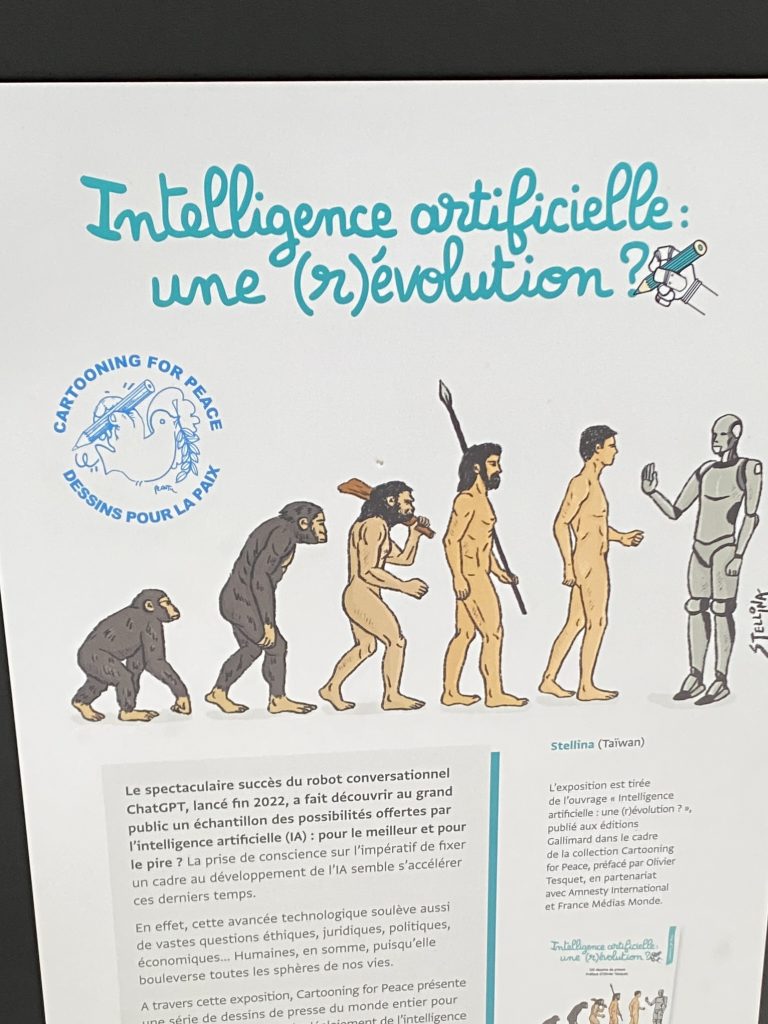
In 2025 the exhibition “Cartooning for Peace” at the BNF in Paris had already an exhibit authored by Stellina Chen from Taiwan, which summarized the evolution and projected the consequences of an all encompassing AI revolution (Image below taken at exhibition 2025 BNF). Currently we exercise ourselves in using various forms of AI or learn how to program them ourselves. It is our aim to master the new technology so it becomes a helpful tool. However, there are already many instances where it is no longer us mastering AI, but the AI has turned around the table and has started to master us. The applications of AI have entered our work tasks, tries and frequently succeeds in improvements of our routines and processes.
In private life a similar revolution is happening, when AI offers advice, which is hard not to follow and very convincing most of the time. Since getting involved in a conversion with AI tests your logic and debating competences, we find ourselves more and more in situations where AI is telling us what to do in the best of a convincing manner. After centuries of humanity to find freedom from oppression and the freedom to what we want ourselves, we seem to be ready to hand over control to AI. We are just like toddlers in this respect, willing or obliged to follow our master.

Antichambrer

In political circles it has been a common practice to “antichambrer”. It traditionally meant that topics are discussed in smaller circles before they are presented to the ruling royals or aristocrats. In modern democracies this role of more or less open “antichambre” (lobbying) is probably best translated as a form of consulting, which builds on personal contacts and small group discussions.
Scientists play a specific role in this political endeavor as they have to offer theories, hypotheses and evidence to support lines of argumentation to convince decision makers. Spin doctors, who know how to turn (around) an argument are, of course, present as well. All this represents the political, religious and business arena. All this happens in splendid locations that are part of the game of convincing, just as much as diplomacy.
The theater play “L’antichambre” by Jean-Claude Brisville, (produced by Alpha Théâtre in Paris 2026) sets the play in a historical 18th century scenario to unfold the intricacies of “antichambrer”, less in the political arena, but in view of the personal turbulence in may engender. (Image: Château Chantilly Antichambre)

Public or Publics

With the advent of the internet and even more so with the (not so) social media, we can observe that the public political arena has been differentiated into several distinct publics. This constitutes a working hypothesis in order to check whether there are necessary as well as sufficient evidence that there is a lack of exchange of opinions between the various publics. Technology is an intervening process which basically might be able to advance or hinder exchange between groups of society. Following the much debated theory of communicative action of Jürgen Habermas the existence of one public is a precondition of the theory. Empirical tests are needed more than ever.