Totalitarian Totality

In political science we study totalitarian regimes across history in order to better understand how the decline into authoritarian and then totalitarian regimes occurred. But it is not only a matter of historical interest. Authoritarian regimes can get worse, like the Nazi-terror demonstrated and it propagated and applied “total war”. Across the world it is necessary to keep monitoring the war like situations of hybrid war and whether we might have to face again totalitarian regimes entering into all encompassing terror and war. It is the people, no matter from which country, who will suffer the most. The installation by Monia Ben Hamouda in the art gallery ChertLuedde allows us to think beyond or what remains “After totality” (image below from 2026-3-24). Maybe the challenge to make people think beyond the totality is the only way to prevent it from happening or totality being repeated. The experience of the installation is impressive and encourages us to question every attempt of totality especially of totalitarian regimes. 

Urban rural voters

On Sunday 2026-3-22 local elections of the 2nd round took place in France and some parts and cities in Bavaria. The voters have in both instances confirmed the hypothesis that voters have very different preferences for political parties along the cleavage of urban versus rural voters. The sociological issue consists in the different socioeconomic as well as educational backgrounds of the populations. Across the 2 countries inner cities have environmental issues, safe transport and rents as major concerns. In rural areas a feeling of being disconnected and left behind is frequently the predominant concern, often in terms of lacking transportation infrastructure. Voters on the local level have a more direct connection to their elected politicians and scrutinize implementation as well as promises more closely. This is a much more complex issue for voters on the national level as more topics enter the equation. The political agenda, therefore, differs substantially for urban and rural voters. This is a tough challenge for the nationwide campaign teams to test the validity of their agenda locally as well. 

Democracy in Nepal

Nepal has witnessed a peaceful revolution in which the young generation of Nepalis has “out-smarted” the previous rulers of Nepal. With close to a 2/3 majority of seats in parliament (Nepali Times), the RSP as the party of a somehow charismatic musician and performer has a 5 year mandate to tackle the many challenges to bring real change for Nepali people. The hopes are running high that corruption will be contained and enough jobs inside Nepal can be created for the young. The positive sign, that many Nepalis migrant workers who had left the country now return to Nepal, encourages further support by international donors and investors.
Running a democratic election in a country that comprises the Himalayan mountainous region is confronted with a particular challenge to make every vote count as communication with remote areas takes additional time and effort. Campaigning through social media can be more effective only if even remote areas have reliable access to the internet. Inter-generational assistance is often a precondition of timely access to information. The Himalayan region experiences already the effects of global warming as melting of glaciers. It is the youngest generation that will have to confront the consequences. Time to take government in their own hands, and beyond a one man show. (Image: ESA Himalayan Mountains, ESA Standard Licence) 

Trust or not to trust

… that is the question. The social science research on trust, distrust or corruption is expanding rapidly. As in some other fields of research the increase in research itself becomes an issue of trust in science as the uncontrolled use of AI has produced an inflation of pseudo-scientific papers as well (Link). However, the finding by Spadaro et al. (2020) that interpersonal trust (trusting beliefs and behavior) is influenced by a general feeling of security as well as trust in institutions is supported by experimental and interview-based research.
There are still many challenges to the research in this field. The “feeling of security” has an overall component, but also several subcategories like the objective or subjective feeling of job security, which is dependent on national and collective systems of employment protection legislation. Economic security or security of a sufficient retirement income might be at times considered more important than (in-)security in cities or the countryside. Differences of the mechanisms by gender and age have to be studied in detail as well, which necessitates large data collections on the issues. Churches that used to be considered as trustworthy institutions or the police forces have been accused of abuses of the high trust placed in them in the last few years. These 2 examples demonstrate that trust itself is a dynamic issue with ups and downs over time, rarely constant over time. Game theoretical considerations add further to the view that trust might be used as a strategy just like economic power. (Image: Cathedrale de Meaux) 

National interest

Especially in times of international conflicts, it is customary that politicians refer to “the national interest” as a justification for their actions beyond the state borders, commonly named foreign policy. There is a huge literature on the subject, in which the concept of the national interest is useful, (1) because it suggests some higher ranking political goal, (2) because it clarifies and prioritizes a country’s goals, particularly at times of military interventions and (3) because it “arouses the support necessary to move towards a realization of the goals” (Rosenau 1968, Int. Encycl. p.34).
A critical assessment of this concept in international relations should start with the democratic perspective that a country’s government is subject to regular elections, whereby the goals a previous majority had put forward, might substantially change as a new majority takes the lead. Continuation of the same foreign policies is not excluded, but at least subject to revision. In authoritarian regimes the definition of the national interest is probably more stable, because authoritarian leadership does not hesitate to define the national interest in “splendid isolation” from its people.
Overall, the concept appears to serve mainly communication purposes, both internally as well as towards the outside as in communicable foreign policy goals. Conflicts between countries can thus be named and become subject to diplomacy and international treaties. But we have to fill this with substance over and over again as new topics arise like climate change and global warming.

External-Internal Threat

In a time perspective of at least since the German unification of 1990, we have to reconsider the perception of what constitutes an external versus an internal threat. Prior to the implosion of the Soviet Union and the Glasnost years, the external Russian threat has been transformed across the globe into more hybrid threats coming from internal forces which have been “instrumentalized” by external forces. In an essay by Valentine Faure (Le Monde 2026-2-21) this twist to internal politics has been described as a form of new forms of interference of external forces into European internal political, economic and social affairs. In fact the basic strategy is as old as the famous Trojan horse, but the strategy has been refined and to work over much longer time spans as well as in other scientific applications. Any form of powerful, interested party would rather use the soft power of persuasion than brutal force to reach political objectives. Corruption and buying votes, directly or indirectly, has become a legitimate way in this hybrid or open use of power from the inside of a society than through a more traditional external affairs strategy. The confrontation of the bipolar world made it easy to put emphasis on external military power. A multilateral as well as more multilayered international political arena precludes to some extent the bipolar confrontation as conflicts on several frontiers  increases risks exponentially. In search of other strategies it seems plausible to turn to hybrid as well as disguised external force. Europe and democratic systems in general are more vulnerable than autocratic states, because the belief in an open form of society is part of its DNA. Open societies shall have to sharpen their sensory systems to transformed external to internal threats.

Time horizons

There is an interesting stream of research in psychology that investigates the future time perspective of individuals. There is a considerable variation across the life span (Katana et al. 2020) where older persons report shorter time perspectives in such studies. At the same time we know that older persons think more about and how to transmit to following generations. Additionally, there exists a less well understood link between shifts in future time perspectives and overall societal, demographic and biological life expectancy. Taken together this allows to discuss  time horizons more generally on the level of social development. In political science it is customary to assume the future time perspectives of politicians to be the next election unless there is ineligibility after repeated terms in office. If politicians start talking about a time horizon of 1000 years like the Nazi-regime in Germany than the time horizon is likely to be abused as an excuse for atrocities in the present or near future. Beware! (Image: Exhibit in « Deutscher Dom » Berlin on NS-State, 2026).

Collaborative Leadership

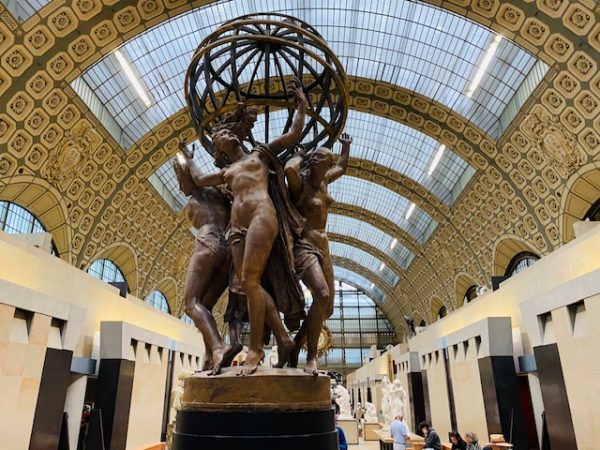
There are many reasons to praise collaborative leadership. Work climate, learning climate and innovation in teams and organizations benefit a lot. Absenteeism from the workplace is a proven and close correlate of hierarchical leadership styles. The theory and empirical evidence is rather clear in this respect, however the effective practice of collaboration among a leadership team is hard to sustain. Not only the ways to reach leadership positions is mostly rewarding tough elbows on the way to the top, the multiple rounds in the competition for top positions tend to train the toughest strategic  behavior. A return to more cooperation and collaboration appears to be a real challenge for persons that eventually arrive in top management positions in politics or business. Administrative science or organization science deserves much more attention especially if we are moving into the age of multilateral international institutions and multinational corporations and organizations. (Image: Les quatre parties du monde soutenant la sphère céleste, 1872, Musée d‘Orsay Paris).

Time in Leadership

We identified already the importance of monitoring in democracies. The same theoretical considerations hold for an analysis of leadership irrespective of the organizational context, be it a government, governmental organization, non-governmental organization, association or private enterprise. In democracies, it is in most cases a constitutional rule that leadership positions are limited in time and it is “best practice” to have clear rules about renewable terms of office as well.
In private enterprises this seems to be of lesser importance, but the issue deserves more close scrutiny, not only by shareholders in case of a shared ownership or stocks. A particular person in the leadership position might be a good match for a company at times of growth or scaling of a start-up, but the same leadership is less likely to be an equally good match for the period of eventual stagnation or shrinkage.
Therefore, as an alternative hypothesis it might be wise to adopt leadership rules similar to filling leadership positions with politicians. Fixed-term and 1 renewal could be worth testing at the leadership level (like in presidential republics, USA or France), even if this does not preclude close monitoring of leadership processes. As a starting point for empirical research, Vogel, Raes, Bruch (2022) offer a toolkit to assess organizational energy and leadership trajectories. Learning from democracies as well as democratic procedures might be a worthwhile leadership model to follow. (Image: ceiling painting in chateau  Vaux le Vicomte)

Regulation and bureaucracy

Economists will celebrate 55 years of the theory of regulation pioneered by George Stigler, which was published in 1971 in 2026. The basic question asked at the time and today is: why do we have regulation? The pubic choice and political economy answer of Stigler (1971) and many scholars after him, is that the industry of a specific sector will acquire the regulation or the public interest in this regulation and, subsequently, the industry will design and operate it to its benefits. At least, this is in a nutshell my summary of the literature inspired by Sam Peltzman (2021, p.20). If we add to this the perspectives of theories of bureaucracy (Sharma, 2020), we become skeptic of an efficient implementation of regulations by governments or governmental agencies.
In the field of pharmaceutical applications, it is the “European Diabetes Forum” which calls for a regulation on reliable “glucose monitoring devices” with industry and user backing. Of course, this asks for bureaucratic control of the regulation, imports and markets of such devices later on. The one (regulation) is rarely coming without the other (bureaucracy). It is about time to acknowledge this for societies as a whole as well.