
Ensor Home

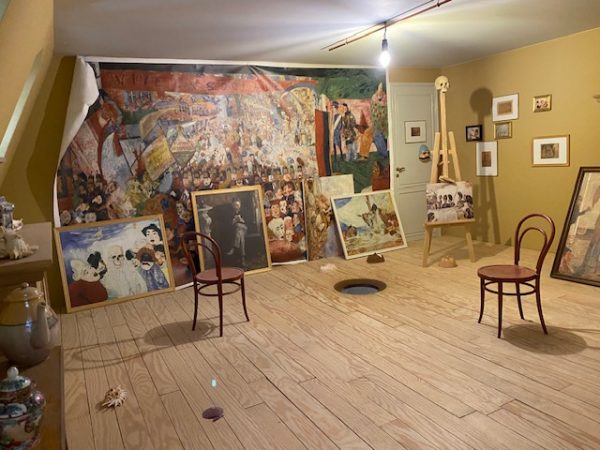
There are few artists who stayed in their home for almost all their life. James Ensor was a personality who was profoundly attached and continually attracted to his native city of Ostend. After a short and unsuccessful spell at the Brussels art academy, he returned to his parents’ home and due to a heritage from an uncle, he could live in a nearby house, which also served him as his atelier. Although I did not come across documents that showed he had traveled a lot, nowadays his art work is spread across the globe. The seaside resort of Ostend was a real tourist destination and, therefore, many famous people of the 1st half of the century passed by and met with Ensor there. Not only fellow artists, but also scientists like Albert Einstein. Critical minds and people searching beyond the trodden paths must have been attracted to him, a personality who dared to challenge conventional painting and techniques of his time. A reconstruction of his atelier and several animations give a lively modern touch to his work and living style. My take home message from the Ensor Home: The search for inspiration might be just around the corner. 
Considerations about Space

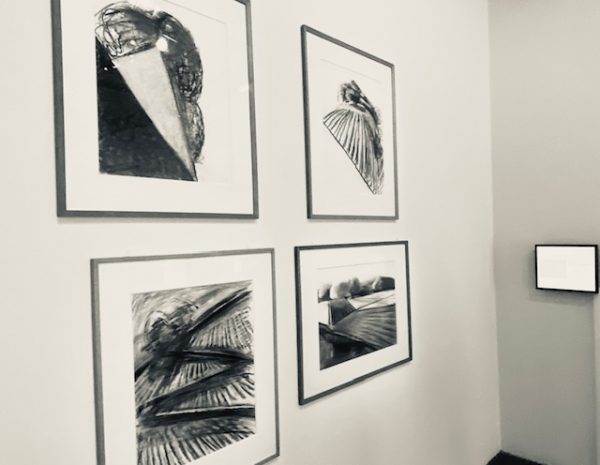
As is true for most architects, for example Le Corbusier, they are mostly remembered for their actual realizations (Scharoun, Mies van der Rohe), rather than the grand designs prepared for an architecture competition. Henri Gaudin has not only left concrete implementations of his ideas, but also several books on his perception and ideas about “concepts of space” (“Considérations  sur l’espace”), which comprises architectural ideas about “empty spaces“. Additional sources of inspiration were a relentless pursuit of drawing and designing what he saw, for example while travelling.  The BNF has received the extraordinary donation of the journals of Henri Gaudin, which allow to trace his continuous search for innovative representations of what creates a space, the impression of space and the relationship between spaces.
His travels with the TGV in France filled a complete “carnet” (booklet). Architecture is surely not about concrete. In the best cases there is a lot of research happening “backstage”, sometimes in small spontaneous sketches that can have a very lasting impact on many people’s perception of space later on. His own landscape drawings were an interesting inspiration for his architectural work as well. “Image: Landscape drawings by Henri Gaudin, BNF Paris 2026-6, Galérie des Donateurs).

Zadkine Prax

Ossip Zadkine and Valentine Prax once had their atelier next door to each other at art school. This established a lasting link between the 2. Whereas Zadkine became best known for his sculptures, Prax became famous as a painter. It appears that influences from one to the other are present in the works and several sculptures or preparations for sculptures were collected by Prax and found their way into the permanent exhibition of the museum. Intertwined biographies of artists are an inspiring reminder that art is not created only within a single mind, but many references or inspirations come from joint conversations or just working next to each other for some time. The social part of creating art is visible in this exceptional exhibition. Valentine Prax is honored with a presence in the Zadkine museum as well.

Image: Valentine Prax

Margot Friedländer memorial

Berlin has been honored by the return of Margot Friedländer who had survived the Shoa in 2010 at the age of 88. Her whole family was murdered in concentration camps by the Nazis. Ever since her return and especially after her biography had been published she was a restless ambassador in the fight against hate, exclusion and the neo-fascist movements. She has been engaged in interreligious dialogue and even through the ceremony after her death, she tried to bring together different Jewish communities in Berlin.
Irrespective of a person’s background she met everybody on an equal level.
A great example to thousands of people, she managed to meet in her life. Each time she met with pupils or students to speak about her horrific experiences she lived through the same traumatic experiences again and again, but turning this into the strength to “vaccinate” people against the deadly virus of fascism.
The day after she had been buried in her family’s grave in Berlin Weißensee people still had to queue to sign the book in her memory in the Berlin town hall. She will be remembered and missed for her unrivalled humanity and generosity. She became engaged to fight for humanity and remained an activist until her very last day at 103 years of age.

Marx Home

The home of an influential philosopher, economist and political scientist is not easily presented like a home of a musician, a composer or an author. However, the home of Karl Marx in Trier on the Moselle river succeeds to present the biographical links of growing up in a historic city, the bourgeois upbringing of the young Marx and his formation as an independent and even revolutionary thinker of the economy and society. In 2025 the home is a museum supported by the Friedrich Ebert Foudation with a great online guide and access to additional scientific material. For authors like Karl Marx it is always of interest to follow not only the origin and evolution of the thought process, but also the shifts in the reception of his writings by subsequent generations. This part of the exhibition and an audio guide (downloadable as App).

In 2025 with an apparently ruthless capitalism at work in the biggest economy of the globe, the reminder that the economy is best to be understood as a political economy, which focuses on self-interest and profitable business deals, we find in Karl Marx still a worthwhile reminder of economic development even in the 21st century. The note-taking and studies in Exile in London are well documented in the tiny home and museum. Studying the misery of exploitation in supply chains and international commerce remains a topic of continuing interest as well. 

Tchaikovsky home

During the time before the “Zeitenwende” it was easy to visit the home of the composer Pyotr Ilyich Tchaikovsky in St. Petersburg. Therefore, we refer to our memory of the visit and the already 10 years ago restrained liking and appreciation of the Russian officials for the aristocratic composer, even accused to not be sufficiently Russian in his music compared other Russian composers. The composer had diverse love affairs, which were also not conform to official doctrines. The world wide success of his compositions, mostly known for his ballet music, remains popular in the 21st century. Similar to Beethoven, the biography by Malte Korff (Tschaikowsky, in German), highlights the final symphony as his masterpiece. The seems to be a reason to study “the last works” of composers specifically. The mature compositions appear to reflect on previous work and build or comment on previous work. The 6. symphony “Pathétique” was completed in his last year of his life, only at age 53. The final IV-th piece of it is entitled “Adagio lamentoso” and ends in very calm tempo and almost silence like a withering away heart beat. To my surprise I found a similarly very quiet ending in one of his early piano composition when he was only 28 years old “Romance Opus 5, Andante cantabile”. This early piece also ended “più lento” and from pp to ppp. (compare extract of image of notes below).

Beethoven Home

The home of Beethoven in Bonn is nicely preserved and full of objects related to his life and his creative work. For the musician and composer musical instruments have accompanied him throughout his life. The visit of his home of birth offers a chance to dive into the extraordinary accomplishments of this great figure of the late 18th and early 19th century. His 9th symphony is strong as ever and the European anthem has just more than 200 years since the first performance now. The visit of the museum is still the highlight of Bonn and the App of the Beethoven House offers unique insights into and listening of his manifold compositions. Handwritten notes and a pocketbook of preparations for the symphony demonstrate the all encompassing nature of music for Beethoven. From romantic letters to the romantic music pieces, the museum has it all. Even it is a rather tiny house from the outside the inner life is as huge as it can be. It is advisable to take at least half a day for the visit much more than you would usually take for visit of a museum. The link between the biographical information and listening to linked musical pieces with a chronological context are a unique experience. This spurs the interest to listen or listen again to some of the romantic masterpieces. The App is great also to listen directly to some of the music.

Politician Cycles

In a bookstore which sells books in English or American language we find lots of biographies or autobiographies of politicians. As a politician you don’t even have to be out of politics when your biographical account or your own view is published, let alone be written. Publishers seem to hunt politicians who made headlines, no matter good or bad. Outside the EU you can always sell biographies at half price, if the volumes sit for too long on the precious shelves of bookstores. Most of the biographies are found in the history section of shops or libraries, however some show off in sections like politics (if not dead for too long) or in the business and management sections. Leadership is a big issue in the latter disciplines, but the psychological or sociological literature starts to meddle with the received wisdom of how single person leadership is in fact facilitated with the many great people around the sometimes outstanding single person. Maybe the focus on a single person is an easily understood and simplifying concept of leadership. In the case of Obama (2x) two single historical accounts complement the one person focus. In 2025 Michelle Obama skipped the funeral of Jimmy Carter where she would have had to sit next to Donald Trump (according to the Daily Telegraph and probably endure small talk). Politics appears to move in circles and politicians might find themselves encircled.

Nazi Reinterpretations

Even almost 80 years after the end of Nazi terror and the 2nd World War started by Germany, we witness attempts to reinterpret the lives and careers of many Nazi officials. In the same realm, the crimes committed to pull out „Stolpersteine“ try to negate the horrible crimes committed by the Nazi leadership and their followers. The special exhibition at „Topography of Terror“ on „Reinhard Heydrich. Career and Violence” allows to study the biography of this high ranking and convinced Nazi official. After the usual career trajectory of a marine soldier he entered the Nazi secret police and made his career moving up the ranks showing readiness to use above average violence. This seems to have been a precondition to qualify for fast career trajectories. These personality traits have been demonstrated for thousands of Nazi officials in their professional life. This exhibition has additional merits to provide shocking evidence that the wife of Heydrich even many years after the end of the Nazi terror and 2nd WW does not show any signs of regret for what were her husband’s crimes against humanity. They had a splendid life and lived in a palace near Prag before her husband died after an attack by partisans. This is a great lesson to sharpen our awareness of those trying to reinterpret the lives of Nazi leaders and many of their followers. It is a timely reminder to not focus on rosy pictures of the Nazi time without the acknowledgment of the responsibility for millions of people who died. (Image: Extract of exhibition on Heydrich, Topography of Terror, Berlin 2024, book publication).

Schostakowitsch Revival

Je mehr Putin sich unablässig in seinem Angriffskrieg gegen die Ukraine und gegen seine eigenen Leute versteift, umso mehr werden die musikalischen Werke von Dmitri Schostakowitsch aktuell. Schostakowitsch hatte viel unter Stalin zu leiden. Sein Werk konnte kaum Gefallen bei der stalinistischen Führung finden, aber dennoch haben voele der Russen seine Werke geliebt. Insbesondere die sogenannte „Leningrader“ Symphonie, die das Volk einte vor den Radioempfängern, selbst mitten im Krieg gegen Nazi-Deutschland. Die Berliner Symphoniker haben diesem Werk eine neuere Ehre erwiesen mit einer Aufführung in Berlin 2024-5. Das Interview dazu mit dem Dirigenten Yannick Nézet-Séguin wurde geführt von Matthew Hunter, Bratschist der Berliner Philharmoniker. Es beschreibt diese eindrückliche Auswahl hervorragend. Die Berliner Philharmoniker haben eine lange Tradition, Werke von Schostakowitsch aufzuführen und einzuspielen. Die Digital Concerthall hat eine umfangreiche Sammlung mit Werken von Schostakowitsch. Oftmals etwas schwere Kost, aber durch das Ausspielen des ganzen dynamischen Spektrums von pp bis ff nie langweilig. Eine kleine Filmmusik „Volksfest“ (Sylvesterkonzert 2022) ist leicht beschwingt oder gar etwas beschwipst. Der musikalische Nachwuchs hat die Tiefe der Werke erkannt und gewinnt international anerkannte Preise mit Vorträgen von Werken Schostakowitschs. So geschehen zum Beispiel beim „Concours de la Reine Elisabeth in Brüssel 2024-5. Der Ukrainer Dmytro Udovychenko würdigte Schostakowitschs Leben und Werk inklusive des Existenzkampfes und gleichzeitig seine Heimat die Ukraine mit dem Belgischen Nationalorchester mitten in Europa. 

Example Audio Playlist on Spotify or Videos on DCH