Dream Peace

To dream about peace is as old as humanity. However, the people who work on the development of weapons and train to use them vastly outnumbers those who think or dream up peace. The strategies and advice about warfare ranging from Aurel to Clausewitz have been studied carefully and the short-cut summary “if you want peace, prepare for war” sounds like a plausible solution to many problematic war-like situations (hybrid wars) even today. Let’s give it a try and dream up peace. There exits already an extensive literature on peace-keeping (forces) an the difficult role of the UN in these efforts. How about a challenge to this conventional wisdom. Voting in the UN should be weighted. The weights are inverse-proportional to a country’s amount of production and trade in arms measured over the last 10, 50, 100, 251 or 2501 years. The probability to favour peace in such a reformed voting system of the UN would shift further peace rather than arms trade and use of weapons in conflict. Of course, a crucial point is the definition of what is a weapon. Hybrid war and dual-use technologies could undermine the new balance of power at the UN. If countries with no arms production and arms trade get the upper hand at the UN decision-making, the peace-keeping force could still be mandated and delegated to joint forces. This could work as a disincentive for Trump to try to sell arms and enter into large-scale arms trade between the US and China. (Image: Ikarus-by-Picasso-at-UNESCO-headquarters-2024-Paris).


Ikarus-by-Picasso-at-UNESCO-headquarters-2024-Paris.jpeg

Autonomous drones

The weapon industry is shifting rapidly. Beyond slow moving tanks, modern warfare has adopted and applies autonomous drones in the battlefield. On the title page of the NYT of 2026-8-26 we learn about a Russian autonomous drone with US hardware technology (Nvidia Jetson Orin microPC) to kill 3 civilians without them being really the target. These drones are trained to select their target autonomously without a human in control. It is the pre-trained machine which decides on the target and whether to “take-out” the target. Disguised objects may survive for longer. People disguised as useless objects have a higher probability to escape detection if you do not fit into the drone’s visual identification. Autonomy based on artificial intelligence has its limits too. Military intelligence will continue to rely a lot on human intelligence to protect us from the realities of autonomous drones.  

Hiding from drone attack at BNF Paris 2026-8

War of drones

The fiction of a war of drones has been imagined, somehow, 500 years ago by Lucas Cranach. His altarpiece of the last judgment (1525) shows on the upper left corner flying little monsters that threaten humans on earth. The danger came from above and followed predefined judgments. The kind of weapon and threat were not so much different from today, but the portrayal of the person in command has changed. For the thousands of victims due to Putin’s war in Ukraine the modern scenario does not change that much. (Image: Cranach extract 1525 Gemäldegalerie Berlin)

Cranach extract 1525 Gemäldegalerie Berlin

Future Conflicts

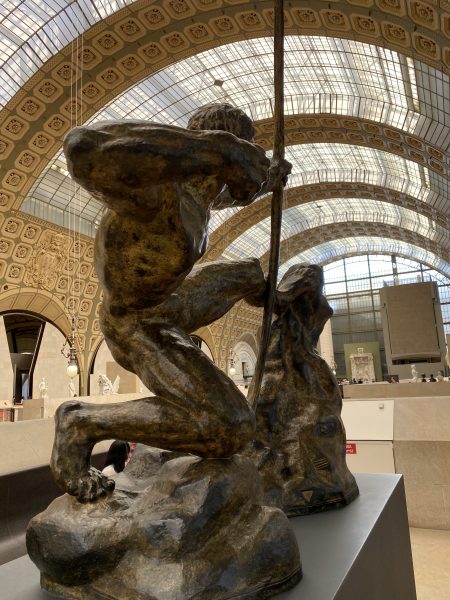
Since 2014-2-27 Russia has occupied the Crimean peninsula. This invasion had started with an undercover mission of unmarked soldiers to take full control of Crimea about 3 weeks later. Russia did not officially declare a war, although the intentions were identical to a land grabbing war. The western world did not react much to this violation of international law. Apparently, this contributed to the next cynical “special operation” by the Russian army to fully invade Ukraine on 2022-2-24 in a failed “Blitzkrieg”, a rapid invasion, which attempted and failed to annex the whole of Ukraine. According to Lissner & Warden (2026) the Russian invasion of Ukraine bears 4 lessons for future conflicts: (1) the risk of using nuclear weapons is real, (2) in addition to nuclear options, prolonged and very destructive conventional wars remain an option, (3) escalation thresholds emerge and evolve over the duration of the conflict, (4) allies and partners in war keep adjusting their risk tolerance as well as escalation options. The authors argue from a US perspective and add a practical comment: “The USA cannot go this alone, but should coordinate closely with allies and partners in time before another conflict arises. Multilateralism seems a valid option and even more so as we move into a multipolar power play on the global scale propelled by AI.
(Image: Musée Orsay, Paris – Archer, Bogenspannende)

Peace and war again

“If you want peace, prepare for war”. This is one of the famous citations from Vegetius an early Roman general. For centuries we have been aware that peace and war are not opposites in a broader sense. Preparation for war can resemble war, if a country’s economy is already heavily turning towards production of weapons and intensifies research in dual use technologies. Political terminologies that shift to a vocabulary using more belligerent language may also be interpreted as a early signs of a shift in balance between peace and and early warnings on war. 4 years of the war of Russia on Ukraine territory have left traces in our vocabulary as well as budgets devoted to the preparation of a defense in Europe.
More countries of the EU state openly what is in their “national interest”, as if they were ready to go to war (Charap & Haukkala 2026) to in case major elements of the national interest were endangered. In going back to Clausewitz’s writing, a long historical line can be drawn from the Crimean War(s) to Putin’s imperialist war of 2014 and 2022 trying to capture Ukrainian territory, irrespective of enormous human losses.
Another lesson from these historical events might be: Let’s not forget to prepare for peace during the hot conflict.

Weaponized Interdependence

The shift in the international political system is clearly expressed in the contribution by Henry Farrell and Abraham Newman in “Foreign Affairs” (2025 (Nr. 5) p.25). “… governments must navigate a terrain with many more players, figuring out how to redirect private-sector supply chains in directions that do not hurt themselves while anticipating the responses of a multitude of governmental and nongovernmental actors.”
As the number of bigger global players increases, the complexity to identify best strategies increases as well. Going it alone is only second best to coordinated actions. New matches of interests may result in the medium term. This could entail enormous long term realignments.
Russia attempted to play the China, and subsequently the India, card to achieve new strategic partnerships in this multipolar world. Other international players test new forms of alliances and strategies (like hybrid wars) in this period of weaponized interdependence as well.
The weaponization of such interdependencies puts critical limits to the basic economic rationale and a world building on comparative advantages together with trade, rather than going it all alone or try the coercive way of exploiting dependencies of mineral resources, supply chains, computing power and AI.
(Image: Chess figures attributed to Charlemagne, dating from 1080-1100 ” BNF Galerie Mazarin 2025-10)

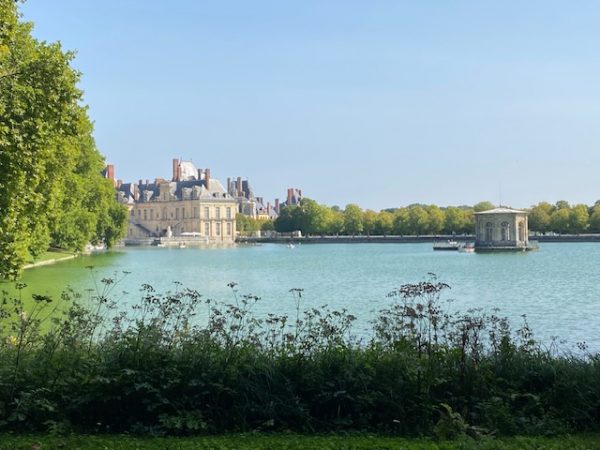
Fontainebleau garden

The garden of Fontainebleau is huge. The design by “Le Notre” is splendid in its combination of trees, greens and water reserves. Beyond walking in the park you may enjoy a horse ride ora  tour in a carriage, some even today. Boating is an additional amenity rarely available at other castles. In the Belvedere in the middle of the water basin romantic or secretive diplomatic conversations might take place. Politics and diplomacy have always needed special locations to prepare decisions. This is a historical constant. 

Preventive War

The term “Preventive War” is staging a revival in international politics. The recall of the famous quote “war is the continuation of politics with other means” from Clausewitz encompasses the idea of a pre-emptive strike and entering into war to avoid an enemy to grow too powerful at a later stage. In the age of weapons of mass destruction and the non-proliferation of nuclear weapons, an intervention to limit the spread of nuclear weapons has taken the form of a preventive war. The international community has been quite unsuccessful to limit the spread of nuclear weapons so far. Research shows that democracies are less likely to go to war than authoritarian regimes and dictatorships.
The preventive war strategy (Levy, 2008), however, is a means for democracies to defend their survival against the spreading and warmongering of authoritarian regimes. However, preventive war, by definition, is a war. The preventive aspects derives from the logic to avoid a much more devastating later war. There is a longitudinal assessment at the base of the calculation to enter now into a preventive war, rather than later into a more difficult defence. In anticipation of the defense, a pre-emptive strike is undertaken. In international politics the lack of a “policing of treaties and international agreements” has initiated the return of the neoclassical concept of national interest as a guiding principle for nation states. A continued threat to the survival of a state, Israel as an example, by the Iranian dictatorship makes the application of a preventive war strategy more likely.
Historically, democracies have applied such military strategies as a continuation of politics and diplomacy with other means. In this sense the 21st century is apparently no different from previous centuries. The revival of “Realpolitik” has been spurred by Putin and his war on Ukraine territory since 2014. How and when to return to the negotiation table is the litmus test of the preventive war strategy.
(Image: Paris, Hotel de la Marine, Le salon diplomatique 2025).

Ballistic Missiles

Ballistic missiles have been studied as part of physics for centuries. The basic mechanics in gravitational fields like on earth are well known. Longer reach intercontinental ballistic missiles (ICBM) have been built by several countries for defensive or offensive purposes. China had demonstrated to master the science and technology of rockets since its latest launch of a ICBM in 1980. In 2024-9 China has demonstrated again, it is still capable to launch such missiles with long distance range (Japan Times 2024-9-25). This is both a technological task, but much more a geopolitical issue as a reminder to be taken seriously on the international political arena currently. Technological capabilities and capacities have regained geopolitical strategic importance as attempts to shift the global balance of power, which is undergoing multiple challenges or even changes. Flagging technological options is not only important to demonstrate own military strength, but to present a country as a potential strategic partner of global reach. Window dressing using weapons is much more oriented towards other countries (buyers of weapons mainly) than of relevance for Chinese society. Strategic alliances seek strategic partners. China is likely to receive more attention in the 21st century than before.
(Image: extrait de Gustave Courbet: La vague, 1870, Berlin SPK)

AI Defence

For those following the development in robotics we have been astonished by the progress of, for example, rescue robots. After an earthquake such robots could enter a building that is about to collapse and search the rooms for survivors. A recent article in “Foreign Affairs” by Michèle A. Flournoy has started its thinking about the use of AI in the military with a similar 20 year old example. A small drone flying through a building and inspecting the dangers of entering for persons or soldiers. Since then technology has advanced and the use of AI for automatic detection of dangers and “neutralising” it, is no longer science fiction. The wars of today are a testing ground for AI enhanced military strategies. It is about time that social scientists get involved as well.
Warfare left to robots and AI is unlikely to respect human values unless we implement such thoughts right from the be beginning into the new technology. An advanced comprehension of what algorithms do and what data they are trained on are crucial elements to watch out for. According to Flourney, AI will assist in planning as well as logistics of the military. Additionally, AI will allow a “better understanding of what its potential adversaries might be thinking”. Checking through hours of surveillance videos is also likely to be taken over by AI as the time consuming nature of the task binds a lot of staff, that may be put to work on other tasks. Training of people and the armed forces become a crucial part of any AI strategy. The chances to develop a “responsible AI” are high in the free world that cherishes human rights and democratic values. Raising curiosity about AI and an awareness of the dangers are two sides of the same coin or bullet. Both need to grow together.
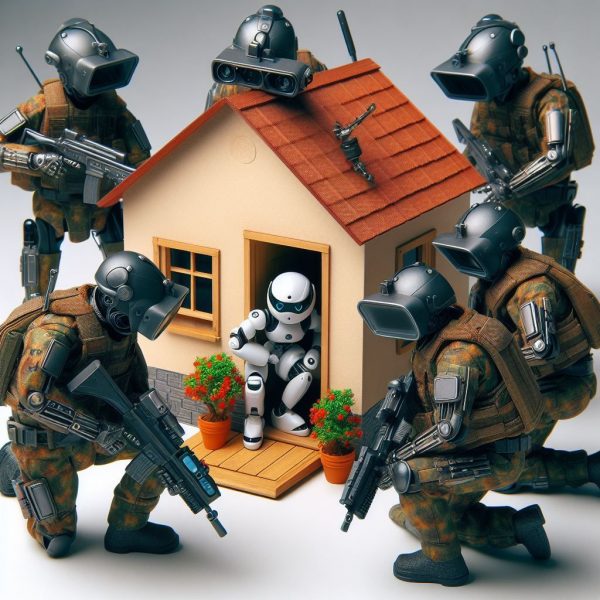
(Image created by Dall-E Copilot Prompt: “5 Robots disguised as soldiers with dash cams on helmet encircle a small house where another robot is hiding” on 2024-4-23)