
Czechia coast

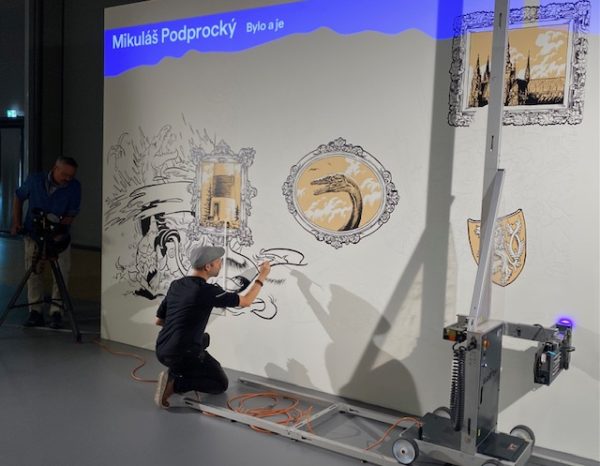
At the Frankfurt book fair we dream ourselves into the imagery of Czechia as a country with beaches and sand castles. The country pavilion of the partnerland of #fbm26 takes us to the ephemeral aspects of literature. While reading we deep dive into uncharted territories and discover unknown landscapes, sometimes even fees. These worlds of imagination become part of us or enlighten sequences of our life course. Taking the perspective of an external viewer widens cognitive and emotional predispositions. There are remarkable ol and new light houses to discover, too. Drawing as performative art, washed away every day like dreams, acknowledges the ephemeral nature of our reading or listening experiences. This message is going to stick with us. 
Paris Room with a view

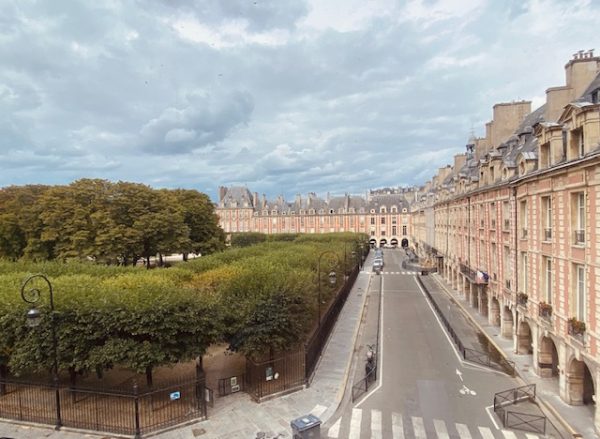
The home of Victor Hugo in Paris offers a splendid view of the Place des Vosges. The image taken from the 1st floor of the building and his living room allows to see a bit like what Hugo saw every day for some time. A small park, probably a lively street with arcades full of shops and people. Lots of inspiration and observation which may come from actual life. The actual time of writing, however, needs also retreat from the busy daily surroundings to focus one’s mind. All this hasn’t changed since Hugo lived in Paris at this address. Writer in residence programs of today allow authors to focus on their work beyond daily tasks. Cultural advances heavily rely on such programs nowadays to be able to have at least temporarily “A room with a view”. 

Hugo home Paris room view through window

Abduction of Europa

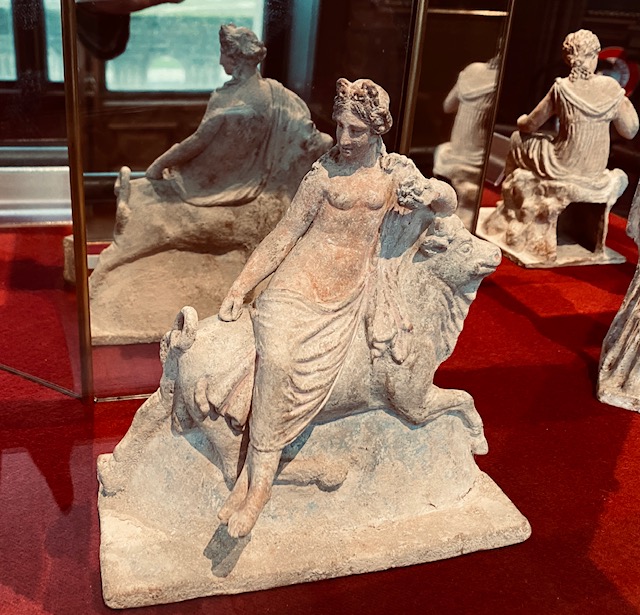
In reading Ovid’s metamorphoses we learn about all those mythical transformations of persons into animals (Jupiter into a bull) or persons into plants (Narcissus into a flower carrying his name). Maybe even today we have Europa being captured again by a bull or bulls that try to take away the freedom of movement and expression from her. The threats have multiplied, but the defensive forces of Europe have risen as well. The power of Europe might simply consist in the charming nature, which outlasts brutal force of the bulls, at least in the long run. A ride on the bull, however, can be tough at times and preparing for a tough ride should start as early as possible. Currently there are too many bulls around to feel safe otherwise. (Image: Europa sculpture on display at Chateau Chantilly). 

Critique of Maps

From a sociological perspective on maps we learn for example, that maps are also instruments to reflect property rights. This can be past claims of imperialism or recent claims of independence. A depiction as a map has historical and societal implications. Superposition of maps according to political, cultural or linguistic communities often reveal contested areas of domination and liberation movements. The specialized field of the history of maps can sharpen the senses for a critical view of maps in the 21st century. (Image:  Brankiza Zilovic, Nusquama 1984 exhibition “Cartes imaginaires’ BNF Paris).

Fact and Fiction on Maps

As a matter of fact, for centuries maps have played in both registers, fact and faction. In geography we expect maps to represent geographical facts, and yet based on a historical perspective on the subject, we realize that early cartographers had to brush over, at their time unknown, territories. What did many of them do? They imagined what could be the case.
In the early days of “creating a map” the artists had to rely on some sort of fiction or were intentionally creating a fictive image of the unknown world. Out of this “science and fiction” approach, a whole discipline of literature has evolved, science-fiction. The imagery of Manga-mania in the 2020s owes a lot to this drawing and mapping of fiction in form of stories.
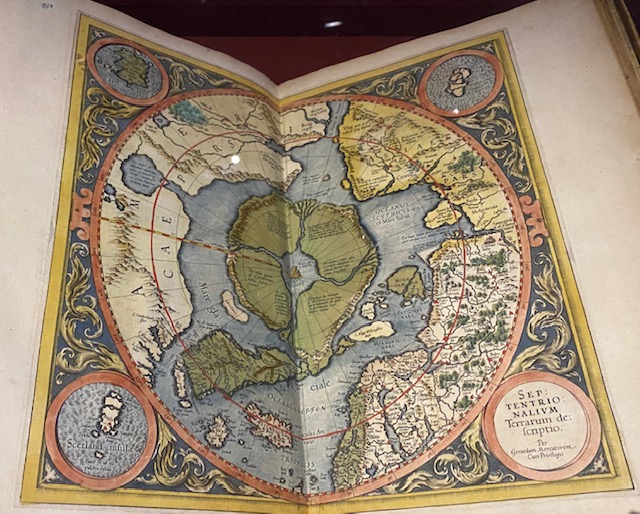
Maps tell lots of stories. They are powerful in their neurological function, similar to mind maps that are a tool to structure our thoughts or story lines. The gesture to point at an area on a map of the Arctic, Greenland for example, can send shivers across the globe. Maps make stories and stories may lead (eventually) to shifts of attribution on maps. In the same vein: the mapping of power also reflects the power of maps, be they based on facts or fiction.
(Image: Exhibition: Cartes imaginaires, BNF Paris 2026-4-8, Gerardus Mercator, Map of North Pole 1595)

Paper and Scissors

In order to produce art it is not always necessary to have expensive materials at your disposal. Henri Matisse has demonstrated that paper and scissors can go a long way. With this in mind, the work by Johanna Beckmann, shown in the upper hall of the “Kulturforum” in Berlin, is quite astonishing. Beckmann relied on just paper and scissors, in addition to her paper and pencil work, to illustrate her own texts as well as collections of fairy tales. Her paper cuts of some hobbit stories might be remembered by a whole generation of children and even some of today’s world. Paper cuts and theatre based on such figures have been a cross-cultural treasure. The illustration of stories, but also the creation of own characters might be derived from such cuts using just paper and scissors. The “Kunstbibliothek” and the “Lette-Verein”-academy in Berlin joined forces for this exhibition and they both continue to transmit this creative craft to students actively involved in this “intergenerational exhibition”. Please bring your (grand 😉 children.
All those who travelled to Paris recently will be well aware that at “Montmartre” you can still have your profile cut these days. At this exhibition there is a “do-it-yourself” section, not only reserved to children.

Xmas as information sharing

In modern theories and tests of the importance of information sharing, social learning in groups and the spreading of information in social networks are known to be powerful mechanisms. Hierarchies and survival might be at issue. In the animal model based on mice it the scent that is the byte of information. For humans thinking of information or narratives are probably more appropriate. The story of Xmas has been spread rapidly and the kings arriving to bring presents testify to this powerful mechanism of information sharing in social networks even before the so-called social media existed. Ever since, written accounts of the story were added in addition to regular meetings of persons who continued to share the story. Add music and theatre to the transmission of the story and the mechanism reaches even broader audiences, and maybe devoted believers. As behavioral flexibility might increase as well, more than one interpretation or ritual of the same narrative is likely to arise over time. In the animal model food is the major reward system. For humans the reward systems are more complex with forms of delayed gratification. Information sharing about the importance of delayed gratification takes us into new spheres of humanity versus rational choice. (M-P Brussels). 

Good or bad

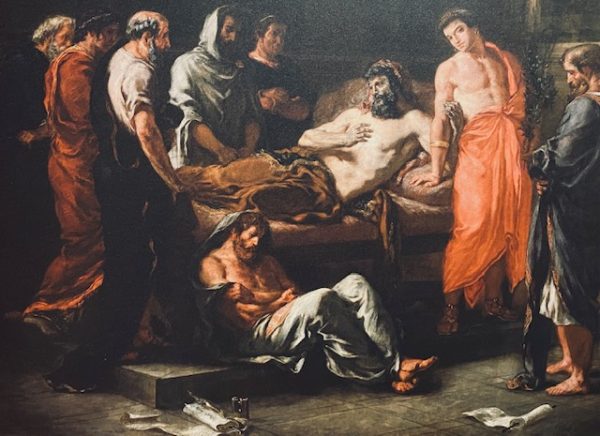
We have been taught by Shakespeare “to be or not to be, that is the question”. In political science we have pondered the question in a slightly augmented form. “to be good or bad, that is our question”. The basic image of women and men in society has been a subject throughout the history of ideas. For those who believe in the good nature of mankind, they tend to find reasons to believe that eventually mankind will find a way towards a peaceful cohabitation on our planet (there is no planet B yet for humans). On the other hand, each outbreak of violence and war are considered as a confirmation that mankind will always recur to some form of violence, even after extensive periods of peaceful cohabitation. According to the evidence presented by Meller, Michel, van Schaik, referring back to Kant, trade between people and nations is likely to prevent more violent relationships (p. 330). One of the major conclusions over the long term view of mankind is, that the periods of war have been far shorter and more rare than a focus on the last 3000 years seems to suggest. Maybe, “to be good or bad” is just a question of demographics of being too many at the same time in the same place.  Population growth and population density might be a powerful driver of “being good or bad”.  (Image: Delacroix, Last words of Marc Aurel)

Headless Saint Dionysius

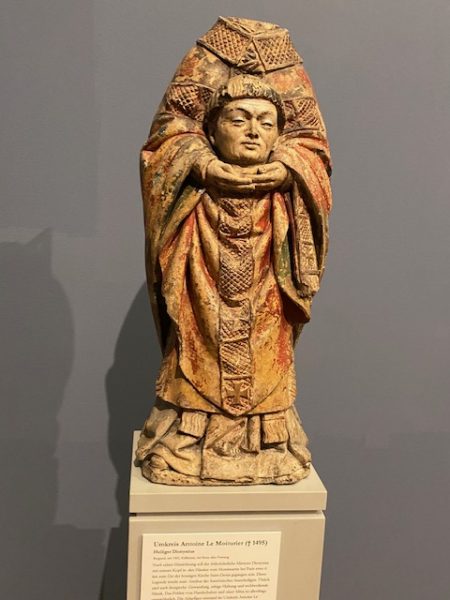
Denis of Paris stands for the Saint Dionysius, who is reported to have walked after being decapitated as martyr for his christian beliefs by the Romans in the 3rd century, all the way from Paris to St Denis in the suburb of Paris. We do not only find such a statue at Notre Dame in Paris, but also a medieval version in the Bode museum in Berlin. The cathedral of St Denis in Paris became subsequently the place for the coronation and burial of many French kings. The last king who lost his head through the guillotines was Louis XVI. It took almost another 200 years to abolish capital punishment altogether in France. Robert Badinter devoted his career to fight for this appeacement within the nation. (Image: Statue St Denis in Bode museum Berlin).  

Cut it short

The “Revue des sciences humaines” (Demanze and Gleizes, Nr. 355, 2024 pp. 7-16) provides an interesting reflection on the widespread practice to find (new) ways to cut long stories or insights short. Short by itself, this introduction to a longer special issue on the topic “Faire court” stresses 4 elements of the contemporary impetus to cut it short:
(1) The creative process may be subject to condensation of content, similar to the process of a “reduction” in the culinary vocabulary. The speed of creativity, inspiration, freedom of expression are exemplified by the twitterization of and aphorisms in literature. Roland Barthes, in his analysis of the “haiku”, raises awareness to the different associations of the short text forms in different societies.
(2) The observed shortening of time spans of attention and the competition and economy of attention have raised the stakes for longer formats and explain to a large extent the success of shorts in the digital age.
(3) The short format works to increase the intensity of the literary experience.
(4) In deconstructing the associations of long formats as “monumental” versus short formats as ephemeral, the “cut it short“ tendency serves to “demonumentalize” the big shots of literature, science and the humanities. Well, about time to cut it short, “hic et nunc”, here and now!