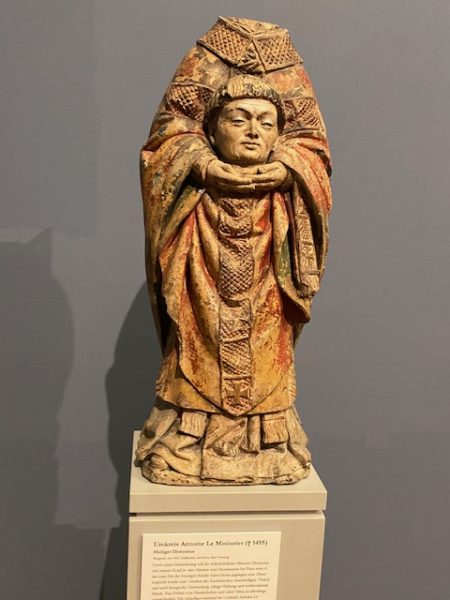
Headless Saint Dionysius

Denis of Paris stands for the Saint Dionysius, who is reported to have walked after being decapitated as martyr for his christian beliefs by the Romans in the 3rd century, all the way from Paris to St Denis in the suburb of Paris. We do not only find such a statue at Notre Dame in Paris, but also a medieval version in the Bode museum in Berlin. The cathedral of St Denis in Paris became subsequently the place for the coronation and burial of many French kings. The last king who lost his head through the guillotines was Louis XVI. It took almost another 200 years to abolish capital punishment altogether in France. Robert Badinter devoted his career to fight for this appeacement within the nation. (Image: Statue St Denis in Bode museum Berlin).  
Cut it short

The “Revue des sciences humaines” (Demanze and Gleizes, Nr. 355, 2024 pp. 7-16) provides an interesting reflection on the widespread practice to find (new) ways to cut long stories or insights short. Short by itself, this introduction to a longer special issue on the topic “Faire court” stresses 4 elements of the contemporary impetus to cut it short:
(1) The creative process may be subject to condensation of content, similar to the process of a “reduction” in the culinary vocabulary. The speed of creativity, inspiration, freedom of expression are exemplified by the twitterization of and aphorisms in literature. Roland Barthes, in his analysis of the “haiku”, raises awareness to the different associations of the short text forms in different societies.
(2) The observed shortening of time spans of attention and the competition and economy of attention have raised the stakes for longer formats and explain to a large extent the success of shorts in the digital age.
(3) The short format works to increase the intensity of the literary experience.
(4) In deconstructing the associations of long formats as “monumental” versus short formats as ephemeral, the “cut it short“ tendency serves to “demonumentalize” the big shots of literature, science and the humanities. Well, about time to cut it short, “hic et nunc”, here and now!

Musician Historian

Musicians are usually perceived as “part of history” rather than being historians themselves. However, recent research on Bob Dylan has extended that view to portray Dylan in his role as historian as well. The issue here is more with the historical periods and references the musician, composer and song writer builds on and interprets historical events. Thereby, his thoughts and impressions on living through historical events enter into his work as an artist. Dylan is literally “doing history”. He puts events of past and present into perspective of his own making and reached authority through the non-conformist perspective, which connected him to as a performer to his various audiences. His approach to doing history consists in the re-presentation and re-creation of historical narratives. Nina Goss (2024) in her book review highlights the “irruptions of the past into the present unique in popular culture”. The re-arrangement of fact and fiction encourages us “to inhabit, question, and revise historical narratives and tropes” (p.399). Several musicians have specific ways of reflecting, sometimes critically, on history in their artistic work. Bob Dylan certainly is a very prominent example of this an has been honoured for this by the Nobel Prize for literature. It remains an interesting perspective to review composers and their choice of libretti for operas as a way of doing history. The shifts from royal drama to revolutions and popular scenes are in this line of interpreting musicians also as historians.

Top 5 Things T5T

Dealing with Elon Musk is a must these days (WSJ 2025-2-26 A4).
So it happened that on his way to Mars, Musk met God the almighty on his way back to heaven. Musk asked, whether he could join the ride.
God, not amused, asked Musk about his T5T (top 5 things) he accomplished in his life. Musk questioned God‘s right to ask this question and said he would tell the other T about this. God gave him just another day to come up with a response.
So here we are: the T5T Elon Musk might put forward:
(1) I created a million fancy electric cars.
God: Well, but there were already too many tin boxes on 4 wheels on earth.
(2) I created rockets that propelled billionaires into space and back again.
God: Your carbon footprint has exceeded a million people of the poorest countries on earth.
(3) I created a network of satellites that facilitated communication.
God: Nobody spoke to me yet using it.
(4) I bought Twitter and transformed the platform to spread evangelism of various sorts.
God: This has become a hoax spreading more lies than truth.
(5) I reformed the public sector employees to share my beliefs or leave.
God: This will ruin a lot of services like USAID, which have assisted me for many years in my caring and charitable service.
With all these T5T of yours in mind I am not sure I should let you return to that planet earth. Maybe I‘ll find another assignment for you where you can cause less harm Elon. Maybe, try “Waiting for Godot“.
(Image: instead of T5T try T4T (tea for two))

Hugo intergenerational

Well, this entry is not about Hugo Boss, whose name is probably known to more people worldwide nowadays than the French poet and writer Victor Hugo. The latter Hugo, however, is likely to be known to more generations to come than the former one. In his 19 years of exile with his family he had the unique chance to get to know his grand children a bit closer, which was rather unusual for the late 19th century. The romantic poet was charmed to an extent that he could help it, but to express himself in a longer poem. „L‘art d’être grand-père“ (The art of being grandfather)“. Victor Hugo experienced the death of own children and his wife before and his grandchildren surely gave him reason to believe in a more joyful tomorrow. Comments on this poem mention the idealised vision of the romantic regard on children and even more so on his own grandchildren. « Leur front tourné vers nous nous éclaire… … Ils trébuchent, encore ivre du paradis. » 

We forget all earthly quarrels just listening to the soothing sound like children’s rhymes. Hugo is a master of all literary classes and he ensured that his intergenerational legacy would be part of this.  (Image: Maison Victor Hugo, Paris, writing desk ro stand in front of)

Text to Image

Long before everybody started to discuss Artificial Intelligence, which in many applications takes the form of transformation of a textual prompt into an Image, Photographers have had literature or quotations in their mind that shaped their images. This was a kind of poetic imagery not always easy to recognize. The exhibition in the „Institut de France“, Bibliothèques Mazarine (LINK), with photographs by Nicolas Fève (LINK) offfers a great insight into this way to conceive of an image and its realization through photography. Exposing the sources of inspiration as well as the photo is like adding textual citations to an image in a much more inspirational and transforming manner than AI is doing these days in 2025. 

Text to image is only one out of the many ways texts might guide imagination, but it is a powerful and gripping one. The history of literature is full of other forms like videos based on novels, comic strips to make classic texts in Latin more accessible. As we shall ask AI products like texts and images to cite their sources and honor authorship, photography as art and science might enhance the literary experience by adding citations to an image. This has the additional advantage that more people will follow up on the sources of inspiration.

Artists Intergenerational

Generations influence each other. That’s a very simple general statement. Biographies, auto-biographies and life course research have all established sometimes more, sometimes less direct influences between the generations. The exhibition “A partir d’elle. Artists and their Mother“, curated by Julie Héraut, combines literature, photo and video that speak to the rather complex psychological or sociological issue. Visits in 2025 available at Stichting A, Brussels.
The starting point of the inquiry into the nature of photography by Roland Barth is chosen like an investigation into a crime. Sophie Létourneau had written an essay which proposes to read the original text by Barthes from this perspective. The artists in the exhibition seem to follow this process of asking themselves what their relationship to their mother is like and how to represent this in an artistic form.
A life course perspective, which takes images or videos with 10 or about 20 years difference, offers a kind of analytical as well as artificialized vision of the evolution of the artists’ relationships with their mother. Realistic images with a morphing backwards from old to young is presented next to images confronting young and old next to each other. “Words don’t come easy to me” could be the title of one of the videos where a young artist has a particularly hard time to talk to his/her mother.
Just after the celebrating Franz Kafka last year and his famous “Letter to my father”, the inquiry into artists and their mothers complements the analytical and artistic vision and interpretations of the child and parent intergenerational relationship.

Happy Maths

The link of maths and happiness is not straightforward. Individual accounts of a happy (euphoric) or unhappy (dismal) life are mostly referred to psychologists for treatment. The biografies (documentaries) or fictional biografies told in novels or cinema allow to trace the changing moods of the personalities over time. This resembles life course research. In happiness research social scientist ask questions like “Overall, how satisfied are you with your life“. Measured over time or coded from biografies this allows to reconstruct happiness trajectories. At this point the maths of happiness enter the stage. Long periods of observations yield interesting patterns of curved lines, rarely simple linear trajectories. Social scientist speak of within person variability in contrast to between persons variability. After all, the (short-term superior) happiness of your neighbor might simply be due to the fact that they are doing drugs.
Whatever, try to remember a bit of your high school maths and the bore to deal with “curve discussions or sketching” beyond the manifold shapes of your classmates. Lots of interesting information derives from growth or decline rates, tangent lines, stationary or inflection points. Different starting points or so-called intercepts vary between individuals as well as he potential  to cross the Zero-line on one of the axes. Additionally, in geometry you would compare syncronicity of curved lines as well as forms of symmetry for the curve(s). This will simplify or comlexify your perspective on the happiness trajectories of people or characters in a novel.
We are so used to narratives or videoss with a happy end, yet we appreciate the complex trajectories and (multiple) troughs main characters have to pass. Novels teach us about tricky inflection points and subsequent trajectories as well. The maths of happiness, however, is rather simple in comparison.
(Image from Toronto District Christian High School -pdf p.207).

Narrative Object

Objects tell stories. Stories get condensed into narratives. Narratives become objects. Yes, we are going round in circles here. Artists have transformed an old splendid atelier and factory building into a new gallery space for “Objects with narratives” in Brussels. We construct, reconstruct and deconstruct narratives almost continuously. However, if narratives are transformed into an object or objects they will become something tangible or a fixed expression of the moment or process. The concept of art objects with narratives invites us to look for the narrative linked to the object. Just like in other disciplines like economics we have ample dominant and heterodox narratives. It is important to reflect on narratives and empirical evidence in their support. When we look at the mountains of plastics and garbage on our planet we see how an economic narrative has been turned into nasty objects. Objects with narratives is also how future generations will confront us with the pollution and waste objects we left and still leave behind us. (Image Bussels Gallery Objects with narratives 2024-7-13 Exhibition Marius Ritiu.)

Family Kafka

100 years after Franz Kafka’s death nearly all facets of his life and writings have been analyzed. The archives of the editor Wagenbach and the publishing house have now opened an exhibition at the “Stabi Ost” in Berlin adding a family picture book description of Kafka’s life (Curator Hans-Gerd Koch). This is of interest because Kafka himself had written an extensive letter to his father (Brief an den Vater) in which he tries to understand his intricate relationship with his father and other family members.
Nowadays, some people would try to analyze Kafka’s life through the parapsychological technique of family constellations. The far-reaching and pan-European family networks of the Kafka (father) and Löwy (mother) families were more than just an excellent source of inspiration. 2 younger brothers died in their first year. 3 younger sisters followed more traditional evolutionary patterns within families. The television series on Kafka’s life add to the understanding of his sources of inspiration and “parallel worlds” he created and lived in. The exceptional “fictionalization” of his own life and existence in the spirit of André Breton’s surrealism remains a milestone in the history of literature.
Kafka himself thought he was not really “instagrammable”at the time, but his image has reached and still reaches millions of people (Link to Picture archive). He himself would probably have defended the thesis that the most powerful images are within us. … and they are hard to escape from.
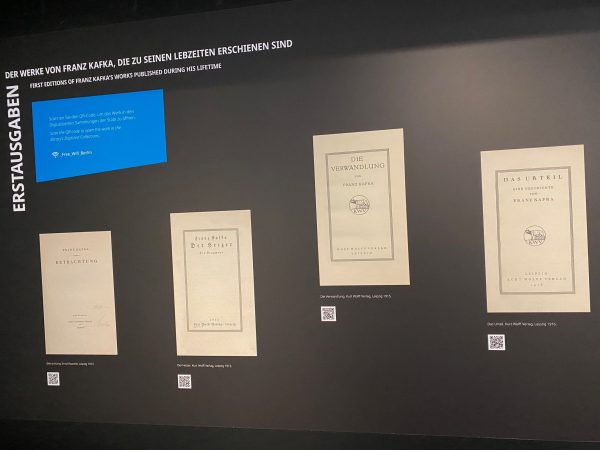
(Image from Exposition in Staatsbibliothek Berlin 2024-4, QR-code links to reading in originals!)