Wisdom of chance

The advantage to toss a coin is that a decision made by chance is usually perceived as acceptable to all parties involved. The wisdom of Greek philosophers also trusted in decisions by chance. In decision-making it is good scientific practice to mention error margins, a bit like in weather forecasts. In case error margins are very high it, therefore, can make sense to leave the ultimate decision to a toss of a coin as this might be just as valuable as making one or the other choice with high uncertainty. Of course we feel uneasy about such a procedure as we tend to be convinced that we have sufficient information to make a better decision than just a shortcut by chance decision. Hence, there may be many more cases than we would like to admit to which can be left to a by chance decision. 

Random choice decoration of kindergarden Berlin 2026

Random randomness

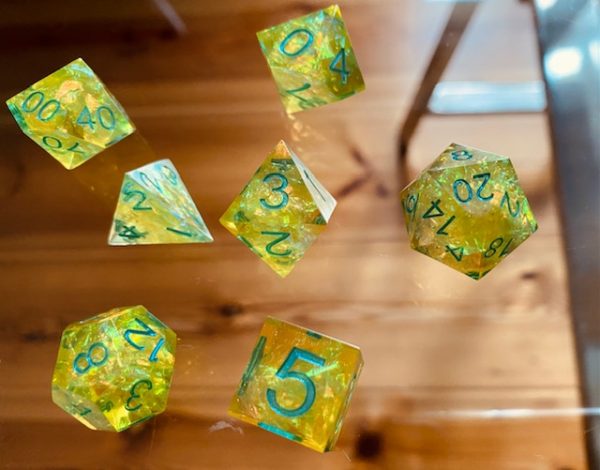
In textbooks or courses of statistics, just as ordinary experiences with throwing a dice, we assume the perfect dice. This means the dice is assumed to have equal probabilities to roll on each side. Further, each throw of the dice of a sequence has an independent equal chance for each number to come up. To determine a “fair” dice we would throw the dice a thousand times to check, whether the probability of each side is about equal. However, the world of dices is not perfect and temporary or persistent margins of deviation are part of the real world. The weekly lotteries demonstrate this over and over again. Playing around with different shapes of dices makes the issue of probability tangible. Well worth to explore further empirically as well as a topic for inspiration of new approaches to learning about statistics. (Image: Dices produced by “devinsdice” Berlin 2026-5-5)