Geometric forms sometimes serve to make international affairs more transparent or descriptive. The Weimar triangle is such a formula, which helps to show the links between states. In the journal “Le Monde” of 2024-9-13 an interview with Radoslaw Sikorski reflects the shifting side lengths and military weights within this triangle. The Polish Minister of foreign affairs points at the threats from Russia to violate the air space of Poland and the legitimacy of Poland and the Ukraine, of course, to defend its air space and territorial sovereignty. The guarantee of international law, however, is heavily dependent upon adequate international geometry beyond the Weimar triangle. The meeting with a representative of the Pentagon (US) enlarges the scope of the triangle.
Talking about the reach of missiles in defense is yet another exercise in geometry as this depends on starting and supposed, or reachable, end points. The use of GPS-signals in civilian and military applications is another example of how geometry is ruling our modern lives. Let’s embrace it, rather than shun away from the geometry behind it. (Image Exhibition room at Wiels Art Centre, Brussels 2023).
It is hard to imagine what it will mean to go to school, if your father has to defend your country, Ukraine, and freedom of education instead of Russian indoctrination. This is tough for all children in countries that have to defend themselves today or in the past. For Ukrainian children and families who had to flee their country this means that they have to go through another education system, not out of choice, but instead of their normal way through their education system. This means a lot of additional challenges for them. In Germany alone the educational authorities have counted more than 200.000 children in schools at the beginning of 2024. Additional efforts are undertaken to allow mothers as well to learn a foreign language to facilitate communication with the receiving countries. We have to make huge efforts that these children are not a scared generation of pupils but rather a strengthened generation of young persons with solid learning experiences in another country. Some will stay in the receiving countries, many will return and rebuild their homes and communities. Our support and assistance needs to be a long term commitment beyond the end of the war after an eventual Russian retreat from Ukraine territory. Solidarity is not a fixed-term commitment. We shall be put to the test and should not hesitate about our continued support.
We live in an age of superstates. Such is the conclusion of Alasdair Roberts (2023). China(1.4), India (1.2), USA (0.33) and the EU (0.45) in billions of people jointly host about 40% of the world’s population (UN data). The Russian Federation with a population of 0.15, Japan 0.13 rank further behind, for example Pakistan 0.24 and Indonesia 0.27. Nothern, Eastern and Western Africa (0.25;0.46;0.42 respectively) have a huge unfulfilled potential that does not reach the impact it deserves.
These big and populated entities contrast with the increasing number of small states that have become new members of the United Nations. The institution of the United Nations, through its setup as an international rule based governance structure, has facilitated small states to seek voice and influence in the international arena of politics. The UN had 51 members in 1945 and has now a membership of 193 of all listed states of 237 on the globe. The increase in membership is due to many small states joining the UN after independence from big imperial powers. The international power relations, however, are only partially determined by population size but economic and military factors. The so-called superstates reach power through their power of direct and indirect “persuasion. Therefore the relationship between small and big states remains a delicate balance of power. Russia attempted to grab Ukraine and its population of 410 millions to remain in the league of superstates by population size and has suffered a hefty setback which further unsettles the disequilibrium of its male (68) and female (78) population with predominantly male soldiers’ lives lost.
Whereas we have seen the small states’ numbers on the rise in the last few decades, the expansion of superstates from Russia, China, India or Pakistan remain a threat to peace on the globe. The crystallization of a multi polar world order is on its way, but the stakes are high and unsettling in many respects. The fallout of war stalls the adaptation to climate change and increases the millions of starving people on the globe. the attempt to reach superstate status by already big states is probably the greatest danger we shall face for the coming years. Preparing for the instability of the world in transition to an increasing multi polar world order will dominate the political agenda of many intermediate powers as well as smaller states. (Image Globe Moscow 1994, displayed Stabi Berlin 2024)
We know that sports and international politics have ample links. This holds true for Opera performances, either due to the way they are presented or due to the content of the libretto. The opera Jeanne d’Arc (Giovanna de Arco, Jungfrau von Orléans) by Guiseppe Verdi was composed in 1844 and had its Premiere at La Scala in Milano 1845. The libretto is based on the drama written by the playwriter Friedrich Schiller. Later in the 19th century musical pieces followed that dealt with the court judging Jeanne d’Arc. The opera by Verdi creates a strong female voice and character which outperforms men around her. Obviously, she was and remains for many a quasi-mythological heroine. In short, this constitutes great plots for drama and operas. This is centuries old despite the rare occasions of more recent performances of Jeanne d’Arc in form of Verdi’s opera or other forms.
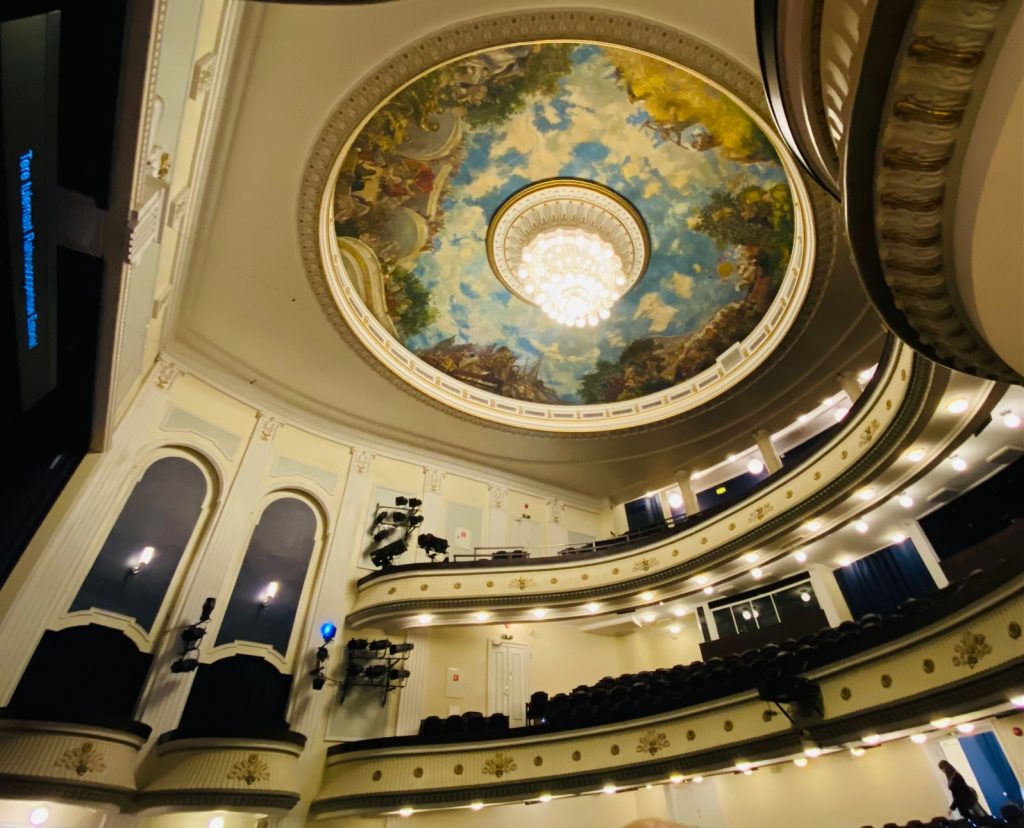
The Opera as arena of politics is currently tested in the Opera at Tallinn Estonia. Due to the aggression and occupation of Ukranian territory by Russia the plot of Jeanne d’Arc regained another European location of potential application. Ukraine pushed back the Russian invasion and struggles to win back its territory from the invaders. The performance of the Opera recreates an impressive Jeanne d’Arc in the person of Elena Brazhnyk who was trained at the National Tchaikovsky Music Academy of Ukraine. The evening inspired hope in many respects. Talents from Ukraine or trained in Ukraine reach out into to the world. Similarly, we have much reason to be inspired by courageous acts. Operas do politics. “Bravi”, as they say in Italian.
(Image: Opera Tallinn-Estonia2024-4-18)
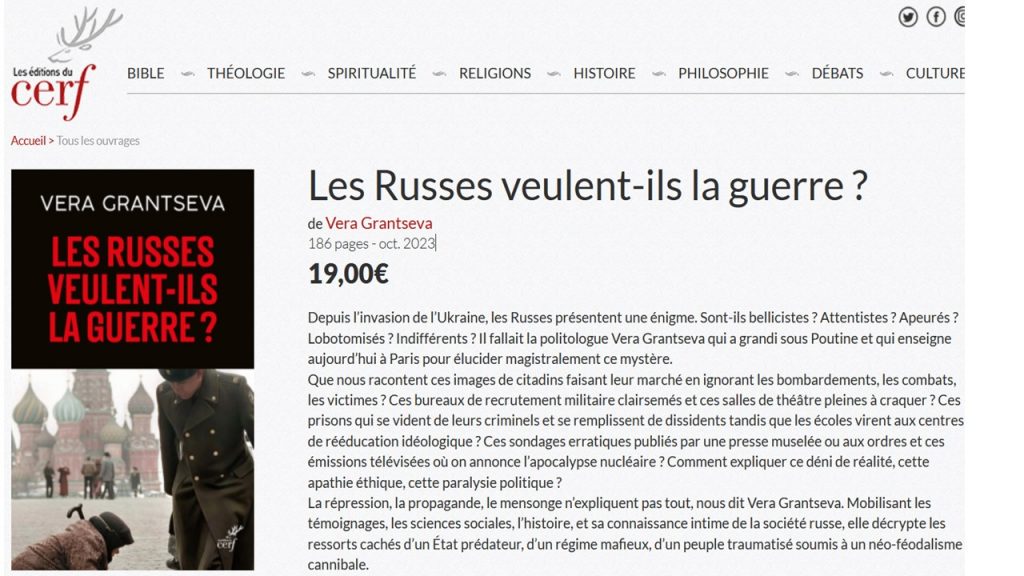
The title of a book “Russian Angst” by Thomas Franke summarizes the state of Russian society under Putin. It dates back to 2017, but the underlying process of Angst in the Russian society is increasing rather than diminishing due to the already 2 years long intensive hot war of Russia against Ukraine. The Russian Angst is a fear of a continued roll back of its authoritarian rule in Eastern parts of the world and its internal threat that its own people will claim more rights like freedom of speech, freedom of the press and effective democratic voting rights. In a dictatorship the “Angst” is a pervasive phenomenon which creeps into all spheres of live. Franke and Dornblüth (2023) describe the toxic society in Russia. Intoxication and torture of opponents are used by the Putin regime as a threat to suppress critical voices in Russia. Through this a climate of “Angst” is spread so that any internal opposition has to face very high risks to utter any discontent. The experience of a barbarian, totalitarian regime is well known. The threat to life and the presence of intimidation to any disobedient behaviour are strictly persecuted. Nevertheless, the need to think beyond the Putin regime is well under way. The more external and internal, real or imagined threats are countered with brutal force, the more the regime reveals its true kind of governance by force. This invites and leads to the strengthening of counter forces both internally and externally. It seems like box fight in the before last round of a very vulnerable, weakened and isolated boxer. Not many will bet on the likely loser and more countries who previously supported Putin will stop their erroneous policy. Russian Angst and loneliness will further increase.
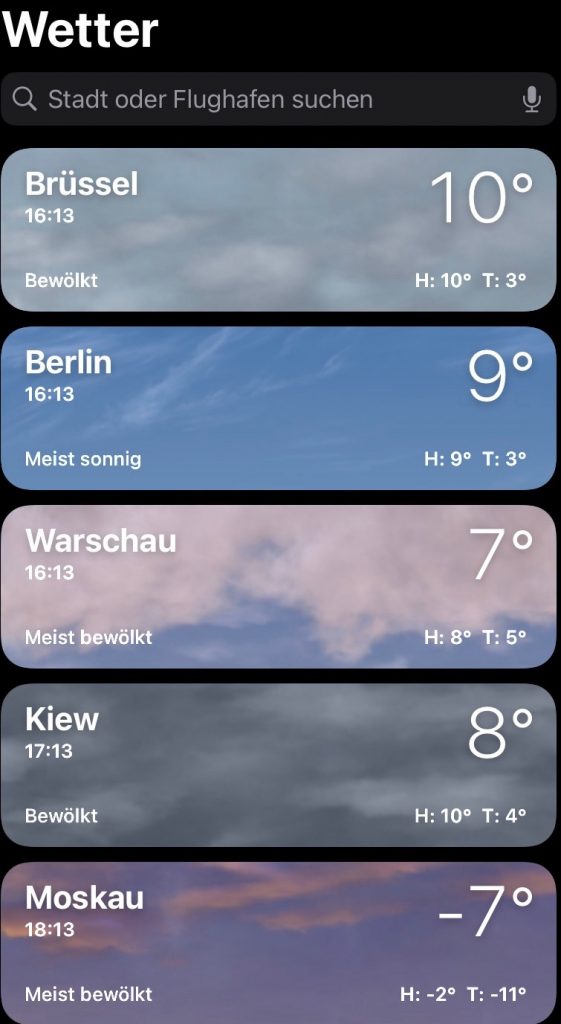
There has been a shift of political borders in Eastern Europe. Russia has been trying to shift its border further to the West by brutal force attacking Ukraine. Political defence and military action have managed to preserve western values in Ukraine. On the 13th of February 2024 the meteorological data confirm a clear belonging of Ukraine to the western climatic conditions. Temperatures in Kiev are very similar to the western hemisphere and very different from the cold in Moscow. This is just a little detail or coincidence but it bears a nice resemblance to the political weather currently in Europe. It is by all means much colder in Moscow than in western Europe. The time and the climate are a changing.
The Russian aggression continues on Ukrainian territory also in 2024. Based on false allegations and stories about a supposed Russian heritage based on Ukraine territory the ongoing war is once again fought more about the past than the present. The future is entirely disregarded by Russia as if it is clear to them that they do not have a future of the dictatorial regime. If a country does no longer care about future perspectives or future generations even, this country is likely to become very dangerous for neighboring countries and beyond because of the high discounting which implicitly applies to all its investments. Western companies who moved out of Russia had immediately high losses. At the same time Russia continues on a daily basis to destroy lives and property. We just shall not stop to support the fight for freedom and democracy in Ukraine as long as it takes. It fighting for our future rather than demons of the past.
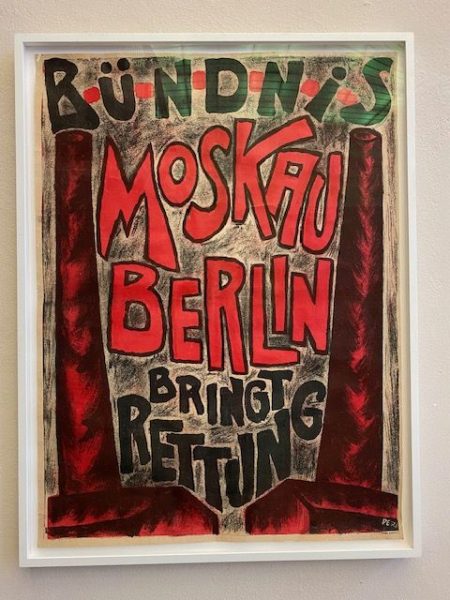
Some historians have a hard time to sort long-term relationships between countries into adequate periods. The ups and downs between Berlin and Moscow are a peculiar example of this. The artist Peter Laszlo Péri expressed this unease in a poster where both cities stand for the dictatorships presumably in the name of the working class. This alliance between Berlin and Moscow, Hitler and Stalin led to occupations of several neighboring countries and war in the following years. With an uncritical stance after German unification the Berlin Moscow link has again facilitated the land grab of Russia with Ukrainian territory. Buying complacency of Berlin in return for cheap oil and gas from Moscow has ended for most European countries now. Great to see Europe united with few minor exceptions and that alliances with other European cities reveal strong and powerful in hope of a more peaceful Europe.
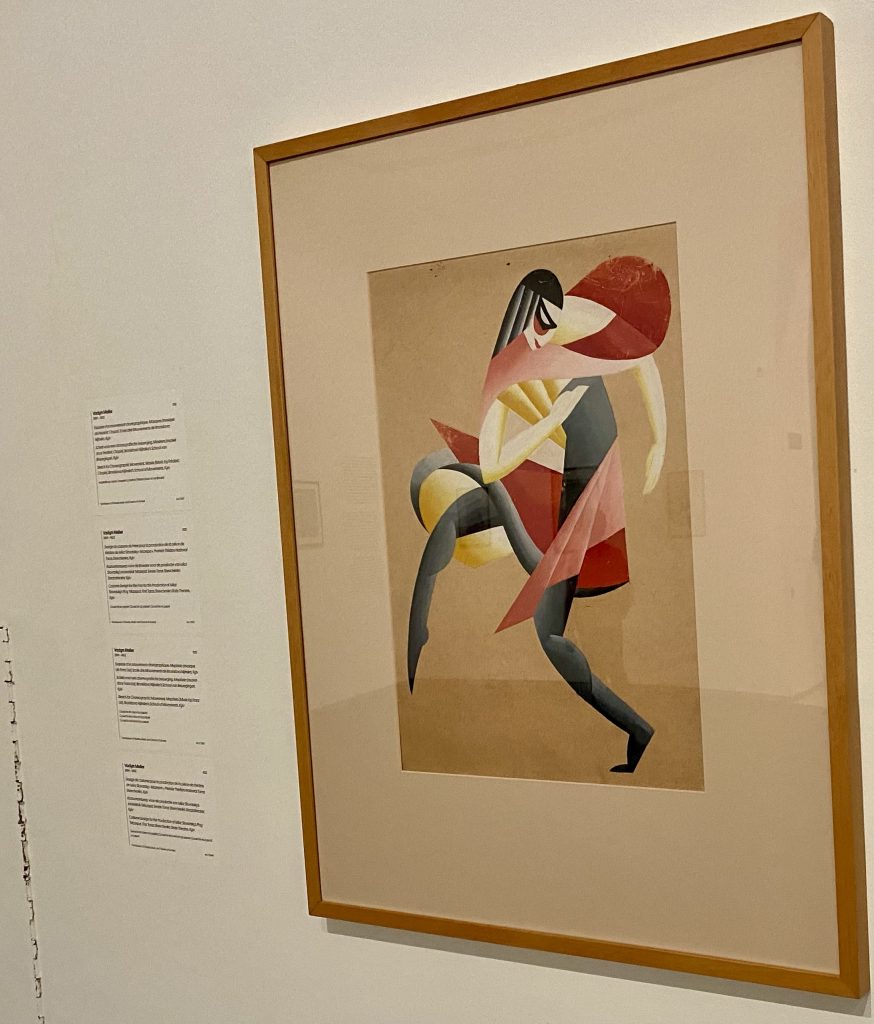
The touring exhibition of art works from Ukraine 1900-1930s is on show in Brussels at the Royal Museums of fine art Brussels in November December 2023. Before Ukraine became swallowed up in the Sowjetunion there was a very active independent artist world that had close links to all capitals in Western Europe. All art disciplines were covered. The paintings of Vadym Meller from 1919 (Aquarell on carton) show designs for a dance performance to the music of Chopin. The modern designs and vivid colors reflect the conscious reference to art movements across Europe. The inspiration from dance to painting is a recurrent theme in impressionistic paintings, abstract paintings and into our own time period. Ukrainian art from early on in the 20th century had a broad scope beyond the narrow focus on art controlled by the soviets. Well worth enlarging our vision to take into account these creative masterpieces from Eastern Europe as independent voices.
Vadym Meller 1919 (Aquarell on carton), Brussels MRBAB 2023-11
As the Russian aggression in Ukraine continues its war in Ukraine, it is important to analyse the impact of the prolonged war. Certainly, Russia underestimated the length of the war in the first place. We shall be soon in the 20th months of the aggression. It is not only an aggression on Ukraine territory and Ukrainians, but also a disaster for all those fighting on Russia’s side. Many young recruits to the army did not expect to be drawn up and be compelled to fight on front lines of a war. Most of these young people will not even really why they are risking their life. Russian imperialistic behaviour is not what they imagined to be their future role. Putin has changed the story book of millions of youth, for those of the soldiers and those who left the country in time to evade been pulled into the horrors of war. With so many months passing while at war, each birth cohort of Russians completing their schooling and serving in the military will face existential threats to their very survival. It is likely to be a lost generation that cannot think of other opportunities rather than passing through the hierarchies of the military ranks. It was not their war at the beginning, but Putin and the old military commanders who are responsible for the mess, but youth pays the highest price in terms of foregone other professional careers and development rather than death or mutilation. The defence by Ukrainians with better equipment arriving day by day is likely to increase the losses of the Russians, where many still do not know why they are sent to fight. The price for Russia to pay for the aggression is rising every day Ukraine manages to defend itself. Other countries in the neighbourhood of Russia were very surprised of the ruthless imperialist approach by Russia. They stepped up their defences considerably to guard against another extension of the conflict. The toll is on youth even beyond Russia and Ukraine.
We use Cookies only for technical performance!
This website uses cookies for the working of basic functionalities of the website.