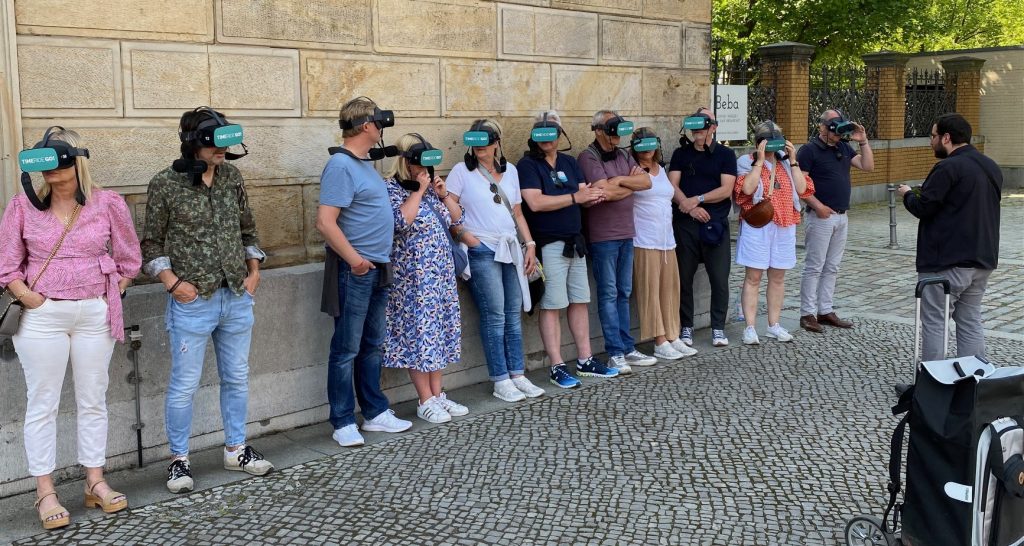
Each time I pass by the closed airport in the middle of Berlin I am amazed by the crazy idea to have built this and maintained throughout the 20th century. Paris is desperately trying to re-naturalize small areas and roads, while in Berlin there is now still the huge park to enjoy for all. Sports activities benefit the most. What an amazing asset in the neighborhoods for so many in need to walk, run or cycle a bit to keep their exercise level up throughout their life course. It has still a huge potential to activate people. It just needs a bit more organizations and volunteers to embrace the opportunities. Only in comparison to other cities you realize what an asset this is now. It will remain a challenge to preserve this centrally located treasure for the benefit of all. In Paris the deconstruction of concrete is taking shape and 300 new sites have been identified for re-naturalization, as reported in LeMonde. In Zurich green spaces in the center have been saved and renovated with a lot of money to allow more people to enjoy the benefits of a green environment near the city center. The house and park by architect Le Corbusier is a fine example of this. Image below. The garden around the house is publicly accessible. As air pollution is threatening more and more and heating in cities is a serious health threat we would really like to welcome more preservation and re-naturalization in inner cities.
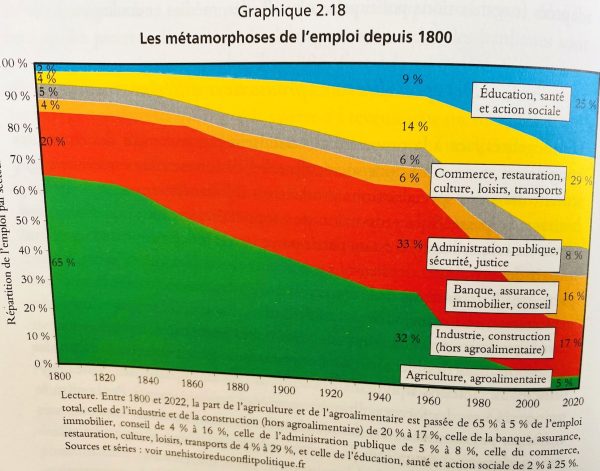
The long-term view of sectoral change in France, for example, from 1800-2022 (Cagé and Piketty, 2023 p. 128) allows us to zoom out of our narrow focus of the last few years of economic change. The decline of agriculture is the most remarkable. The reduction of employment in industry and construction has been an ongoing trend as well. Banking, insurances, property and consulting have seen remarkable expansion over these years. Public services, security and legal affairs are still on a moderate rise. Other sectors like education, health, commerce and transport manage to grow equally.
The merit of the comprehensive volume by Cagé and Piketty (2023) is that it is thoroughly data driven and based on quite unique long data series. The data on structural change and just the employment trends depicted below refocus our attention on likely consequences of these changes.
For the 2 authors we should redirect our attention much more to the implications of these trends (like rising inequality) on political conflicts and power struggles. Democracies are at risk, if we continue to ignore these seminal changes of industrial structures and shifts in employment. The traditional strongholds of trade unions and progressive forces in the manufacturing and construction industries as well as in public transport seem to have unaccounted implications for our political systems as well. The volume by Cagé and Piketty (2023) will soon be available in English and reach broader audiences just-in-time for the European Parliament elections in June 2024. Particularly the spatial implications and how the neglect to take into account the fundamental differences between the rural development and structural change needs urgent reconsideration. After the time for reading and working with the data (LINK) is the time for action to preserve our European Dream of peace and social development.
The sustainability of war depends a lot on the availability of arms. The Stockholm International Peace Research Institute (SIPRI) publishes regularly updated data on arms trade. The report ranks countries who are the most important exporters as well as importers of arms (from 2018-2022). The lists show for exporters that the U.S has been at the top of exporters with 40% of the global export share followed by Russia with 16%. France 11%, China 5.2, Germany 4.2 come next on the list. Taken together Italy, Spain and the U.K. reach another 10% jointly of global exports. South Korea and Israel come in with shares of 2.4 and 2.3 respectively. The top ten serve allies but also more broadly the world arms trade and race. New dynamics have started to come into force. The Russian aggression and war on Ukraine territory will have an impact to the extent that Russia is probably exporting less and shift to a more importing state.
Among the importing countries India is leading the ranking followed by Saudi Arabia and Qatar. More generally Asia and the Middle East were the most important buying countries. Importing arms might be interpreted as an indicator of perceived threat to a country. Long cycles of arms renewal may also drive statistics of arms trade, but new threats like cybersecurity and space technology have created new fields of potential attack and defence.
All in all, yet another rationale attributed to Clausewitz seems to play a role in driving the arms trade. “If you are perceived to be weak, an enemy will use this to attack”. Well, this also means that buying arms, producing or importing them, could deter a military aggression. That form of deterrence of aggression is known from the nuclear arms race as well. In the realm of conventional weapons, we have thought, it would no longer apply. We were mistaken in this respect. The dividend of peace has come to an end for many countries. The SIPRI report (2003, summary p.9) shows the continued rise on the global level of the arms trade. Why are we so scared of each other? Russia has reverted to imperial politics using conventional weapons. Containing such disrespect of internal law needs our full attention to avoid a spreading to other areas. The link of diplomacy and trade needs close scrutiny.
Mating birds have astonishing capabilities. Some songbirds can expand areas of their brains during the mating season. Apparently this helps to outperform other birds in singing contests. The expansion of the brain in the preparation for mating is not so much of an interesting phenomenon in view of the fact of subsequent decline of the capacity. Of course in human engineering the expansion might be useful and the hope to repair a damaged brain is worthwhile as well. In a few years we might know how to expand brain irrespective of brain functions. The naive hope that we might just sing more beautifully in preparation for mating is probably misplaced. While everyone is talking about AI new horizons for HI as human intelligence or hybrid forms become more feasible. Meanwhile we continue to focus on our preparation for mating songs. It seems to exercise parts of the brain with the best intentions in mind. Composers have created fantastic arias and singers impressed audiences across the globe with melodies in preparation of mating like the birds. Art is full of such extraordinary examples. Let’s keep up the preparation as long as the season lasts and before climate change kicks in more forcefully. The mating season might be prolonged a bit, it might be too hot or too wet to prepare for mating as well.
In societies it is not easy to derive collective preferences of citizens. Elections every 4 years tell sometimes nothing on specific issues which were not debated or of sufficient relevance at the time of the election. Dealing with snow and slippery sidewalks is hardly an issue at all. However, the preference to clear roads meticulously rather than bicycle and pedestrian paths in a dead end road reveals preferences for „s‘heilig Blechle“ the holy tin box (car) in many cities. Our orthopedic units in hospitals are crowded at such times and those costs are hardly attributed to the source of human negligence for fellow humans. We would expect that aging societies start to address such topics but little change has occurred so far. Hence we claim airbags for pedestrians and cyclists😂. Preferences probably have changed already but implementation is slow and faces strong opposition as well. It’s always easier to lock frail persons into their apartments at such snowy times. It feels a bit like corona where it was also easier to restrict mobility for pedestrians and children than to deal properly with the virus. Aggregation of preferences in societies remains a challenge and sociology has a lot to offer in this regard.
News agent Reuters has published an analysis of the setback for short peak coverage of electricity by power plants fueled with gas. Conclusion: economically no longer viable. Investors draw back even from contracts already signed. What is the game changer technology here. Batteries that store energy just like the batteries of millions of cats that have a storage capacity to supply energy for a whole household for more than 2 days. Other giant batteries cost only half the price compared to 5 years ago equal to $150 per kwh. In five years solar energy doubled its share of energy production to now reach the same amount as energy provision by gas. Reaching a critical turning point in energy generation, investors flock to the more profitable medium or long-term investment. Good news for the planet. Wind and the sun are all around us. We have only started to cover roof tops of office buildings, car parks and other shelters. Start thinking about your energy storage as of now and reserve a suitable space for it. Costs are coming down rapidly in a few years or maybe only a few months.
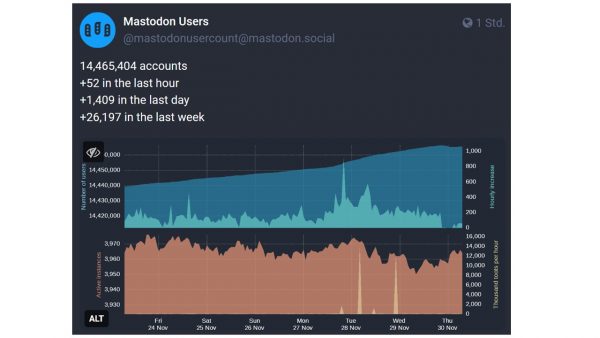
In the Post-Twitter-world there is room for other platforms to take over the information function and opinion exchange on an international level. Mastodon has made a good start to fill this gap. The number of registered users has surpassed the 10 million users by large. If the anger about the union-busting and Trump supporter Elon Musk increases further, more and more people will join Mastodon as users and content providers. Advertisers will follow where they can reach their appropriate audiences. If you sell seats on a spacecraft to the moon you will advertise on eXit-Twitter. If you care about responsible investment you advertise on elsewhere or on Mastodon, because that is where your audience will be. Ethically responsible advertisers started to make such moves already. The decentralised structure to potentially filter human rights violating hate messages will need to grow accordingly on this platform. This is a challenge for all platforms and involves costs. To better understand the idea behind Mastodon, think of a platform which connects many other local networks or platforms. Yes, it is a platform of platforms. Decentralised instances provide and can remove access to the local platform. Even whole sub-platforms might be shut out. This increases the potential to build a “caring platform”. Decentralised organisation often incurs higher costs than a central instance that decides and administers a one-size fits all solution. But it is worth a try.
An example makes is more clear, what are the advantages of such decentral organisation to achieve more shielded privacy. For example, a small local chess club targeting primarily youth can open its own server on mastodon and admit only its known members to the network. It is easy to control who gets access to your posts of solutions to riddles or innovative game and learning strategies. Access to other Mastodon instances is an additional option. For enterprises or larger organisations, it needs the communication department to talk to the IT-service to get such a structure on its way. A dedicated person needs to monitor what content gets posted and what kind of “traffic” is generated. But this can largely be automated. In case you know your members of the local platform it is much less likely to occur than on the eXit-Twitter or other centralised huge international platforms.
Many federated structures will find it useful and part of their social-DNA to join the FEDIVERSE. We shall have to wait for some more time to get the so-called social media platforms civilised. These are social investments and learning processes which deviate from the profit-maximising rationale of other platforms. (Image: screenshot from @mastodon-user on 2023-11-30).
There are many migrating species in nature. Birds form a large part of the them. This follows a kind of annual or seasonal pattern. Depending on the migration experience and dangers some, sometimes many don’t come back. This seems to describe the migration experience of the tweeting bird called twitter. Changing the name from Twitter to X, whereby X for maths-oriented people stands for a variable name that can be filled with any value. For the cinema industry X stands for x-rated adult only content and has rather obnoxious content. This might hold for web content as well.
Online through “https://netzpolitik.org/2023/x-odus-immer-mehr-medien-machen-schluss-mit-twitter/ the disastrous consequences of harsh human resource policies and lack of political sensitivity can be followed. Multiplying biased opinions of right-wing extremists, the platform has been highjacked and many tweeting birds leave or have left already.
Leaving is not easy though. People and enterprises have invested substantial amounts of money into tweeting and software developers have created specialised features to make it easy to spread press releases or info via these add-on services. I myself benefitted from services to show my tweets on my webpage or to easily publish info or links to the webpage. As of now, with migrating away most of these investments will be lost. It was smooth and easy, but now we start this all over again with other comparable platforms and assistance from developers. Mastodon and Bluesky are on the rise as alternative platforms and most likely we shall use both for some time just like Netzpolitik and many others. If already 1/3 of users intend to leave Twitter/X the impact of big advertisers leaving the platform has even more impact. After all they pay for reaching potentially millions of platform users, but now they reach only a steeply biased subset of previous users. Deleting the Twitter/X app saves you from other potential unwanted monitoring or tracking. Only the addresses on Mastodon for example are a bit longer like @mastodon.social@klausschoemann. Decentral monitoring of illicit undesirable content has advantages and disadvantages. We shall have to monitor this a bit ourselves and contribute more actively to save such platforms from bad weather or seasonal migration.
We are all keen to have as many APPs as possible on our Smartphones. Instead of collecting post stamps some of us collect APPs on our mobile devices as well as desktop computers. As with almost all so-called for free software, the APPs are not for free, we just pay with our personal information used for some usually not disclosed other purposes. On webpages we are used to at least confirm that we agree to the use. Alternatively, we should have the option to decline the use of transmitting personal information, user analytics or tracking. The organisation “Netzpolitik.org” has published a short overview article on the results of the research by Konrad Kollnig published in Internet Policy Review. The main message is: even 5 years after the adoption of the GDPR (General Data Protection Regulation) little has changed for the tracking and data collection in the world of APPs. Both Apple store IOS and Google Play Android are concerned.
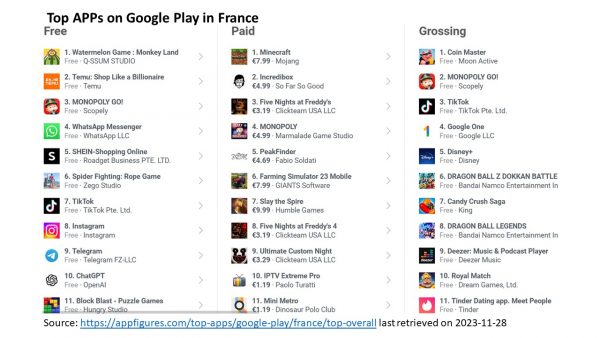
In contrast to webpages APPs a vast majority of APPs, which we perhaps thought would provide tracking-free access to services, does in fact use “secretly” the tracking. Additionally, many APPs transmit personal information and credit card details even without encryption. A so-called middle man attack would “listen” to the transmission and potentially abuse the accessed information. The proof of the abuse of your financial details will be on the side of the consumer, completely ignorant of the potential threat from all sorts of APPs. This market is evolving with rapid speed and what used to be at the top in 2022 is no longer at the top in 2023. Based on an online query for France on 2023-11-28 via www.appfigures.com the data reveal interesting market insights. Gaming is making a new push on the APP-market again. TIKTOK still remains fairly high up in the ranking. Conversion from free download to paid versions seems to work in several instances as well. It needs to be checked whether the paid versions do use less tracking and provide better overall security. A frugal use or regular checking whether you really need all those APPs you have currently installed on your device should reduce your very own cybersecurity risk. It seems like “Less can be more” – fewer APPS, more security – is also valid in this respect.
Over a generation the association with the word mail or AI has changed. Younger generations will automatically think of email as the obvious association with “you have got mail”. Asking people for their mail address, most people will respond immediately with their email account. That has certainly changed over the last 20 years. Email has become extraordinarily important for contacts, content and “crime”. The original set-up of mail servers were supposed to exchange data and information between trusted and trusting individuals. Nowadays we have become “anyone” on an email-list or part of a cascading email-chain. Pishing emails that try to lure us to potentially fake webpages to enter personal information is widespread. A whole new industry of cybersecurity has evolved in parallel with ever faster pingpong of new threats and costly remedies. Most critical remains the human factor to protect email and vital information from abuse. All training to better manage email should therefore begin with awareness building on the need to take cybersecurity seriously right from the beginning. It is not an issue to deal with towards the end of learning about it. Some general points have become common practice. Think carefully if you need to open the mail. Check whether there are external links in it. Do you really need this extra information? Be careful about the number of persons you forward or put in the copy field of your mail.
Unfortunately the simple mail transfer protocol (SMTP) makes it technically fairly easy to abuse email addresses and send an email from a domain name which you do not own. Same holds true for the content of emails. Originally only basic letters and numbers were allowed, no Umlaut etc. But then the “multipurpose internet mail extensions” (MIME) enabled more formats of attachments and illicit links and files within the email content.
In consequence it became necessary to scan emails en masse for malware and obnoxious content. Hence the quality of your email programs reveals itself with the amount of spam you still receive. Next come the email filters that sort your inbox for spam and other modern plagues like unwanted newsletters or notifications.
In consequence we sometimes wonder that we never received certain emails albeit the person sending it reiterated that the email was sent. Even checking your spam folder in the email program might not solve the issue because your receiving email server has been instructed not to accept emails from previously unknown mail servers. Not much you can do about this as an individual person, you mail server is just not on the so-called white list from which to accept incoming emails.
With a mail address from the big national or international companies you have little to worry about in this respect. Smaller companies or organizations might suddenly face a thorny issue if their i@xy.z address appears on a dubious list. You will end up sending but nobody receives your emails. It might take you quite some time to find out about it and even more to fix the issue. Hence the take home message is, have more than one email address registered on different mail servers to check that sending out and receiving emails works properly for you. Managing an own webpage with email service for members or employees is a nice service, but beware of the implications for cyber security as well.
Once upon a time we drafted letters to 1-2 friends 🫠
We use Cookies only for technical performance!
This website uses cookies for the working of basic functionalities of the website.