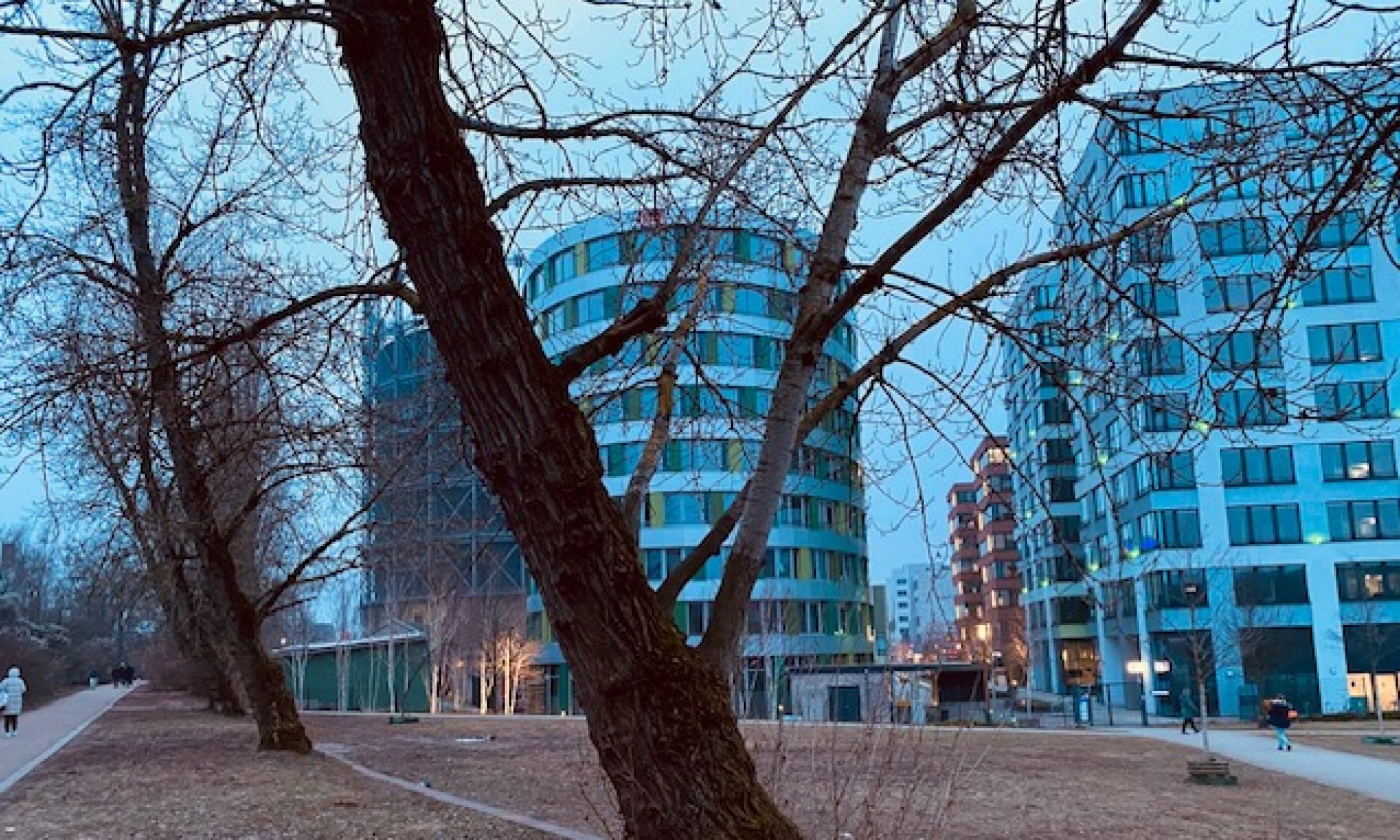

Well yes, this is the latest fart in design and architecture. The Berlin International University of Applied Sciences composed an exhibition on “Air Architectures” which takes air seriously. The international group of 7th semester students took Air Architecture seriously and developed their ideas in the context of a curated exhibition. Nice semester project.
Air is a fundamental precondition for humans to (co-)exist. The biology of air (breathing) or the chemistry of air (fine particle matter) have been studied extensively. The physics of air flows in cities receive more attention as well in architecture. Interior design has yet a lot to contribute in the age of heat pumps and air conditioning.
Let’s think architecture from the perspective of air and air flow. Depending on our cultural background we might have very different associations with air. Indian or Chinese practices like yoga or Tai Chi teach us to take air more seriously than Western practices. Most architecture in cold countries of the northern hemisphere aim to keep air to the outside of buildings. Yet, the percentage of humidity of air is a serious concern of architecture as well. Air flow and quality then becomes a key issue of construction and architecture, somehow through the back door.
Maybe in approaching architecture we might think first of what is or has been the architect’s concept of air or aerodynamics. 100 years after the death of Gustave Eiffel and the Olympic Games in Paris, we still gain from thinking about air (not only air pollution) and its dynamics. Looking forward to the next generation of air architects.
(Image: Exhibition, Air architectures, at Berlin International, University of Applied Sciences 2024-12) 
Korea relieved
On Saturday 14th of December 2024 the Parliament of Korea voted with 204 out of 300 votes, the required 2/3 majority of the parliament to dismiss the president. The declaration of martial law has been the most serious attack on democracy in Korea since its founding in 1987. It is the 3rd impeachment of a Korean president in this short time of democratic life cycle. After impeachment the constitutional court has to confirm the impeachment also with 6 out of 9 judges in favor of impeachment. In 2017 the judges confirmed the impeachment of a president due to corruption charges, but in 2004 another president was reinstated after illegal campaigning charges were retracted. Democratic procedures hinge on checks and balances in the constitutional set up of a state. Nominations, votes of confirmation of judges are important safeguards against illegal martial laws to restrict or even abandon democracy. Pressure from the street, the people at large, is another safety net of democracy. It should not be the last resort for democracy’s survival as it is likely to come at high costs of human lives. 
Sociolegal Circularity
At times legal systems feel like going round in circles. Legal procedures move from one stage to the next and they may get referred back to the previous instance to resolve a particular issue or restart the procedure. This has good reasons with the aim of “doing justice”. Sociolegal circularity, however, begins before the, right at the beginning and negotiation of legislation on which all legal systems are based in democracies, that is. Hence, the legal definition of waste, recycling as part of the circular economy and society is rather crucial.
Circularity is a complex sociolegal issue as the example of PFAS in plastics demonstrate. In economic theory the existence of externalities invites profit seeking of the kind like: “the sea in large part is owned by us all and there is no price attached to the (ab)use of it. Dumb PFAS into the sea, because the costs of cleaning up will be shared by all of us”. In order to limit the extent of this economic logic, we have to rely on sociolegal processes. The precise definition of property rights and liabilities beyond the PFAS issue have to be well-defined. It is an intergenerational topic as well, not only in view of deferred payments.
Parliaments have to be rather competent to look through all the complex issues of producing and recycling of materials to make sound provisions in law including future generations. Going round in circles in parliament is yet another element of necessary condition of circularity in a rather broad sense.
The air we breathe and the water we drink have become part of this “economic externality”, which is a very internal, inside of our body kind of sociolegal affair. Who is responsible for the bad air we breathe and the contaminated water we drink? Air and water have for a long time become marketable products. The more your local water is polluted, the more we are forced to buy water. The more the air in inner cities is filled with fine dust particles, the more medical doctors, hospitals and rehabilitation facilities we need to construct.
For GDP calculations these are win-win-win situations, although they make us all worse off. Society and politics are in charge to define and redefine (yes, circles again) the legal basis with a lot of precision and scientific detail. Sociolegal circularity is key. You just have to turn it in the right direction.
(Image, Palais de Justice, Brussels view from Forest district).

Socioeconomic Circularity
Some sectors of the economy receive a lot of attention, for example sectors selling fancy cars. Other sectors, like the ones regrouped under the name of circular economy, receive much less attention and show up little in headlines. In fact, the circular economy is a great example of this. There are thousands of waste and rubbish collection, sorting and recycling centers, several hundreds of waste-to-energy plants, composting sites across the European Union. Of course, there is also a European Federation of the sector (FEAD). On the last FEAD conference in Brussels 2024 it became clear that Europe is finally waking up to the challenge of recycling costly raw materials.
The narrative concerning the sector needs to change further: what used to be subsumed as costly nuisance is in fact a potential profit center for companies and society at large. We do no longer want to import lots of raw materials from countries with dubious social and environmental records as part of our supply chains for raw materials. Time to act. This, however, is a rather complex socioeconomic challenge of circularity. The price mechanisms are not fully functional in most Member States, let alone across the EU. Additionally, the social practice to recycle varies greatly between countries. Distributional issues matter as well. It is rather obvious that dumping waste from one region/country in another one has huge implications (nuclear waste), but if one country values waste more than another one, due to innovative recycling techniques, the matter takes a marketable turn. Regulation should carefully distinguish categories of materials as we do for hazardous materials in production, consumption and for health and safety purposes of employees.
Metal, battery, cement, plastic and wood recycling pose challenges, but also opportunities to improve the European material import/export balance sheets. However, first in the circle of circularity is the use of materials. There we are clear that “less is better”. Less input of raw materials, most of which we import in the EU, reduces our dependence on other countries. This is the tricky social question of circularity. Mainstreaming of more conscious use and reuse of resources is a huge social issue, which we tend to relegate to a task for the education system. The awareness that supposed waste is also a valuable resource is spreading and the growth of the sector a business and employment opportunity for many. Circularity is the new sexy sector of the 21st century.
What have you recycled today? and myself? Well, scientific online publications. Now think of ChatGPT and the AI gold mines of 2024. There is lots of value in recycling.
(Image FEAD conference Brussels, 2024) 
Book Annotation
For most people book annotations are considered a nuisance. However, most pupils or students mark their so-called textbooks, which contain many images nowadays anyway. A good mindmap, summary of text, highlighting or critical comments may be part of their day-to-day working with a book. Some editors facilitate this using broad margins and more space between lines. Working through a text can take multiple forms and books have allowed over centuries different kinds of their usage.
There is yet another underexplored usage of books. On printed volumes annotations of previous readers may serve as a guide to a script of places, thoughts or material of particular importance. I have always found annotated copies of other readers interesting in their own right. Reading an annotated copy felt like reading another person’s mind, thought or learning process.
A modern view of books as a tool of communication might extend this perspective to study annotations of several readers on the same copy. Just like we comment today in word processing on texts from collaborators or students. Books are a means of communicating with other people or machines (AI) usually with the aim of spreading ideas, content, horror or pleasure.
Therefore, I am always happy to find annotated versions of a book, especially of prominent authors. It sometimes feels like reading a “partition”, a transcript of music which contains the comments or fingering of the reader or the performing musician. The BNF has a lot of such special copies in its archives, usually found in the donations of persons or prominent authors and their families to the archives. This can be put together to make an interesting exhibition of the process of thinking and writing and of special treasures – annotated books.
Image Bibliothèque nationale de France BNF, collection, “Annotations by Jean Racine on Homer “Ilias“.

Democracy in Korea
For all scholars of the theory of democracy the writings of Alexis de Tocqueville (1835) “De la démocratie en Amérique” are a major point of reference. The comparison of the democracy in America with the French king and both constitutions reveals comparative strengths and weaknesses of political systems. Korea after the 4th of December 2024 is yet another warning of what are the dangers to democratic systems. The attempted “coup d’état” by the president of Korea together with a former defense minister and several hundred soldiers has failed due to the speedy reaction of the elected members of parliament and an attentive and reactive public (Korea Times reports).
Tocqueville (p.130-131, French edition online) states, beyond the separation of powers (John Locke), the importance of the right to nominate key positions in a society also public opinion for the survival of democracy. Modern social media have increased the “reaction time” of public opinion and the “time to action” if need be. The combination of both elements of public opinion ensured that parliamentarians in Korea rushed to parliament and used their potentially last chance to vote against the imposed martial law, which started to seal off parliament already.
Several lessons for democratic systems derive from this. Separation of power remains key for democracy. The distribution of state functions on many shoulders under the control of parliament are essential. Legal mechanisms, in case of a spontaneous attack on the system, have to be able to react fast in order to avoid spreading fake news about legality/illegality of interventions. Public opinion, the people at large, should have their opinions distributed rapidly as well. This is necessary even beyond the traditional media of TV, radio and print. In Korea 2024 the attempted “coup d’état” tried also to block traditional media and prominent figures of the opposition with high power of influencing and reach on social media.
Tocqueville stated already that kings are threatened by revolution. Elected presidents have to fear public opinion. A lesson still valid beyond the US., France and Korea in the 21st century.
(Image: joint exhibition at “Traditional Korean Painting”, Korean Cultural Centre Brussels, 2024) 
Degré zéro
As all of us use GPS systems to navigate across the world or just in your city, “degré zéro” might nowadays be associated first of all with the prime meridian 0° longitude, which runs through Greenwich near London and around the globe.
In « Le degré zéro de l’écriture », Roland Barthes (1953) challenges the bourgeois kind of writing of literature. He introduced the pertinent distinction of the verticality of writing styles in the sense of social classes as well as the horizontal form of spoken language He further distinguished écriture as a person’s style which is embedded into the historical and social context of her/his time. As a radical change, Barthes proposed to use scriptor instead of writer as the latter expression is too much loaded with the historical package of the person. Barthes inserts the scriptor as écrivain into her/his time and insists on the intellectual and social context of writing or the author.
As the scriptor (p. 26) does not escape to become a writer « écrivain «, the degree zero de l’écriture postulates a homogeneous society, which obviously is an ill-conceived vision of reality. Language and texts, therefore, are not universal in kind, but bound to situations, which are defined in historical time and space (p. 67). Semiotics was a major field of his analyses of literature and language.
Whereas in a talk you might focus on the person you are talking to, in a written text the other person is « the many » readers, wherever they are and maybe at a much later time as well. There is a qualitative difference and yet modern “voice to text” transcription makes all spoken words immediately available as written document or “compte rendu”. (Source: Roland Barthes: De la parole à l’écriture. in Le grain de la voix, Entretien 1962-1980. p. 12).
Let’s watch our language as we follow the longitude or latitude around the globe and even small deviations from degree zero matter a lot. 
Société du Spectacle
In 1967 Guy Debord published “la société du spectacle”. The content of the book and Debord’s original thoughts are presented in 221 numbered paragraphs, just like blog entries, with a table of contents with 9 chapters each introduced with a quotation. The first paragraph reads: “Toute la vie des sociétés … s’annonce comme une immense accumulation des spectacles. Tout ce qui était directement vécu s’est éloigné dans une representation.” Modern societies are conceived as a huge accumulation of events. What used to be experienced directly, has become only a distanced representation. The spectacle or the events society has moved beyond the state of being just a part of society to become the defining element of society. At the same time, events in the broadest sense are an instrument of unification (para. 3). Events constitute social links between persons, which are mediatized through images (para. 4). It is a “Weltanschauung, which has become effective and through the force of images (including faked ones) creates an “objectivation”, a kind of imagined reality.
This society of events, following Debreu, creates a positivism with a reflexive structure. Only things get attention that are great events (instagramable, make headlines, clicks), and only great events will receive broader attention (para 11). The result is a tautological character of the events society and it has become self-referential. Society shifts from the definition of (1) être = to be, (2) avoir = to have, to (3) paraître = to appear. It is the appearance that counts. A person’s individualism becomes socially mediated by its ways to appear in front of others (para 17). Social power then derives from the form of representation that can be achieved.
The final entry of the 1st chapter (para 34) states. “Le spectacle est le capital à un tel degré d’accumulation qu’il deviant image”. Events form a kind of capital, which through its accumulation becomes an image or the image of society. 
Legal devices
In the 1st chapter of “The code of capital”, Pistor (2019, p.3) specifies the 6 major modules of the code that creates a lot of wealth, but is also eager to keep it to a few privileged persons in society. In order of appearance and not exclusively they are: “contract law, property rights, collateral law, trust, corporate, and bankruptcy law. In these modules 4 major attributes of assets are defined for the holder and later exercised courts as well as other state institutions: (1) priority, (2) durability, (3) universality, and (4) convertibility. In other words, the legal devices rank claims in a qualitative sorted order and guarantee the value of such claims over time and space. The fatal vice of the device is the convertibility of private claims in to one against the state as the ultimate insurance against a risk of credit default by other parties. Similar to bitcoins today, the financial derivatives make it possible to “create money” out of nothing, just like a “deus ex machina”. The states had and still have no control over this “artificial creation of money without being linked to a kind of reserve value.
Such intangible assets may contribute to wealth creation as tools that facilitate a faster turnover of goods and services in an economy or between countries and thereby create corresponding real value. The control of trade and currencies, however, becomes also subject of additional possibilities of fraud and crime. Here again it is the legal system that is challenged to protect the application and efficient functioning of the 6 major modules of the code of capital. The concerns of inequality in and through law are relegated to politics and policies within single states.
The final chapter 9 states rather bluntly: “capital rules by law” (p.205), but it enumerates several ways, how to curtail this code of capital. Tax sheltering in other countries or taxation by choice of country should be made more difficult. Blacklisting is efficient in most cases (p. 225). Arbitration might work if somehow an equality of power is achievable. Internalization of externalities is easier said than done, but needs to be considered right from the beginning of changing laws. Purely speculative contracts should be referred to “casinos” and betting instances and no longer be eligible for business contracts. The revision of the education of lawyers is another part of the counter measures. The autopoiesis of the legal system and its profession has been highlighted by Niklas Luhmann before. A great deal of the difficulties we face with the code of capital appears to be due to the self-referential exclusionary practice of legal devices. We have to bring society back into the discourse of law in order to preserve democratic structures and the equality of chances in society.
The strength of “collective rights” in labour law, of cooperatives or the share economy allow for potential remedies to the hijack of law through capital and exchange markets. Open source movements as in software creation are forward-looking models that the creative commons licensing for security, but also equality purposes. Employees’ input in the process of capital creation should be rewarded and codified accordingly. Last, but not least, countries will have to reclaim legal authority in parts of law that affects “the wealth of a nation” and its distribution. Similar to “no taxation without representation” we should claim “no legislation on us, without us”. The role of legal advisory firms to draft laws outside of parliament has probably gone too far already. The task of politicians to understand the consequences of what they vote for in parliament has become more and more difficult, yet there is no way around a drastic increase in competences, legal and otherwise. 
Shorter is better
Contrary to a lot of received previous recommendations, the shorter duration of antibiotics prescription and use (3-5) days is overall better than the prolonged use of durations between 7-14 days (JAMA Link). A so-called narrative review of medical studies (Lee et al.2023) reports more precise results separate for medical indications (pneumonia, sinusitis etc.), which tend to go in the same direction for the majority of indications. In view of the serious issue of antimicrobial resistance, a consequence of overconsumption and too widespread use of antibiotics (also in animal health and food production), the slogan of shorter is better should receive serious attention.
It is not only a medical, pharmaceutical or public health issue. The topic has become an issue of nutrition as well. The food chain contains largely unknown amounts of antibiotics as well, especially if larger amounts of animal or fish products are part of it.
The knowledge from these sciences has still to filter through to the broader public. This means it has become a social science topic as well. The transmission of knowledge and patient expectations on prescriptions, which is also linked to regulations concerning sick leave, make it more difficult to shorten prescriptions of antibiotics. There is a steep challenge to change behaviour according to the new mantra “shorter is better” with respect to antibiotics, even if we know that it is better for all of us in the medium or long term.
(Image: Jan Harmensz. Muller, De keuze van de rechte levensweg 1571-1628, MRBAB, Brussels) 