
Good or bad

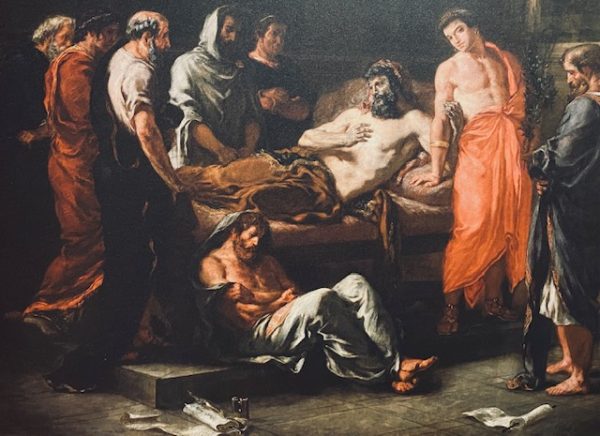
We have been taught by Shakespeare “to be or not to be, that is the question”. In political science we have pondered the question in a slightly augmented form. “to be good or bad, that is our question”. The basic image of women and men in society has been a subject throughout the history of ideas. For those who believe in the good nature of mankind, they tend to find reasons to believe that eventually mankind will find a way towards a peaceful cohabitation on our planet (there is no planet B yet for humans). On the other hand, each outbreak of violence and war are considered as a confirmation that mankind will always recur to some form of violence, even after extensive periods of peaceful cohabitation. According to the evidence presented by Meller, Michel, van Schaik, referring back to Kant, trade between people and nations is likely to prevent more violent relationships (p. 330). One of the major conclusions over the long term view of mankind is, that the periods of war have been far shorter and more rare than a focus on the last 3000 years seems to suggest. Maybe, “to be good or bad” is just a question of demographics of being too many at the same time in the same place.  Population growth and population density might be a powerful driver of “being good or bad”.  (Image: Delacroix, Last words of Marc Aurel)
Piano & Dance

Young talents sometimes offer innovative approaches. This was the case of Amiri Harewood in his performance of short piano pieces in the Espresso series at the Konzerthaus in Berlin. In an effort to take the Berlin audience on a lunchtime journey his program started with Schostakowitsch and Rachmaninow to move to less familiar repertoire from George Walker and Joshua Uzoigwe to “Valses Poéticos” from Granados. The live performance by Amiri Harewood in Berlin was at its best when he started to move head and shouldlers, breathe in tune and dance a bit while playing the piano. This rather unique feature of his performance is certainly different from a “stiff upper lip” or rigid posture we observe too often. This created an interesting “Kontrapunkt” for many in the audience who rather came for the espresso and to visit the building expecting some classic piano in the historic setting of the Konzerthaus Berlin. It took a while until people realized they were up to a unique piano experience. “Neuer Wein in alten Flaschen” = young, fresh music in old bottles or settings.

Climate & Health

The priorities of reporting in newspapers and in media more broadly neglects the direct links between climate change, global warming and public health. The study by Weathers et al. (2025) has investigated this underreporting of scientific facts between 2012-1-1and 2023-12-31 with regard to China, India and the USA. As these are not only big countries, but also among the heaviest polluters. Public health is in the majority of cases addressed as a general public health issue, Extreme heat (51%) and extreme weather (44%) are mentioned most as single issues followed by poor air quality (35%) and food insecurity (25%). The human species suffers from a severe short sightedness when it comes to the public health issues that will intensify due to global warming. Directly following the destructions, worsening health due to heat and pollution, sometimes both even coinciding, will cause additional medium and long term detrimental effects. Although this is known today, there is still little concern about real policy change. The COP 1-30 has achieved little in this respect. It is questionable, whether this format outside of the regular UN institutions (for example within UNESCO) was and still is the right choice.

mAga mEga mIga mOga mUga

Just take all the vowels of the Latin alphabet and the absurdity of the MAGA saga becomes evident. If other states would start to claim like the US under President Trump to make X great again, the world would soon fall into disaster. Let us go through the hypothetical cases like MEGA, make Europe, England or Ethiopia great again. Go back to colonial imperialism? Certainly not. How about make Israel, Indonesia or India great again? Well, that would alarm neighbors, just as much as make Osmania, Oman great again. With the potential of Russia getting its way to keep illegal possession of parts of Ukraine, make Ukraine great again spells continued trouble on the European continent. Once MAGA mania has been unleashed, it is difficult to get the spirit back into the bottle and close it firmly again. Return of brute force rather than diplomatic exchanges become the rule. A return to rule based international politics in a multilateral context needs to be reclaimed by the vast majority of states that have an interest in lasting peace without expansionist views.  (Image from: “The beast is dead”)

Bulimia Capitalism

Each time a wave and speculative bubble in the economy is building up or even bursting there are thousands of people who become drawn into chaos. Let us quickly review: Oil bubbles in the 70s, financial crisis and  subprime lending in housing markets, 1st internet bubble and the year 2000 bugs, AI excesses in 2025. These boom and bust cycles resemble the medical and psychological patterns of a bulimia nervosa. The overly optimistic outlook for AI companies’ future profits and shifts in the size of office space needed for companies announce bulimic behavior when at the same time vomiting by the same companies occurs with regard to investments in nuclear energy plants even in the sites like Fukushima in Japan or Three Mile Island in the USA. Bulimia Capitalism seems to be eating its own children. The upcoming year 2026 will be full of revelations in this respect. (Image: collection of about a hundred barbies exposed on a flea market in Brussels on 5 levels).

Socio-technological obsolescence

The standard literature or AI-sytems will give you a definition of on technological obsolescence, which specifies that obsolescence does not mean that a device is broken, but that it is outdated. In computers this might be due to hardware no longer supporting newer, more resource demanding software, or newer software insisting on the use of other hardware. The seemingly rapid innovation cycles in smartphones, cars or robots might justify such technological obsolescence, but the real advances like shifts from 3G to 4G to the newer 5G mobile frequency standards have taken place rather slowly due to provider coverage of sufficiently large, particularly rural areas.
Therefore, the technological obsolescence has to be enlarged as a concept to socio-technological obsolescence as the societal, legal and economic boundaries of technological innovations have to be taken into account as well. Provisions for health concerns or CO2 saving circularity, i.e. reuse of resources have to be taken into account as part of a precautionary principle.
Computer screens have asked us to move from square designs to wide screens (watch videos) to smartphones’ standards of long formats. My 20 years old square screen has been doing a reasonable job throughout these periods, though not for serious games.
The socio-technological obsolescence relies on a “socio-technical prestige score” of products, like for luxury brands in other industries, where fashions drive obsolescence more than technology.
(Image: Robotic arm made by Kuka writes on paper sheet at Frankfurt book fair 2017)


Foul-smelling dictatorship

The animal world is full of interesting strategies of how to turn over a foul-smelling ruler or dictatorship. The ant queen of “lasius orientalis” infiltrates a colony of “lavius flavus” to spray the incumbent queen with a foul-smelling substance which turns the worker ants against their own queen and eventually kills the queen. This is a rather intelligent strategy to trick the defense system of rival colonies and prepare a takeover of a whole colony to install your own reign.
This may constitute a stark warning for democracies just as much as a threat to persistent dictatorships. In the age of the not so social media there is a lot of foul-smells produced. Beware of the risks to democracy as open societies are much easier to infiltrate than closed societies or dictatorships. (Link)

Philosophy of Voyage

In an interview Claude Lévi-Strauss described himself as a philosopher of voyage. The excursions which lasted sometimes several months to live with indigenous people and study their languages, habits and culture became a scientific field of its own called social anthropology. He travelled with his wife and wrote down hundreds of notes and collected items. Only years later the concept of stuctural theory became evident to him. A voyage might go on after the end of traveling. It might start well before departure as well, not the least due to all the preparations. Colette, the French writer and polyartist, coined the phrase “ce qu’on sait faire, au fond, c’est de la route, ce  n‘est pas du voyage ” in the novel « La chatte ». In the pre- and immediate post 2WW years “taking to the roads” often had a gendered view of this with women being rare to hold a driver’s license. To “find meaning through voyages” or “the voyage is the meaning” fill whole libraries. For better or worse, travel books are still best selling books in a shrinking overall book market (less print books sold, but still higher value of sales).   

All electric again

The “all electric society” has been identified by Dan Wang and Arthur Kroeber (2025 p.48) as one of the underlying driving forces of “The real China Model”. Despite the heavy reliance and pollution caused by China’s use of coal, the large share of electricity  (30%) of energy use is unmatched by the rest of the world except Japan. Investment in electricity grids and innovative ways of mobility around electricity will allow China to buzz rather than steam ahead. Solar cells, batteries for electricity storage and innovative ways of distribution of electricity through AI enhanced “learning” devices will widen the gap between China and other countries that suffer from inefficient path dependency.
Taking the advent of the “All electric society” seriously will free resources through the focus on future-proof technologies. We should not be afraid of the sparks of a short-circuited “All electric society”, the environmental challenges ahead for all of us, particularly China, ask to shift to high voltage solutions urgently. 

Weaponized Interdependence

The shift in the international political system is clearly expressed in the contribution by Henry Farrell and Abraham Newman in “Foreign Affairs” (2025 (Nr. 5) p.25). “… governments must navigate a terrain with many more players, figuring out how to redirect private-sector supply chains in directions that do not hurt themselves while anticipating the responses of a multitude of governmental and nongovernmental actors.”
As the number of bigger global players increases, the complexity to identify best strategies increases as well. Going it alone is only second best to coordinated actions. New matches of interests may result in the medium term. This could entail enormous long term realignments.
Russia attempted to play the China, and subsequently the India, card to achieve new strategic partnerships in this multipolar world. Other international players test new forms of alliances and strategies (like hybrid wars) in this period of weaponized interdependence as well.
The weaponization of such interdependencies puts critical limits to the basic economic rationale and a world building on comparative advantages together with trade, rather than going it all alone or try the coercive way of exploiting dependencies of mineral resources, supply chains, computing power and AI.
(Image: Chess figures attributed to Charlemagne, dating from 1080-1100 ” BNF Galerie Mazarin 2025-10)