Positive negative Utopia

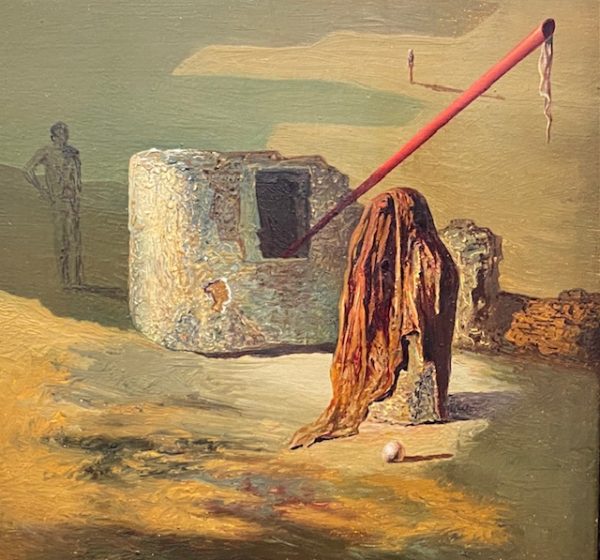
We have been used to distinguish between a positive or a negative utopia. The idea of a paradise is usually associated with a positive utopia, however, from the perspective of mankind being unable to live together without the idea of God being the ultimate arbitrator, this is more like a negative utopia. The industrial revolution and communism as the utopia to spread wealth equally across generations and all people, have been turned into negative utopia by dictatorships and authoritarian regimes. The fascist ideas of superiority of a race has also turned into negative horror and Nazi-terror. Hence, skepticism is in order, if either form of utopia is advocated. There are numerous examples of unintended or not explicitly stated consequences that have to be considered as well. (Image: Extract from Salvador Dali, Looming Danger Alarm, 1934, Neue Nationalgalerie, Stiftung Pietzsch)  
Xmas as information sharing

In modern theories and tests of the importance of information sharing, social learning in groups and the spreading of information in social networks are known to be powerful mechanisms. Hierarchies and survival might be at issue. In the animal model based on mice it the scent that is the byte of information. For humans thinking of information or narratives are probably more appropriate. The story of Xmas has been spread rapidly and the kings arriving to bring presents testify to this powerful mechanism of information sharing in social networks even before the so-called social media existed. Ever since, written accounts of the story were added in addition to regular meetings of persons who continued to share the story. Add music and theatre to the transmission of the story and the mechanism reaches even broader audiences, and maybe devoted believers. As behavioral flexibility might increase as well, more than one interpretation or ritual of the same narrative is likely to arise over time. In the animal model food is the major reward system. For humans the reward systems are more complex with forms of delayed gratification. Information sharing about the importance of delayed gratification takes us into new spheres of humanity versus rational choice. (M-P Brussels). 

Good or bad

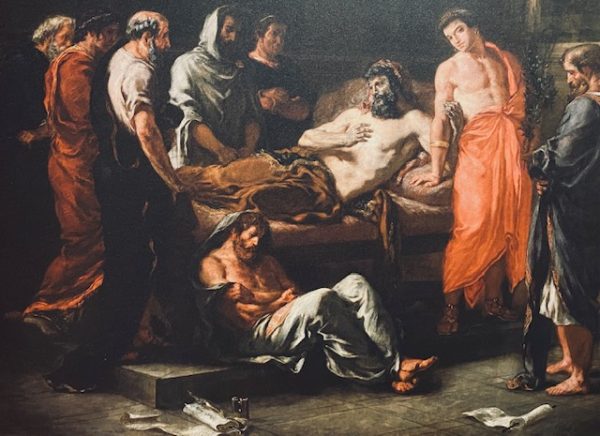
We have been taught by Shakespeare “to be or not to be, that is the question”. In political science we have pondered the question in a slightly augmented form. “to be good or bad, that is our question”. The basic image of women and men in society has been a subject throughout the history of ideas. For those who believe in the good nature of mankind, they tend to find reasons to believe that eventually mankind will find a way towards a peaceful cohabitation on our planet (there is no planet B yet for humans). On the other hand, each outbreak of violence and war are considered as a confirmation that mankind will always recur to some form of violence, even after extensive periods of peaceful cohabitation. According to the evidence presented by Meller, Michel, van Schaik, referring back to Kant, trade between people and nations is likely to prevent more violent relationships (p. 330). One of the major conclusions over the long term view of mankind is, that the periods of war have been far shorter and more rare than a focus on the last 3000 years seems to suggest. Maybe, “to be good or bad” is just a question of demographics of being too many at the same time in the same place.  Population growth and population density might be a powerful driver of “being good or bad”.  (Image: Delacroix, Last words of Marc Aurel)

How could this have happened

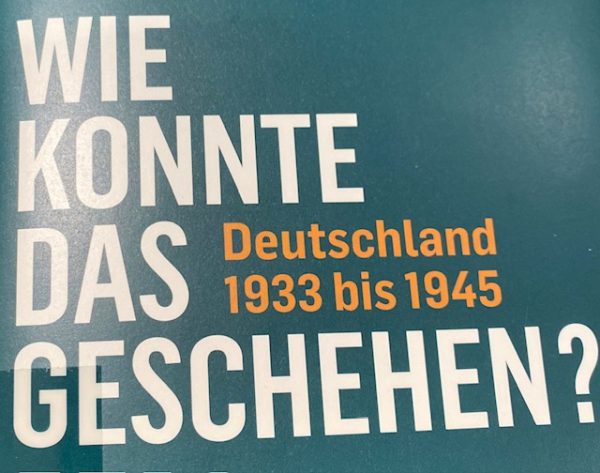
The latest thorough reflection on how the Nazi-terror could have stopped or being prevented remains an important question in our time. The more we see countries descend into the authoritarian regime types, the more we have to know our lessons from previous historical experiences. Götz Aly made a great contribution to this literature. He points our attention to the collective euphoria the Nazis (NSDAP) managed to make people believe, by at the same time blaming others for the past crises. People just wanted to believe the fake narrative of a promising future (p. 175) for a society based on social exclusion. The pattern, unfortunately, seems to find its replication in other parts of the world nowadays. This is a very slippery road which often leads to disaster rather than relief. Easy or catchy answers are preferred by many people rather than the nuances of well-informed differentiated options. Patience in social development is a collective virtue, but often misunderstood as a form of conservatism, which is is something very different.

Rilke’s Advice

One of the poems by Rainer Maria Rilke is entitled “You don’t have to understand life”.
And the first line of the first paragraph just repeats the programmatic sentence of the quite revolutionary romantic movement. Following a century of the enlightenment, which narrowly developed and focused on rationality and Kant’s “Critic of pure reasoning”, the authors of the romantic movement were eager to explore the world beyond reasoning again.
“Du mußt das Leben nicht verstehen,
dann wird es werden wie ein Fest.”
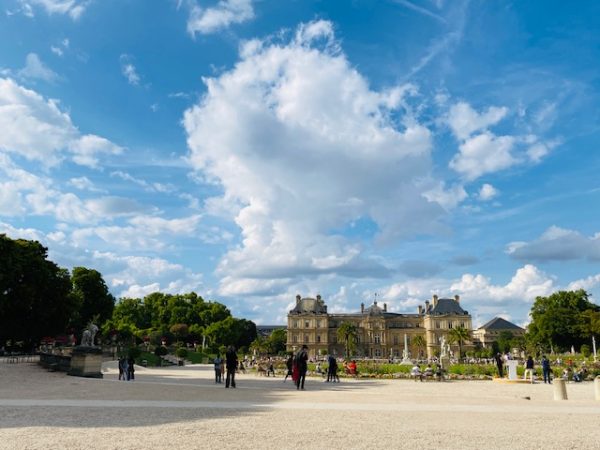
Rilke brings back the exuberant, Dionysian element into literature and captured the new spirit of his time. After a period of fast innovation in the sciences and applications of them in day-to-day life, Rilke revels in the innocent days and years during childhood, where youth is simply asking for more without hindsight. In doing so: “Life will be a like a feast”. So be it, we should like to add. (Rilke wrote a poem « Das Karussell » with subtitle Jardin du Luxembourg, Image below)

Generation Hope

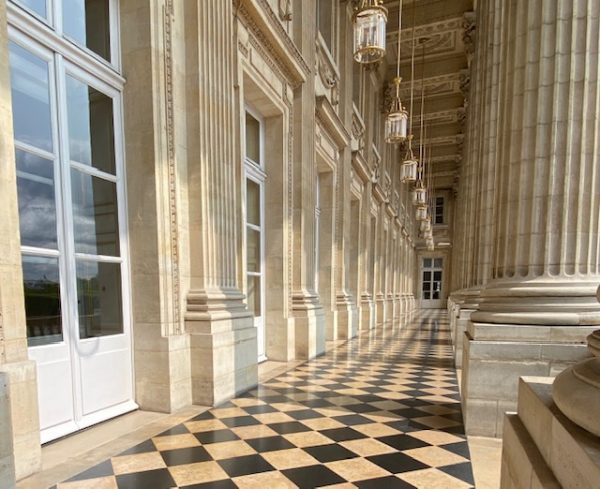
The whole of Europe has good reasons to take a careful look at the stunning protests organized by the young generation in Bulgaria (Le Monde, 2025-12-13). With spectacular repeated demonstrations in the center of Sophia, the young people attempted to stop a government that is likely to sink further into corruption. It is this generation of young people that have experienced and/or lived in other European countries or in other Western-style democracies around the globe that have enough of corruption in politics and social systems more generally. The well-educated Bulgarian youth has managed to overthrow a government that had been subject to pressure from corrupt forced. It is not easy to get rid of corrupt politicians and powerful business interests as a system based on merits rather than ability to pay remain fragile in the first few years of such a transition. It needs a sizable “Generation Hope” as I would like to call these young enthusiasts of democracies. The message reaches well beyond Bulgaria and gives hope to all those whose political systems deteriorate into authoritarianism across the globe. It took 20 years to build this “Generation Hope” and mobile youth that takes home the messages and learnings from other democracies. Based on statistics from Eurostat we know about the strong in-migration from Turkey and Russia into Bulgaria. Youth is particularly likely to leave authoritarian regimes to seek a better future in democracies, for example as part of the Generation Hope” in Bulgaria. (Image: Cour constitutionel Paris) 

Jewish book art in Berlin

One of the treasures of books in the collection of the Staatsbibliothek in Berlin is the Hebraica collection. It is currently presented in the museum space of the library. The curators Martini and Eichhorst have succeeded in the task to present the sanctuaries in a form that a larger public can better understand the skills needed to produce these fine pieces of art and worship. Similarly, great care has been taken to explain the formidable task to preserve and sometimes restore these precious pieces. The exhibition explains in an accessible manner what place each piece has in the Jewish tradition and regional varieties. Examples of annotations to assist interpretation of the texts or graphical annotations complement the original documents and sacred texts. These exhibits allow a  for a starting point for a better understanding of the importance of the Hebrew Bible and the scrolls of the Book of Esther in the practice of Jewish rituals. A more permanent exhibition could greatly enhance inter religious understanding and respect of traditions. 

Dancing School

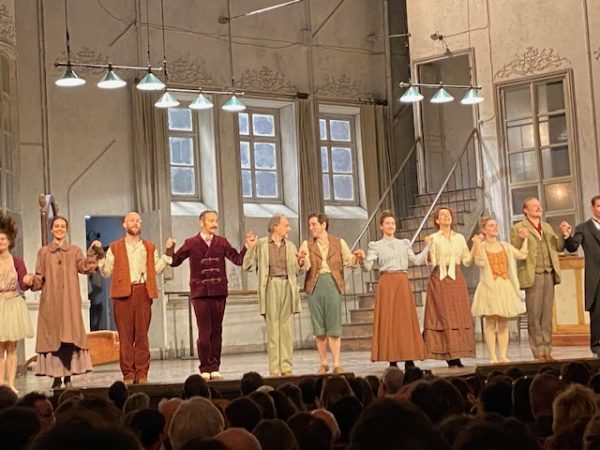
Most of us know very little about what happens in a dancing school. This has intrigued artists for centuries. The Paris-based “Comédie francaise” has chosen the “L’école de danse” de Carlo Goldini as one of the pieces to enter its repertoire in 2025. Whereas modern dance celebrates the freedom of motion of humans, the early 18th century theatre piece by Goldini is a comedy in which the tyrannic ballet teacher attempts relentlessly to maximize profits based on the talents of the dancers either by placing them at a high reputation theaters or marrying them. Of course, each time a sizable commission has to be paid to the dealer of talents. Sounds familiar to what happens in other professions today, doesn’t it?
The borders between “dealing with love” and “dealing in love” become blurred in this comedy and Goldini shows his talent to play out intrigues on stage in an admirable way. It is a pleasure to experience the fun on stage with the manifold intrigues. (Image: actors of Comédie francaise in L’école de danse 2025-12).

Europe x.0

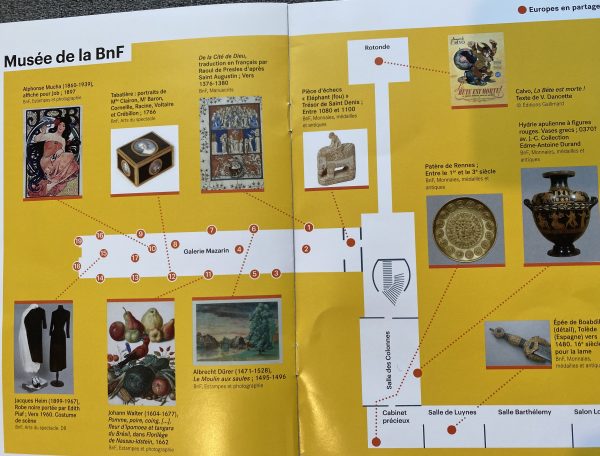
There are many places to ponder, think or dream about Europe. The centre of Paris is certainly a great place for this. More precisely, the “Galerie Mazarin” invites us to pass the centuries looking and reading about artefacts that made Europe or all different versions of it across history and geographic spaces. The short extracts of chansons that we share and shared across Europe are presented in their original language, which highlights the multilingual heritage of the different versions of Europe. There are parts of the heritage, which have fallen into oblivion like the customary use of tobacco exposed with a “tabatière” and a poster advertising paper for your cigarettes. Of course, the “Robe noire portée par Edith Piaf” on a stage is another highlight of the visual and audio joint European heritage.
Where do we go from here? Image Europe with an emphasis on its shared culture. There is so much diversity to be found in each country and regions within countries, but a shared appreciation of the valuable contributions to the whole. This builds a shared European strength, which has proven to overcome several fierce wars. This is the future-oriented version of Europe xx.0. (Image: BNF Musée Europe en partage, 2025)

mAga mEga mIga mOga mUga

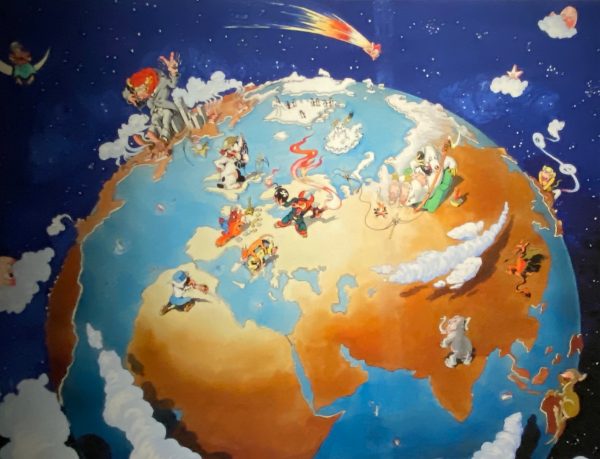
Just take all the vowels of the Latin alphabet and the absurdity of the MAGA saga becomes evident. If other states would start to claim like the US under President Trump to make X great again, the world would soon fall into disaster. Let us go through the hypothetical cases like MEGA, make Europe, England or Ethiopia great again. Go back to colonial imperialism? Certainly not. How about make Israel, Indonesia or India great again? Well, that would alarm neighbors, just as much as make Osmania, Oman great again. With the potential of Russia getting its way to keep illegal possession of parts of Ukraine, make Ukraine great again spells continued trouble on the European continent. Once MAGA mania has been unleashed, it is difficult to get the spirit back into the bottle and close it firmly again. Return of brute force rather than diplomatic exchanges become the rule. A return to rule based international politics in a multilateral context needs to be reclaimed by the vast majority of states that have an interest in lasting peace without expansionist views.  (Image from: “The beast is dead”)