Holocaust commemoration

The commemoration of the Shoa or the Holocaust is part of an international remembrance of atrocities against humanity. It needs to be present in countries beyond Germany, even if Germany under Hitler’s rule caries the sole responsibility for the ruthless execution of a plan and the murder of 4 million of its own people of Jewish decent and additional 2 million Jewish people of neighboring countries. In the speech by Tova Friedman, a Shoa survivor, she pointed to the perceived threat which children posed to the Nazi-regime as witnesses of mass murders. There she is. In front of the whole nation she testifies for what seems like a distant past, but for many this past is still not over. Responsibility of Germany does not stop after a certain number of years, maybe in judicial terms, but a moral obligation to act against denial of these atrocities is primordial. 20 years after the inauguration of the memorial of the holocaust in the center of Berlin and the exhibition center “topography of terror” (image below, 2026-1-27) we should start an initiative to make the International Day of the commemoration of the holocaust a national day, of commemoration, where all daily routines are paused in Germany to give people time to act and reflect on what can be done that such atrocities will never happen again.

Utopian Antifascists

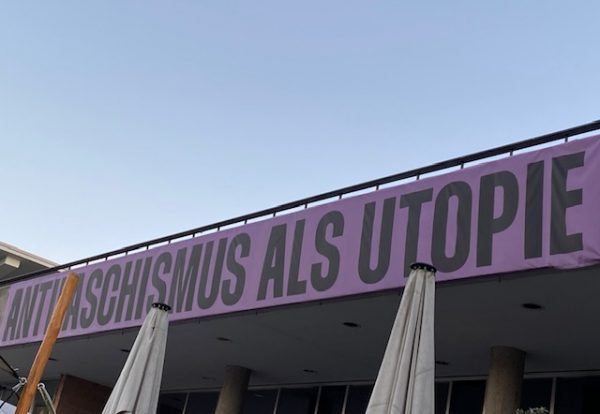
Next to the exhibition on “Global Fascism” in Berlin in 2025-12 there was a banner on the wall, which stated “Antifascism as Utopia” (see image below). This statement invites the question, whether an antithesis can serve as a positive utopian idea guiding large numbers of people. It is certainly necessary that all people who subscribe to democratic principles and human values should be able to unite under the banner of antifascism, but the ways to pursue this goal are manifold. This makes the claim of an utopian objective a bit more obvious and, at the same time, more plausible as a potentially overarching objective. The statement might well turn out to be the defining statement or key visual of the year 2026 with rising nationalist and in some places also fascist ideas and rhetoric. Thoughts and words might be only precursors of more such actions in the coming months. 

Positive negative Utopia

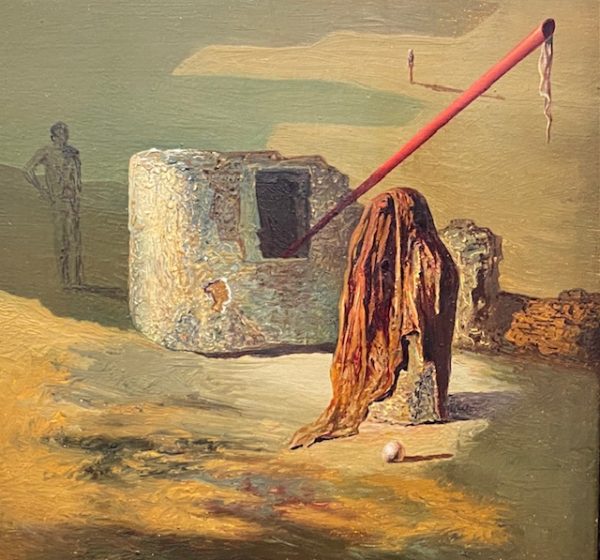
We have been used to distinguish between a positive or a negative utopia. The idea of a paradise is usually associated with a positive utopia, however, from the perspective of mankind being unable to live together without the idea of God being the ultimate arbitrator, this is more like a negative utopia. The industrial revolution and communism as the utopia to spread wealth equally across generations and all people, have been turned into negative utopia by dictatorships and authoritarian regimes. The fascist ideas of superiority of a race has also turned into negative horror and Nazi-terror. Hence, skepticism is in order, if either form of utopia is advocated. There are numerous examples of unintended or not explicitly stated consequences that have to be considered as well. (Image: Extract from Salvador Dali, Looming Danger Alarm, 1934, Neue Nationalgalerie, Stiftung Pietzsch)  

How could this have happened

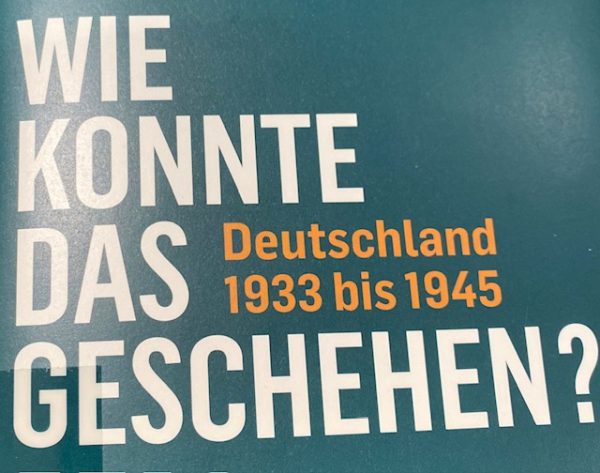
The latest thorough reflection on how the Nazi-terror could have stopped or being prevented remains an important question in our time. The more we see countries descend into the authoritarian regime types, the more we have to know our lessons from previous historical experiences. Götz Aly made a great contribution to this literature. He points our attention to the collective euphoria the Nazis (NSDAP) managed to make people believe, by at the same time blaming others for the past crises. People just wanted to believe the fake narrative of a promising future (p. 175) for a society based on social exclusion. The pattern, unfortunately, seems to find its replication in other parts of the world nowadays. This is a very slippery road which often leads to disaster rather than relief. Easy or catchy answers are preferred by many people rather than the nuances of well-informed differentiated options. Patience in social development is a collective virtue, but often misunderstood as a form of conservatism, which is is something very different.

Fighting the Beast

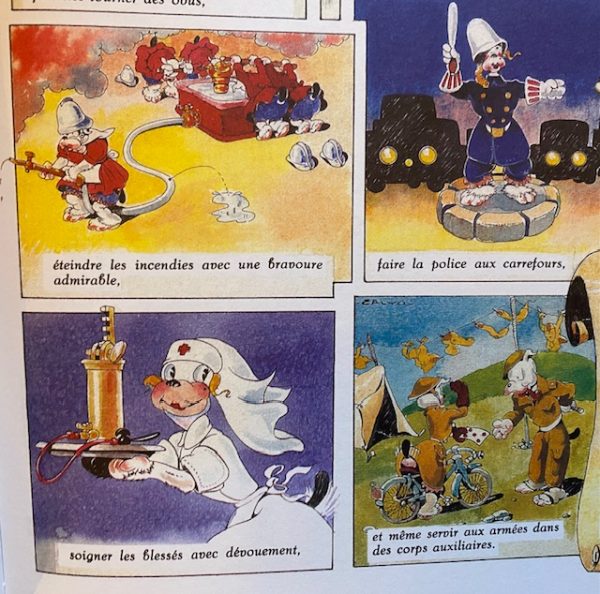
The earliest post 2nd WW cartoon stems from Calvo in France, published in its first edition in 1945. After the first part entitled “When the beast became unchained”, the second part could report on the happy ending “When the beast was overturned”. Amongst the admirable comprehensiveness to talk about the preparation of war, the battles and atrocities committed by the wolves, the allied forces of animals gained the upper hand. The role of women in the fight against the beast takes almost a whole page in the historically precise narrative of the 2 WW. With a fine sense of necessary historical detail, the reporting of British women (the female dogs in the cartoon) as essential part in the war effort to win the war against the beast(s). Women exercised professions were not previously allowed to enter. Gender awareness as early as the mid 1940s was rather advanced at the time.
Great topics to talk about with your children or grand-children.

The Beast is dead

The BNF and the gallery Auguste Rondel celebrate the acquisition of the original drawings of “La bête est morte” by „Calvo“ at the fabulous Richelieu site. The appearance of the story and cartoon in 1945 was a landmark in artistic achievements for several reasons. (1) Calvo made it possible for whole families to talk about the horrors of war and the Shoa by use of text and images in an form of an animals’ world, well known in France. (2) Because all generations are familiar with the fables written by Jean de la Fontaine, the story set in the world of animals is both appealing and yet a bit more distant than drawing human faces on this traumatizing reality. (3) The cartoons managed to overcome the barriers to understand the beginning and ending of World War II and the geographical spread.
Uderzo, the well known cartoonist of “Asterix” did small services for Calvo when he was still an adolescent in 1945. Learning from the best of a field can give you a head start later on.  (Extract of Image  by Calvo 1945). 

Social Anthropology

Dina Dreyfus, married several years to Claude Lévi-Strauss, has shared with Claude the long anthropological expedition to Brazil in the 1930s. They jointly studied the social organization of indigenous people across Brazil. Their abundant notes of field studies have now been digitized and the BNF is making this accessible.
Additionally, an exhibition on these field studies reveals the close collaboration of both partners. Returning to France in 1939 meant that soon after the return due to their Jewish decent had to interrupt their academic careers in France and some notebooks were lost during the Nazi occupation of France. After the war both separated and Claude Lévi-Strauss embarked on the drafting of the structuralist theory, Dina became influential in the field of the philosophy of education and teaching philosophy herself.
Besides all these lasting achievements, the exhibition shows the typewriter which had accompanied them for many years. The German language layout is quite remarkable as this asked for an additional mental versatility in putting their thoughts and experiences into the form of a manuscript. According to Claude Lévi-Strauss the use of this technical device allowed him to detach himself emotionally from his analytical work.
(Image: Exhibit: typewriter Claude Lévi-Strauss, BNF 2025-10)

Jewish Heritage

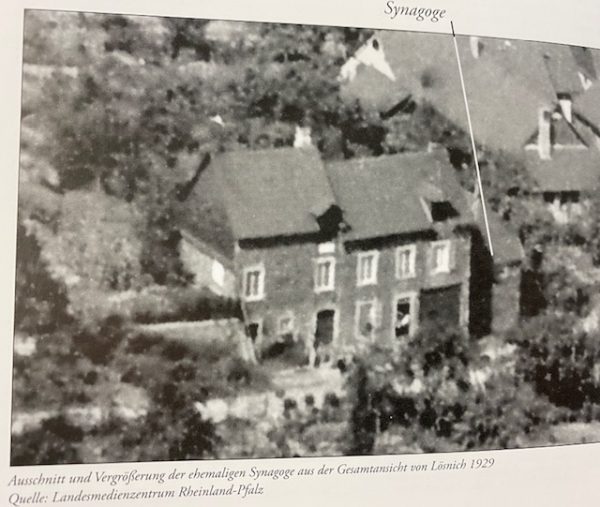
In the Germany of the 21st century, we have to dig deeper into history to understand the Jewish heritage due to the horrific terror of the Nazi-regime and it’s millions of supporters. The traces can be found in some historic photographs even in the countryside. Marie-Louise Conen and Hilde Weirich (2010) have thoroughly studied such documents for the Moselle village of Lösnich. The little annex to a house served as a Synagogue (image below). The village has a history of Jewish settlements which extended to neighboring villages as well. Interestingly, the heritage of Napoleon’s occupation of the Rhine and Moselle regions brought equally for all men (not yet women) and the separation of the state and religion making Jewish life, property acquisition more easy. The tolerance of the 19th century was then reversed by Nazi Germany again. History is present in many places, where we do not seem to expect it nowadays. 

Memories updated

In Berlin and many other German cities it is a regular practice to scrutinize the memory inscribed into street names. In order to correct the honors given to persons with a past as fascist or responsible for mass killings street names were changed at several points in the history of the city. Streets named after battle fields, for example, are a continuous point of discussion. It is important to keep the perspectives of victims in mind. Therefore, changing street names is a little contribution to rethink the role of places and persons. Such changes are sometimes very controversial as people become accustomed to names, some might even not care much at all. Recognition and responsibility, however, have a lot of currency in historical perspective. Overpainting like in the paintings from Gerhard Richter has an important function in society and can be one way of coping with the demons of the past.

Margot Friedländer memorial

Berlin has been honored by the return of Margot Friedländer who had survived the Shoa in 2010 at the age of 88. Her whole family was murdered in concentration camps by the Nazis. Ever since her return and especially after her biography had been published she was a restless ambassador in the fight against hate, exclusion and the neo-fascist movements. She has been engaged in interreligious dialogue and even through the ceremony after her death, she tried to bring together different Jewish communities in Berlin.
Irrespective of a person’s background she met everybody on an equal level.
A great example to thousands of people, she managed to meet in her life. Each time she met with pupils or students to speak about her horrific experiences she lived through the same traumatic experiences again and again, but turning this into the strength to “vaccinate” people against the deadly virus of fascism.
The day after she had been buried in her family’s grave in Berlin Weißensee people still had to queue to sign the book in her memory in the Berlin town hall. She will be remembered and missed for her unrivalled humanity and generosity. She became engaged to fight for humanity and remained an activist until her very last day at 103 years of age.