More about books

The Frankfurt book fair opens its books and doors on 2026-10-7. The thousands of authors, publishers, translaters and agents are quite concerned about the amount of infringements that AI has brought to the industry. The market is under increasing pressure to secure intellectual property rights and copyright protections. A flood of AI-produced books shall ruin margins out of which authors are paid as well. The spreading of ideas in form of books across borders is threatened. Sebastian Guggolz from the German book trade association claimed even a double theft, first the books, then the ideas by AI. In order to counteract this, the Frankfurt book fair is continuously expanding is function as a platform of exchange of ideas (Juergen Boos) and face-to-face meetings of all involved in writing, editing, producing, trading, teaching and discussing books in the broadest sense. This discourse about books is the real human added value which AI is lacking so far. In this sense of talking about books, books become a kind of merchandising product of an event or a form of take-home-message to participants. A great and promising forward looking agenda for us rather than the retro-captive approach of AI. 
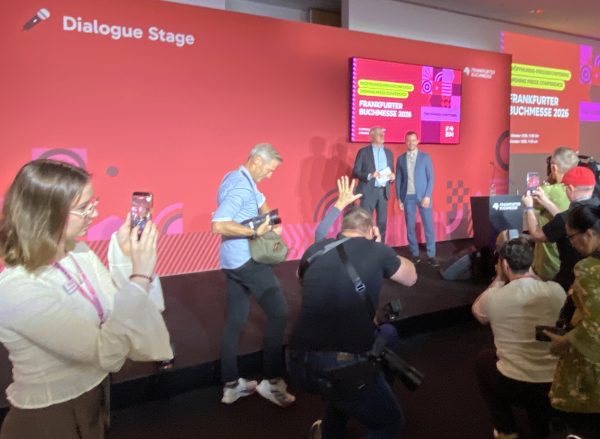
Frankfurt book fair 2026-10-6 press conference

Gone napping

There are cultures where naps are part of a national identity. People living in hot climates are very familiar with the benefits of a napping. Due global warming, the spread of napping as a time to recover or limit yourself from strain during the hottest hours during a day. Napping is not limited to humans, the animal world has many species which also adopted the power of napping. As with many processes the duration is of crucial importance. In short, don’t overdo it. Too long a nap is likely to impede a good night’s rest. Even while at work,  colleagues manage to throw in a short re-powering session at times locking doors to feel safe. Techniques differ, but the hotter the workplace, the more the healthy they are. Efficiency and overall productivity at work do not suffer. In many creative professions the time spent at your desk correlates little with indicators of success. However, we still know little about the effects of regular napping on longevity. 

Phoques on beach 2026-9

Paper and Scissors

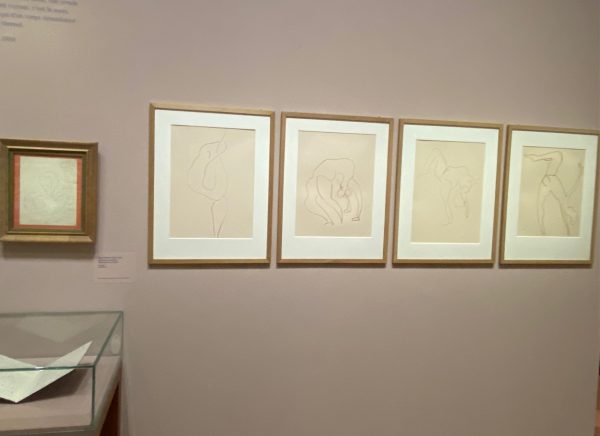
In order to produce art it is not always necessary to have expensive materials at your disposal. Henri Matisse has demonstrated that paper and scissors can go a long way. With this in mind, the work by Johanna Beckmann, shown in the upper hall of the “Kulturforum” in Berlin, is quite astonishing. Beckmann relied on just paper and scissors, in addition to her paper and pencil work, to illustrate her own texts as well as collections of fairy tales. Her paper cuts of some hobbit stories might be remembered by a whole generation of children and even some of today’s world. Paper cuts and theatre based on such figures have been a cross-cultural treasure. The illustration of stories, but also the creation of own characters might be derived from such cuts using just paper and scissors. The “Kunstbibliothek” and the “Lette-Verein”-academy in Berlin joined forces for this exhibition and they both continue to transmit this creative craft to students actively involved in this “intergenerational exhibition”. Please bring your (grand 😉 children.
All those who travelled to Paris recently will be well aware that at “Montmartre” you can still have your profile cut these days. At this exhibition there is a “do-it-yourself” section, not only reserved to children.

Polyartist Colette

It is a complex task to do justice to a polyartist like Colette. The curators of the exhibition “Les mondes de Colette” (BNF 2025) Bouvard, Dimerman, Le Bras do a great job to present the biography of Colette, the writer, journalist, dancer in music halls, model (for Matisse) and entrepreneur in all facets of her activities. The role model of an emancipated women as early as the 1910s, 1920s and 1930s. The struggle of women artists in the early years of the 20th century to make a living from art is well documented already. To make a living of writing has always been a challenge if you do cherish your independence and liberty of expression. Versatility in artistic production is one escape route. Colette made a strength of this in diving into different forms of art and professional activities close to the artistic and creative world. In a quite unique way, she became her own muse for her own artistic work; and a character and inspiration exploring many facets of live. The economic misfortune experienced her parents became a source and force of inspiration.
Contrary to the expectations of the market of arts and literature, she did not feel like sticking to just one activity. Her most lasting achievements, probably, were her literary accomplishments for most people, although Matisse immortalized her in his specific style of abstraction.
Polyartists just like Polymaths, make more comprehensive contributions to our experiences.
(Image:Lithographie by Henri Matisse of Colette, exhibition Colette at BNF 2025).

Video Doku by AI

Based on my own blog on this webpage “schoemann.org” Google NotebookLM creates a video of about 7 minutes. Using Microsoft Clipchamp automatic subtitles with a slightly different storyline are produced based on the video data. In the end, the blog entries are re-modelled into something like a lecture on “AI in a wider social context” (see and play below). No voice layover so far, read by yourselves. A podcast format is another option.
It feels like walking across landscapes in my own mind. Content creators of today or the past never imagined the impact they might have through the powerful tools of AI. The only caveat, jokes I incorporated into the texts cannot really be handled by AI tools unless they are explicitly designated as such. These AI tools take me much more seriously as I do myself. This is serious.

Claudel & Hoetger

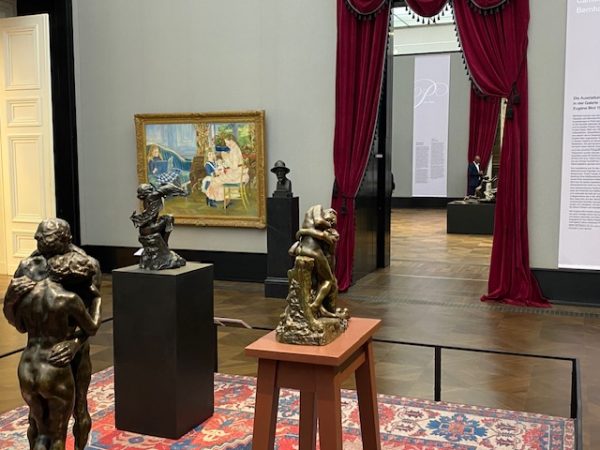
It is well known that artists joined other artists and groups to get inspired. The entangled relationship between Camille Claudel and Auguste Rodin has become a special example of the tricky relationship between learning and co-creation or inspiration. The role of galerists in building a reputation for artists is less well understood. The “Alte Nationalgalerie“ in Berlin opens up this black box a bit through juxtaposition of Camille Claudel, Bernhard Hoetger as disciples of Auguste Rodin. The influences are rather obvious, yet each disciple developed her/his unique style. The emancipation was not without frictions. The galerist Eugène Blot organized a joint exposition of both disciples in 1905 in Paris, which is partly reproduced in Berlin 2025. Great work by the curators of the exhibition Yvette Deseyve and Sintje Guericke who managed to bring together unique sculptures from 3+ museums and a great explanation of the links between the artists as well as the proximity of ateliers. (Image: view of showroom in Alte Nationalgalerie Berlin, Claudel & Hoetger 2025)

Satie Popular

Erik Satie has been quite involved with the surrealist and Dada movement of his time. He personally knew the main proponents ranging from Breton to Magritte. He became one of the major figures applying the ideas of surrealism to music. His early compositions like the Gnossienne (extract of Nr. 1 below) are admired for their simplicity. They became popular only years later and have entered popular music repertoire through many retakes of the original tune in various styles ranging from jazz to rap. Many of Satie’s formative years he spent playing and performing popular music in the animated cafés, bars and shows of Montmartre in Paris. The making of a living based on music can be a challenge. Satie had to bear the full risk of a life in poverty at times to reserve sufficient time for his creative work.
He remained very much connected to the working class as his later membership of the Communist party after the Great War testifies. Composing for children and transmitting music to the next generation was equally close to his heart and mind, especially in his later years.
For him, popular music constituted a fountain of original tunes and a test with an intuitive audience rather than the academic circles. Maybe, with this attitude, he followed the footsteps of Flotow, Offenbach, Ravel and many others later on until pop music became the vastly dominant music in the late 20th and 21st centuries.

Erik Satie Satisfied

The collection of letters from Erik Satie contains more than 1000 letters amongst them some in exchange with the best artists of his time. The range is largely due to the circle of artists who met at Montmartre in Paris before and during the Great War. We discover letters to Maurice Ravel, Claude Debussy, Pablo Picasso or Henri Matisse. For some artists there are 100+ letters preserved like to Jean Cocteau. In the 1920s he composed music for shows at Montmartre, where the scenario was painted by Pablo Picasso and costumes designed by Coco Chanel. The sculpture by Brancusi must have been familiar to him, just as much as the cubist paintings by Georges Braques, as there are also letters or references to such letters in the impressive 1000+ pages collection. Like Ravel he was rejected by the Conservatoire de Musique de Paris in his early days as student. Montmartre allowed to live and create at the same time while living on a minimal budget. Erik Satie signed his letters with ES. In German this denotes a “neutrum”, maybe, beyond male or female differentiation, but also a tonality in music (E flat). There is no trace that this was a conscious choice. It is just another unresolved puzzle about the self-declared “Gymnopédiste” and composer of the “Parade” and the popular piano music the “Gnossienne”. 100 years after his death on 1925-7-1 he (ES) could be rather satisfied with his impact on the course of music in the 20th century and beyond.

Musician Historian

Musicians are usually perceived as “part of history” rather than being historians themselves. However, recent research on Bob Dylan has extended that view to portray Dylan in his role as historian as well. The issue here is more with the historical periods and references the musician, composer and song writer builds on and interprets historical events. Thereby, his thoughts and impressions on living through historical events enter into his work as an artist. Dylan is literally “doing history”. He puts events of past and present into perspective of his own making and reached authority through the non-conformist perspective, which connected him to as a performer to his various audiences. His approach to doing history consists in the re-presentation and re-creation of historical narratives. Nina Goss (2024) in her book review highlights the “irruptions of the past into the present unique in popular culture”. The re-arrangement of fact and fiction encourages us “to inhabit, question, and revise historical narratives and tropes” (p.399). Several musicians have specific ways of reflecting, sometimes critically, on history in their artistic work. Bob Dylan certainly is a very prominent example of this an has been honoured for this by the Nobel Prize for literature. It remains an interesting perspective to review composers and their choice of libretti for operas as a way of doing history. The shifts from royal drama to revolutions and popular scenes are in this line of interpreting musicians also as historians.

Archi Octagon

The architecture we see around us has lots of interesting mathematical features. Some are the basis for more complicated calculations. The octagon shape is not that common, but with some formulas the calculations become easier and construction in the real world is more feasible. Well worth to dig a bit deeper into this shape. The geometry of angles and circumference follows rules that have been laid out a long time ago. The webpages explaining this are manifold and it is a project of its own kind to compare them and recommend the best ones. My current favorite is: mathmonks. A reasonable choice is in most cases also wikipedia, the long running amazing knowledge project also for the octagon.

Image: Berlin Europa Center 2025.