Holocaust commemoration

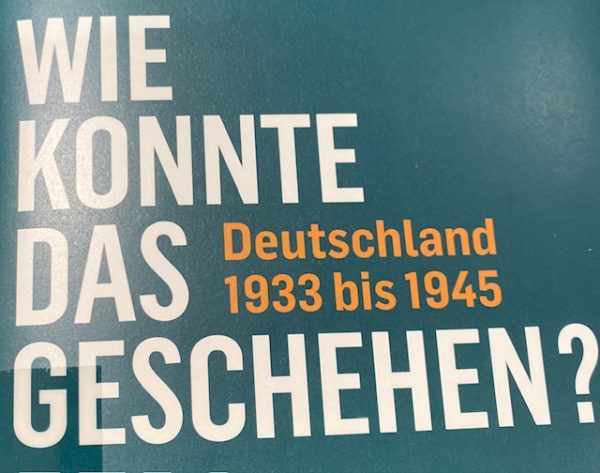
The commemoration of the Shoa or the Holocaust is part of an international remembrance of atrocities against humanity. It needs to be present in countries beyond Germany, even if Germany under Hitler’s rule caries the sole responsibility for the ruthless execution of a plan and the murder of 4 million of its own people of Jewish decent and additional 2 million Jewish people of neighboring countries. In the speech by Tova Friedman, a Shoa survivor, she pointed to the perceived threat which children posed to the Nazi-regime as witnesses of mass murders. There she is. In front of the whole nation she testifies for what seems like a distant past, but for many this past is still not over. Responsibility of Germany does not stop after a certain number of years, maybe in judicial terms, but a moral obligation to act against denial of these atrocities is primordial. 20 years after the inauguration of the memorial of the holocaust in the center of Berlin and the exhibition center “topography of terror” (image below, 2026-1-27) we should start an initiative to make the International Day of the commemoration of the holocaust a national day, of commemoration, where all daily routines are paused in Germany to give people time to act and reflect on what can be done that such atrocities will never happen again.

Utopian Antifascists

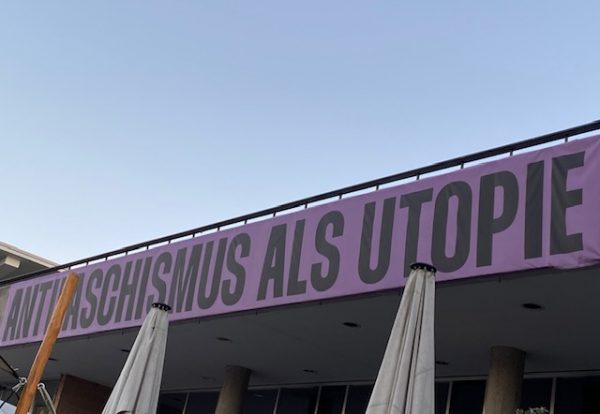
Next to the exhibition on “Global Fascism” in Berlin in 2025-12 there was a banner on the wall, which stated “Antifascism as Utopia” (see image below). This statement invites the question, whether an antithesis can serve as a positive utopian idea guiding large numbers of people. It is certainly necessary that all people who subscribe to democratic principles and human values should be able to unite under the banner of antifascism, but the ways to pursue this goal are manifold. This makes the claim of an utopian objective a bit more obvious and, at the same time, more plausible as a potentially overarching objective. The statement might well turn out to be the defining statement or key visual of the year 2026 with rising nationalist and in some places also fascist ideas and rhetoric. Thoughts and words might be only precursors of more such actions in the coming months. 

How could this have happened

The latest thorough reflection on how the Nazi-terror could have stopped or being prevented remains an important question in our time. The more we see countries descend into the authoritarian regime types, the more we have to know our lessons from previous historical experiences. Götz Aly made a great contribution to this literature. He points our attention to the collective euphoria the Nazis (NSDAP) managed to make people believe, by at the same time blaming others for the past crises. People just wanted to believe the fake narrative of a promising future (p. 175) for a society based on social exclusion. The pattern, unfortunately, seems to find its replication in other parts of the world nowadays. This is a very slippery road which often leads to disaster rather than relief. Easy or catchy answers are preferred by many people rather than the nuances of well-informed differentiated options. Patience in social development is a collective virtue, but often misunderstood as a form of conservatism, which is is something very different.

Local history

In Berlin and many other big cities in Germany like Munich and Hamburg there are local history projects which tell the stories of specific places or a house linked to liberation day or deportation or courageous acts during the Nazi  grip on Germany and terror across Europe. The initiative « Denkmal am Ort » has become a kind of citizen science project which brings people together to raise awareness again for the cruelties committed under the dictatorship of Hitler and the fascist political movements. Remembrance is not a passive form it can take many active forms as well by simply trying to find an answer to the question what happened during the 30s, 40 and 1950s in the house you are currently living in? Access to archives of cities and small towns can tell very surprising stories about local history. It is a great inter generational experience as well and sometimes the unspoken history turns into a great conversation about history and responsibilities. History is everywhere you just need to keep your eyes and mind open.

Constitutional Responsibility

The memory of horrors caused by Nazi-led Germany before and during the 2nd World War is our constitutional obligation in the Federal Republic of Germany since its beginnings in 1948. 80 years after the unconditional surrender this has become a state responsibility. Since the shift of tone introduced by Richard von Weizäcker on 8th of May 1985 framing the end of the 2nd WW as liberation day in Europe and Germany. On the same day, 40 years later, the top 5 political instances of democracy in Germany, president, chancellor, presidents of the parliament (1st chanber), the council of the regions (2nd chamber) as well as the constitutional court. The constitutional and moral responsibility of the crimes is not reserved to a presidential address, but all pilars of democracy in Germany committed to the narrative of a liberation of Germans and Europeans at the end of the 2WW. It is a truly European topic to celebrate the end of war jointly in all countries. This is even more the case as the memories of the last survivors of the Shoa in Europe is less transmitted by the rare survivors until today due to very old age. The impressive unity of the top constitutional powers sets a the path for a far reaching renewal of the acknowledgement of a specific constitutional responsibility to counter extremist tendencies. The speeches by Frank-Walter Steinmeier and Julia Klöckner in the Bundestag (Link in German) were remarkable in explaining in plain language, why we are happy about this liberation also in Germany. The emphasis of the end of pervasive and endless oppression and suffering caused by the Nazi-regime are an essential part of this feeling of liberation. With this commemoration Germany today has become even more a European nation which takes its historical responsibility seriously.

Gedächtniskirche Berlin

The church of commemoration „Gedächtniskirche“ in German has been chosen as the central place of commemoration on Liberation Day in Germany for the ceremony of all religions. All institutions of democracy were represented in addition to the president of the FRG. The church was destroyed, but not completely and the decision to keep the remainders as a permanent warning is visited by thousands of people each year. The public television broadcasts live from the ceremony and some regions of Germany have chosen Liberation Day as a bank holiday following many other European countries. The official end of fighting of the 2nd World War 80 years ago has spurred many events. The need to understand how this could happen and how to guard against extremism to take hold of a country and start a war have preoccupied following generations. The task is not accomplished yet as many people still deny the facts or try to rewrite historical facts with misleading interpretations. The commemoration is well worth a pause to reflect, for example, what were my grandparents doing during these years. Beyond the speeches on this day there are many ways to get involved in carrying the memories to the ones born later.

Lasting memory

On the 8th of May 2025 we celebrate 80 days of liberation from the Nazi regime in Germany. It is the liberation of all those who survived the horrors of oppression and war. The Nazi terror intensified  after the power grip in 1933 and reached unprecedented levels throughout the ruling of the NSDAP until the Allied Forces managed to chase down the last fighting cells and Hitler hiding in a bunker before he killed himself. Liberation was the experience of survivors all across Europe. On this day and on many other commemorations it is important to remember the 60 millions of people who died due to the Nazi terror before and during the war. The “Stolperstein” initiative commemorates the millions of Jewish people who were deported or had to flee Germany and even neighboring countries to survive. In Berlin there are yearly activities to clean the “Stolpersteine” so that they are visible enough to remain a lasting memory of the horrors. (Image: Cleaning of Stolperstein in Berlin Schöneberg organised by Michael Biel on 2025-5-4). 

Biography Memorial

Some biographies take the form of a memorial. Marie-Luise Conen and Zdravko Kucinar have erected a memorial for the researcher, author and Social Demokrat “Milian Schömann” from the “Moselle” region near Traben-Trarbach and Lösnich. The biography reads like a narrative of crimes, which goes without punishment, before and during the Nazi-terror and the power grip in rural areas in the late 1920s and early 1930s. Milian Schömann achieved his university entry qualification A-levels in Traben-Trarbach before he moved on to study German literature and philosophy in Heidelberg, Bonn and Berlin.
His studies and political engagement were driven by a humanist approach and his letters and publications as literary critic as well as his contributions to philosophy are partly reproduced in this biographical account. This allows to follow in the footsteps of the curious and open-minded person of Jewish descent. As a contributor and speaker at meetings of SPD-members and associated political movements, he risked and eventually lost his life for his humanitarian convictions in 1942 near Belgrade.
It is the merit of Marie-Luise Conen and Zdravko Kucinar to let Milian Schömann live on in our time through the reprinting of some of his work, which is embedded in a  well-written historical account of the political and family setting at that time. The professional psychological training of Marie-Luise Conen helps to reproduce the anxious atmosphere Milian Schömann has lived through, albeit he remained a productive writer despite the economic hardship and living in exile.
This biography accomplishes in a rather unique way to enter into the mind and thinking of the author Milian following his very personal perspective on the “history of ideas” and inner call to action. Similar to the appreciation of Viktor Ullmann in the Jewish Museum in Berlin, where the music of the composer lives on after his death, the writings of Milian Schömann survived extinction, despite that he was murdered. After more than 80 years we still feel the loss of potential other contributions to philosophy and literary studies. The recognition extends to Milian’s academic and personal mentors Oskar Walzel and Arthur Liebert, important sources to understand the reasoning and motivation of Milian.
(Image: Extract from Marie-Luise Conen and Zdravko Kucinar (2024) Milian Schömann, Paulinus Verlag, Trier, p. 139)

Nazis bipolar

Thanks to the exhibition « How Nazis photographed their crimes in Auschwitz 1944 » in the Mémorial(Link) of the Shoa in Paris, the biased photographer’s view of what happened in Auschwitz is evident. The inhuman, factory-like organization of these concentration camps were constructed and managed with the primary aim of humiliation of Jewish people and other inmates. Careful reading and interpretation of these images is necessary to spot the sometimes small signs of resistance to be taken on photo by a Nazi photographer.

The revelation of a kind of bipolar disorder of the Nazi murderers shows up in the seemingly normal family meal of officers in their nearby homes. You might be surprised that many of these family members even decades later report on normal and comfortable lives despite their pitiless exercise of mass killings by the Nazi officials and their hired staff. Bipolar disorder is maybe the result of such split personalities, although we already have ample evidence that doing drugs was quite common at the time as well.

Shoa Memorial

In the neighborhood of the Paris City Town Hall you find the Mémorial de la Shoa. There is a constant flux of visitors and pupils with their teachers passing through the rooms. They all continue to be really moved by the shocking images and their efforts to try to understand the full extent of the Shoa and the terrible effects it had even on survivors of the concentration camps. The continuation of the memory of the memories of those survivors by young people is one of the strong points of this exhibition. The transmission of memories finds many new ambassadors against the tendency to forget or downplay the horrors committed by the Nazis. 

Of course it is overwhelming as an experience, but it all the more necessary to keep memories alive and guard against each tendency of denial. In the age of fake news and historical deep fakes, it will be all the more important to immunize people against any attempts of manipulation of historic truths. The availability of the information online and through youtube-videos is an indispensable next step in the preservation and dissemination of the documentaries. The Mémorial of the Shoa in Paris is an essential part of this commemoration as 76.000 Jewish persons were deported to concentration camps from France as well.(Image: Mémorial de la Shoa, Paris 2025)