In the modern world places of silence have become rare. During the industrialisation noise has become a synonym for modernism. Many people even celebrate noisy engines as an image of strength or horse power. In the wake of the 21st century is has become evident that this co-evolution has made us sick and whole cities suffer from the abundant sources of noise.
Can we talk about silence? No, wrong approach, but we can write or realise images dealing with silence. Yes, surely. Spiritual locations often build on the mystic experience that silence might incur. Measuring silence in physics is a lot more complicated. Sound has several forms of measurement. Also, silence is probably experienced by most of us as a relative concept. Compared to a noisy atmosphere we might appreciate less noisy situations as more or less silent already.
Therefore, a reasonable, but evasive definition of silence is the absence of noise. Depending on our auditive capabilities different persons will define silence at different levels. Sound near us blends into sound in the background and vice versa.
Temporality plays an important role. In complete silence we might imagine even to be dead. Otherwise, some distant vibes or vibrations will reach us and potentially stimulate our senses. Silence works as a bridge between two atmospheric impressions. It creates a feeling of expectation for something still unknown. Silence is underrated as our smart phone attempts to disrupt silence as much as possible to draw our attention to messages or reminders. Hence, silence is about to be turned into a new status symbol. Practice of meditation, listening to isolate and subsequently to discard sound, has become an advanced level competence, not only for musicians. Feel free to be silent and see what happens around you. It is easy in locations of supposed spirituality or in most libraries. Almost everywhere else you have a hard time to experience a silent atmosphere.
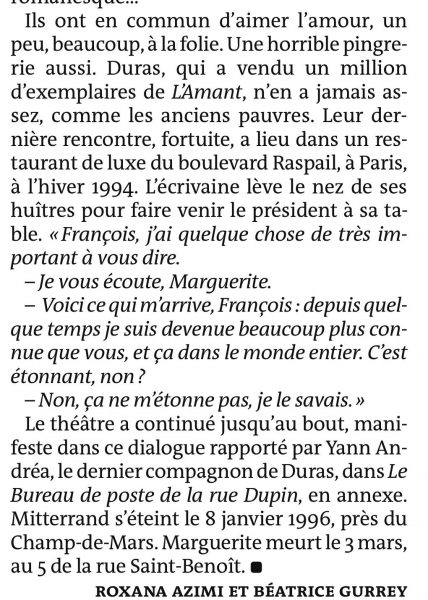
The composer John Cage made silence the title of one of his quite well known pieces. The willingness to pay for the entry to the silent concert might be surprising although the listening experience is unique to each location and diversity of audience. Composing silence remains a challenge, making noise is easy. (Image: NASA/ESA Hubble Space Telescope, extract of Link) 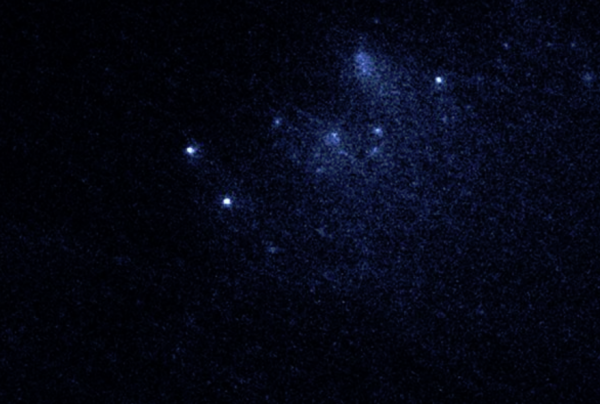
Write, write, write
A poster announcing the “internationales literaturfestival berlin 2023” prints in big letters: “Read, read, read, … 14 times”. This is a quote from Werner Herzog when he was asked what makes a good filmmaker. The message from Manjeet Mann to the young audience at Berlin added to this: “write, write, write”. At least this was my impression as a summary of the talk and her short readings from her novel in verse “The crossing”.
The lecture hall of the “Stabi” was packed with students from high-school who felt at ease with the English language presentation and talk. The host Shiva Mesgarian managed to get the crowd of students to ask questions in the huge lecture theatre. 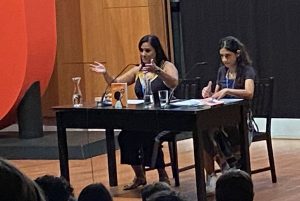 Manjeet was giving a lot of insights into writing, editing, motivation and the difficulty to give a voice to persons from marginalized backgrounds. In her case as a person of colour herself, born and raised in England with additional links to India, she took issue with the topic of refugees. Living in Folkestone (Kent), she is confronted with people crossing the Channel on a daily basis.
Her book “The crossing” is actually building bridges between countries and continents. Her entertaining way to talk about her hard work as writer motivates, inspires and encourages young persons to pick up their pencil and/or notebook to start writing. Just don’t stop. Journaling helps. Take your emotions of an issue seriously, then work on it. Give characters a voice who have not received much attention. Go out and interview persons to get authentic input.
It is not about appropriation of a story. It is about meeting and exchanging with marginalised persons. Return your written pieces to those “sensitive readers”, whose story you attempt to develop. All this takes time. Re-writing is an important element as well. “Having written the story for yourself, you then re-write it for the readers”. Edit, clarify, sharpen, blur, attend to detail – all this helps the reader to follow and enjoy. These were the messages to all the students who were grateful for advice as the new season of essay writing in school, university and beyond is about to start. 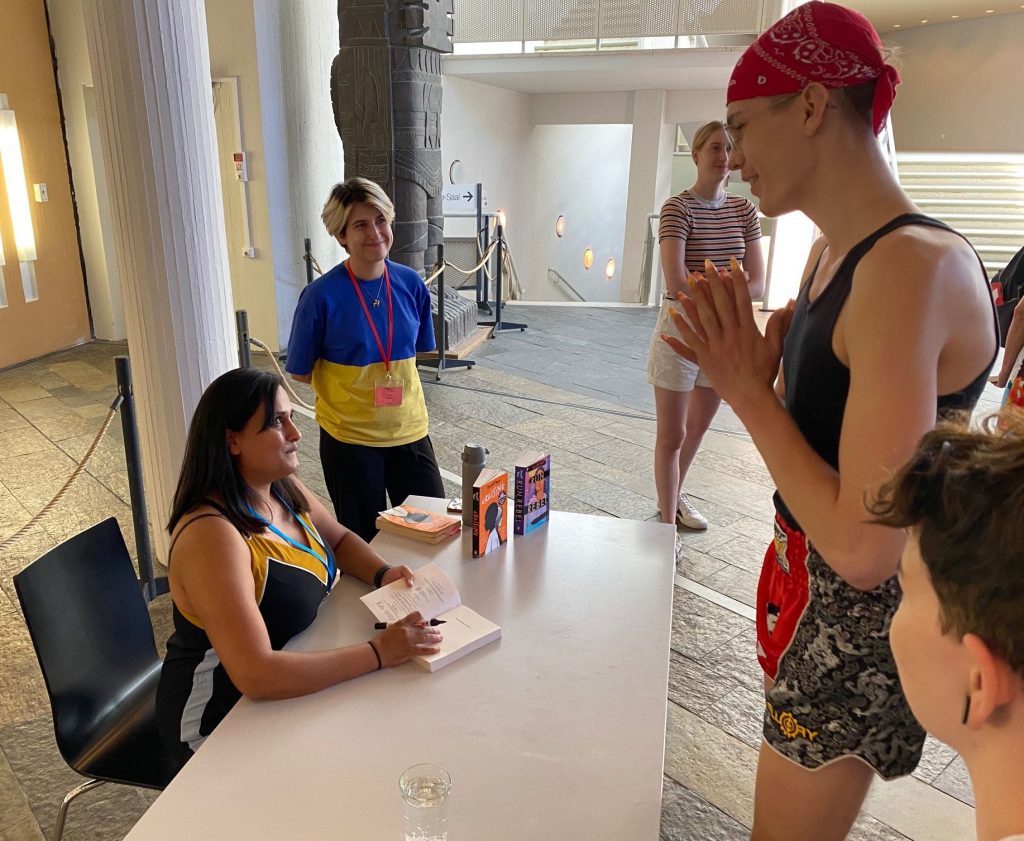
Poetic Coffee Break
The rather stiff and rigid structure of the “Staatsbibliothek” in Berlin does not yet have a reputation to be a place of poetry, translation of poetry and recitals. This is about to change. As a student, researcher or lecturer I would have adored to see my library proposing a poetic coffee break. I would have gone for the necessary break in the afternoon, the coffee and, okay why not, a poetic experience. This time it was different. The organisers, “ilb and Stabi” got together and Ursula Jäcker together with Michael Bucher presented poetry from Shakespeare (Sonnet) in English followed by the German translation by Wolf Biermann.
Translating poetry is a very tricky thing. Just try it yourself and you will be full of admiration for the admirable work of translators of words, sentiments, rhyme and rhythms. The presentation of Biermann’s comments on his own work on translating Shakespeare’s sonnets gave interesting additional information on the short and precise English original and the longer, somehow fat translations into German (Biermann’s words). Thanks for the indication that Biermann deviated from the Shakespearean “iambic pentameter” to add a sixth foot most of the time (to be checked OMG). The choice of numbers 6, 18, 27, 66, 73, 76, 121, 147, 154 from the Shakespeare Sonnets were witty and entertaining for a coffee break. For example, from 27:
“And keep my drooping eyelids open wide,
Looking on darkness which the blind do see:…”
Also, from 76:
“Why write I still all one, ever the same,
And keep invention in a noted weed,
That every word doth almost tell my name,
Showing their birth, and where they did proceed?”
More than 400 years ago, these rhymes were drafted and still today writers and learners, at the Stabi and beyond, can somehow identify with the intricacies of the process of creative writing.
More of this, we need, today and for tomorrow. THX. 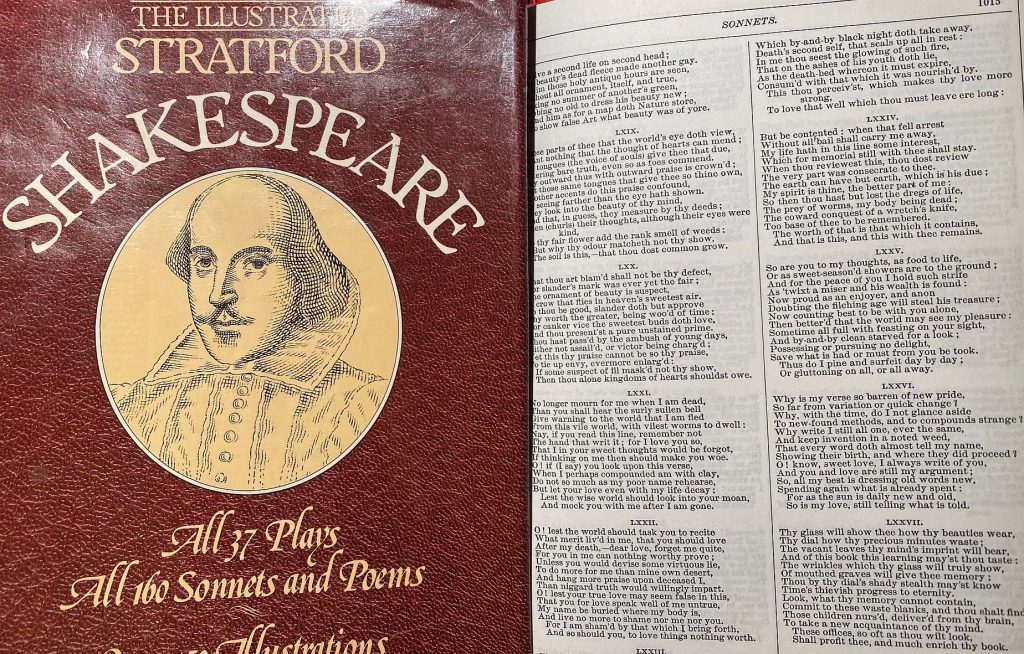
Princess
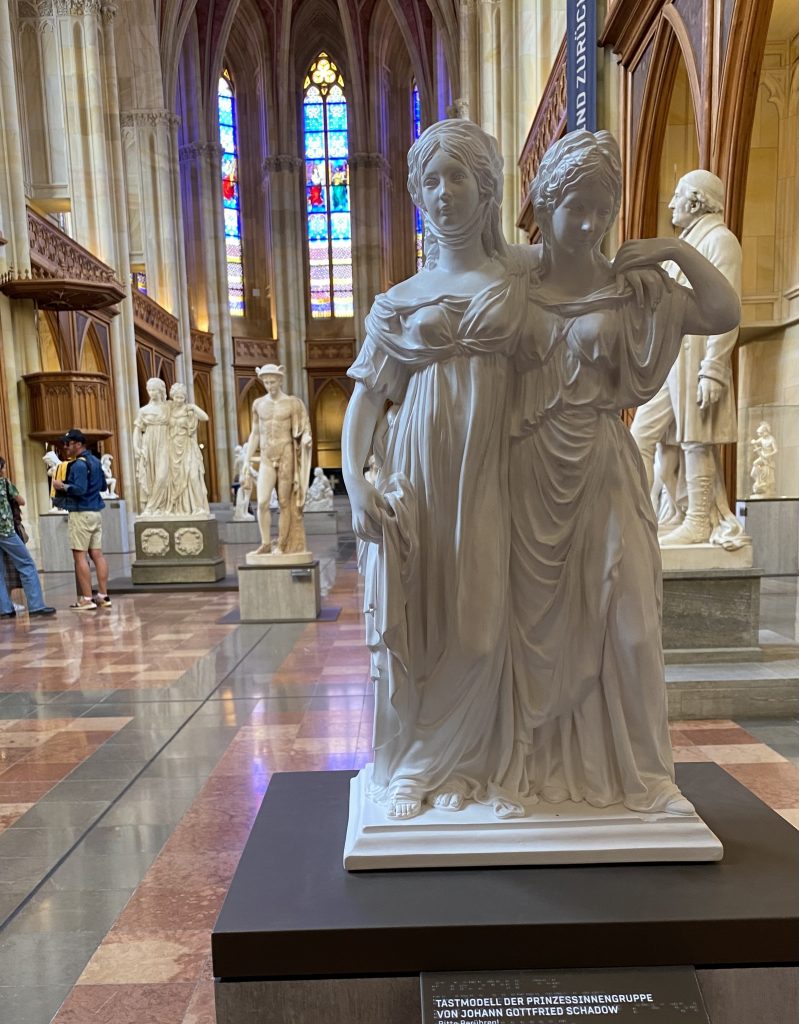
Berlin is proud to present its princesses after a marvelous lifting. Yes, in the middle of the barbie hype, Berlin exposes two of its princesses of the late 18th century. And you can touch them, if you like or dare to. They don’t bite. I have not seen anybody kissing them either, except for a Spanish football president. All this is happening in the Museum Church Friedrichswerder designed by architect Schinkel an built until 1830s. The grouping of the two sisters was unusual for the time and only the inscription at the bottom introduces the distinction that Louisa on the left is the princess heriting the throne. Frederica on the right is wearing a different foot wear, considered less noble. The privilige to touch the princesses applies only to the smaller copy in front of the image below with “Braille inscription”. The original is further behind. Of course, this one is protected against unwanted contact with the masses or “followers”. At the time “follower” still had a different meaning from today.
Bogenspannerin
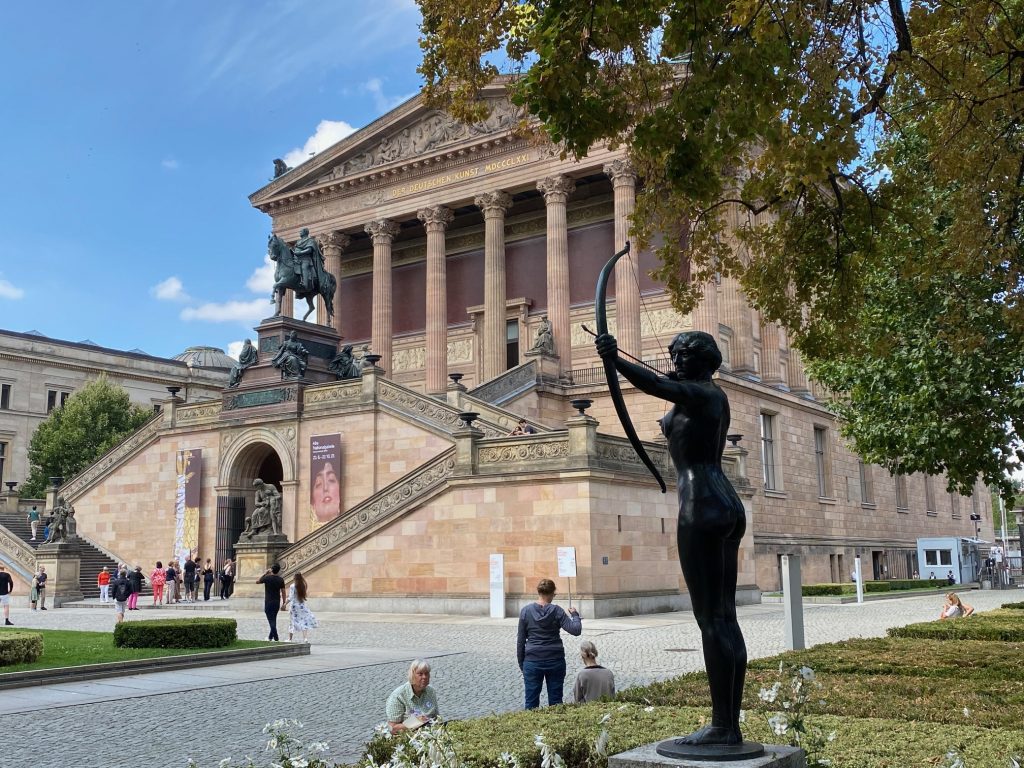
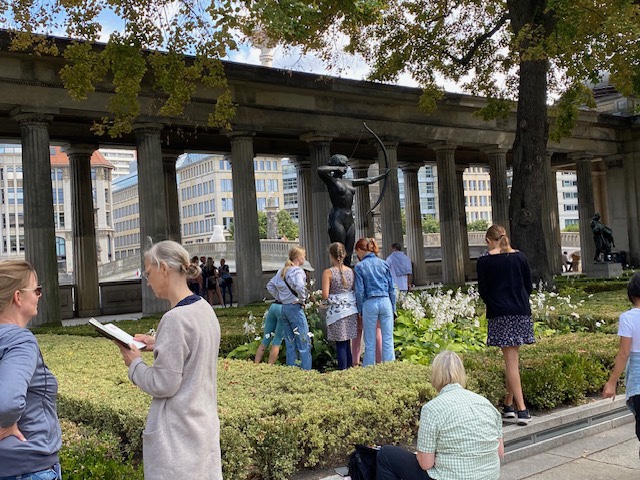
Seit der Antike sind Bogenschützen und Archer ein Thema der Künste. Meistens ist die männliche Repräsentation die dominierende Variante. In Berlin lässt aber auch seit langem eine starke weibliche Realisierung bewundern. Nahe dem Pergamon Museum und der Alten Nationalgalerie steht die Statue der Bogenspannerin. Die Zielrichtung geht Richtung Hedwigsdom, als ob der Kampf zwischen Kunst und Religion ein andauernder wäre. Erfahrene Stadtzeichnerinnen, aber auch Jugendliche fühlen sich dadurch angeregt. Kunstschaffende können einen nachhaltigen Einfluss haben. Innerhalb Berlins ist nicht nur die Vielfalt der Kulturen zu bestaunen, sondern auch der Wettbewerb der Künste um Aufmerksamkeit. Da werden nach Regierungswechseln oft viele Bögen gespannt. Bleibt abzuwarten, wen es alles dieses Mal treffen wird.
Everyday objects
If you were wondering whether everyday objects can be a piece of art, then the exhibition at the “Neue Nationalgalerie Berlin” is for you. Isa Genzken challenges our traditional view of everyday objects through small transformations of these objects. At first sight you “only” see something utterly familiar to you. A window, a radio, a rose or a wheelchair are immediately recognisable. However, all objects have a little twist to them causing some alienation, questioning or finding new connections. This is the stimulating experience of a visit of the exhibition. The booklet gives an informative overview of choice of sculptures chosen for the exhibition. Walking around in the spacious entry forum allows to appreciate the objects from many angles and in different lighting including twilight. Allow yourself to be challenged. Distancing your perspective beyond the obvious object you recognise broadens our vision of what we see and how we perceive it. The huge pink rose in front of the gallery overshadows even the monumental appearance of the Neue Nationalgalerie. In memoriam “Rosa Luxemburg” and Karl Liebknecht who were murdered not far away, near the “Landwehrkanal” in 1919.
Some visitors might like the skyscraper models she created to remind us that “design catastrophe” with the usual high rising buildings are pervasive around the world. Sculpture as architecture or architecture as sculpture has been her forward looking work from 2008 “Ground Zero – Hospital”.
With the construction work in full swing in the neighbourhood of the gallery with the design of a barn (Scheune) we understand the choice of the artist as a timely reminder that Berlin could be more daring in the architectural design. 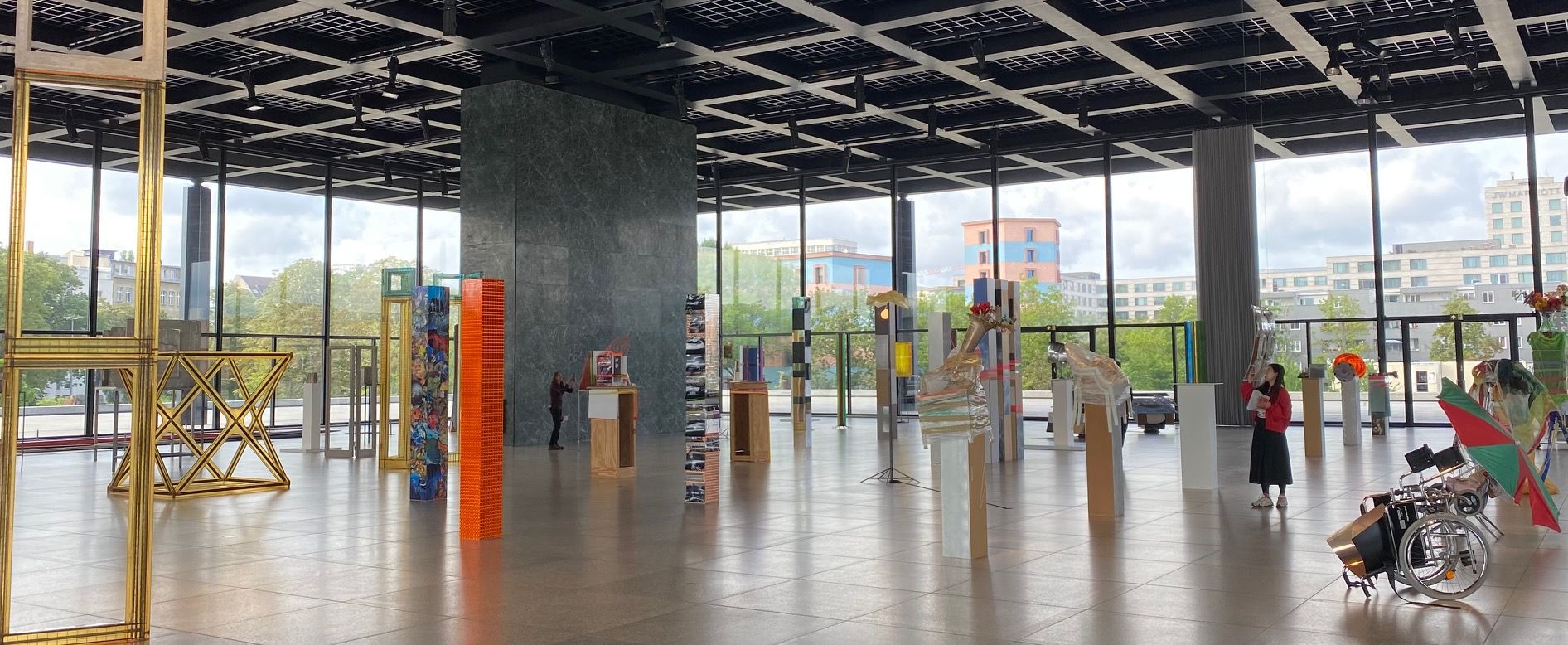
Barbie explore
The film on Barbie after more than 60 years of the first puppets to arrive on the market is a huge money spinning exercise. Hitting more than 1 billion $ is really a huge box office success. More interesting even is the banning of the film in some countries like Algeria. This gives the film an interesting subversive touch to it, which we in the Western countries no longer see as something special. Emancipated women pose a threat to authoritarian regimes.
However, we see in the stereotypes of beauty-driven dolls not that much of an emancipatory chance. To view emancipation independent of the looks of a person is another interesting twist to the role in stereotypes of beauty. It is not only fun to play around with stereotypes, that is mostly, if you are not negatively affected by them (age, gender, ethnicity, extraordinary persons). A nice task for sociology and psychology to explain the working of stereotypes in society and possible remedies. Tolerance is a competence that needs to be learned and updated continuously, from early age onwards.
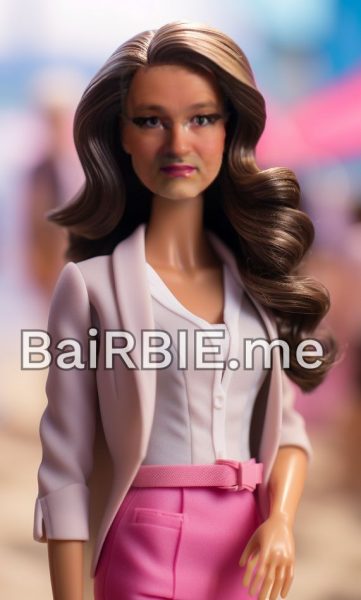
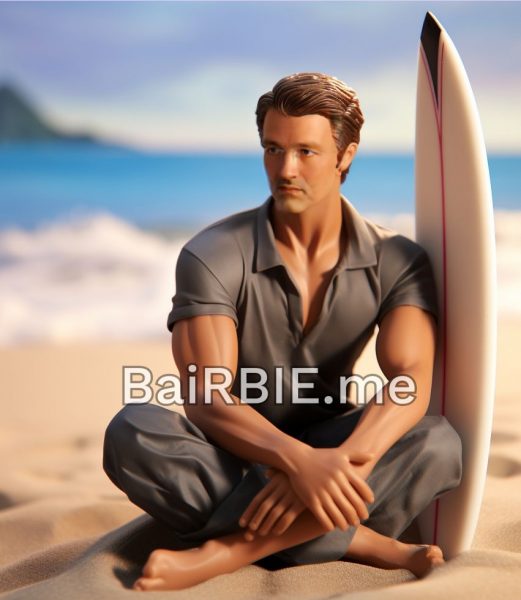
Therefore, the website created by the US Design Agency Rvnway offers an entertaining way to play around and learn about stereotypes. Perceived, generalized beauty or gender roles can be explored using the tool. Maybe some see themselves differently after such explorations. Everybody is a model. This is the message. www.bairbie.me will let you explore other formats of yourself. After 3-D rendering and printing your children or grandchildren will decide what role they would like you to play in their playfull, or virtual “real” life. I suppose many of us will be up for a big surprise. Go on and imagine in 4D. In the age of selfies all around us, all the time, we believe we are very modern, but the artists of the 19th and 20th century following all great painters before, frequently started their careers with an “autoportrait” or “Selbstbildnis” or series of those as they were aging. 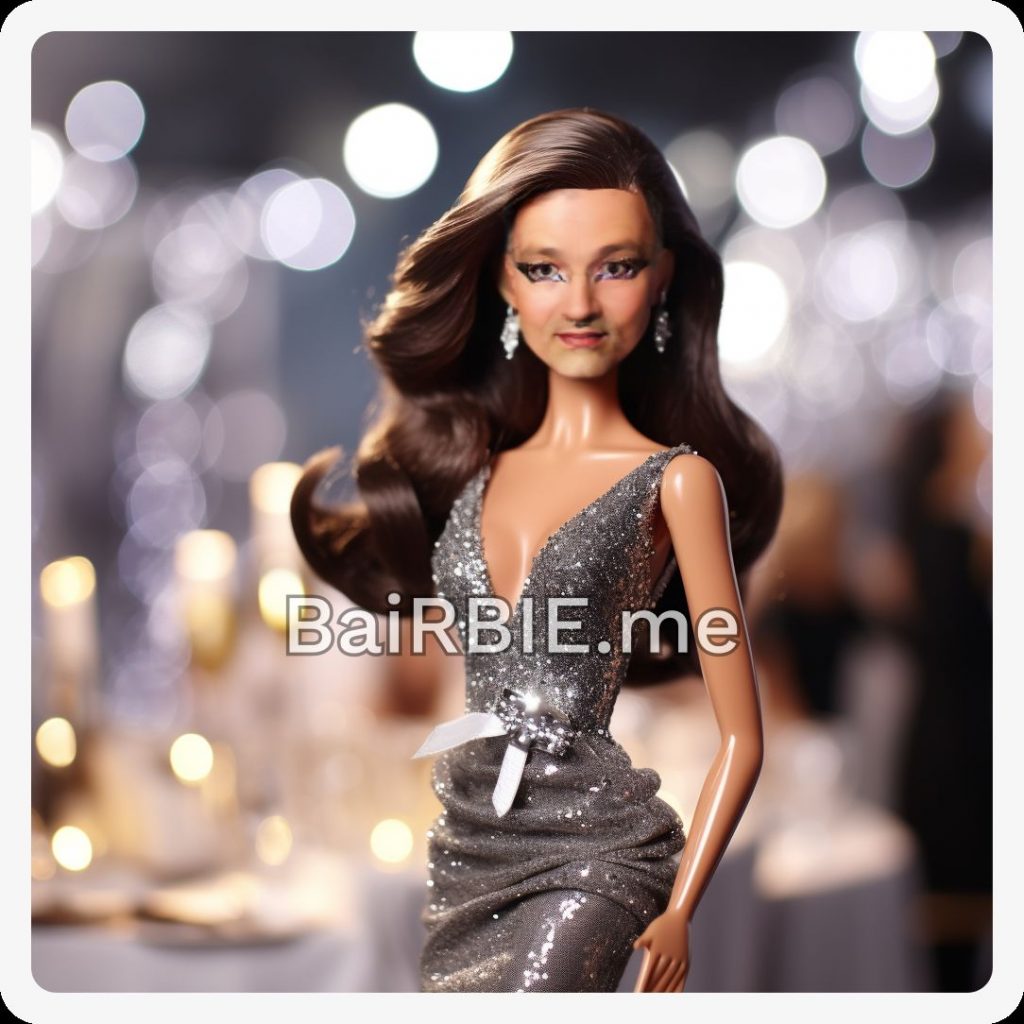


More Design
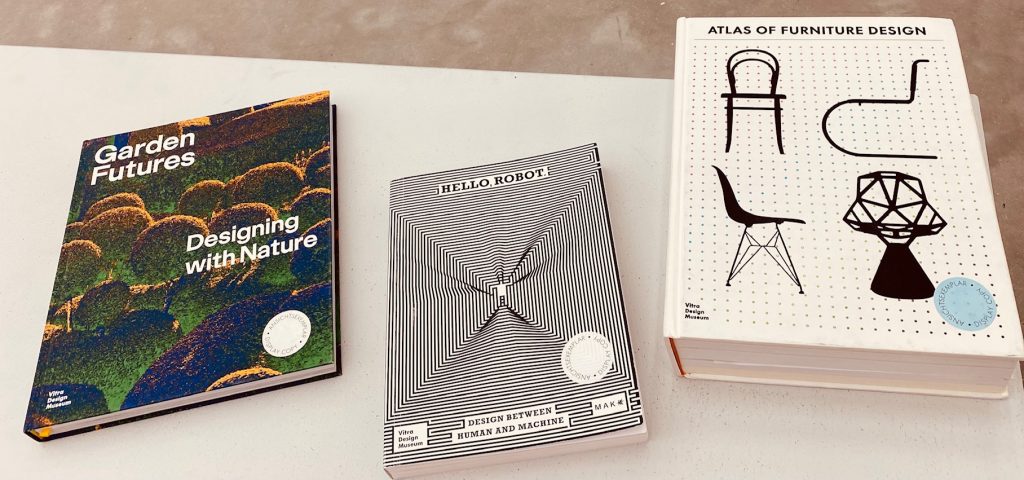
How about a subject like Design in school. Rather than the same old boring teaching manuals in art, music, economics or social science, young learners have always been attracted to making things by themselves. The theoretical context is then coming to the subjects and objects more naturally. Economics as market design, design social security for platform workers, sound or furniture design could bring in the creative potential of the learners. Lessons learned through subsequent applications or realizations of prototypes allows the link of theory and practice. A school garden would even be a fantastic cross-discipline learning opportunity.
The most difficult part is probably to find competent coaches to guide the learners exploring and designing. The world is not perfect, so why should learners not be confronted with imperfections in learning set-ups. The most fun part in science is when experiments go wrong, hopefully not too badly though. Catching learners by their curiosity is very likely to get them hooked on more thorny scientific questions as well. Across Europe holidays are coming to an end and millions of pupils go back to their benches and rigid curricula. We should really care more about the next generation.
Europa Meer
Europa und das Meer, so lautet der Titel eines Buches und Katalogs zu einer Ausstellung des Deutschen Historischen Museums (DHM) aus dem Jahr 2018. In 2023 im August sind die Zeitungen voll mit Artikeln über Meererwärmung und die schwerwiegenden Folgen für Menschheit und Bio-diversität. Die Geschichte der Beziehung zwischen Europa und dem Meer ist leidvoll und euphorisch zugleich. Alljährlich zur Sommerszeit wird das Mittelmeer von Wellen mit Touristen überspült die „over-tourism“ erleiden müssen. Menschen sind oft eine in Massen, aber nicht in Maßen, auftretende Spezies. Das Meer spielt zusätzlich eine faszinierende, verheißungsvolle Anziehungskraft aus. Europa sieht sich zudem gerne noch als Dreh- und Angelpunkt der Weltgeschichte.
Der Ausstellungskatalog enthält lesenswerte Beiträge von der Antike übers Mittelalter bis in die Neuzeit. Die Thematisierung von Herrschafts- und Handelsräumen , Brückenschlagen und Grenzziehungen, Meer als Ressource bis hin zum Sehnsuchts- und Imaginationsort bieten eine originelle Herangehensweise. Schon 2018 enthielt der Katalog einen Beitrag zum Massengrab Mittelmeer sowie zum Sehnsuchtsort Hafenmetropole Odessa.
Migration in ferne Länder samt der Verheißung eines vermeintlich besseren Lebens sind so alt wie die Menschheit. Die Weite des Meeres suggeriert zusätzlich die Möglichkeit des Neuanfangs und Althergebrachtes, hinter sich zu lassen. Freiwillig oder gezwungen, das ist dabei oft die entscheidende, unterscheidende Frage.
Politicians and Literature
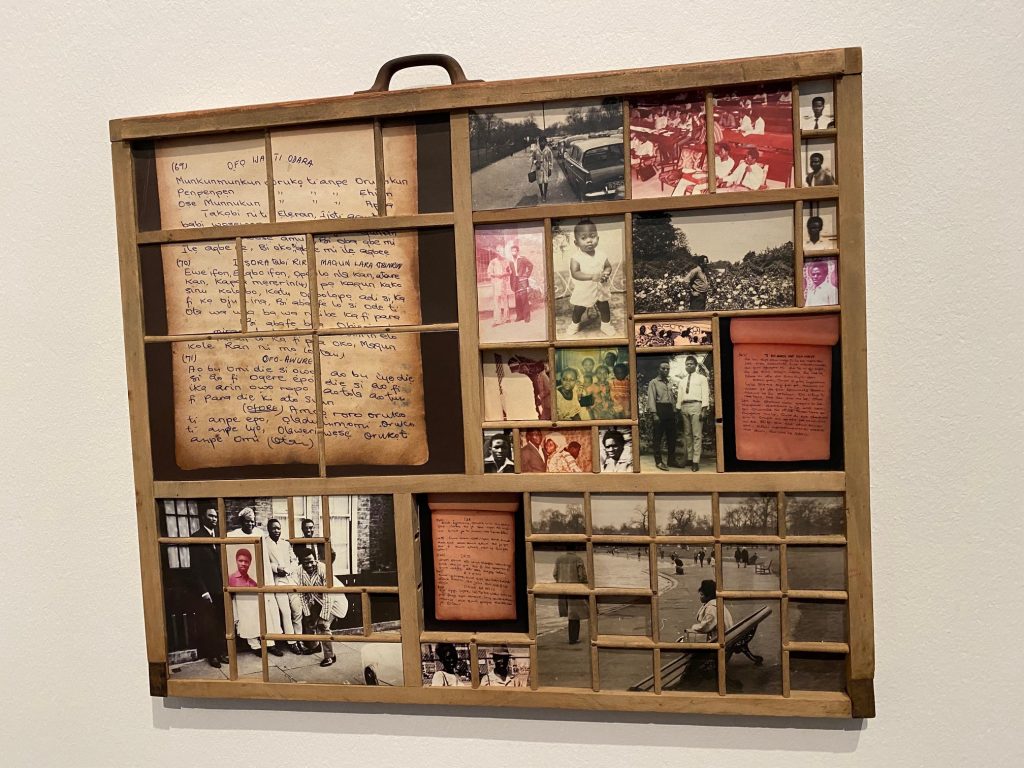
Biographies as well as autobiographies of politicians receive a lot of attention. Even spouses of politicians or artists benefit from this sensational effect (Obama). But beyond these ex-post or after-office effects, it is more interesting to look at what literature or authors have had an impact on the life and, maybe, office of presidents. So-called literary couples or specific relationships between artists or authors can reveal interesting additional information to understand “what made these personalities”.
In “Le Monde” there is a series of articles devoted to such relationships. It is a kind of romantic summer reading satisfying nosy looks into the private lives of politicians and other celebrities of a more intellectual kind. On the 25th of August 2023 it was the turn of the relationship between Francois Mitterrand and Marguerite Duras entitled … “menteurs sublimes, forcément”.
Their long-standing relationship had in common to cover-up some of their failures in the Nazi-occupied France.
Post-war each person had more than just sympathy for the other person’s accomplishments. The interesting feature to accept advice and criticism from the other person is rare for highly exposed persons. Relationships between artists and presidents are somehow tricky for both. As artist you can get instrumentalised by power rather quickly. As politician you run the risk to open-up too much, as they are rarely unobserved. Paparazzi or other agents go a long way to get or make up a good story. “Tell me what you read, and I tell you who you are”. The relationship between literature, politics and politicians will never be easy. It remains good stuff for literature and cinema.