Claudel & Hoetger

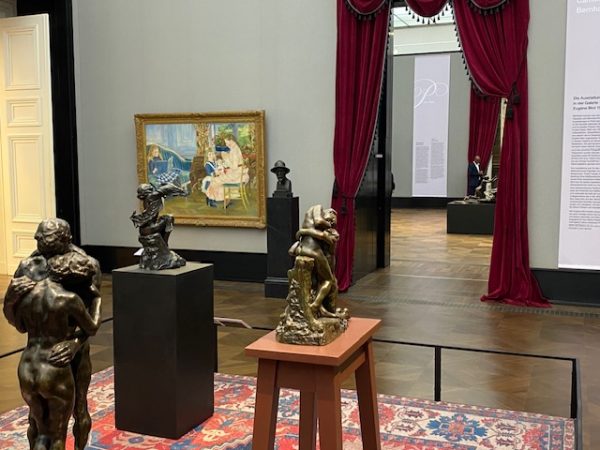
It is well known that artists joined other artists and groups to get inspired. The entangled relationship between Camille Claudel and Auguste Rodin has become a special example of the tricky relationship between learning and co-creation or inspiration. The role of galerists in building a reputation for artists is less well understood. The “Alte Nationalgalerie“ in Berlin opens up this black box a bit through juxtaposition of Camille Claudel, Bernhard Hoetger as disciples of Auguste Rodin. The influences are rather obvious, yet each disciple developed her/his unique style. The emancipation was not without frictions. The galerist Eugène Blot organized a joint exposition of both disciples in 1905 in Paris, which is partly reproduced in Berlin 2025. Great work by the curators of the exhibition Yvette Deseyve and Sintje Guericke who managed to bring together unique sculptures from 3+ museums and a great explanation of the links between the artists as well as the proximity of ateliers. (Image: view of showroom in Alte Nationalgalerie Berlin, Claudel & Hoetger 2025)
Jewish Heritage

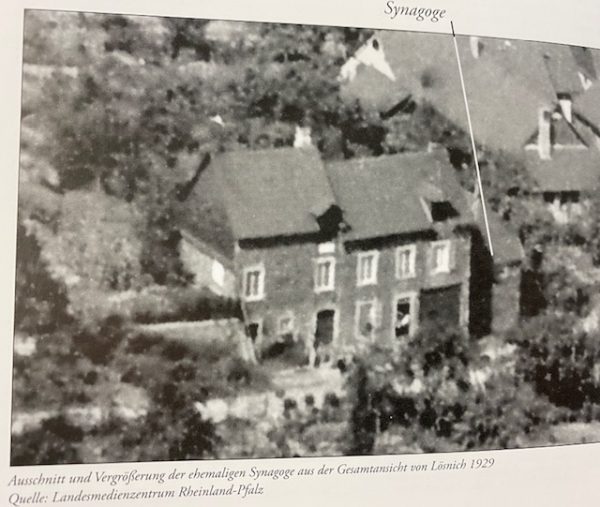
In the Germany of the 21st century, we have to dig deeper into history to understand the Jewish heritage due to the horrific terror of the Nazi-regime and it’s millions of supporters. The traces can be found in some historic photographs even in the countryside. Marie-Louise Conen and Hilde Weirich (2010) have thoroughly studied such documents for the Moselle village of Lösnich. The little annex to a house served as a Synagogue (image below). The village has a history of Jewish settlements which extended to neighboring villages as well. Interestingly, the heritage of Napoleon’s occupation of the Rhine and Moselle regions brought equally for all men (not yet women) and the separation of the state and religion making Jewish life, property acquisition more easy. The tolerance of the 19th century was then reversed by Nazi Germany again. History is present in many places, where we do not seem to expect it nowadays. 

Napoleon legacy

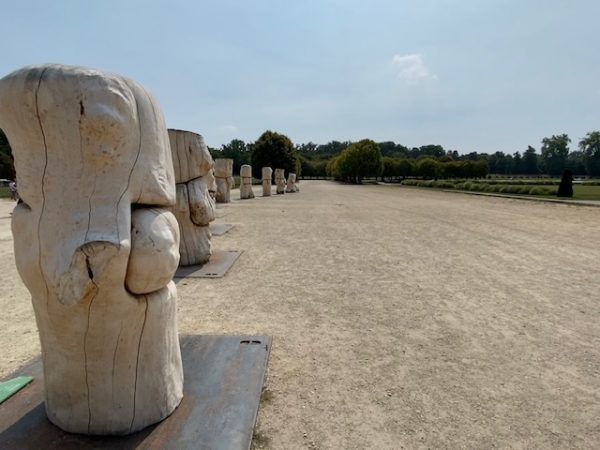
It is huge historical project to try to summarize the legacy of Napoleon Bonaparte. AI is by design less hesitant to come up with any length of a summary statement some with good references on which the statement is based. In combination with a visit at Fontainebleau and a first hand impression of the environment of the autocratic ruler, the remainders like the introduction of a Civil Code to guide also administrations to lawful conduct, we still see influences of this legal innovation in many other countries across the globe. The recognition of Jews as equal citizens and to allow equal access to property and many professions have been influential across Europe mostly in occupied territories. Military service for Jews in Napoleon’s army was another consequence, which spread into the Prussian army and the 1st world war. It is in the 21st century that we see shifts towards more authoritarian governance styles spreading again, we did not want to see this happen until Russia‘s war in Ukraine. (Image: La Chair de la forêt, Frénésie des Géants by  Wang Keping Fontainebleau 2025-8)

Fontainebleau time

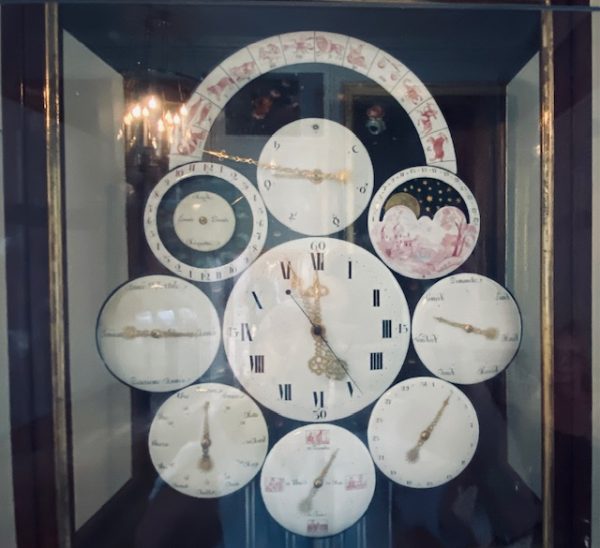
In the Chateau Fontainebleau time seems to pass with a different speed compared to the busy times in Paris. Taking a stroll at the park, boating or horseback riding along the endless paths contributes to the perception of wide, open space and a different space-time experience. The measurement of time shown on a fine craftsmanship of a clock in the castle highlights the fact that there is more to time than just seconds and minutes. The hunch of the time that there is maybe a cosmic time beyond our calendar is a precursor of later scientific discoveries. Time in the early 19th century of Napoleon’s reign had just been restored from calendar of the French revolution. Whether time is counted as 2×12 hours or in 24 hours was also a matter of politics rather than rational decision making. The impressive clock in the Chateau Fontainebleau shows ambitious as much as awareness of defining and counting time, just like an absolute ruler might conceive it. 

Fontainebleau walks

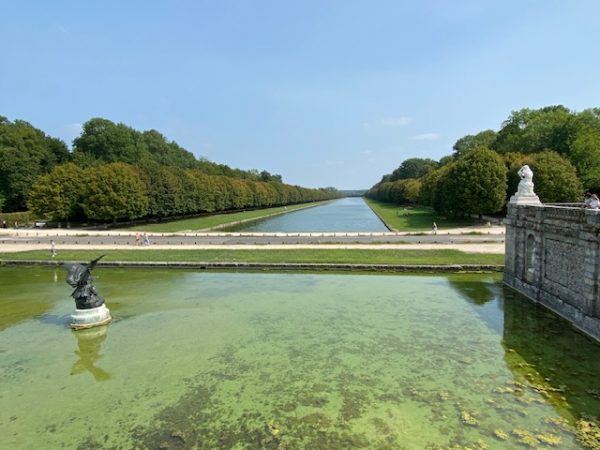
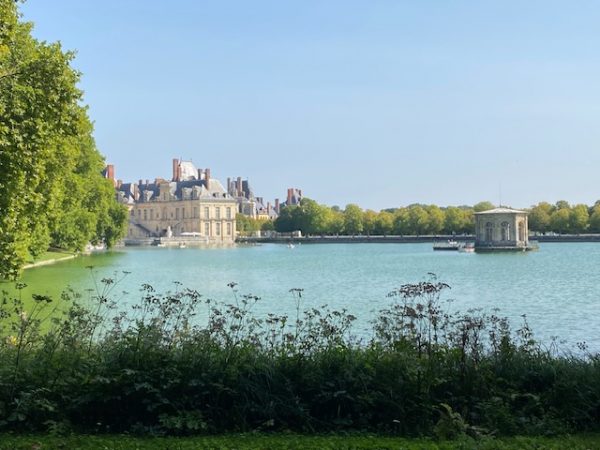
In the Fontainebleau gardens it is easy to reach your daily walking goals of 7000 a 10000 steps/day. Upon entry into the park you walk around the small lake. Towards the far end of the lake you’ll discover a long waterway which takes you beyond your usual walking distance due to the calm and great surroundings. The forests around the Fontainebleau gardens are another great walking or hiking exercise. You might find companions all along the trails. Just take enough water and food with you as there are no shops around, just you and nature. A bit of advance planning is necessary to make it a great experience. 

Fontainebleau garden

The garden of Fontainebleau is huge. The design by “Le Notre” is splendid in its combination of trees, greens and water reserves. Beyond walking in the park you may enjoy a horse ride ora  tour in a carriage, some even today. Boating is an additional amenity rarely available at other castles. In the Belvedere in the middle of the water basin romantic or secretive diplomatic conversations might take place. Politics and diplomacy have always needed special locations to prepare decisions. This is a historical constant. 

Fontainebleau library

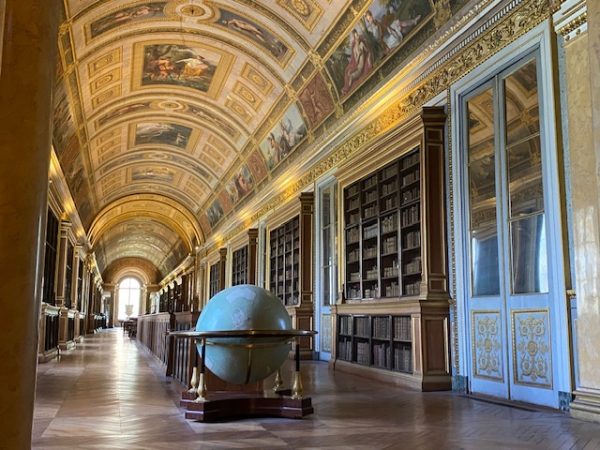
The “Galerie de Diane” in Fontainebleau has been built during Napoleon’s reign. It hosts the library with a large collection of books. The function of the books seems to be more to intimidate the persons passing by rather than ready for inspection. The globe at the entrance reflects the ambition of the ruler. The fact that you have to walk some stairs upwards increases the impression to be little compared to this universe of knowledge. It is great that libraries have flipped this perspective and today we study the period of Napoleon’s reign with our democratic values in mind. The top-down approach was the incarnation of Napoleon’s style of government. Despite the revival of such governance styles in the 21st century across the globe, they are unlikely to last for more years than Napoleon’s fate. A simple reason for this may be the only representative or intimidating role of knowledge in such forms of governance rather than an open mind approach. 

Fontainebleau Throne

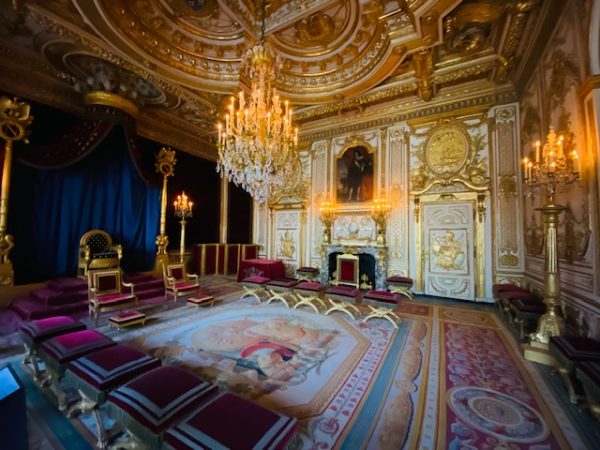
The French history is full of kings and emperors who have ruled the country. The Chateau Fontainebleau has the longest history of kings who lived there and held office, a pre-modern version of “home office”. The most remarkable and distinguished furniture of a king is the throne reserved for office hours. Napoleon created a special throne room at Fontainebleau which is also the only one preserved in its original form until today. It is just one of the home office rooms of the emperor. The antechambers, council room and study had to be passed before to reach the ear and audience of the emperor. The history of the home office and thrones have been intertwined ever since. 

Paris Sorbonne

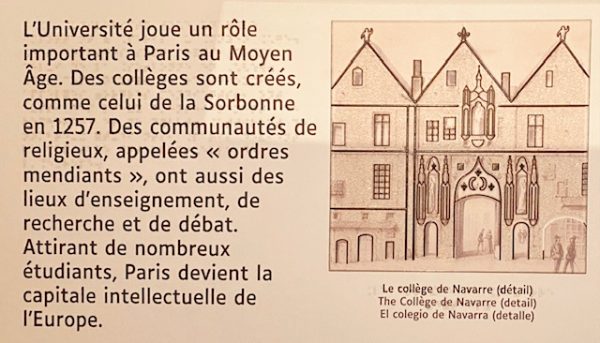
The history of the university on the left bank of “La Seine” dates back to 1257 when Robert de Sorbon an advisor to Louis IX was asked to create a unifying structure of several colleges which provided room and board already. The location on the left bank in Paris allowed these colleges to escape the religious doctrines and archbishop who dominated the right bank. The choice of the name of the advisor rather than the King was already showing early signs of independence which was cherished by generations of students and professors. The Colleges had individual names like “Collège des Bernardins” or “Collège de Navarre” and operated under the title of “La Sobonne”. The “Musée Histoire de Paris Carnavalet” shows an early design of the Collège de Navarre. Independent thinkers and writers were formed there who became very influential later on in their careers. Thomas d’Aquin was one of them.

Paris Olympics history

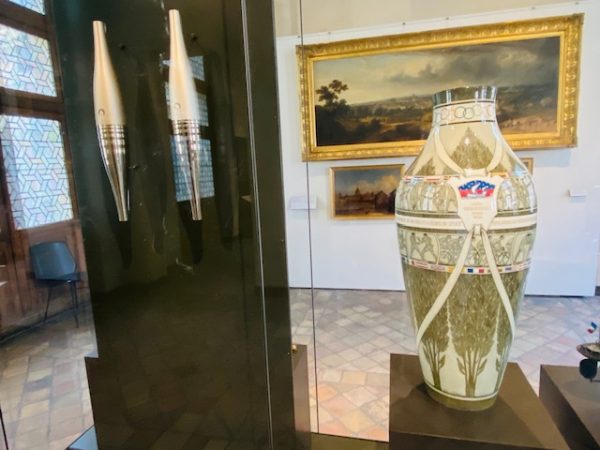
The 2024 Paris Olympic Games will go down in history as the event that has achieved to put Olympic Games and Paralympic Games on an equal footing. At least this is the message the  museum of the history of Paris tries to transmit. In the “Musée Histoire de Paris Carnavalet” we find a vase from the Games from 1924 in Paris next to the 2 Olympic torches, one for the Paralympics and one for the Olympics 2024. Both torches are the same only a different logo on them, same message, same spirit. The impact of these games is likely to set an example for many years to come and other hosts of the Games will be measured against this benchmark. Making history is one thing, taking care of the posterior image another one. Paris has taken of this as well.