Marc Aurel Memorials

The depiction of Marc Aurel as Emperor has become a trade mark in the history of art and politics. As an emperor with good horse riding skills, Marc Aurel was the first emperor to be portrayed as riding on a horse without saddle whilst, of course, in perfect skill to master the horse and give orders or strategic commands. Many subsequent emperors, Napoleon or Friedrich have had their power positions “immortalised” as such, which served at the same time to make them appear taller and “in command” of something.
Travelling by horse has  also been for a long time the fastest mode of transport, yet another symbol of social status used in media campaigns of those times. The memorials in honour of Marc Aurel had already during the ancient time the function to transmit an image, the emperor wanted history to keep in mind, rather than the view of ordinary people in the Roman empire. Memorials of political leaders have been a demonstration of power for centuries before and for centuries to come.
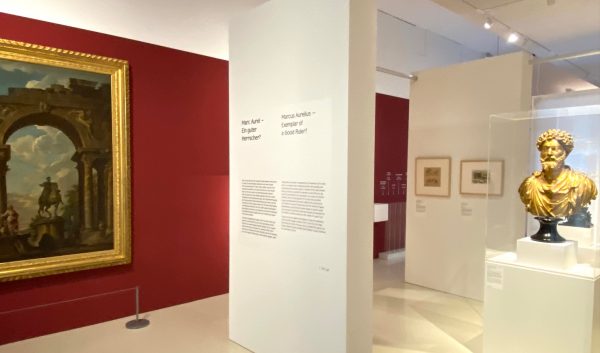
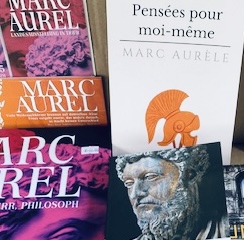
(Image: Trier Marc Aurel exhibitions 2025-9)

Marc Aurel critics

In the literature on and about Marc Aurel (Brenan 1882, pp. 484) the end of the ancient world is mentioned frequently. This refers to the beginning of the end of the Roman empire and the rise of Christianity to be become more influential. What caused the decline? The nepotism in the governance structure through the placement of family members to influential positions and as successor alienated many followers who previously believed in the high moral standards advocated by Marc Aurel.
Justifications of superiority by social origin are standard at the time of writing, but Marc Aurel did not see the potential of a more equitable distribution of offices. Women were relegated to subordinate or no public positions and are not mentioned with respect to  the importance of reasoning or social competence either, none but one in his acknowledgements (Book 1). The discrepancy between the formulation of virtues as well as ideal standards versus own practices of hierarchical leadership, recourse to slavery and brutal upholding of the empire should not go unmentioned.

Marc Aurel Advice

The study of Marc Aurel’s Meditations offers advice on how to conduct one’s private and public life. The role as advisor or teacher is an important part of his writings, albeit quite indirect. In going back to Book 1 and his acknowledgements of his own advisors, teachers and good examples indicate the motivation and intention to write down his meditations. “People exist for one another. You can instruct, or endure, them” (Book 8, paragraph 59, see also Barrientos 2020). Marc Aurel does not shrug away from the treatment of general concepts of humanity like justice. In his view “… justice entails the exercise of wisdom, kindness, and fairness in our relationships with others both individually and collectively.” This includes already tolerance as a part of justice as in Book 4 paragraph 2, according to Robertson (2020). The idealistic view of humanity, following Platon’s philosophy and other Stoic authors, still serves as a benchmark against which many leaders are measured today (compare Le Monde 2025-9-25 p. 26).

Marc Aurel Book 12

The closing book of Marc Aurel’s Meditations is taking issue with his own posterity. As a guideline for others, he formulated the claim not to care so much more about the opinions of others, but to stand by own reasoning and trust in one’s own opinion. “I have ofetn wondered how it is that everyone loves himself more than anyone else, but rates his own judgement of himself below that of others. … So it is that we have more respect for what our neighbours will think of us than we have for ourselves.” (Paragraph 4, Penguin Classics).
Of course, in the age of “philosophy as discourse” (Habermas), we are used to criticism of books and their authors. For the emperor philosopher this was less obvious, albeit the Socratic tradition of exchanges between teachers and their scholars was a kind of precursor of 20th century philosophy.
His writings in ancient Greek, however, remained little known and debated until its first Latin publication. Ever since, it has been a prominent work on ethics and leadership. The exhibition in Trier featured the copy of Helmut Schmidt, as the long reach of stoic writings on virtues and leadership.
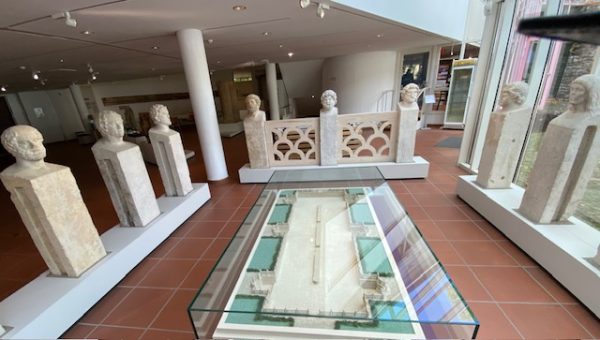
(Image: Stadtmuseum Trier, Model of Villa in Welschbillig)

Marc Aurel Book 11

Throughout the Meditations, Marc Aurel concerns himself with the idea and importance of the common good. Based on his experience as Consul and Roman Emperor, the common good is of primary concern. At least in his thinking and writing these concerns play a very prominent role just like the “social“. In order to ensure his own successor, as described by Katherine Kennedy (2020 through www.classicalwisdom.com) he was only the 2nd Roman Emperor  to appoint a biological heir as his successor, which met a lot of criticism already at that time. Nevertheless, in his philosophical thinking and leadership guidelines he cherished the common good above all. “Have I done something for the common good? Then I too have benefited. Have this thought always ready to hand: and no stopping.” (Book 11 paragraph 4, Penguin Classics edition). This is in contrast to the predominant utilitarian thoughts many centuries later where the pursuit of your own benefit will further the benefit for society. The reversal of the logical sequence in later thoughts is particularly remarkable as well. The process of individualisation seems to be another additional factor in the lack of concern for the common good in the 21st century. Raising the awareness to further the common good is a continued challenged in most societies.

Marc Aurel Book 10

Book 10 offers some referrals to previous books and topics: Marc Aurel defends a wholistic vision as in book 10 paragraph 17: “Keep constantly in your mind an impression of the whole of time (χρόνον) and the whole of existence (οὐσίαν)…” (Penguin Classics version, also in Greek original/French translation). In the same vein, he wants all this knowledge and considerations to be “actionable”. This reads in his words: “No more roundabout discussion of what makes a good man. Be one!” (book 10, paragraph 16 in the same two editions). As the late Marc Aurel’s writings progress, he becomes even more “exigent” in the sense of demanding ever higher standards (of himself). “Whole-ism” paired with a request to, nevertheless, be ready for action at any time is not only a high cognitive demand, but also a reminder to leave procrastination behind. The virtue of a stoic leadership style remains an ambitious challenge.
(Image: Trier Exhibitions on Marc Aurel, 2025-9)

Marc Aurel Book 8-9

In book 7 paragraph 38 the stoic wisdom is exemplified in the the the short phrase „If you have sharp sight, use it: but, as the poet says, add wise judgment“. Being sharp in your reasoning or data collection is only part of the human endeavor. A wise judgement is, however, an ambitious aim as judgments have different short term and long term consequences. Intergenerational considerations as for climate change ask for respect of other species, biodiversity and to take into account very long time horizons.  The quote from book 8 paragraph 5 appears very modern or post-modern in this context. „There can often be wrongs of omission as well as commission.“ (both citations from Penguin Classics edition) Not acting on behalf of future generations and disappearing species is the most crying omission of our time.

Marc Aurel Book 7

In paragraph 63 Marc Aurel refers to Plato as one of his sources: “No soul”, says Plato, “likes to be robbed of truth” ( and continues himself) “– and the same holds of justice, moderation, kindness, and all such virtues. Essential that you should keep this constantly in your mind: this will make you more gentle to all.” The remarkable reasoning is to transform the own generalized experience into a behavioural recommendation. It may be argued that Marc Aurel starts from a kind of Aristotelian empirical study of persons in different life domains to derive an empirical fact. Based on this he develops a more Plato inspired “idealistic picture of mankind”. He is very much preoccupied with the philosophical question, how is a good life for all possible. In a previous paragraph (55) he outlined his 3 guiding fundamentals: (1) “The main principles in a man’s constitution is the social; (2)… resistance to the promptings of the flesh, like impulses; (3) judgement unhurried and undeceived”.
With such a claim for a “rational constitution” of man, he puts himself into the footsteps of previous philosophers of the ancient Greek tradition and, therefore, his writing in Greek rather than Latin is also a homage to this philosophical heritage.
(Image: parts of Installation by Fujiko Nakaya in Neue Nationalgalerie Berlin 2025)

Marc Aurel Book 6

Some passages of Book 6 can be understood like quotes of much later works, even like writings of the enlightenment period. Take this one: “If someone can prove me wrong and show me my mistake in any thought or action, I shall gladly change. I seek the truth, which never harmed anyone: the harm is to persist in one’s own self-deception and ignorance.” (para 21 in Penguin Classics version, also in Greek original and French translation).
The same passage in historic English: “If anybody shall reprove me, and shall make it apparent unto me, that in any either opinion or action of mine I do err, I will most gladly retract. For it is the truth that I seek after, by which I am sure that never any man was hurt; and as sure, that he is hurt that continueth in any error, or ignorance whatsoever.” (Para XX in Gutenberg.org online reader).
Why is this already an enlightened vision of truth? In the search for truth, he is open to criticism or doubt by others (maybe even irrespective of societal standing) and, moreover, ready to change his conviction and action. Religious doctrines of the time and many centuries after his writings would not have accepted such a doubtful mind who might change due to (scientific) reasons. Long before “Cogito ergo sum” (René Descartes, (1637), I think, therefore I am, of the early enlightenment, Marc Aurel might be summarized in this paragraph as “Cogito, ergo dubio”, I think, therefore I doubt – and I may change accordingly.
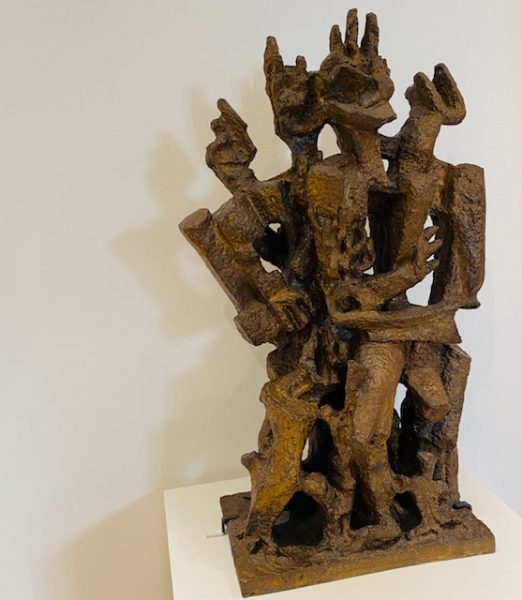
(Image: Ossip Zadkine, Forêt humaine, Musée Zadkine Paris)

Marc Aurel Book 2-5

There are several translations of Marc Aurel. In the Shakespeare English translation from the Greek original of the Meditations a passage (Book 5 paragraph XXIII) describes or idealises humans as a “reasonable and sociable creature, regulated and directed.” The same short quote of this paragraph in the English translation by Martin Hammond (Penguin Classics p.43) reads: “…my wish is to follow the nature of a rational and social being.” Of course, both translations are pretty similar at first glance, but the difference of “reasonable” versus “rational” and “sociable” versus social” mark very important differences that had and have different impacts throughout the following centuries up to today. As in many other instances going back to the original version in Greek (book link) might clarify the issue, however, the entry barrier is access to the bilingual version and use of an ancient Greek dictionary.
With almost 2000 years of advances in rational approaches and its tools like mathematics, the scope of the rational is huge and the behavioural turn in the social sciences demonstrates the limitations of human’s use of rationality (λογικός) in decision-making. Reasonable seems to come closer in today’s “post-enlightenment” world.
There is also quite a divergent connotation in the simply “sociable” (κοινωνικός) being or the “social” being, which has a wider scope attached to it. Hence, lets be aware of the implicit interpretations of translations. For a start the parallel reading of translation and original (Link) might enhance our understanding and spur even new translations and interpretations, which speak with the classic originals to today’s audiences (with or without AI).
A witty joinder of both previous translations is “And my will is the will of a reasonable and social being”. (Link Book V, paragraph 29 bottom).
From the Greek to French in book V (Link)  with an even broader understanding of the social as “la société universelle”.

(Image: Camille Claudel 1905: “Persée et la Gorgone, Lucile Audouy collection Paris, exhibited in Berlin 2025, Alte Nationalgalerie)