Colette nature narratives

In the 21st century we know that posting images of cats and dogs yields thousands of likes on the digital social media. Long before today, writers have tried to make us understand our existence through the narratives among animals, also beyond cats and dogs.
Embedded in nature, stories unfolded through the interaction of these animals. Transfigurations and lessons were derived from such fables as well as the tales constructed around the interaction of nature, animals and humans. The commemoration of Colette in the park of the Palais Royal in Paris combines all those aspects.
She grew up in the countryside, wrote “La Chatte” and lived in an apartment at the Palais Royal with a splendid view of the park later in her life.
It is a tiny spot of cultivated nature in the heart of Paris, even a bit isolated from the busy surroundings. Certainly, these days in the centre of Paris you are more likely to meet “Aristocats”, maybe from the 5 star hotels around, rather than the ordinary cat passing by.
(Image, bench in park of Palais Royal, Paris: inscription is a citation from Colette 1925 letter)

The Beast is dead

The BNF and the gallery Auguste Rondel celebrate the acquisition of the original drawings of “La bête est morte” by „Calvo“ at the fabulous Richelieu site. The appearance of the story and cartoon in 1945 was a landmark in artistic achievements for several reasons. (1) Calvo made it possible for whole families to talk about the horrors of war and the Shoa by use of text and images in an form of an animals’ world, well known in France. (2) Because all generations are familiar with the fables written by Jean de la Fontaine, the story set in the world of animals is both appealing and yet a bit more distant than drawing human faces on this traumatizing reality. (3) The cartoons managed to overcome the barriers to understand the beginning and ending of World War II and the geographical spread.
Uderzo, the well known cartoonist of “Asterix” did small services for Calvo when he was still an adolescent in 1945. Learning from the best of a field can give you a head start later on.  (Extract of Image  by Calvo 1945). 

Colette Bewitched child

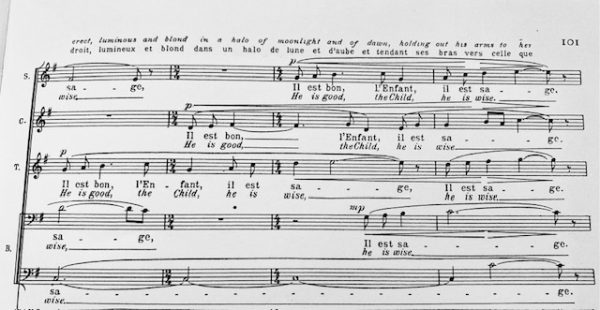
The English translation of the libretto written by Colette “L’enfant et les sortilèges” is translated to “the bewitched child”. The first representation was performed in Monte-Carlo in 1925 before it was represented in Paris at the Opéra Comique in January 1926.  The printed edition of Ravel’s orchestration classified the work as Fantaisie Lyrique based on a poem by Colette. This opus constitutes a forgotten forerunner of the much more popular musical “Cats” . In the end of Colettes narrative the animals call the child her “mama” and praise the good and wise child. It probably remains a forgotten 100’s anniversary, despite the fact that the topic of humans and animals, or nature in more general terms, have become more and more unbalanced over the last 100 years. 

Colette Home

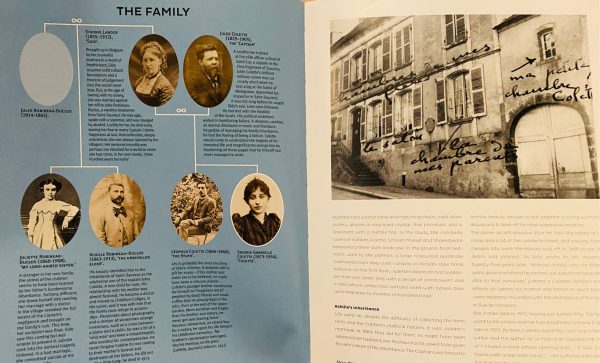
  1. The home of Colette, the French writer of the first half of the 20th century, is an interesting example of the high attributed value for her later creative career. The home and the gardens around, seemingly had a huge and lasting impact on her imagination.Her writings are firmly embedded into not just her home of childhood and adolescent years, but also the changoof homes and contexts literally made Colette. The documentation of this in the “Musée Colette”, which presents the different phases of her life course, allows to get a better understanding of the interconnected world of experiences and artistic work. It takes an especially broad set of influences to form such a polyartist. The libretto for an opera orchestrated by Maurice Ravel or a model for Matisse, stand for the openness to new experiences and take risks when she embarked on new creative endeavors. (Image Musée Collette catalog p. 6)  

Polyartist Colette

It is a complex task to do justice to a polyartist like Colette. The curators of the exhibition “Les mondes de Colette” (BNF 2025) Bouvard, Dimerman, Le Bras do a great job to present the biography of Colette, the writer, journalist, dancer in music halls, model (for Matisse) and entrepreneur in all facets of her activities. The role model of an emancipated women as early as the 1910s, 1920s and 1930s. The struggle of women artists in the early years of the 20th century to make a living from art is well documented already. To make a living of writing has always been a challenge if you do cherish your independence and liberty of expression. Versatility in artistic production is one escape route. Colette made a strength of this in diving into different forms of art and professional activities close to the artistic and creative world. In a quite unique way, she became her own muse for her own artistic work; and a character and inspiration exploring many facets of live. The economic misfortune experienced her parents became a source and force of inspiration.
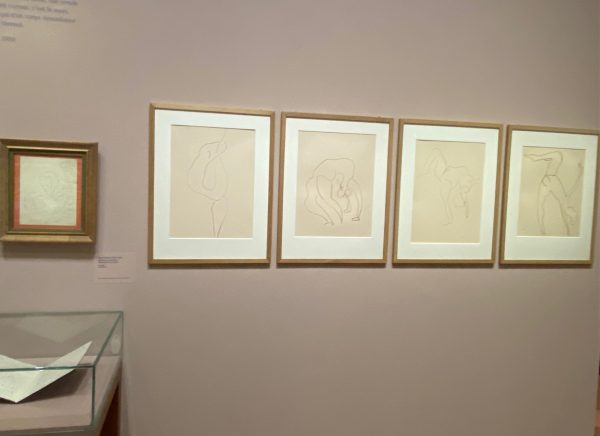
Contrary to the expectations of the market of arts and literature, she did not feel like sticking to just one activity. Her most lasting achievements, probably, were her literary accomplishments for most people, although Matisse immortalized her in his specific style of abstraction.
Polyartists just like Polymaths, make more comprehensive contributions to our experiences.
(Image:Lithographie by Henri Matisse of Colette, exhibition Colette at BNF 2025).

Social Anthropology

Dina Dreyfus, married several years to Claude Lévi-Strauss, has shared with Claude the long anthropological expedition to Brazil in the 1930s. They jointly studied the social organization of indigenous people across Brazil. Their abundant notes of field studies have now been digitized and the BNF is making this accessible.
Additionally, an exhibition on these field studies reveals the close collaboration of both partners. Returning to France in 1939 meant that soon after the return due to their Jewish decent had to interrupt their academic careers in France and some notebooks were lost during the Nazi occupation of France. After the war both separated and Claude Lévi-Strauss embarked on the drafting of the structuralist theory, Dina became influential in the field of the philosophy of education and teaching philosophy herself.
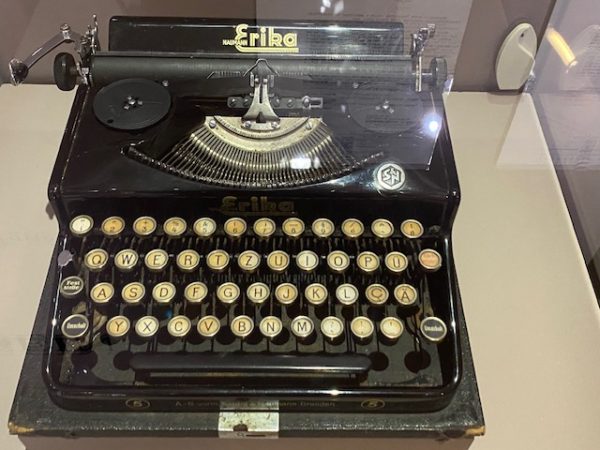
Besides all these lasting achievements, the exhibition shows the typewriter which had accompanied them for many years. The German language layout is quite remarkable as this asked for an additional mental versatility in putting their thoughts and experiences into the form of a manuscript. According to Claude Lévi-Strauss the use of this technical device allowed him to detach himself emotionally from his analytical work.
(Image: Exhibit: typewriter Claude Lévi-Strauss, BNF 2025-10)

Place of the Church

What is the place of the church(es) or religion in society? Some would answer that the answer depends very much on the historical period which you focus on. Social scientists would zoom in on the changes that have taken “place” and the reasons as well as major actors of these societal changes. Churches are highly symbolic places with exposed visibility and demonstrations of power. Therefore, it is interesting to follow the changes in the architecture of churches. Whereas biblical communities gained in wealth and power over the centuries, they moved from the backyards to the city centres and the market places for centuries.
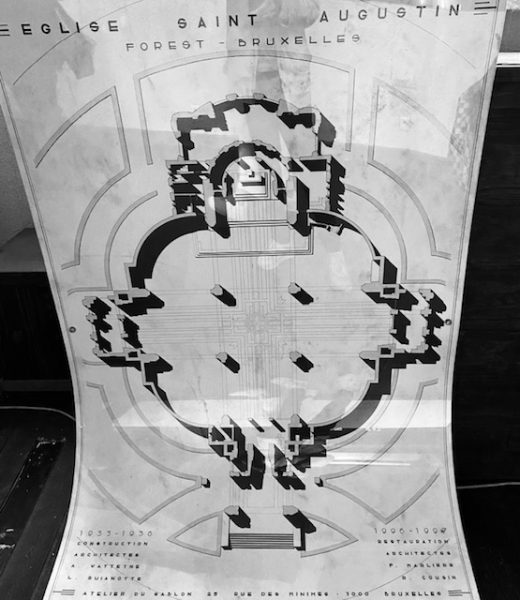
In the early 20th century many cities have grown so rapidly that in newly built suburbs new churches were considered an obvious extension of the places where churches belonged as well. In several instances the planning of a city’s extension was still being organised around the idea that a church should be the (new) focal point. At the same time the ideas of democratisation entered into churches as well leading to the deviant choice of round shapes rather than the traditional linear structures. The hotel became visible from all angles and was positioned as the mid point and rayons or beams could be imagined to reach into the newly built suburban areas. Frequently the road traffic was organised accordingly. Saint Augustine church in Forêt Brussels is a prominent catholic architectural example of this.
Another example of a round shape church with a place defining architectural function is the evangelic Königin Luise Gedächtniskirche in Berlin. Much smaller in size and in the axes that originate from there, the “Place of the Church” aims to fulfil a similar function, a central place in the new suburbian area.

Modernist Urban planning

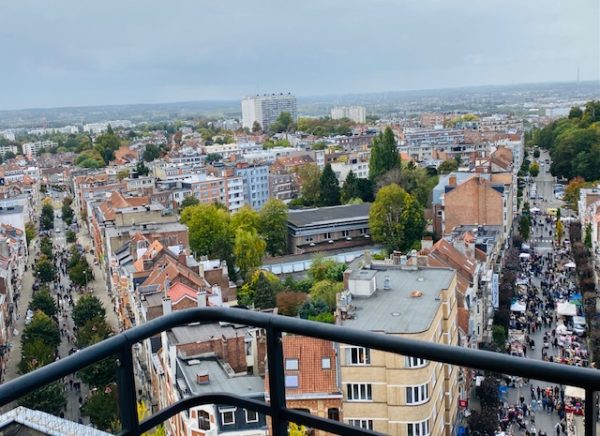
Saint Augustin in Brussels is one of the lesser known defining architectures in Brussels. It is visible from far away much beyond the immediate surroundings. Situated on Altitude 100 it is on the highest hill in Brussels with a 58 meters high Campanile built out of concrete in 1933 in a predominantly art nouveau style. The order of the St. Augustines in the center of Brussels was terminated and at the outskirts of Brussels as a new city suburb was being built starting in the late 19th century An appropriate way to demonstrate continuity despite discontinuity was the placement of the church in the middle of a roundabout and a star-like organisation of roads des descending from the top. The form of an equal length (orthodox) cross is in the spirit of the unity of the Christian churches. Even despite the prominent and exposed situation, most people pass by with little concern for the innovative, architectural features of this edifice. (Image: View from capanile St Augustin Brussels). On a small scale this urban planning concept resembles the Paris of the « Arc de Triomphe » and the views and corridors which we designed and implemented.


Deus ex machina

The term “deus ex machina” used to be applied more in its figurative meaning. With the rise of digital tools like chatbots, facilitated and enhanced through AI, God is speaking to us not only in multiple languages, but also from our pockets through our smartphones and headsets. This is a rather recent form of “deus ex machina”, which we did not expect some years ago. The bible as e-book or pdf-file has been around for some decades, but only more recently we can enter conversations with God through chatbots as another version of “deus ex machina “ about almost everything (and pay for it via digital credit card). Programming of such an AI-tool is easily achieved. AI will prepare a weekly or daily sermon or prayer for you, following your predilections of your favourite quotes of the bible. An interesting twist to the programming is to use authorized as well as unauthorized translations of the bible across several centuries.
Another interesting enlargement of the input data base is the inclusion of interpretations and discussions not only within your own religious community, but beyond. Maybe the discussion of several different religious chatbots with each other could prevent aggressions due to differences in basic beliefs. These “dei ex machina” might further our understanding of what makes us humans different from machines and machine-based solutions of human conflicts.
As genetic clones of ourselves have become already technically more feasible, our digital alter-egos (the comprehensive collection of traces in the internet and digital images, plus social scoring) help to empower those “dei ex machina”.
This kind of “Brave New World” asks us to be rather brave ourselves.
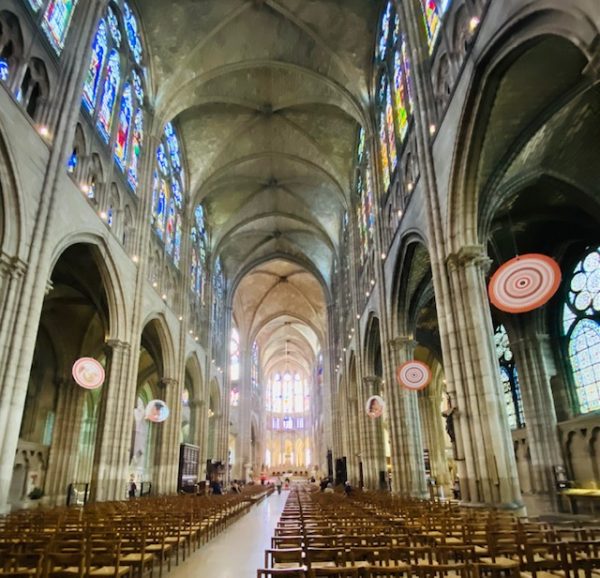
(Image: interior St Denis Basilique Cathedral Paris 2024)

Marc Aurel Memorials

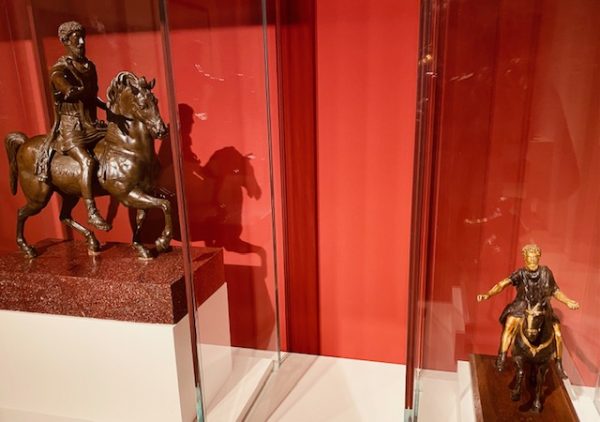
The depiction of Marc Aurel as Emperor has become a trade mark in the history of art and politics. As an emperor with good horse riding skills, Marc Aurel was the first emperor to be portrayed as riding on a horse without saddle whilst, of course, in perfect skill to master the horse and give orders or strategic commands. Many subsequent emperors, Napoleon or Friedrich have had their power positions “immortalised” as such, which served at the same time to make them appear taller and “in command” of something.
Travelling by horse has  also been for a long time the fastest mode of transport, yet another symbol of social status used in media campaigns of those times. The memorials in honour of Marc Aurel had already during the ancient time the function to transmit an image, the emperor wanted history to keep in mind, rather than the view of ordinary people in the Roman empire. Memorials of political leaders have been a demonstration of power for centuries before and for centuries to come.
(Image: Trier Marc Aurel exhibitions 2025-9)