Heat Health Protection

The heat waves of 2026 had serious health impacts in Europe and beyond. Hence, it is urgent to propose better protections to shield people from negative heat exposure which worsened the health of millions of people. Digital tools which work to personalize heat warnings and increase preventive strategies like drinking water or reduce physical activity outside during the hottest times of the day. Sounds simple, but thousands of people continue to put themselves at risk to suffer seriously from heat exposure. The macro-level general population warning’s could be much more specific if they included additionally the relevant medical conditions of an individual (Du et al. 2026). Prior health conditions affect the general preparedness to cope with heat. We have an obvious case of bi-directional causality. A worsening heat health spiral could be at the origin of so many premature deaths during heat waves. Search for “cool locations” should be considered very seriously for heat-health protection.
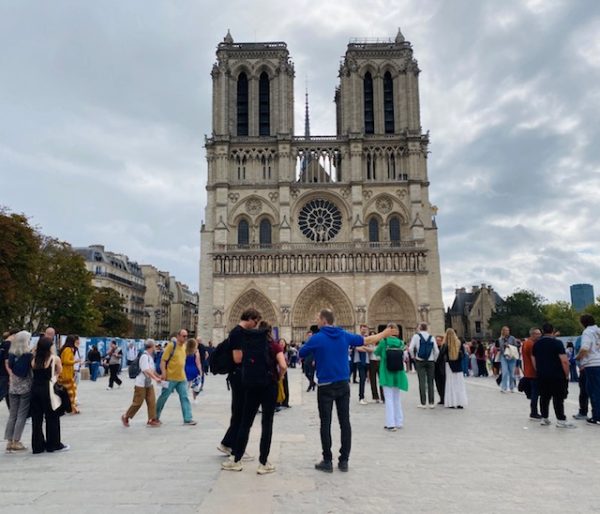
Notre Dame Paris 2026-8

Gothic Paris

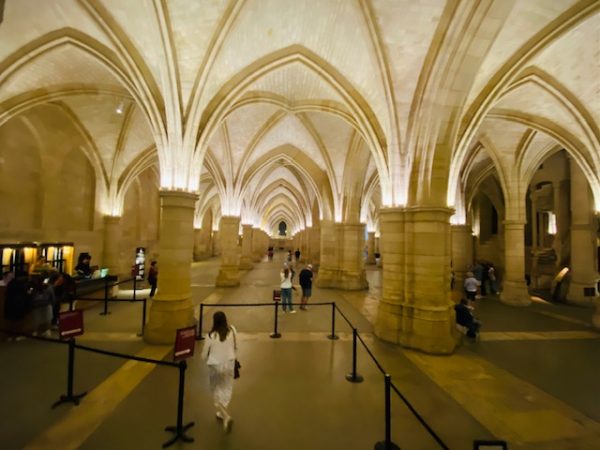
At the “Conciergerie” in Paris you can really and virtually dive into the early medieval period. The royal meeting room and the huge kitchen with 4 impressive stoves brings to life what a royal feast had been like. A guide with virtual reality adds to the lively experience of history of French royalty. Some might like the later functions of some rooms in the annex, where prisoners of the “Palais de justice” where held. During the French Revolution even a Member of the Royal family was imprisoned and later executed there. A long evolution of historical facts is captured in a relatively small space. The weight and violence of history is an almost overwhelming experience there. The modern lighting is definitely more healthy and the smell of cooking next door is also just happening in our imagination or the animation on the tablet.

Conciergerie Paris 2026-8

Swimming Paris

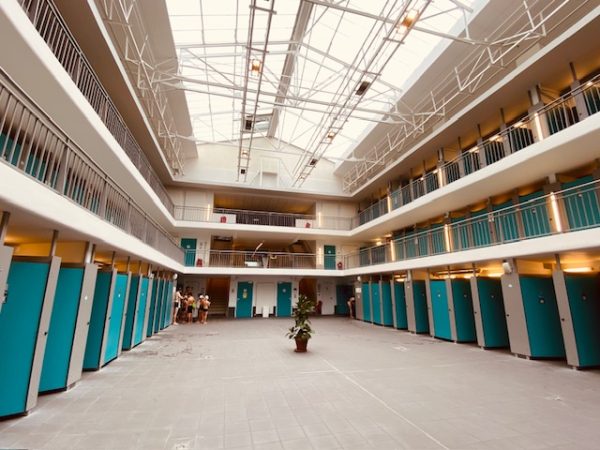
Swimmingpools are rarely on the to-do-list of tourists in Paris. This is good news for all those who go to a Swimmingpool for real exercise. In Paris you can enjoy the almost a century old public pool for swimming exercises with 50m lengths. In the entry hall you have literally a hundred doors where you change and, previously, you kept your clothes while swimming. Light by design welcomes you to do something good for you, physically and mentally. The “Piscine Blomet” (Paris 15th arrondisement) preserves a bit of the charm of the early 1930s Art-deco style in Paris. Sports deserved to be performed and exercised in fine architecture not just functional concrete. It is quite a challenge to preserve such architectural treasures including their original function. It is not all just business and tourism in Paris.

Blomet piscine Paris 2026-8

Healthy intervention

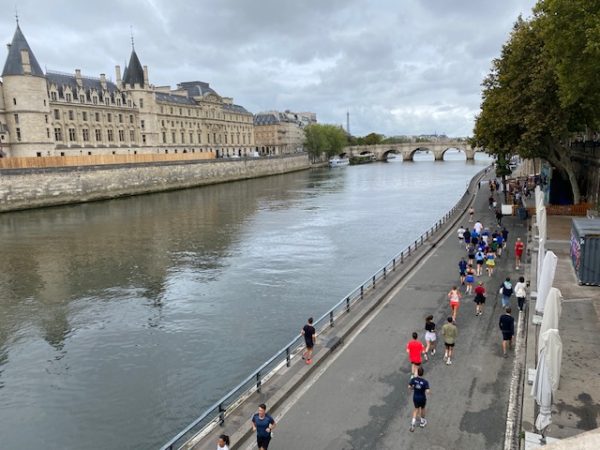
The shift back from a city which favors mobility on wheels to a city where more people move using on their feet is healthy intervention. Paris has succeeded in many inner city areas to improve the „walkability“. On Sundays joggers pass in groups where previously cars were rushing across the city. Noise levels and pollution have been reduced which attracts even more tourists. Many more than the city could handle with too much space occupied by cars and trucks. Security levels are increased by restrictions to car access to some roads and people feel safe and relaxed even in the city center of a metropolitan city. Besides the effect that more tourists come to enjoy this atmosphere, those living and working in Paris feel less forced to leave the city over weekends due to unhealthy pollution levels. Access from suburbs by public transport runs at high frequencies also on weekends. This brings people into the center for events, shopping and event shopping.

Palais de Justice Paris Seine 2026-8

Paris Room with a view

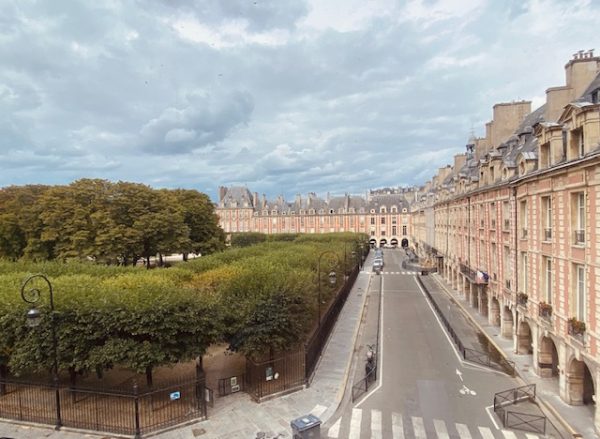
The home of Victor Hugo in Paris offers a splendid view of the Place des Vosges. The image taken from the 1st floor of the building and his living room allows to see a bit like what Hugo saw every day for some time. A small park, probably a lively street with arcades full of shops and people. Lots of inspiration and observation which may come from actual life. The actual time of writing, however, needs also retreat from the busy daily surroundings to focus one’s mind. All this hasn’t changed since Hugo lived in Paris at this address. Writer in residence programs of today allow authors to focus on their work beyond daily tasks. Cultural advances heavily rely on such programs nowadays to be able to have at least temporarily “A room with a view”. 

Hugo home Paris room view through window

Fleeting memories

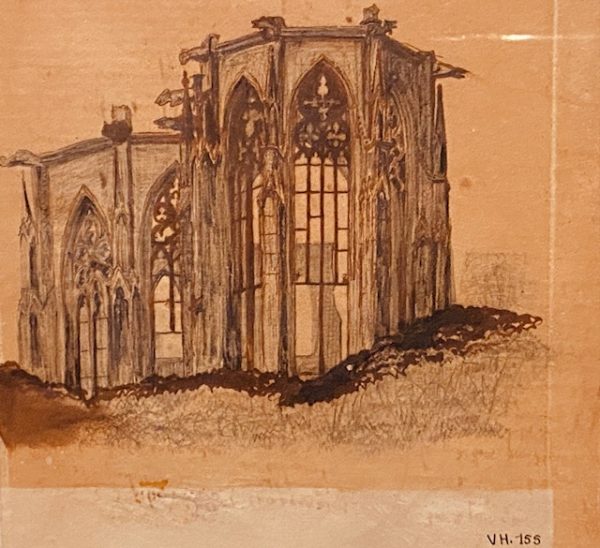
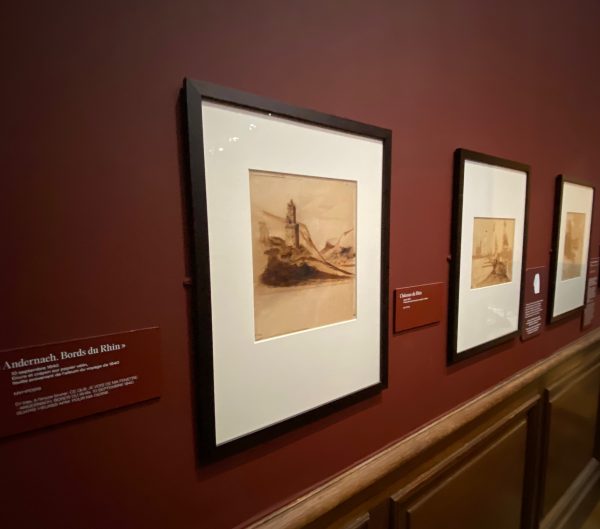
Our memory function is challenged once we travel. There are so many new impressions that ask for prime time in memory, but our capacities to safely store every detail of it is rather limited. On his voluntary travels, less when going into exile, Victor Hugo drew places with astonishing architectural detail and made literary descriptions on the back of the copy. The ruins of a gothic church in Bacharach (Germany) on the banks of the Rhine are a great example of his attempts to beat the fleeting memory. The ink and graphite pencil drawing date back to 1840. The imagery of the abandoned church, itself rich in memories of conflict by way of drawing details inscribes deeply into his own memory. A description in words on the back of this piece reinforces this effect beyond the mental exercise of precision versus dramatic blurriness. Repeating this exercise months later would reveal our fleeting memories when traveling. A great technique which is still valuable 186 years later. 

Church ruins at Bacharach by Victor Hugo 1840 exhibt at Maison de Victor Hugo Paris

Hugo voyage

Victor Hugo traveled for inspiration to neighboring countries. He has been attracted to o mysterious places and its people. In his booklets of such inspirational journeys he drew images of several architecturally interesting places. “Burg” meaning castle was a recurrent subject trying to capture the mysteries about such medieval places and their surroundings. The rivers “Rhein”,”Nahe” and “Mosel” in Germany were a great source of inspiration for him. The images drawn of “Burg Eltz” as well as others (Andernach from 1840, image below left) testify to this. The Home of Victor Hugo in Paris, Place des Vosges features in 2026-8 his drawings which seem to have served him as studies in architecture and sometimes as idea of maybe a scenery for his theatre pieces. Of course, his drawings of cathedrals similar to “Notre Dame” in Paris are also among those ink sketches. To get scared a bit, traveling might suffice and then write it down and sketch it. Franco-German influences can be found in many European artists of the 19th century as well as today.  

Victor Hugo home in Paris exhibition on his drawings of architecture 2026-8

Gone sailing

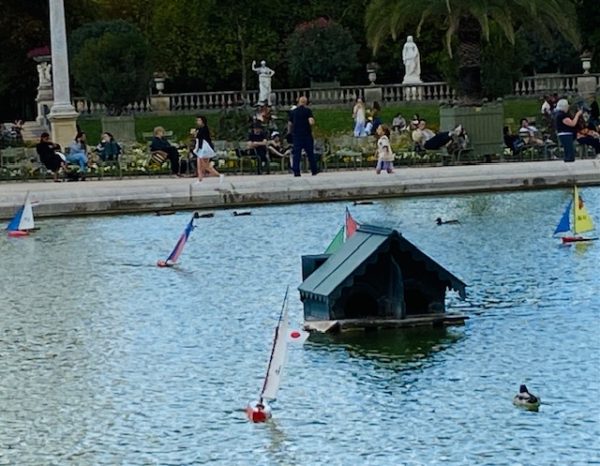
There are numerous ways to spend a nice vacation and take off your mind from daily routines. Sailing is certainly one of those leisure activities which ask for full concentration. Steady winds are more the exception than the rule and the skipper is asked to adapt rapidly to changing wind directions and other conditions. Waves and other sailing boats may of course ask you additionally to adapt your course to unforeseen circumstances. All this is a great training to keep on track even in stormy weather conditions around you. Team work helps to set sails as well as in manoeuvers to enter into ports. The Paris Jardin de Luxembourg (image below) allows training of parts of these competencies from an early age on and into old age as well. The physics of power and capsizing are part and parcel of sailing as well just as much as rules for crossing course, of course. 

Activity and dementia

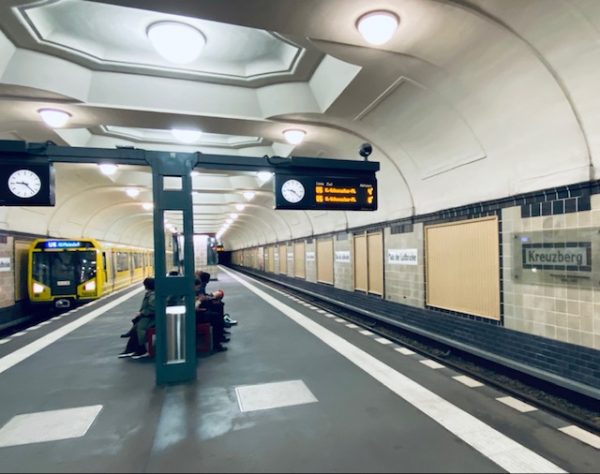
In view of the huge challenge of dementia to people and the public health systems, it is primordial to test potential remedies with high precision. So far general measures of just any physical activity like walking were considered beneficial. Recent and more comprehensive data on domain-specific physical activities by Feter et al. (2026) emphasize the importance to differentiate between walking for leisure or walking rather stressed to work. The former contributes to a delay of the onset of dementia, whereas the latter bears higher risks of dementia due to the “negative” stress involved. However, as Kivimäki and Hamer (2026) point out dementia itself has a long gestation period in which persons might reduce physical activities because a “silent” onset of dementia is not yet diagnosed but inhibits already more activities. Commuting to work or leisure might already be a challenge in early dementia particularly if public transport has to be organized independently. 

Commute in Berlin by underground U-Bahn

Painter influencer

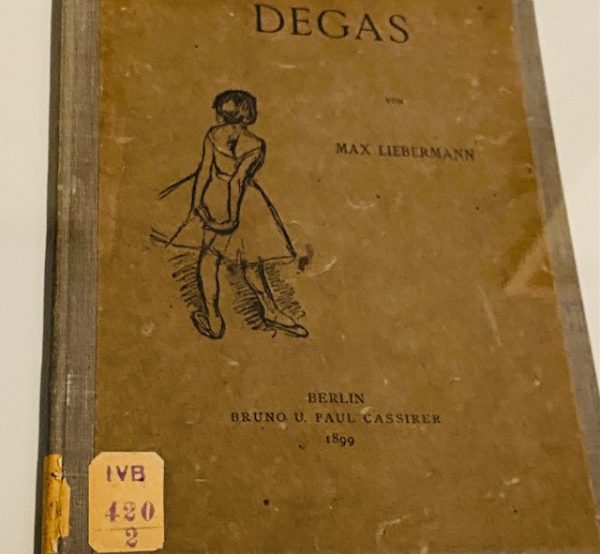
In modern terminology we could say Edgar Degas has been an influencer for many other painters, gallerists, art collectors and our way to look and interpret paintings or drawings. Max Liebermann wrote an appreciation of the work of Degas for a German audience in an attempt to bridge the gaps in the understanding of modern art between France and Germany towards the end of the 19th century. Cassirer as editors facilitated the publication and jointly they achieved to build a remarkable collection of impressionism before the atrocities of war took over in the first half of the 20th century. Fates can change quickly and painter influencer may become discredited due to more forceful political influences. (Image: Booklet by Max Liebermann 1898 on Degas in Cassirer exhibition in Berlin) 

Max Liebermann on Edgar Degas published by Cassirer