A lot of important activities do not receive the attention they deserve. During a humanitarian crisis, Europe frequently acts with varying involvement of Member States. This holds true in droughts, inundations, earth quakes, civil wars or imperialist state conflicts. The extent and time of commitment are an additional and differentiating element. Coordination of such activities is important for those wanting to help and those asking or receiving assistance. Efforts, equipment and political support vary enormously as well. There is a need to approach this topic more strategically. The Union Civil Protection Knowledge Network (UCPKN) goes a long way to attempt to find a common language, data infrastructure and responses in this respect. It surely is important to go beyond the piecemeal approach of the past to be able to address emergencies in multiple kinds more effectively. It is, however, also in some instances a highly controversial issue as well. For each term in this old (Tschernobyl nuclear disaster) and still novel field (Fukushima) for joint activities, we have to come up with compromises of definitions.
For example, what constitutes an emergency? Does the climate crisis and disasters related to it already constitute an emergency now? Some say yes, we have to act now to avoid bigger floods and wild fires as of next year. Others, do not want to tackle the root causes, but rather focus on curing actual devastating effects of disasters.
We are back to a well-known topic of preventive rather than curative approaches. In the meantime, we are convinced that we have to commit more resources to both approaches: immediate relief and structural change to prevent an otherwise never-ending sequence of disasters in varying places.
Most important probably is the keeping of address books and fast digital networking facilities to react and communicate with the competent institutions and civil organisations. Beyond the involvement and linking of experts in the field, the larger public and volunteers make up for additional invaluable resources to act.
It is crucial to make it possible for decentral links between cities like in city partnerships to be involved. Building on existing human to human links motivates and mobilises huge additional resources. Of course, continuous training is a very important element in all those efforts. We should embrace it in the private and public sector, at school and in retirement even. (Image: Extrait de Peter Paul Rubens La chute des géants MRBAB, Brussels)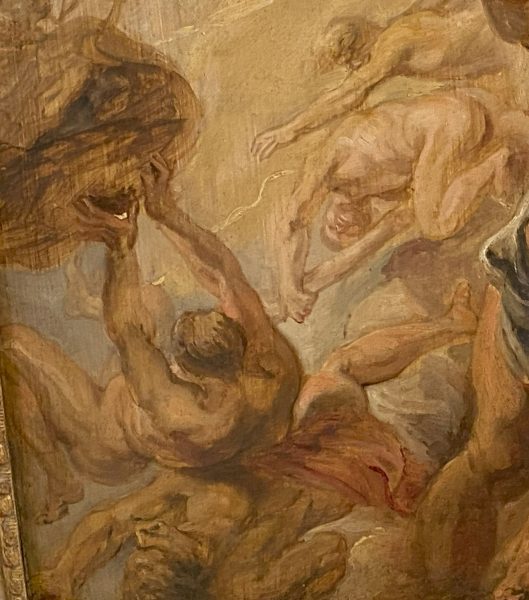
Strafbar
Wir alle wissen, dass in Deutschland die Verwendung von Symbolen der Nationalsozialisten zum Beispiel in Fotos strafrechtlich verfolgt werden kann. Das trifft auch auf vermeintlich nur private Verwendung zu. Dazu hat das Bundesverfassungsgericht eine hilfreiche Erläuterung und Auflistung erstellt (Link dazu hier).
Das Oberverwaltungsgericht von Rheinland-Pfalz hat bereits klargestellt, dass eine Unterstützung der Reichsbürger für Beamte zum Verlust des Ruhegehalts führt. (Pressemitteilung OVG RF) Die Demokratie hat sich Mittel für ihre aktive Verteidigung geschaffen. Diese rechtsstaatlichen Mittel müssen wir noch entschiedener einsetzen.
Hilfreich kann das Weiterlesen auf der Konrad Adenauer Stiftung dazu sein. Dort wird in allgemeinverständlicher Art beschrieben, dass die zur Schau Stellung von Teilen der Uniform und Symbolen seit Gründung der Bundesrepublik verboten ist.
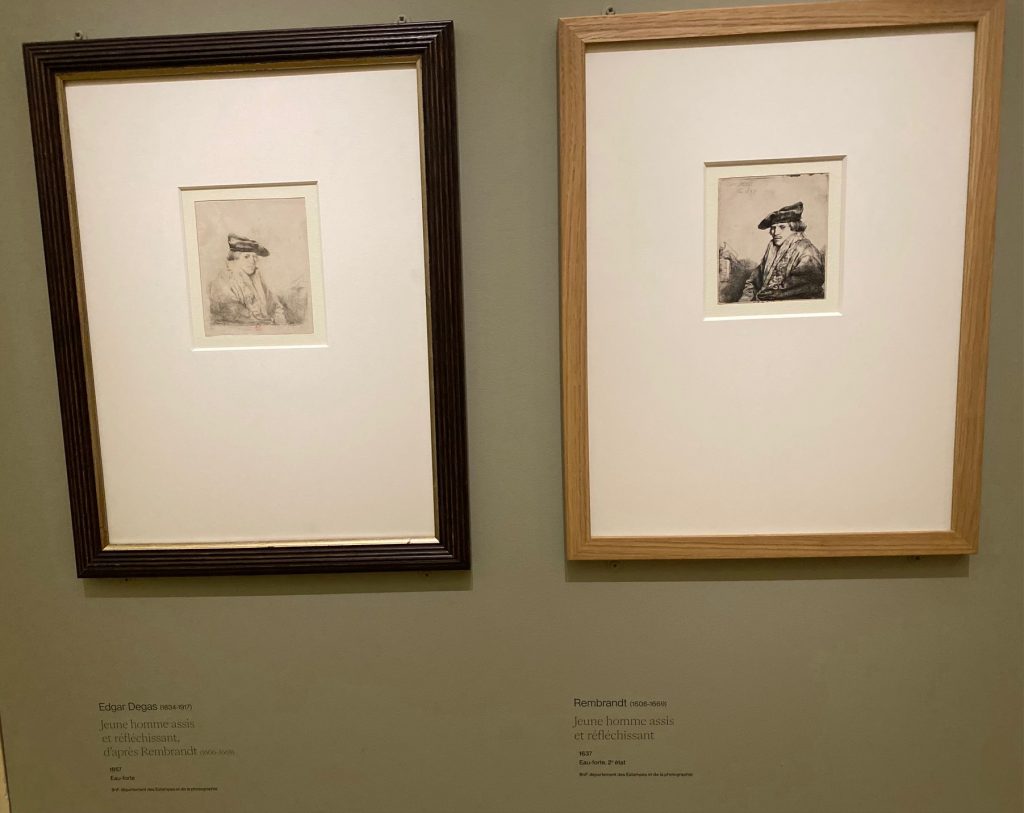
Meist steht hinter der Verwendung dieser Symbole keine Dummheit, sondern eine bewusste Aggression oder gar Boshaftigkeit gegenüber anderen Menschen. Menschenverachtung der Nationalsozialisten lässt sich nicht entschuldigen, damals nicht und heute nicht. Image: Edgar Degas d’après Rembrandt 2023 BnF.
Beckett by Beckett
There is an interesting discourse in literature about how to define irony. This really begins with Plato commenting on Sokrates who makes use of the term “eirôneia”. In the history of the idea of irony comes next the philosopher Kierkegaard with his not-ironic treatise “The Concept of Irony. With Constant Reference to Socrates”. Reading philosophy can be really entertaining. It is, therefore, no surprise to find a publication entitled “Ironic Samuel Beckett” (Pol Popovic Karic, 2009). Following Karic there are 3 defining elements of irony: (1) “The message should be intentionally created, …(2) The meaning of an ironic message needs to be “covert”,… (3) During the analysis of a stable irony, the reader can assume that the first interpretation of the ironic message is correct.” (Pol Popovic Karic, 2009 p.49).
Additionally, to understand irony it might be necessary to know more about the context of the statement. Sometimes the ironic statement can only be interpreted as such if you have additional knowledge about the biography of the author (p.47). To understand Beckett better it is advisable to read about his life course in the many biographies available nowadays.
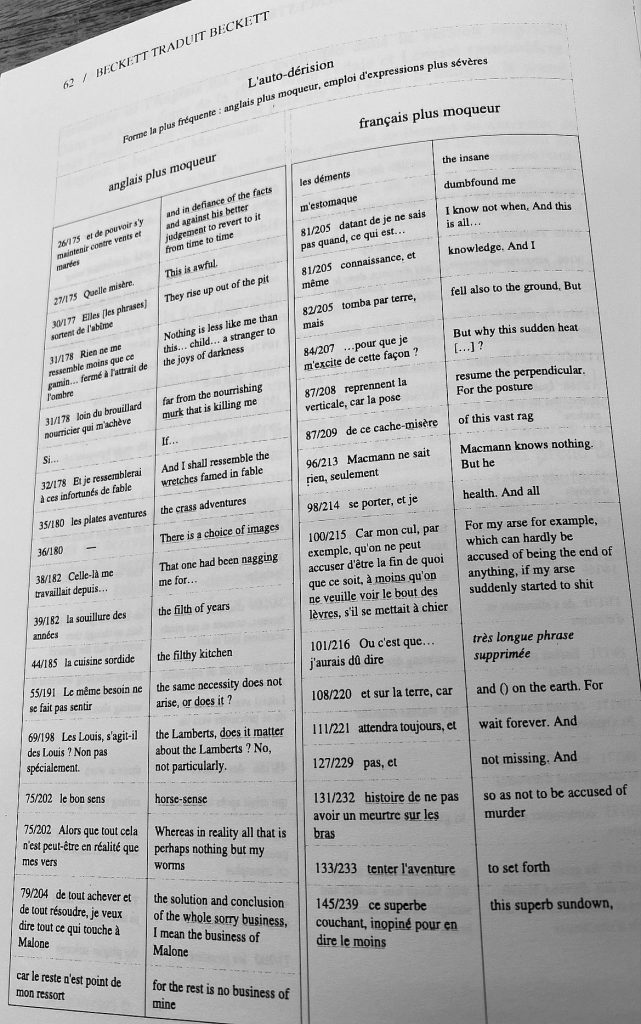
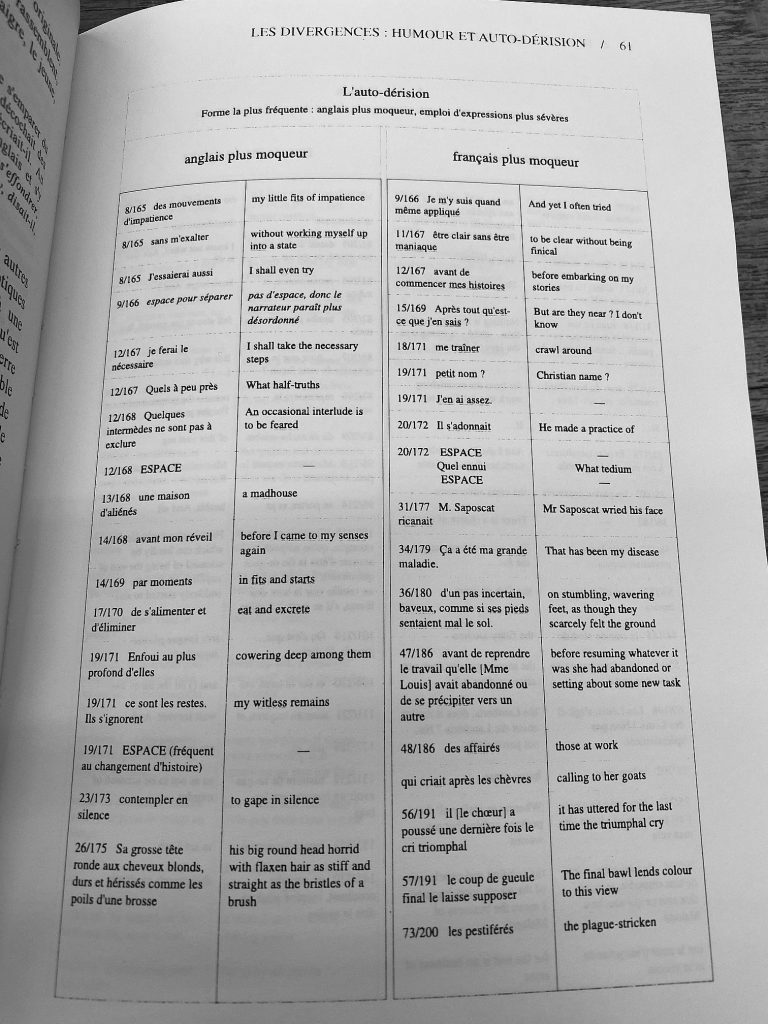
Beckett by Beckett, meaning the translation of Beckett by Beckett himself yields many fruitful insights into his kind of irony and constant reflection and laughing about himself as his very own form of irony. This becomes most evident in the many helpful tables Linda Collinge (2000) presents in her book on “Beckett traduit Beckett”. Translating irony is a tricky endeavour. Many of the translations do not seem to be straightforward at all and can only be understood from the perspective of the whole translation of a piece and the underlying “Haltung”, ironic attitude of the author to his own work. Beckett by Beckett remains a master piece for translaters beyond those from French to English. (Images: Linda Collinge, 2000, p.61-2).
Book traders
Some book traders have a mission. They assemble little corners on their book shelves or in tiny cupboards reserved for their passion or mission. In some book shops you’ll find a corner devoted to a specific language or translations, in some a world region is represented as a specific predilection. The choises are as numerous as there are books. Of course, from an economic point of view national and international bestsellers will be shown in the most prominent places. Second come books for children, cooking, life and travel guides. All those are the cash cows for book shops and traders.
But beyond those, it is always worth the effort to search for those little carefully curated corners in a good bookstore that derive from the vision or mission of the book trader, employed or owning the shop. In some areas this contributes even to a small community building. Readings of authors add to the function of book sellers to build a relationship to their non-random book buyers. I keep going back to my favourite book stores and libraries with those curated corners for decades and across countries to find inspiration and updating of special topics.
There is a danger that we are going to lose all this professional work of thousands of well-trained book traders that guide readers in addition to publishing houses, literary critics, numerous awards and huge marketing campaigns of derived products (as with Harry Potter). Living up to your mission while running a book store must be a great experience. If is really increases the buyers and readership for the topic, would be a great result. However, I suppose many bookshops manage to keep their little curated areas despite economic pressure to go with the mainstream marketing campaigns and top selling books and gadgets.
With the decline in the number of smaller book shops (in Germany from ca 5000 to 3000 in about 20 years) we see a parallel increase in number of franchises of the big book sellers (Thalia.de 500 stores in D). Big chain increase seems to cause fewer professionally trained book traders (-10% in D) within a country. For younger generations TikTok (BookTok) has taken over large parts of the “book counselling” of book traders previously. This was a big event at the Frankfurt Book Fair 2023 as well.
Time to rush to your local bookstore and book trader before it is taken over by a big chain or simply disappearing silently. We are likely to lose many of those book traders with a mission to make this world a better, more beautiful, more tasty, enjoyable or inclusive place. 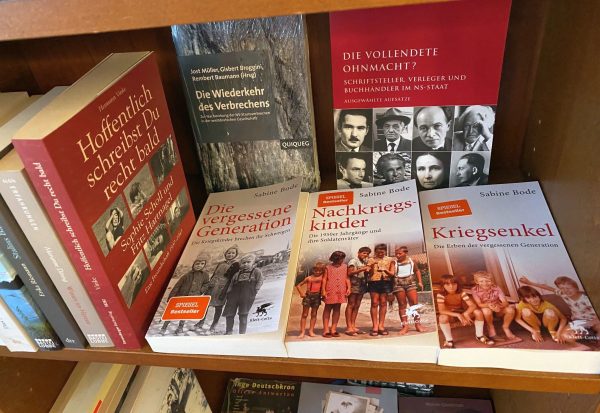
Comme les peintres
« Moi aussi, comme les peintres, j’ai mes modèles ». So beginnt ein Gedicht von Jacques Prévert. Ein Klassiker der französischen Poesie. Prosagedichte sind eine Gattung der Gedichte, die in kurzen Texten einen Moment oder Augenblick einfangen und sublimieren. In diesem Genre publiziert Philippe Delerm seit Jahren prosaische Gedichte. Der in 2023 erschienene Band „Les instants suspendus“ reiht sich ein in die Sammlungen von Momentaufnahmen, die sprachlich veredelt die Wahrnehmungen schärfen und sie zum Salz des Lebens werden lassen.
Für Weinliebhabende drängt sich die Assoziation „vendanges tardives“ (späte Lese) auf. Während wir in deutschen Weinanbaugebieten ganz nüchtern die zu erreichenden Öchsle für die Spätlese zählen, verbindet Delerm mit den „vendanges tardives“ „une jeunesse prolongée, glissant vers la mélancolie, et célébrant mezza voce le mariage de l’automne et de l’été “. (2023, S.87).
Die Sammlung „Les instants suspendus“ – auf Deutsch vielleicht „Momente, die schweben“ bietet zahlreiche, aufheiternde und, ja auch erhebende Augenblicke, die trotz der Intensität der Schilderung für viele Menschen Anknüpfungspunkte bieten. Übersetzen lassen sich die Szenen schon, aber es schwingt bei den kurzen 200-300 Wörter umfassenden Texten viel französisches Flair mit.
Bei „Commander l’eau“ wird „Le bruit de l’eau dans la bouteille devient chant“. Wasser einfüllen ist Musik. Oder, « Le moteur de la deux-chevaux », der Motor des 2 CV, « c’était humble et c’est devenu chic », das war bescheiden und ist schick geworden. (S.82). Das federnde, schwebende Fahrgefühl wird bei Delerm ein „accord prolongé“, zu einem nachwirkenden, verlängerten Akkord.
Aus dem Netz der Spinne (toile d’araignée) wird der Stern der Spinne (étoile d’araignée) auf Seite 101. Fast alle hätten diesen Versprecher schon gemacht, aber es ist einer der Wenigen, den die Erwachsenen nicht berichtigen.
Lassen wir den Kindern ihre „instants suspendus“, ihre Momente der Poesie.
(Image: Innenansicht und S.9 Anregung Proust zu lesen im Vorspann). 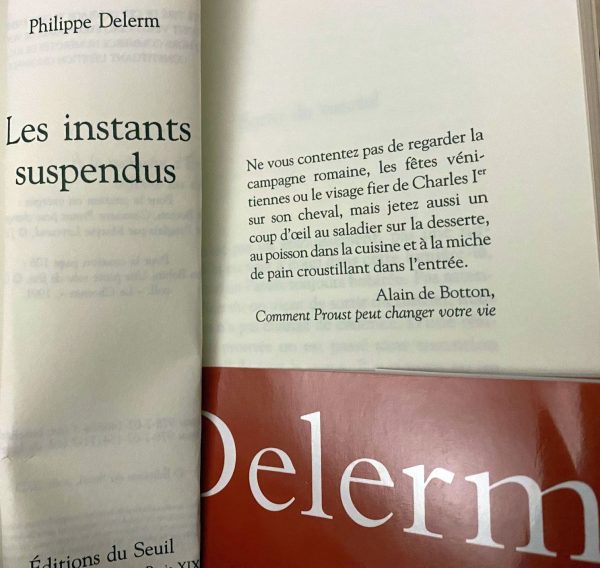
Dramen
Jon Fosse hat bereits viel Erfolg mit seinen Dramen gehabt. Wahrscheinlich können wir sein umfangreiches Werk mit der Kenntnis von Ibsens Dramen und Becketts Dramen besser verstehen, falls Verstehen überhaupt eine relevante Kategorie ist Fosses Werk. Durchaus vergleichbar mit Beckett hat Jon Fosse früh schon erfolgreiche Aufführungen seiner Theaterstücke neben seiner norwegischen und skandinavischen Heimat in Frankreich. In Deutschland hat der Regisseur Thomas Ostermeier seine Werke in Salzburg und Berlin vor ca 20 Jahren bekannt gemacht.
Suzanne Bordemann beschreibt in ihrem Buch zu der Rezeption von Jon Fosse, wie der schriftstellerische Werdegang des Kunstschaffenden verlaufen ist. Interessant ist dabei die weniger bekannte Ausgangsbasis Fosses als Herausgeber der Literaturzeitschrift Bok oder seine literaturtheoretischen wissenschaftlichen Aufsätze. Selbst seine Tätigkeit als Übersetzer von Dramen aus dem Deutschen und dem Englischen hat sicherlich zu einer Ausprägung von Sprachfertigkeit geführt, die uns heute noch einzigartig erscheint. Schreiben hat enorm viel mit Lesen und stetigem Arbeiten an Texten vielfältigster Art zu tun. Dieses literarische Gesamtkunstwerk ist sicherlich Grund für die höchste Auszeichnung des Gesamtwerks mit dem Nobelpreis für Literatur.
Aus Stille lernen heißt dann für mich, Jon Fosse selbst zu Wort kommen zu lassen. Das hat Suzanne Bordemann in ihrem 2. Kapitel vorgemacht. Als Auszug möchte ich 2 Seiten (S. 26-27) zitieren, die für mich besonders aufschlussreich waren. Sicherlich Grund genug für eine intensivere Befassung mit diesem umfassenden Werk. 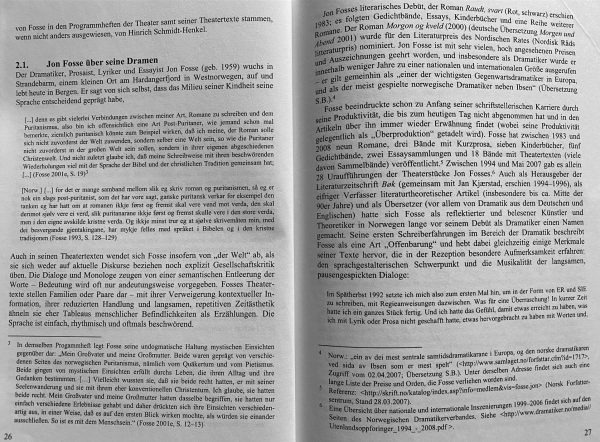
Kriegsenkel
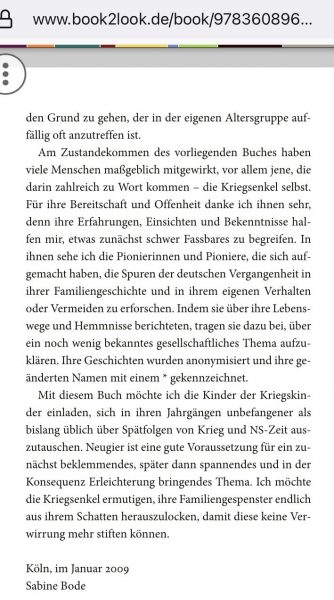
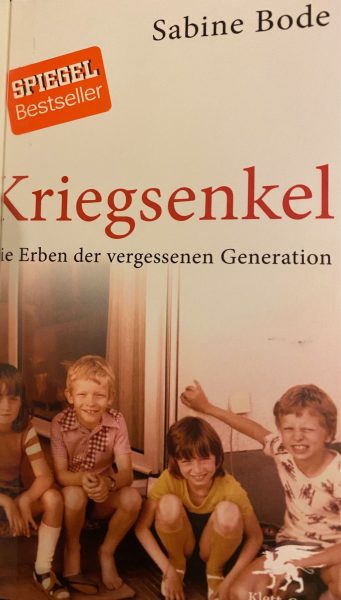
Bereits in 2009 folgte das Buch „Kriegsenkel – Die Erben der vergessenen Generation“ auf das Buch über die Kriegskinder 2004 von Sabine Bode. Im Vorwort zur 9. Auflage in 2014 wird deutlich wie sehr es weiterhin nötig ist, sich mit Familienlegenden und Familienbeziehungen zu befassen, wahrscheinlich auch wegen des lieben Familienfriedens willen. Selbst etwas überraschend berichtet Sabine Bode, dass so viele Kriegsenkel das Buch über die Kriegskinder gelesen und diskutiert haben. Es ginge dabei nicht um Schuldzuweisungen, sondern eher darum, sich über eigene Verunsicherungen, Unausgesprochenes und bisher Unbewusstes klar zu werden. Sabine Bode schreibt über die „Familiengespenster“ oder wie der Titel des ersten Kapitals heißt. „Gespenster aus der Vergangenheit“. Otfried Preussler mit seiner Mitläuferbiografie hat mit dem kleinen Gespenst versucht, eine positive Wendung für Familiengespenster, zumindest als Fiktion zu generieren. Der Versuch einer beispielhaften Immunisierung gegen NS-Versuchungen bringt dann sein etwas düsteres Buch Krabat.
Sabine Bode interviewte auch die Kriegsenkel und berichtet von einem bei vielen vorhandenen „verunsichertes Lebensgefühl“. (S.21). Sicherlich ist die sexuelle Revolution in den späten 60er und 70er Jahren viel daran beteiligt, dass die Kriegsenkel weniger und viele keine Kinder bekommen. Dennoch lässt sich nicht ausschließen, die Verunsicherung der Kriegsenkel hat ebenfalls zu dem Rückgang der Geburtenraten beigetragen. Das ist allerdings kein einfaches empirisches Unterfangen. Starke Rückgänge der Fertilität in Kriegsalliierten Nationen Japan und Italien weisen in eine vergleichbare Richtung, aber es lassen sich auch Gegenbeispiele aufführen. Verunsicherung der Identität der Eltern kann sich noch bei den Kindern als Orientierungslosigkeit äußern. Bode zitiert selbst (S.22) aus einem Theaterstück von Fehling über das Beziehungsgefälle zwischen Kriegskinder und Kriegsenkel. Die Enkelin gesteht darin etwas frustriert, Sorgen macht sich ihre Mutter gerne, „aber immer nur um sich selbst“. Anders als intrinsisches Mitgefühl eignet sich das Kriegskind lediglich die Missgeschicke der anderen an, sozusagen in der Relevanz für sie selbst. Weitere anekdotische Evidenz dazu weist auf einen hohen Wiedererkennungsgrad dieser Geschichte hin. „Risiken und Nebenwirkungen“ eben auch für die Kriegsenkel und Kriegsenkelinnen.
Kriegskinder
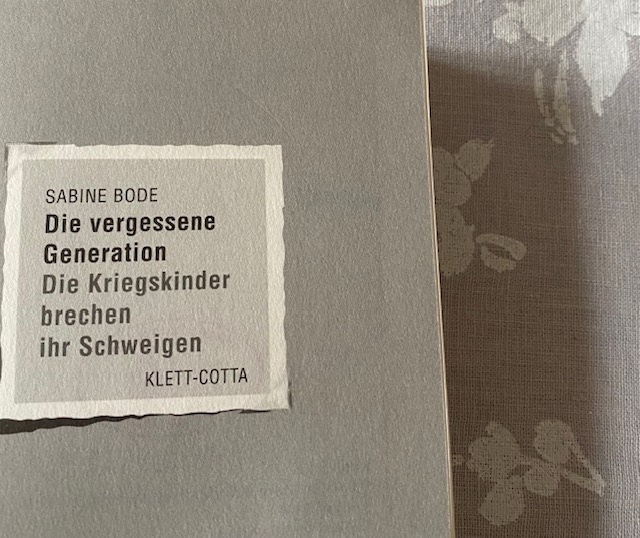
Sabine Bode hat bereits in 2004 eine ausführliche Beschreibung und Berichterstattung zu Interviews mit den Kriegskindern, den 1930-1945 geborenen, vorgelegt. Die meisten haben lange, lange geschwiegen doch es ist ihr damals gelungen, einige aufschlussreiche Gespräche zu führen. Diese lassen sich mit den sehr unterschiedlichen Schicksalen nachlesen. Die vergessene Generation als Titel könnte vielleicht sogar treffender heißen die vergessende Generation. Die Verdrängung von unangenehmen historischen Wahrheiten wurde zu einem Dogma erhoben. Sabine Bode schreibt bereits in der Einführung: „Nun ist ja bekannt, dass Kinder auch extreme Lebensumstände hinnehmen, wie sie sind. … bis es mit den Normen der Aussenwelt in Kontakt kommt.“ (S.17). Erstaunlich aus heutiger Sicht ist laut Bode auch das Festhalten an „eigentlich unpassenden Gefühlen“ auch viele Jahre sogar Jahrzehnten danach noch als normal fanden und einige noch finden.
Sehr treffend formuliert es Sabine Bode, dass es weiterhin eine äußerst beunruhigende Angelegenheit ist, über die Erfahrungen zu sprechen. „Die Antworten liegen unter der Last von Schuld und Scham begraben, als Folge der Naziverbrechen, des Holocaust.“ Oft wird eine quasi Normalität berichtet, die jedoch in keinster Weise als solche von späteren Generationen so gesehen wird. Dieser Diskrepanz sollte sich mehr Aufklärung und Literatur widmen. Philip Sand hat dazu eine gute Abhandlung verfasst, die auch die Erlebnisse der Kriegskinder einschließt. Das laute Schweigen von Millionen von Kriegskindern bis hin zum Verdrängen und Beschönigen des Verhaltens ihrer Eltern vor und während der Kriegsjahre befremdet nachwachsende Generationen. Gerade das häufigere Verbreiten von menschenverachtenden Naziparolen im 21. Jahrhundert verlangt eine entschiedenere Aufarbeitung der Verbrechen und wie es dazu kommen konnte. Schließlich wurden aus vielen dieser Kriegskinder dann die Nachkriegseltern wurden.
Teaching Ethics
Ethics is frequently taught by referring to reference cases, moral dilemmas and readings on the evolution of the discipline as some ethical issues arise due to technological innovations. Some fundamental ethical principles pertain to professional standards or so-called codes of conduct. This is also part of the sociology of professions which includes the societal and political role professions and professionals. The medical profession has been subject to ample research already. And yet it is important to notice that there is a renewed effort to include into the teaching of ethics “The hard truths about medicine and the Holocaust”. (AMA J Ethics. 2021;23(1): E59-63. doi: 10.1001/amajethics.2021.59). Eugenics were practices well before WWII. “Legal coercive sterilization, which progressed to the notorious “euthanasia” (medically sanctioned murder) program” (p.59) were the beginning. Medical doctors were not reluctant to implement the Nazi medical doctrines. “Most joined eagerly, earlier, and in much greater numbers than other professionals” (Chelouche, 2021; Kater MH, 1989). Physicians made the horrors of Nazi ethics efficient in its implementation. Nazi physicians had a strict ethical code which priorities obedience to the state rather than to the individual.
Research and experiments conducted by medical doctors during Nazi rule is analysed by Weindling (2015). In summary he states “Nazi experiments were accepted forms of science at the time, conducted not only in concentration camps but also in hospitals and clinics across Germany”. This concise overview of recent research by Tessa Chelouche in this field is not only important to teaching ethics in the medical and care professions, but it is of high relevance to much broader audiences and many more professions like judges. Only the awareness and guarding against a renewed failure to respect human values and human rights of the individual allow us to advance humanity. Decentralisation of power, checks and balances, professions following widely accepted principles rather than authoritarian rules can avoid another failure. Teaching about this is a “conditio sine qua non” and not a nice to have part of the curriculum in schools as well as professional colleges. 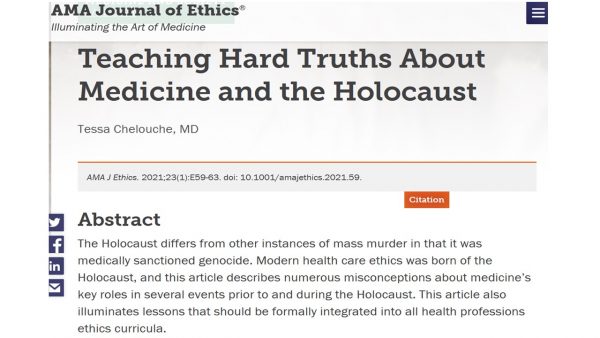
Narratives
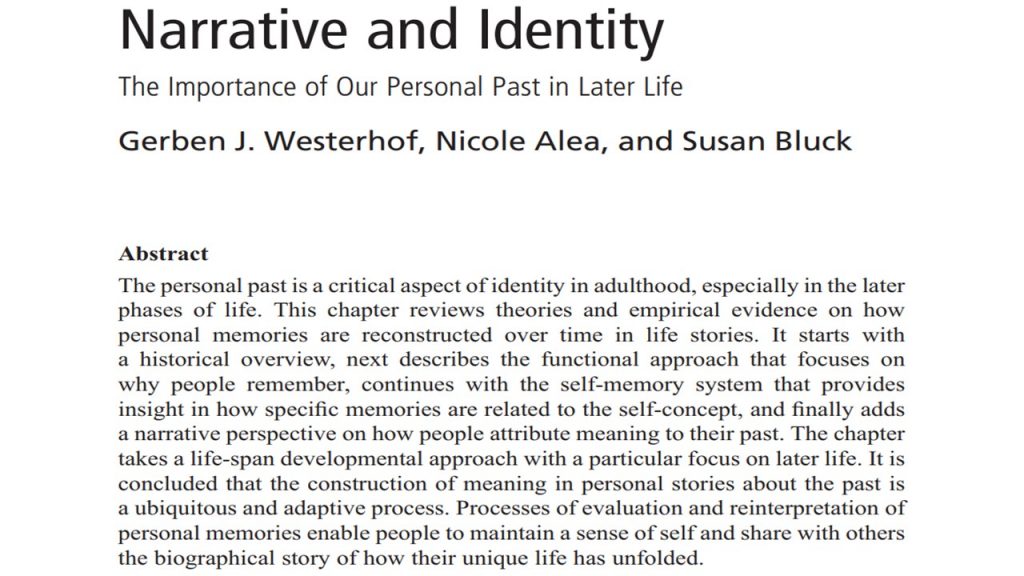
In psychology it is a long-established field to study narratives of persons as they age. To make sense of individual narratives might even be considered as one of the foundations of psychological research since its starting times. “The Cambridge handbook of cognitive aging : a life course perspective” has 2 entries that enlighten the issue of personal life stories or narratives. We have to consider the importance of our personal past to the construction and reconstruction of our personal narratives. As persons age reconstruction of narratives becomes a more frequent exercise as life experiences and new evidence continue to accumulate. The chapter on “narratives and identity” supports the view of plasticity in old age, which means that narratives and identity are an adaptive process. “Processes of evaluation and reinterpretation of personal memories enable people to maintain a sense of self”. The importance of recalling personal life events and positive self-regard is a well-established link in this research tradition. The self-memory system consists of the autobiographical memory, the self-concept and the working self as its components. It is evolving in most persons as part of the construction and reconstruction of the self, as well as narratives of it.
As persons age our brain and memory functions age as well. This starts earlier than most people expect. “Many studies in gerontology have shown that being able to remember, evaluate, and integrate personal memories and thereby dynamically maintain identity is related to mental health and well-being in later life (Westerhof et al., 2010).” (p.392). Reconstruction of narratives is a process that is hard work for our brain, therefore as people age many seem to shun away from these tasks. It is easier to clinch on to the old narratives of the self.
The chapter on emotion recognition and aging of the social brain summarises the research (p.369) by Ruffman et al. (2012, 2016) which shows that older persons were not as good as young persons to detect lies due to difficulties with emotion recognition. “Finally, we examined right-wing authoritarianism (Ruffman et al., 2016), that is, the tendency to hold conservative social attitudes (e.g., believing that women should have to promise to obey their husbands when they get married). Older adults had more pronounced right-wing attitudes than young adults, and even within the older adult group, these attitudes were entirely explained by their worse emotion recognition”.
The causal link, however, is less clear. The positivity bias in old age might be a major factor. The positivity bias describes the fact that older persons prefer to look at positive stimuli and avoid negative stimuli. The evidence is rather inconclusive about this effect. Probably persons have a positivity bias all along their life course as part of their personality traits. The other explanations of brain region decline and activation seem to receive a bit more empirical support (p.375). In any case, men seem to be even at higher risks.
Archives of personal diaries, letters, correspondence of persons are a valid additional source to study the process of the construction and reconstruction of the self. Biographical accounts of life histories serve as empirical material to analyse narratives and historical validity of narratives. The better the story, the more scepticism should be applied.