Ever since the visit to the exhibition “Care, Repair, Heal” at the Martin Gropiusbau in Berlin the image of flying protheses rests with me. Repairing the human body is feasible in many fantastic ways. The inner wounds, however, are less visible and sometimes hurting even more. In recognition of the thousands of victims again in the Russian war on Ukraine’s territory and the atrocities causes by mines to injure humans, we have to assist in caring, repairing and healing. This has not changed since the Great War or the Nazi-induced mass murder and mutilations. Humanity is unable to bann such landmines despite international conventions trying to achieve this.
The strong image produced by the protheses as clouds in the sky (Kadar Attia) remind us of the lasting effects of war. Images we had associated with the mutilated soldiers and civilians of the 2nd world war, many still around us in the 60s or 70s, are coming back to Europe. Writing about the 20th century, Aurélien Bellanger described in words a similar traumatising vision of flying protheses in his story of the lonely poet and philosopher. We cannot repair history, but we can work towards reducing useless additional suffering. It is part of the absurdities of our world that technology has created masterpieces to assist us and reduce suffering, but at the same time technology is applied to create the worst suffering as well. Rather than thinking of this relationship as 2 sides of the same coin, I prefer to hope for dialectic evolution towards a better synthesis solution using enforceable international law. Yes, I still have a dream! … 
On Noise
The 3 authors Daniel Kahneman, Olivier Sibony, Cass R. Sunstein have published in 2021 the impressive attempt to sell statistics to non-statisticians. The grip on the topic: “Noise. A Flaw in Human Judgment” is a bit misleading. Even the German translation (“Was unsere Entscheidungen verzerrt”), in my opinion, is grossly misleading. The work deals with judgment, or arriving at a sensible judgment. Decision-making is only the next step with a lot of other intervening processes. The German philosophical term since the enlightenment period has been “Urteilskraft“. We are all more or less familiar with the notion “bias” in judgment. Me, originating from the Moselle, will always be biased in favor of a Riesling compared to other vines. In addition to this naive bias I may apply a more professional judgment on wine. Testing several wines even from the same small area from the Moselle valley and then repeating the tasting I might make a noisy judgment. “When wine experts at a major US wine competition tasted the same wines twice, they scored only 18% of the wines identically (usually, the very worst ones).” (p. 80). In addition to the previously defined form of “level noise, pattern noise and system noise” (p.77), we have occasion noise, when judgments vary from an overall statistical perspective.
Having received a second dose of a vaccination yesterday and having spent an unpleasant night my judgment for this review might be biased, because of impatience. So in order to reduce bias and variants of noise I shall repeat the review at a later stage. Let’s see what this returns. But for today, the Epilogue “A less noisy world” (p.377) appears rather odd to me. It is probably an illusion to believe that we can create a less noisy world, even with the best of wishes. The authors abstract from any strategic use of noise to influence judgments. The political form of choosing judges for Constitutional Courts in the U.S. needs to be dealt with. Noise in judgments is an important element, but strategic use of bias might be more influential to impact outcomes. Noise, when faced with a judge who has a reputation to be very tough in sentences might be overturned in an appeal court decision. There are plenty of procedural ways to overcome noise in judgments. I agree with the authors that you better know about the noise in judgments than ignore it. Awareness of random errors and noise involved in grading exams and recruitment decisions have determined many excellent “failures” to leave historic contributions to our world. In music, maths or literature some splendid talents probably have been impeeded at earlier stages of their life to make average or normal careers. Some of them left us with fantastic pieces thanks to the noise in judgment of others.
There seems to be an age bias in the tolerance of noise in the acoustic sense. Noise in the statistical sense has left a strong mark on me when I learned about white noise as error or stochastic process.
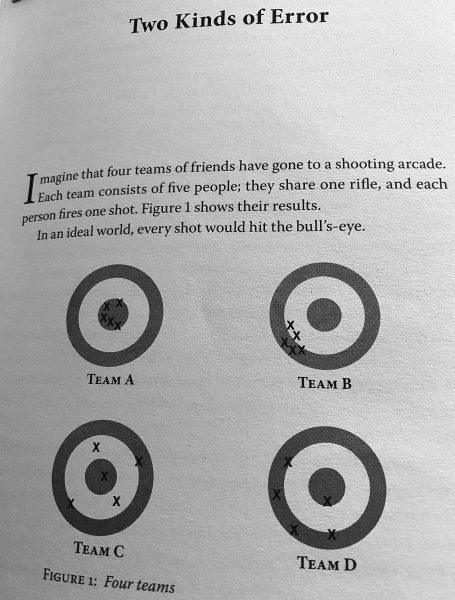
Image Kahneman, Sibony, Sunstein 2021. p3.