
In French cinema Jean Gabin is a much adored person. Equally, Marlene Dietrich had, probably an even more far reaching international career. Both were accomplished and successful actors long before the 2nd world war broke out. In the U.S both fell in love and had a long lasting romance together. Their war time activities and “engagement” in fighting Nazi-Germany were extraordinary. It meant that both took active roles to use their charisma to mobilize people and soldiers to fight for freedom.
Shortly after the war then, both made a last attempt to work together in a movie production, but it could not unite the couple again. The “Deutsche Kinemathek” displays currently a page from the Diary of the “Diva” to underscore to what extent “Dietrich” was depressed about the break-up of their longer lasting love affair. Some say Gabin was the only person who quit her, all (most?) other relationships were terminated by the Diva. The junctions of biographies are hard to predict. The circumstances of the 2nd world war and internalized civic obligations to fight for freedom and democracy were wholeheartedly shared by both, but eventually they grew apart nevertheless. Tough experiences even for the much adored persons on the forefront of the stages worldwide. There seem to be many instances of repetition of the same story not only in movies, but also in real life.
Image: Deutsche Kinemathek Museum 2024-5 
Image History
The archives of the history of movies and/or television show to us the multiple ways how images capture our attention and memories. Visual narratives are an own category of our personal and collective memory. The wide range of visual experiences are a powerful way to influence. Not only the movies and stories matter, but the whole range of images associated with the cinema world. Poster collections, newspapers and today the so-called social media multiply the original images. The Deutsche Kinemathek allows a special, critical understanding of image history as Germany has been using and abusing images and movies in a very manipulating manner historically. The message is: do not take images for face value. The ways and techniques to manipulate images have been widely used and are all around us today. Whereas the mass media in previous decades have dominated the collective memories we have entered into an era with many more subcultures that evolve within their own bubble of images. An original attempt to cut 65 movies of German film history into less than 4 minutes is presented in the exhibition (Milkowski and Simbeni). It focuses on gestures and “les regards”, “Blicke”, how the actresses and actors seem to look at us. Eyes capture attention, and this as soon as we open our eyes as children. Our brain works as image recorder and our memory algorithms tend to favor image recognition while processing images continuously. We do not know much about our own image sorting algorithm or algorithms yet. Research on aging of the brain gives some hints. With declining short term memory the images stored in long term memory take the upper hand. This makes an understanding of the history of images even more important.


Deutsche Kinemathek
Just in the vicinity of the Potsdamer Platz in Berlin you’ll find the Deutsche Kinemathek, the museum movies, actors, actresses, directors and the history of cinema in Germany. There is a small specialized library in the Kinemathek that allows to dive not only into journals and books, but also video material, scenarios and accessories. Of course, you will find a lot of material on all sorts of movie stars (heroines) over more than a hundred years. The “Divas” of the industry take up a large part of the exhibition. “Marlene Dietrich” much more than “Hildegard Knef“, the former born and the latter lived for a long time in Berlin-Schöneberg (Berlin-Pretty-Hill as some locals call it nowadays). The 2 Divas probably caused the funny translation. Anyway, the hall in the Kinemathek which is exclusively devoted to Marlene Dietrich impresses with a lot of glamour and mirrors around.
For those with not only a biographical, but also life course interest in cinema cherish the public access to the library. The most impressive table there is the desk with access to the Ukrainian movies and about cinema in Ukraine. A list with QR-codes allows you to readily approach the recent developments before and during the Russian aggression on Ukraine (See image below). After all Potsdamer Platz in Berlin was a hot-spot of the cold war period in the divided Berlin. A little bit of a “Metropolis-atmosphere” can still be felt. The Kinemathek explains well what this is all about. 
Deutsch Deutscher
In English grammer we use comparative adjectives to express that something or someone has changed or undergoing change. Germany might have become more German. The second usage is to make comparisons not only between two points in time, but between two statuses or of two artefacts more generally. The statement “Deutschland wird deutscher”, therefore, intends to describe an ongoing process or the transition process from one state to the other. This statement as such does not offer any explanation or definition of the original state, nor of the second point of reference. It might just describe the dynamics or the direction of the dynamics. In this example it deals with social dynamics. Germany in the 21st century is posing more questions about its identity and future directions than some time ago. The artist Katharina Sieverding has put up this reflection as a poster on walls to provoke discussions about the way to identify and deal with German identities in the early 1990s, shortly after re-unification of the 2 parts of Germany (Image below from “Nationalgalerie für Gegenwartskunst, Hamburger Bahnhof, Berlin” 2024-5).
30 years later we are scared by a ruthless right-wing extremist and brutal movement that takes to the streets and commits crimes.
It is no surprise that the Higher Administrative Court in Cologne has confirmed that the “BfV’s classification of the party AfD and of its youth organisation as a “Verdachtsfall” (subject of extended investigation to verify a suspicion) as well as the publicising of this classification to be lawful“.
It is a step ahead to become “deutscher” if we battle out such decisions in courts rather than by force on the streets, although this has failed once in German history already. The poster action by Katharina Sieverding is a reminder to monitor and deal with these topics continuously, albeit the knifes may be coming in closer than before. Being frightened is no option in order to defend democratic values. 
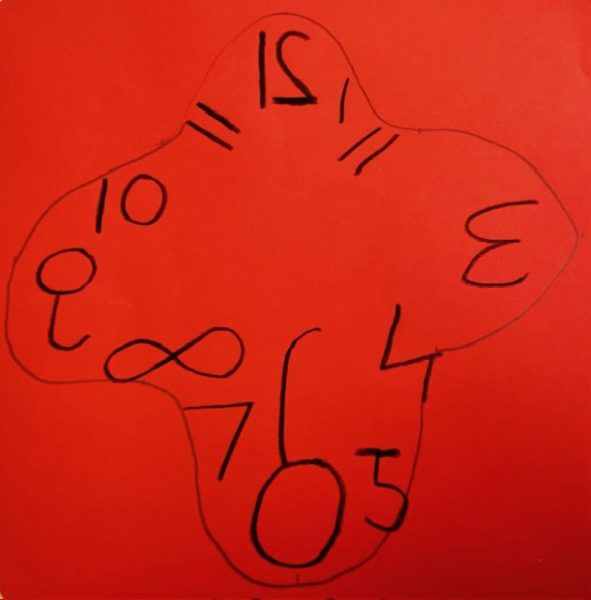
Time Perception
There are many different angles from which to look at time. Of course, we all do it several times a day or during boring meetings. The study by Ma, Cameron and Wiener (2024) highlights the bi-directional link of perceived time and memorability. Visual stimuli alter our perception of time. Watching a video we all make the experience that the perceived length of the time spent watching varies according to content and maybe only the cutting technique applied to shorten the perceived length. Similarly it has been demonstrated that looking for longer at an image and grasp the meaning or implicit story we tend to remember the image for longer. In courts it is a usual procedure to question the memory capacity of persons and the sources of bias. The study by Ma et al. demonstrates the impact of the size of the scene, how cluttered it is and aspects of memorability in visual perception. Our memories are co-determined by these factors. The other direction of causality i.e. that memorability determines the time perception seems equally at work. This apparent undetermined element, so far, calls for additional care when analyzing recall from memory. Memory is not only selective in terms of content, it also is subject to the impact of all sorts of visual stimuli.
Time can be many things. For humans it is everything but exact. In science we measure time with ever more exactitude and try to standardize time on the moon now. In addition to exact time, humans have perceived time and subjective versions and even concepts of time. About time to take time more seriously.