Vaim and the sea

Vaim is not a person, it is an imaginary place, somewhere next to the sea, rather small in size, and in conventional terms nothing much is happening there, aging persons go about their daily routines in their more or less splendid isolation, speaking to someone is a rare act of achievement, most of the talk is speaking to yourself not even really thinking aloud, just ruminating on and on for days, sometimes weeks or maybe years in a person’s life 

Okay, my exercise in “slow writing”, a wee bit attempting to copy Jon Fosse, kept me going for 10 lines before the end of my paragraph. Jon Fosse keeps going without the end of a sentence  punctuation for 66 pages in the German translation by Hinrich Schmidt-Henkel. Reading the three phrases of Vaim, each as an extended poem and an “homage” to life from three intertwined perspectives, resembles a cubist painting and, maybe, at least for me, each one like the novella “The old man and the sea” by Ernest Hemingway. It is also a triptych in the religious tradition of paintings, just as much as “Vaim” follows in the footsteps of “Waiting for Godot” by Samuel Beckett. For all those who don’t care about any previous literature just read Jon Fosse as an endless love story of platonic relationships, silence and romance,  next to the sea. Please, don’t pass on your copy of Vaim to school-aged children as they might become very creative about punctuation. The only allowed end of a sentence are occasional question marks, which is a nice philosophical twist in Jon Fosse‘s literal exploration of time and love. 


Q Q Utopia

Projections into the future, the painting of a futuristic image or an utopian narrative can be based on a quantitative or a qualitative approach. A quantitative projection into the year 2100, for example, is form of creating an utopian vision of quantitative developments. Projecting the small reduction of working hours into a very distant future will eventually approach zero hours (tous sublime). Alternatively, utopian scenarios for qualitative characteristics of work and employment range from full health and safety or “cure yourself by work” (?really, “Arbeit macht frei”) to AI and robots designed to solve major laborious tasks and challenges for us. It is important to differentiate between the qualitative and quantitative forms of utopian visions. The time frames matter, too. In politics various combinations of utopian perspectives have frequently been combined. The human mind’s capability to project itself into the future explains our tendency to come up with utopian ideas or scenarios irrespective of our ability for rationality. We better acknowledge these human characteristics rather than insist on an either, or image of ourselves.  

Good or bad

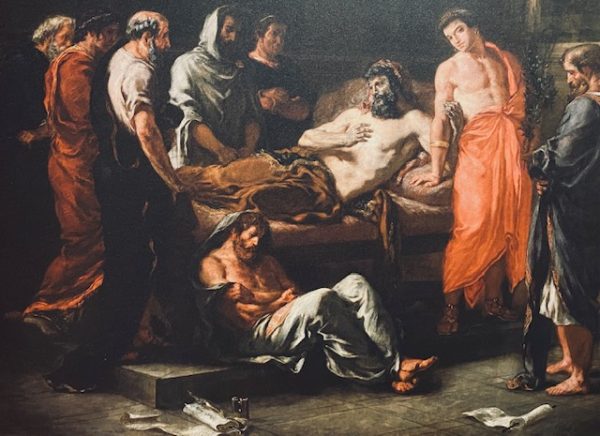
We have been taught by Shakespeare “to be or not to be, that is the question”. In political science we have pondered the question in a slightly augmented form. “to be good or bad, that is our question”. The basic image of women and men in society has been a subject throughout the history of ideas. For those who believe in the good nature of mankind, they tend to find reasons to believe that eventually mankind will find a way towards a peaceful cohabitation on our planet (there is no planet B yet for humans). On the other hand, each outbreak of violence and war are considered as a confirmation that mankind will always recur to some form of violence, even after extensive periods of peaceful cohabitation. According to the evidence presented by Meller, Michel, van Schaik, referring back to Kant, trade between people and nations is likely to prevent more violent relationships (p. 330). One of the major conclusions over the long term view of mankind is, that the periods of war have been far shorter and more rare than a focus on the last 3000 years seems to suggest. Maybe, “to be good or bad” is just a question of demographics of being too many at the same time in the same place.  Population growth and population density might be a powerful driver of “being good or bad”.  (Image: Delacroix, Last words of Marc Aurel)

Reverse causality

Reverse causality is a beast, which empirically minded scientist fear almost like death. However, many processes we study are running not only in one direction. In most cases, causality is tested with, or assuming, a unidirectional model of causality in mind. But some processes have not only a set of multiple causes to take into consideration, but some processes might be reversible or run in a rather complex manner, which are difficult to quantify. Mind captioning is a technique in neuroscience, where easy language is used to describe an image perceived in a person’s mind. Such thinking aloud data is based on thousands of brain scans, where people watched videos or images (study link).
In my own journey into the working of my mind I play around with different directions of causality. Sometimes the text is the origin and the image follows in a selection of a telling illustrations, but occasionally the reverse causality is at work. The image is the starting point and gets the mental process going. It is a rather complex process which is not easy to approximate with the help of algorithmic thinking. Reverse causality has many surprises to offer. As scientists we have a hard time to come to grips with it. (Inspiration Link) 

Typewriter history

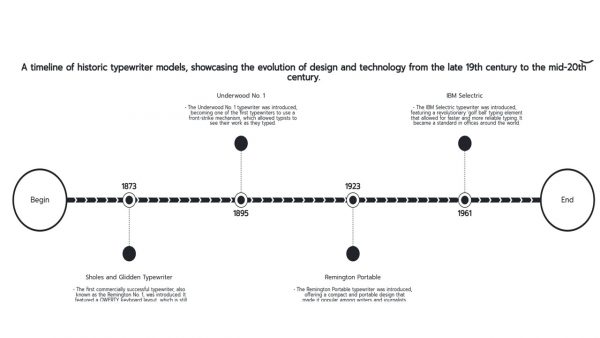
The history of the typewriter and typewriter is comparatively short compared to the history of literature or other technologies as partners in the creative process. With the advent of AI (here as part of infografix, see image below) the skills of using and mastering a typewriter have become almost obsolete. The original design by Remington (timeline below) has dominated for almost 100 years the technology of typewriters. Then came the electronic IBM technique with an automated correction type, which was not only faster, but also more forgiving of “typos”, short for typing errors.
The craft of handwriting had suffered a tough blow, despite its almost intimate touch to it. Knowing the typewriter outline by heart allowed typing with closed eyes or a focus on another text or image as well as a parallel thought process. Scientists and writers (Claude Levi-Strauss) reported on their creative process as intrinsically being linked to their typewriter.
QWERTY outlines for English language typewriters still dominate the keyboard typing today. With the AI interaction on the rise, we might move away from typing as a “Kulturtechnik” a technology of our cultural era and focus more on human-machine interactions via our voice and microphones. The underlying question, however, remains the same: What is the best technology to enhance our thought process? This, in fact, tends to be a very personal human choice, where technology plays only a subsidiary role.

Philosophy of Voyage

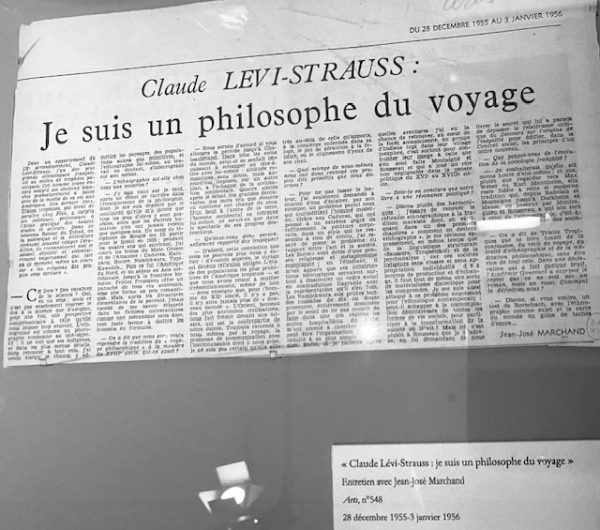
In an interview Claude Lévi-Strauss described himself as a philosopher of voyage. The excursions which lasted sometimes several months to live with indigenous people and study their languages, habits and culture became a scientific field of its own called social anthropology. He travelled with his wife and wrote down hundreds of notes and collected items. Only years later the concept of stuctural theory became evident to him. A voyage might go on after the end of traveling. It might start well before departure as well, not the least due to all the preparations. Colette, the French writer and polyartist, coined the phrase “ce qu’on sait faire, au fond, c’est de la route, ce  n‘est pas du voyage ” in the novel « La chatte ». In the pre- and immediate post 2WW years “taking to the roads” often had a gendered view of this with women being rare to hold a driver’s license. To “find meaning through voyages” or “the voyage is the meaning” fill whole libraries. For better or worse, travel books are still best selling books in a shrinking overall book market (less print books sold, but still higher value of sales).   

Spring in Autumn

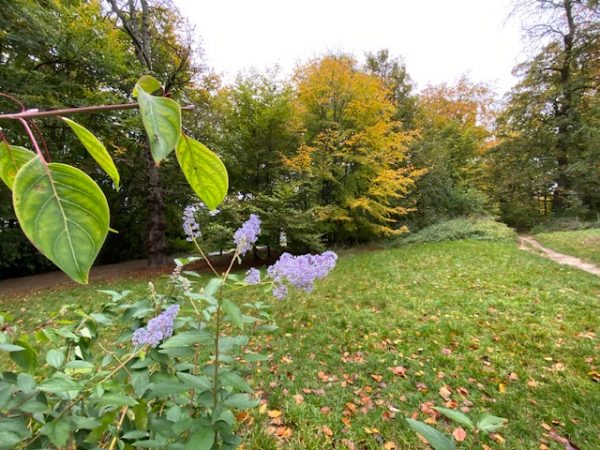
Can we have spring in autumn? Of course not, most people would answer. The definitions of spring and autumn are clearly defined as separate seasons. Depictions of the seasons in paintings in the Romantic or Impressionist periods are hard to imagine with somewhat blurred distinctions between seasons. And yet, climate change in the 21st century show surprising spring flowers in autumn across Europe. This leads to lots of confusion in nature’s time table.
From a life course perspective, we may ask, whether it is possible to experience a 2nd spring in the season’s view of the life course. More healthy years and spring feelings in the autumn of live have propelled a whole new industry around longevity and the mantra to “stay healthy for the wealthy”. The growing health inequality over the extended life course is a silent killer. The experience of spring in autumn remains a distant dream for most people with multi-morbidity.
Our experience of sequential or linear time, where one season follows the other, gets disturbed or at least blurred. The “Gleichzeitigkeit des Ungleichzeitigen” in English the “simultaneity of the non-simultaneous“ can be observed in the macro-world of everyday experience, albeit in a different way than Ernst Bloch defined the concept. On the other hand, it is no longer necessary to invoke Einstein’s theory of relativity or quantum physics to come up with apparently strange phenomena, but empirical facts allow us to question received wisdom, evidence based.

Inclusive images

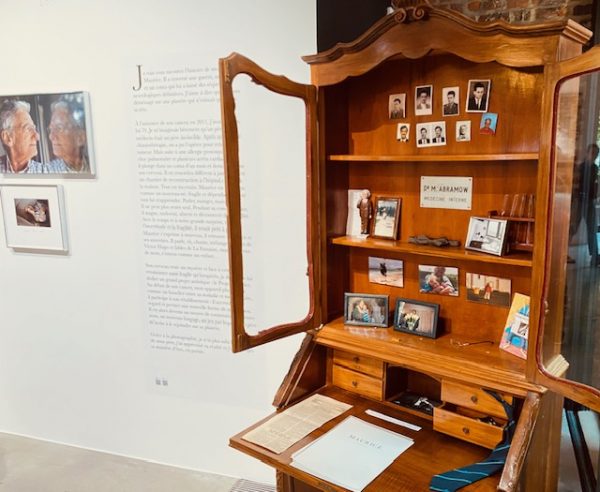
In the last 2 decades we can observe a strong concern among photographers to broaden the spectrum covered by images beyond well established imagery of non-binary gender. Diversity in imagery has taken a broader scope to extend, for example, the age range of people who are portrayed as central topic of exhibitions. The topic of mental diversity is more recent and needs a similar or even increased sensitivity to do justice to the whole spectrum of people. The photography of people with mental challenges necessitates a much more careful approach to the persons and complex personalities the photographer intends to portray. Trust and the development of trust of more vulnerable persons is a time sensitive process. The work by Charlotte Abramow “Maurice, Tristesse et rigolade” is a fine example of a photographer who portrayed over a long time of taking care of her father, previously a medical doctor, The years of the final stages of the life course of her father have been the subject over many years as the survivor of an extended medical coma had to struggle with the tough challenge of re-learning basic life skills again.
Abramow portrays her father as an actor of his “second life”, where the borders between reality, reconfigurations of his memories,   and “mise en scene” to co-produce the images. The images go far beyond the portrayal of aging and mental challenges as a deficit of persons. Yes, it is an integral part of these persons, but there is so much fun and positive emotions that derive from the intensive collaboration of actor, father and photographer that the images stick with us for a longer time. The presentation of props along with the photos creates an immersive installation, which strengthens the emotional bonding with the inclusive images of the later phase of the life course of Maurice.

Sink / Rise

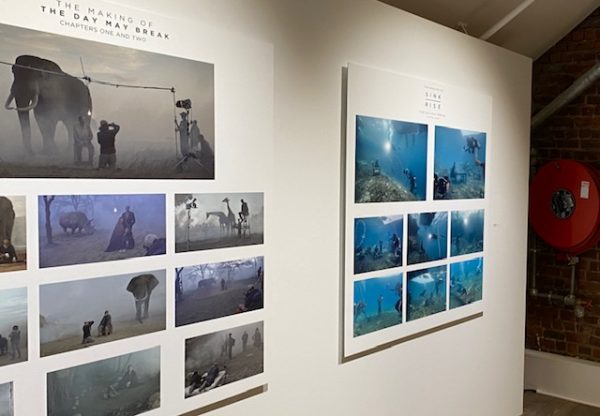
Nick Brandt presented his engaged photographic projects “The day may break” in Brussels at the Hangar Gallery space in Brussels (2025-9-21). The photographic work spans the globe to document and tell the story of a an endangered planet. The environmental and social fabric is at risk of an unprecented scale in the 21st century. Rather than producing hours of documentation, Nick Brandt focuses on images that stick. His “mise en scene” is meant to haunt us. And it succeeds in it. In the best sense of a tradition of a “photographe engagé” he intends to convey messages, even whole narratives to us about and from people in remote places, who are endangered through our inaction or paralysis in front of the challenges posed by global warming and climate change as well as the social and societal consequences.
We can save people from drowning in floods and rising sea levels. The chapter Sink / Rise of this project was produced with people from the Fiji islands who participated in the futuristic scenario of a sunk island. Without accusations, these people question us. Why? How? What for? Where to? – without speaking a word. They spend time in on a sunk island, surrounded, submerged by beautiful, but morbid, turquoise water and the graveyard-like remainders of a broken coral reef. These are photographs not of these people, but about them, about their likely fate, and (very important) produced with them as empowered actors. May they have a chance to rise like a phoenix from the ashes from these photos.
The documentation on the “Making of …” (image below) as part of the same exhibition allows transparency and additional insights into the artist’s work and proceedings.
(Image: Hangar Gallery, Brussels 2025-9-21, On the making of Sink / Rise by Nick Brandt)


Marc Aurel AI

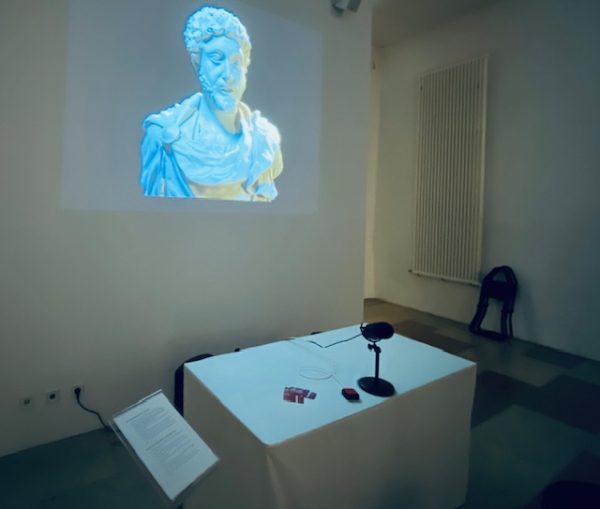
In the 21st century it is possible to chat with Marcus Aurelius. Part of the exhibition at the Simeonstift is a chatbot you may freely consult and questions with or about Marc Aurel. Based on your questions the animated screen image of Marc Aurel will reply based on his own writings like the Meditations and (probably) other secondary literature on Marc Aurel. Questions about feminism or slavery are answered based on the original texts. Some of these answers  appeared rather modern like the basic equality of all including women or slaves. The Meditations are an idealistic vision of mankind in the stoic tradition. In practice such ideals have proven very ambitious for the many and growing temptations in the day-to-day lives of ordinary people including their political, religious, business and military leaders. The AI is confronted with the issue to give answers to ethical questions which refer to the time of the author, but not all can apply to today’s ethical standards and basic human rights. Reading the original source, therefore, remains the preferred choice.