Park Impressions

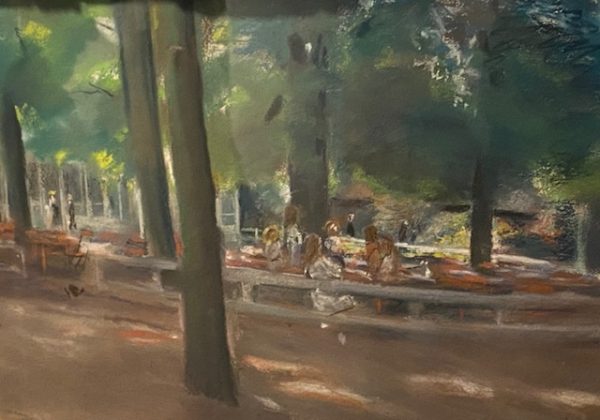
Parks and gardens have been among the preferred items of impressionist painters. In Berlin it is possible to visit the Villa of Max Liebermann and the splendid garden next to the Wannsee. The 3 years Liebermann spent in Paris as well as his friendship with Cezanne “converted the young painter to impressionist’s painting style. The subjects of his paintings became similar as well. Splendid gardens and people working or going about their daily routine inspired him. The visits to the Netherlands (image below) inspired him to paint the joyful and relaxed atmosphere during summer. Sunlight and shadow outside an atelier became the fascinating moment he captured so well. Enjoy the summer and take a break. (Image: extract from Max Liebermann: Park in Laren).
War of drones

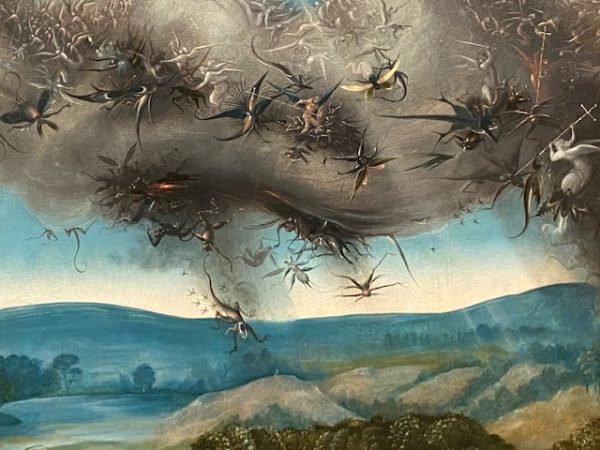
The fiction of a war of drones has been imagined, somehow, 500 years ago by Lucas Cranach. His altarpiece of the last judgment (1525) shows on the upper left corner flying little monsters that threaten humans on earth. The danger came from above and followed predefined judgments. The kind of weapon and threat were not so much different from today, but the portrayal of the person in command has changed. For the thousands of victims due to Putin’s war in Ukraine the modern scenario does not change that much. (Image: Cranach extract 1525 Gemäldegalerie Berlin)

Cranach extract 1525 Gemäldegalerie Berlin

Outdoor Pleasures

Summertime surely is time for outdoor activities and pleasures. Besides the broad spectrum of more or less strenuous activities, summer is perfect for socializing in parks, restaurants, cafes or beer gardens. We might think of this as more recent inventions, but in historical depictions by Bruegel or Jan Steen (1661 in Gemäldegalerie Berlin, extract below) we find evidence that socializing in a restaurant or beer garden has been around for more than 460  years. Monks were brewing beer and the consumption was reserved to a more elitist group of people. The concept is quite old. Fortunately, we have managed to democratize the joyful and socializing part of being together.  Places where people from different social classes come together have always been rare and this, additionally, varies across regions, countries and often social strata.

Jan Steen 1661 Gemäldegalerie Berlin beer garden

La gaya sienza

Nietzsche published his 1st version of “Die fröhliche Wissenschaft“ in1882. Ever since a controversy over the translation and interpretation of the title broke out. The publication in English referred to the title as “Joyful Wisdom”. A major question remains: is the opus a piece about science in the sense of philosophy, or less rigorous in method and therefore more a kind of general contribution to a perspective on wisdom? 12 x 12 years later of the 1st publication the “Motto” on the opening page should be taken more seriously. “Dem Dichter und Weisen sind alle Dinge befreundet und geweiht, alle Erlebnisse nützlich, alle Tage heilig, alle Menschen göttlich.“ Such a  radical Version of enlightenment as scientific method announced his attempts to demystify everything from religious beliefs to also science as well. The Motto of the 2nd edition in 1887 goes beyond the original one to include himself into this demystification. “Ich wohne in meinem eigenen Haus, Hab Niemanden nie nichts nachgemacht Und – lachte noch jeden Meister aus, Der nicht sich selbst ausgelacht. In a nutshell, mock yourself as much as you mock about anyone else. Can this science be science, intelligence, artificial intelligence or is this already the precursor of „super intelligence“ of the 21st century AI hype? 

Marc Bloch Library ENS Paris

Co-evolution process

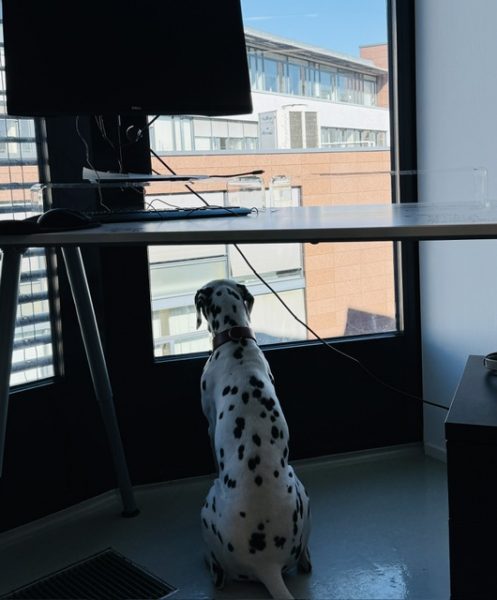
Humans look back on a long co-evolution process with viruses, bacteria, insects and animals. The focus on a solitary evolution of humans alone is already a challenge, although we know that the evolutionary process is much more complex. Within the co-evolution process of humans and animals, the co-evolution with the species of dogs has lead to interesting learning opportunities for both. Braeuer et al (2024) show that a dog’s cognitive capabilities to perceive human emotions beyond simple positive or negative emotions. As dogs seem to monitor their owners constantly, many of them are able to alert persons about health and/or emotional state. This is a learning process for dogs, but also for their human owners as their authentic emotional expressions are immediately recognized by their dog. A co-evolutionary approach offers a lot of benefits to all involved. 

Heat Mortality

Heat waves can be deadly for humans, animals and vegetation. According to the cumulative estimates by the RKI (Robert Koch Institute) in Germany up until 2026-7-26 there were 11.900 deaths within the confidence interval between 10.700 to 13.100 of the estimates. About 6.000 of the people who died due to the heat waves were aged 85+. 1.140 were attributed to persons younger than 65. Chronological age appears to be a significant factor as frequently chronic diseases accumulate in older individuals as well as poly-pharmacy. Hydration levels and deficiencies are associated with the increased mortality, but we have few or no precise measures of hydration readily available for people before it becomes an emergency (cognitive impairments). We know a lot about precision medicine. However, precision hydration for people remains rather arbitrary. 

On graveyard inscriptions

Open source gratitude

The advent of AI increases the need to react to more cyberattacks and faster. This means open source software, where many persons develop and implement defense strategies against malware, has a great potential to react fast to running attacks. The Mozilla Firefox Browser or the WordPress community, which facilitate webpage development and security do a great job to make the internet a safer space. Transparency in programming is a definite advantage which increases the number of people who continuously test the software and contribute solutions to malfunctioning parts of it. Thanks to so many, often anonymous or operating under pseudonym, we can navigate online with relatively high levels of security. Updating is our little contribution to value the community working on open source software. (Image: Exhibits by Hertzsch and Leetz/Waywood 2026-1 Lettegrafik, Schere, Stil, Papier).

Exhibits by Hertzsch and Leetz/Waywood 2026-1 Lettegrafik, Schere, Stil, Papier

Cyber anxiety

The threat of AI to be used for cyber attacks has increased. This is serious matter and should be addressed not only by your IT-department, but by a whole organization or enterprise. Doors of entry have always existed. 100% cyber security has never existed. It has always been a cats and mice kind of game. Timely patches were the solution, which means you have to be faster than the attack to avoid or limit thefts of data. It is easy for web developers or persons responsible for data security to slip into a kind of “cyber anxiety”. There are multiple types of threats which range from complete loss of access to your own website or more subtle changes to content and contact information, which might be just embarrassing or get you into serious legal trouble. Login attempts to your accounts are a frequent occurrence and we should be carefully monitoring them and make necessary (name or 2nd factor) changes swiftly. Of course this is a pain, but thieves have checked open doors and Windows for generations before we had digital homes. Best way to deal with cyber anxiety is to take it seriously and check your points of entry regularly.

Cyber threats through failed login attempts

Climate Anxiety

The events of several wildfires and a too hot summer in 2026 have raised the level of anxiety related to climate change for many people. From the field of economics we know that the fear of an economic recession can be as bad for the economy as a statistical economic downturn. The anxiety about climate related bad events can trigger or worsen symptoms of depression. The research by Zacher and Kühner (2026) shows that psychological evidence supports this hypothesis. The 1 year follow-up clarified, that the opposite direction of causality is not supported by the data analysis. A pre-existing depression is not worsening due to climate change. The consequence of these results is that the total number of persons with depression is likely to increase with an additional source of depression, for example after experiencing a wildfire. Oceans are warming and the number of injuries on beaches due to poisoning from algae or medusaes (jellyfish) become more frequent as well. Lots of sources for increasing climate related anxieties. In the economic costs of global warming and climate change we frame this as second round effects of climate change.

young curious boy touching jellyfish on beach

Forest sponge

Forests work like sponges. They can stock enormous amounts of water. Trees, even when cut years ago, keep a lot of their humidity, especially if they are underneath other trees. A rich nourishing soil allows biodiversity to thrive. It takes years and sometimes decades for these ecosystems to grow, but they are destroyed within a few months or just days in case of wildfires. We have to put higher monetary values on these ecosystems and their contributions to biodiversity in order to make the preservation economically feasible as well. The sole ecological value does not seem to stop us humans to exploit this resources beyond sustainability. The succession of seasons should be a reminder of the essential role of circularity in nature and a principal of conservation of biodiversity.