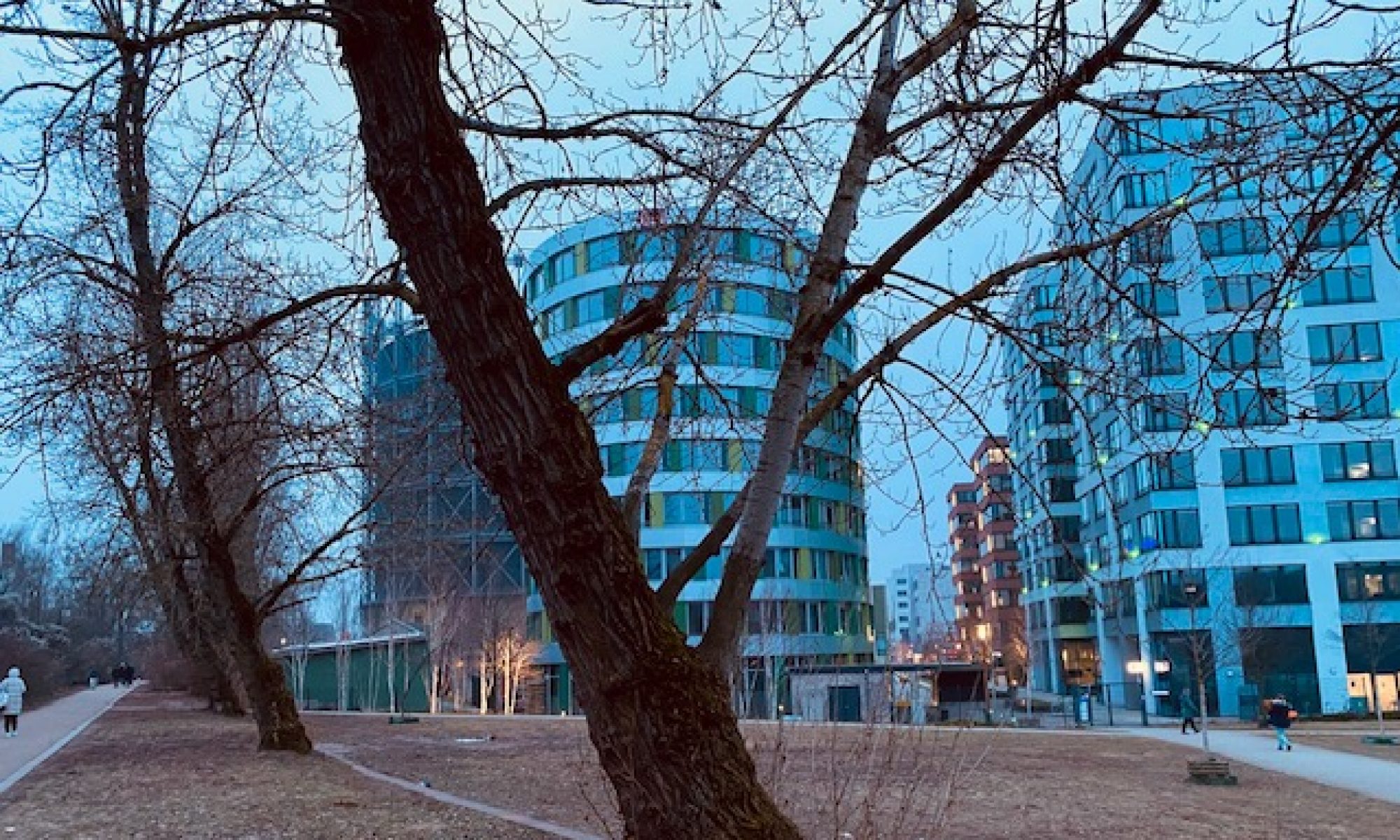

Walking Danger

Autumn brings color into nature. This is for some the bright side of life. However, the sun sets much earlier every day and many people begin to walk to school or work and back during the dark time of the day. Unfortunately, this entails an additional danger to those walking the cities as bad light conditions cause many accidents of pedestrians. The statistics provided by Destatis (2024) for Germany show a marked increase of walking accidents from September onwards and lasting throughout winter. Equip yourself with bright colors and reflectors to avoid being a walker in danger or a walking danger. On Sunday it is pretty safe to go for a stroll. City life is less stressful and professionals in a hurry usually take a rest on that day. The conclusion is to choose your track wisely in order to feel safe on weekdays.

Innovation Painting

Innovations have fascinated painters just as much as photographers. The impressionists have painted trains and steel bridges as well as modern city life. Innovations change the atmosphere of a situation and new forms of transportation have been admired for many decades. Artists and painters have dealt with this phenomenon in various ways. Either the innovations have puzzled the normal vision of people or things or the artists hinted at curiosities or incompatibilities. Gustave Courbet has depicted in a unique style (Realism), as early as 1865, a seated woman with a paddle on something similar to a catamaran. It is maybe surprising that the modern form of stand-up paddling looks a little bit like the „podoscaphe“ painted by Courbet. Innovations in sports continue to evolve and become part of Olympic Games as well. Some disciplines make it into the Olympic canon rapidly, others never make it. The exhibition of „Artists and Sport“ gave ample opportunities to reflect on the the relationship of artists and innovations as well. (Image Musée Marmottan Monet, Paris 2024, Extrait de Gustave Courbet, Femme au Podoscaphe. 1865)

Waiting time

A new report by Darzi, a former cancer surgeon and past minister of health in the UK, paints a dismal picture of the British health service (NHS) over the last 15 years under conservative rule. The public service has seen no increase in its budget accounting for population growth and the aging of the population. The service is no longer able “to give patients the timely care they need” (The Guardian 2024-9-12 title page). Increased waiting times lead to an estimated 14.000 premature deaths per year. Darzi presents data that show 300.000 persons had to wait longer than one year for a treatment that should have been performed within 18 weeks.

The staff seems desperate for changes as well as they have to spend more time on management of waiting times, time which is lost for real treatment. The quality of care is another issue which awaits urgent attention. Health cannot wait for most patients, but the neglect of investment in hospitals and people is expensive in the longer run. Even the reform efforts should not wait any longer. Time is a precious good and each life matters. (Image back cover of exhibition catalogue Käthe Kollwitz at MOMA 2024).

International Geometry

Geometric forms sometimes serve to make international affairs more transparent or descriptive. The Weimar triangle is such a formula, which helps to show the links between states. In the journal “Le Monde” of 2024-9-13 an interview with Radoslaw Sikorski reflects the shifting side lengths and military weights within this triangle. The Polish Minister of foreign affairs points at the threats from Russia to violate the air space of Poland and the legitimacy of Poland and the Ukraine, of course, to defend its air space and territorial sovereignty. The guarantee of international law, however, is heavily dependent upon adequate international geometry beyond the Weimar triangle. The meeting with a representative of the Pentagon (US) enlarges the scope of the triangle.

Talking about the reach of missiles in defense is yet another exercise in geometry as this depends on starting and supposed, or reachable, end points. The use of GPS-signals in civilian and military applications is another example of how geometry is ruling our modern lives. Let’s embrace it, rather than shun away from the geometry behind it. (Image Exhibition room at Wiels Art Centre, Brussels 2023).

Health GDP

A report by the WHO and the World Bank (2023) on universal health coverage and financial hardship has emphasized the difficulties to reach the goals defined by the strategic development goals (SDGs) by 2030 in this policy field. Moreover, the paper by Mazzucato and Ghebreyesus (2024) invites us to reconsider the importance of health in the overall assessment of development and progress. The authors ask us to “rethink the narrow focus on growth in gross domestic product (GDP) that typically dominates economic decision making”. There is of course a long debate on the status of health, GDP or wellbeing as major policy issues or even foundations of the a state’s major objective. For economists the question has been answered for decades to favor GDP growth and more or less the other objectives can be achieved with a time delay. Recently social scientists have highlighted the overall importance of wellbeing or happiness rather than GDP as stated in some constitutions. Health as an overall objective is another challenge to the existing economic framing of societies. In a traditional economic perspective the health sector is part of the GDP increasing public and private sector of the economy with insurers, equipment and persons contributing to it. On the other hand, health enters into the distribution or consumption part of the economy. Each country strikes its own balance between production and consumption. Put simply, in form of an equation where production equals consumption, health enters on both sides of the equation in each country. On the global, scale the distribution between costs and benefits of health have not narrowed over the past. The challenge for the world population remains steep. Considering unequal population growth across continents, the situation might get worse before it hopefully gets better. We still have to continue huge efforts to increase overall health on earth for example through large scale vaccination programs. (Image The tombstone of Molière in Paris 2024)

Desertification

Since 2018 we have evidence of the progression of desertification into some Member States of the European Union. The mediterranean countries are concerned as well as regions of Bulgaria and Romania near the Black Sea. There are multiple sources of desertification. The 3 main reasons of desertification are soil erosion, loss of soil fertility and loss of natural and desirable vegetation besides wind or water erosion and salinization. We also know that man-made climate change is at the root of the past and recent problems. The statistical indicators of land degradation are collected by the European Joint Research Centre and these data show a dismal picture of land degradation in general and desertification as part of this process. A study by Ilea et al. published in Nature 2024 projects an intensification of extreme weather in the coming years. Higher temperatures will most likely enhance desertification and more frequent flooding will contribute to more soil erosion as well. It is a rather strange process that we know we are creating severe problems for some regions which endanger the roots of their existence and yet we do not act upon those undeniable facts (United Nations SDGs list). The amount and dynamics of land deterioration put the global South under severe pressure, but also the wealthy parts of the Mediterranean basin will be affected. It about time to acknowledge that we are all part of the global changes and challenges. (Image palm tree in Paris, Jardin du Luxembourg, 2024)

Heat Stress

Heat causes cardiovascular and pulmonary stress. This has been well-known for a long time. A newly published epidemiological study for Germany reiterates this finding and adds more details to the picture of who is affected most by heat stress and heat-related mortality. Old age and being female increase the heat-related deaths in Germany according to the study by Zhang et al. (2024) published in the Lancet Regional Health. Our body’s thermoregular responses to heat stress like vasodilation or hyperventilation cause additional stress to our cardiovascular and pulmonary system. Excessive sweating and dehydration, possibly increased through medication, amplify heat-related risks. The study corrects the estimates by using fine particulate matter (PM2.5), ozone (O3), and nitrogen dioxide (NO2) data on the district level in the analysis. High concentrations of PM2.5 and NO2 increase heat stress and related deaths as well. Inner cities are, therefore, not the best place to be during the hot season. Most southern European inhabitants of big cities are aware of these health hazards and act accordingly. In Germany it is much less a habit to quit inner cities during the hot days in summer, but climate change will make this a major concern. Greening inner cities is an urgent necessity, which is not just nice to have, but saves lives. (Image Berlin Bears, Berlin City Center 2023)

Games over

All nice things eventually come to an end. So do the Paris 2024 Olympics and Paralympics.
The images have been impressive of both events and the millions of spectators give a good testimony in this respect. The cultural by-program of the Games was equally remarkable. The live performances of dancers not only on the opening and closing ceremonies attracted big audiences. Many well-known sites of Paris prepared their own events and inspired as well as entertained the visitors.
On the small stage in front of the “Marie de Paris”, the city hall (Image below), ballet performances (video) were staged to hint at the possibility to see more artistic performances throughout the year in Paris opera houses and other stages.
Showcasing many forms of cultural, inspiring and entertaining events gave a valuable additional flavour to the Paris Olympics. Many good reasons to come back and renew unique moments in Paris beyond 2024. Paris hotels will be more accessible again for moderate budgets and waiting times for entries should come down to normal levels as well. Back to a new normal for Paris. Well, maybe. The millions of spectators who followed the Games on television and social media might eventually decide to rank Paris higher in the “cities you have to go to at least once in your lifetime”.

Painter Sociologist

In going to a gallery and exhibition of paintings from the 17th century (Gemäldegalerie Berlin) you do not really expect to attend a class of sociology. However, this is exactly what the Flemish painter Frans Hals does with his paintings of various genres of society of his time. His sociological categories are for example unmarried young persons, married couples or pensioners living in a shared home. Other social categories of interest to him are a caregiver or, more common for the time, persons from noble or wealthy families. His painting „The Regents of the old men’s Almshouse” (ca 1660), the male pensioners home is one of his last paintings when he himself was already about 80 years old. Similar to a College of students the elderly home was run by a house father and house mother who took care of the daily living. The paintings of Frans Hals covered the entire life course with a cross-section perspective of society at his time. From few of his supporters he painted even several images moving towards a kind of longitudinal perspective on a person’s life course. Certainly, with “Oude-mannenhuis” (image below) he was interested not only in individual life courses, but of the conditions, forms or images of aging at his time. He probably was one of the first to challenge the negative stereotypes of aging.

Theatre Archives

The process of creation in the realm of theatre performances has manifold facets. The French National Library (BNF) in Paris has received the archives of the „Théâtre du Rond-Point” in 2023 and honors the donation with a fascinating exhibition on the immense creativity of the author, scenarist and director Jean-Michel Ribes. (Image below) The professional diaries of Jean-Michel Ribes and the documentation through photographs from the performances and video extracts allow an intimate view into the hard work of producing theatrical performances, popular television shows and comedies. Jean-Michel Ribes took notes of all sorts and kept extensive lists of potential collaborators, actors, daily occurrences and just nice sounding phrases. From just a simple phrase heard on the streets he developed a small piece to be performed in shows. Listening to the people and enriching this with great actors in superb scenery made his popular success. The creativity seems to derive from ample note taking and coming back to them eventually.