
Hugo intergenerational

Well, this entry is not about Hugo Boss, whose name is probably known to more people worldwide nowadays than the French poet and writer Victor Hugo. The latter Hugo, however, is likely to be known to more generations to come than the former one. In his 19 years of exile with his family he had the unique chance to get to know his grand children a bit closer, which was rather unusual for the late 19th century. The romantic poet was charmed to an extent that he could help it, but to express himself in a longer poem. „L‘art d’être grand-père“ (The art of being grandfather)“. Victor Hugo experienced the death of own children and his wife before and his grandchildren surely gave him reason to believe in a more joyful tomorrow. Comments on this poem mention the idealised vision of the romantic regard on children and even more so on his own grandchildren. « Leur front tourné vers nous nous éclaire… … Ils trébuchent, encore ivre du paradis. » 

We forget all earthly quarrels just listening to the soothing sound like children’s rhymes. Hugo is a master of all literary classes and he ensured that his intergenerational legacy would be part of this.  (Image: Maison Victor Hugo, Paris, writing desk ro stand in front of)

Innovation Painting

Innovations have fascinated painters just as much as photographers. The impressionists have painted trains and steel bridges as well as modern city life. Innovations change the atmosphere of a situation and new forms of transportation have been admired for many decades. Artists and painters have dealt with this phenomenon in various ways. Either the innovations have puzzled the normal vision of people or things or the artists hinted at curiosities or incompatibilities. Gustave Courbet has depicted in a unique style (Realism), as early as 1865, a seated woman with a paddle on something similar to a catamaran. It is maybe surprising that the modern form of stand-up paddling looks a little bit like the „podoscaphe“ painted by Courbet. Innovations in sports continue to evolve and become part of Olympic Games as well. Some disciplines make it into the Olympic canon rapidly, others never make it. The exhibition of „Artists and Sport“ gave ample opportunities to reflect on the the relationship of artists and innovations as well. (Image Musée Marmottan Monet, Paris 2024, Extrait de Gustave Courbet, Femme au Podoscaphe. 1865)

Impressionism 150

How many impressions made impressionism? Too many to be expressed in a single number. 150 years after the movement started with a spectacular exhibition in Paris the admiration of the paintings still attracts huge crowds. As a kind of revolutionary movement the artists mounted their own exhibition as they were not allowed to expose their paintings in the official exhibition of the Academy of arts in 1874. They accumulated a sufficiently large group of artists to form their own distinctive style of paintings. Painting outside in the countryside was a joint predilection. The regions, nowadays in the suburbs of Paris where many people daily commute to Paris has discovered the attraction to review the original scenario of the paintings as well as their living environments. Yerres, for example, hosts in 2024 an exhibition to show paintings from Claude Monet and Gustave Caillebotte which highlights the inspiration both painters took from the surroundings. Nowadays it is also interesting to see that the agglomeration makes efforts to make more people aware of the treasures to see in their own surroundings. Even if conservation of nature is hard to achieve the parks of yesterday have remained visible today. For us to transmit the cultural heritage and landscape to future generations as well. An affordable booklet that documents the cultural heritage allows people to dig deeper into the subject also for those who live in the region only because of a job nearby in Paris or Orly airport.

Park surrounding Maison Caillebotte, Yerres

Composing Assisted

Before the existence of digital composition tools composers were assisted by “Kopisten”. These persons rewrote the original draft of a composition into a “proper” version of the original document. Musicology has a tough time to deal with deviations from the original. It needs to be clarified which is the final and authorized version. In some instances this is far from evident. Just as an example Robert Schumann made ample use of the assistance of Kopist Otto Hermann Klausnitz (cf Nr 6), sometimes for the preparation of the composition, the finalized versions or the explicit drafting of different voices. Klausnitz himself was a flautist in Leipzig (Gewandhausorchester) and a conductor in Duesseldorf. Overall the debate is still going on, whether the composer’s draft or in many instances the Kopist’s version of the composition (authorized or not) prevails. In the age of AI, which is highly influential in modern music, such questions will most likely be intrinsic to the process of composition as well. AI is influential in evening out rough edges. Anette Mueller (2010) has done a great job to make this work of “Kopisten” much more transparent and her concluding chapter is programmatically entitled “Komponist und Kopist- Aspekte einer produktiven Kooperation”. (Image Mueller, A 2010 p. 340).

Gas light

Even if it sounds crazy from today‘s perspective gas lights once were the symbol of progress. In the middle of the 19th century gas lights started to lighten and brighten the boulevards of major cities in Europe. The historic evolution of the various designs can still be followed in Berlin in the open space museum of gas light in the Tiergarten area near Zoologischer Garten. These gas lights were brighter than candles or petroleum lights and needed less maintenance. The CO2 footprint was no concern at that time and also safety concerns have been tolerated. Mechanical maintenance was relatively easy and sufficiently qualified personnel still abundant. All this has changed and the lamp posts powered by gas are mostly a part of industrial history now. The image below shows a fine example from Amsterdam. The solid construction shows nice ornaments on steel. The rounded shape remained quite unique.
Unfortunately, the accessibility of the museum has contributed to the loss of many nice examples of gas light designs. Many were destroyed during the football world cup in Berlin in 2006. Let’s hope the Tiergarten survives the Euro2024 better than the previous huge football events and Love parades. Serious precautions have been taken with quite solid fences to protect the inner city wild life.

Berlin Gas Light Museum

Schinkel Winkel

Was wäre Berlin ohne Schinkel. Die Berlinerin sagt sogar, „in jedem Winkel steht ein Schinkel“. Das trifft das historische Berlin schon recht gut. Am Charlottenburger Schloss mit seinem schönen rechteckigen Parkanlagen, ganz nah, steht das sogenannte „Schinkel Palais“, genauer heißt es das Neuer Pavillon. Wenn Könige reisen ließen sie schon mal ganz gerne eine Kopie einer schönen Architektur in ihrem Park anfertigen. Das Vorbild eines italienischen Palazzos war hinreichend eindrucksvoll, um Schinkel mit einem Nachbau zu beauftragen. Viele rechte Winkel ließ der Schinkel mauern. Die verhältnismäßig kleinen Innenräume sind heute mit zeitgenössischen Bildern ausstaffiert. Da darf der Caspar David Friedrich natürlich nicht fehlen. 200 Jahre nach Beginn des Bauens am Schinkel Pavillon lässt sich noch recht gut sozusagen in die Epoche eintauchen. In einem etwas abgelegenen Winkel vom großen Schloss lässt sich somit die Zeitreise architektonisch Fortsetzen und mit weiteren Kunstgegenständen verknüpfen. Es ergibt sich so eine „dichte Beschreibung“ der Berlin prägenden Epoche.

Schinkel Pavillon 2024-5

Nocturnes

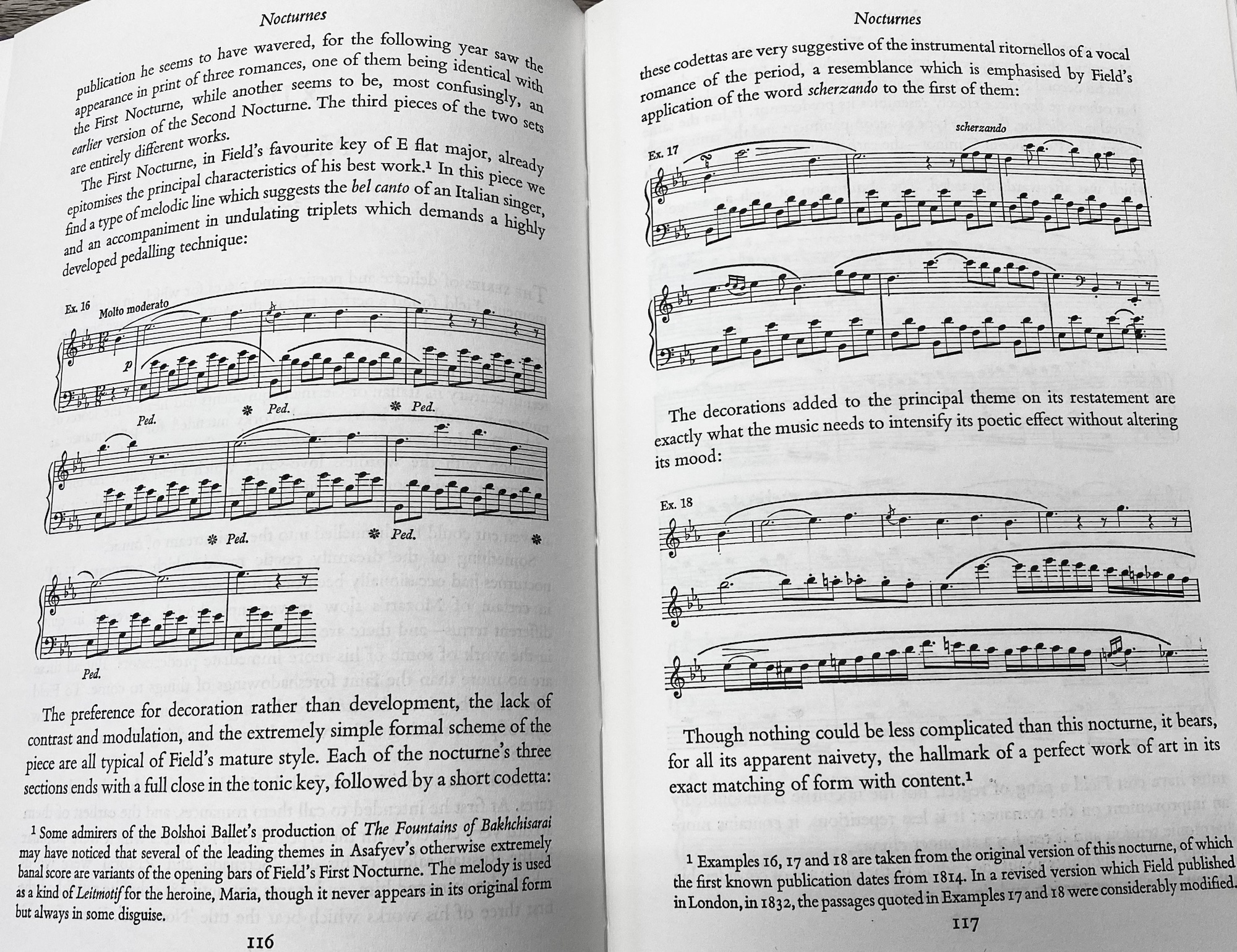
Contrary to some people’s belief “Nocturnes” is not only the denomination of the late opening of splendid shopping centres selling French fashion, but the name of music pieces. The origin of the Nocturnes as innovative form of composing is attributed to Irish born and bred John Field. The Polish born Frédérik Chopin developed the art form to perfection and he is the person who is also remembered for master pieces of this type of short romantic music pieces.
Mozart has left a famous piece entitled “Eine kleine Nachtmusik” and previous lesser known attempts of this kind were named Notturni, popular “Serenade” or “Pastoral”. All these Nocturnes shared the basic emotion, which we might call nowadays some kind of love-songs (Piggott, 1973, p.115). “Bel canto”, the tradition of emotional recitation of songs or arias, Paganini’s virtuous violine play were predecessors of the Nocturnes.
John Field published the first 3 pieces named “Nocturne” in 1814 and continued to produce new Nocturnes and revising former ones. These somehow more easy-going melodies or phrases often written in E or A flat major are technically less demanding for piano players than the later ones composed by Chopin, but their “charme” lies especially in their simplicity. Reducing complexity of sound rather than the virtuous effect seeking of a tune could attract large audiences. After the rebellion in France in 1830 and the foundation of independence of Belgium in the same year, so-called high culture had to address a lot widely differing emotions.
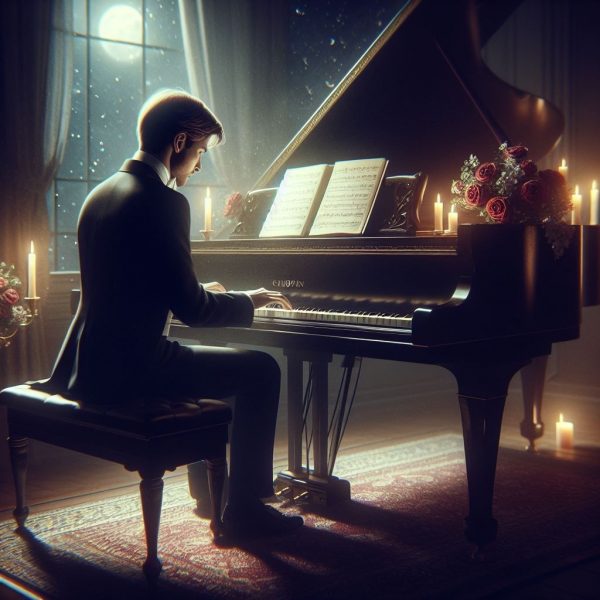
Maybe, in 2024 we are less surprised to rediscover the value of straightforward emotional tunes when even so-called high fashion shows in Paris return to more simplicity.(Image: KI Dall-E, Composer plays on grand piano Nocturnes by Chopin with romantic flair, photorealistic style on 2024-3-5).

Paris 1830s

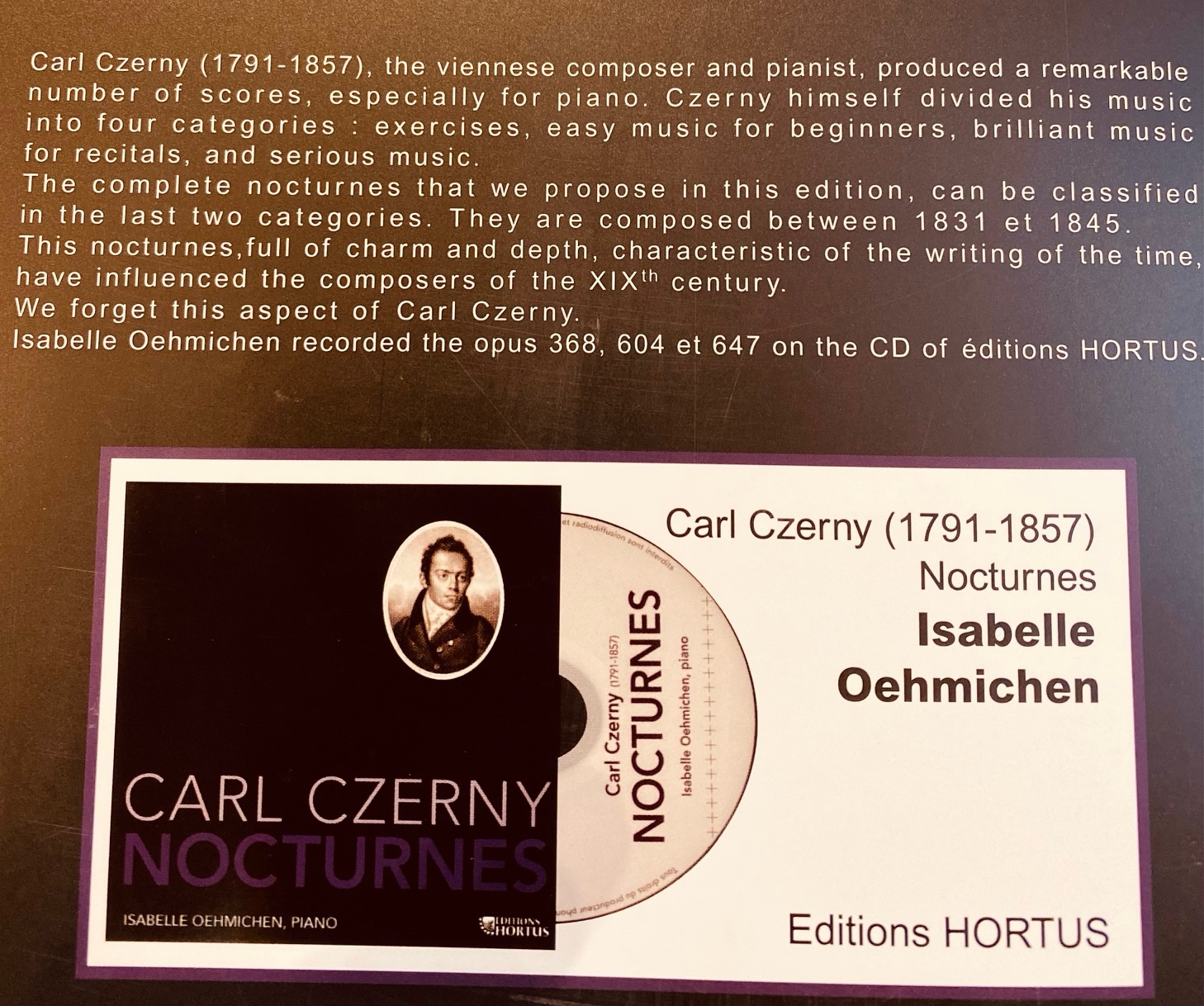
The music life in Paris in the early 19th century, almost 200 years before now, was incredibly rich. In 1828 the young Flotow arrived in Paris to receive lessons. The pianists Liszt, Chopin, Fields and Czerny passed or lived for longer times in Paris. The innovation in this period of romantic music and operas saw also a fierce competition among those talents. It was no easy task to find your niche to thrive in composition or in both performing and composing.
The 1830s had a rich urban bourgeoisie, which animated and indulged in festive events of live music and social life. Friendships of Chopin and Sand are a testimony for this. Similarly, the young Flotow and Offenbach paired to find their place in the Paris music salons and society of that time. The biography of John Field, written by Patrick Piggott (1973, p.73-81) supports this density of musical experience. The period is also characterized by the fast industrialization and the rise of the global trade. The musical life found refuge in the romantic period and more and more artistic performances by musicians. Theatres, opera houses, concert halls and private salons were meeting points of the upper social class which practices networking in rather closed circles with rather rigid routines and admission at the time.
In architecture the Operas became meeting points and a matter of national pride with National Operas contributing even to national identities. The opulent “Palais Garnier” in Paris was started in 1861 to become an iconic place in the new Paris with the huge boulevards à la Haussmann. The wealthy citizens cultivated a new lifestyle of a networked upper class that had the leisure to participate in the masses of modernity. Cultural events of all kinds filled newspapers and specialized editions. There were inner and outer circles of influence in the economic, military, political and cultural spheres.
Recommendation letters were a real currency for entry in each of these circles. Some of these social practices, have still a lot of currency even in 2024. In short, in the 1830s Paris was the place to be. Compositions of that time still fill concert halls today and their music is abundant on the new music platforms and streaming as well.

Schubert Franz

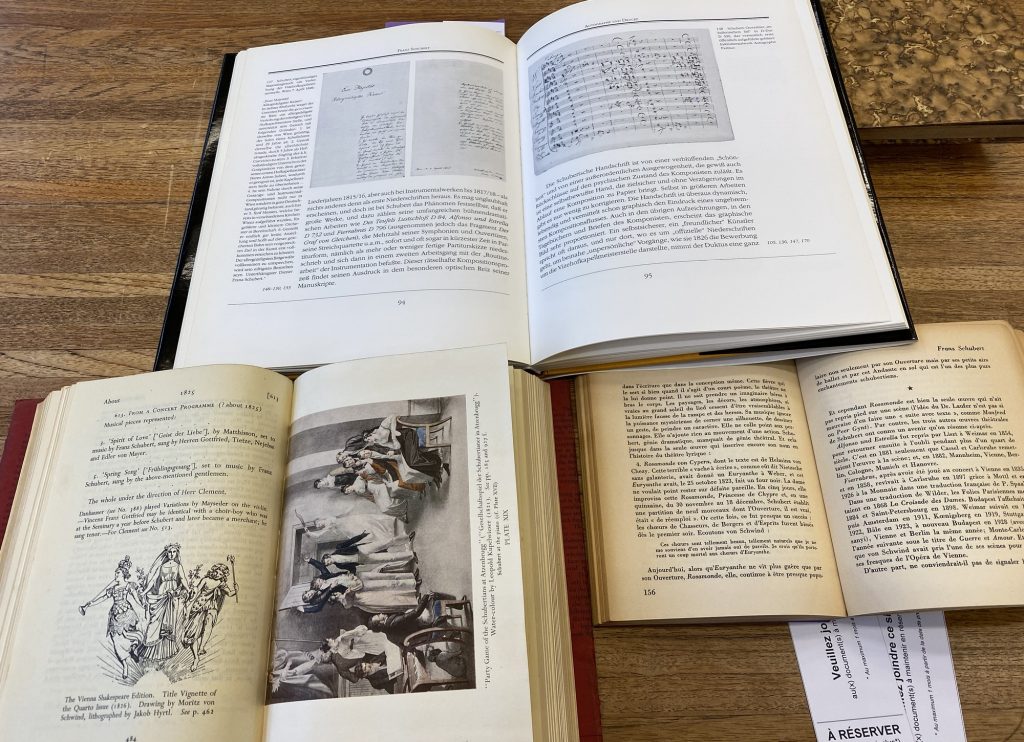
Franz Schubert hatte ein kurzes Leben. Geboren in 1797 verstarb er bereits mit 31 Jahren. Seine Lieder werden nach wie vor viel gehört und aufgeführt. Mit 10 Jahren wurde er vom Hofkapellmeister Salieri in Wien bereits als Sängerknabe in die Hofkapelle aufgenommen, was gleichzeitig die Aufnahme ins Stadtkonvikt bedeutete. Seine Lieder wie „Der Lindenbaum“, „Die Forelle“ oder „Die Rose“ blieben lange Standards in den Musiksalons und Konzerthallen. Beeindruckend bleibt auch die Schaffenskraft des jungen Schuberts der in seinem „Liederjahr“ 150 Lieder komponierte. Seine Versuche eine Oper zu schreiben waren weniger erfolgreich. Das hat dann fast 200 Jahre gebraucht bis die Pariser Opéra Comique diesen Traum Schuberts erfüllt hat. Vielleicht hatte es etwas mit seinem Lehrmeister Salieri zu tun oder den hohen Ansprüchen der Wiener Klassik in der damaligen Zeit. Friedrich von Flotow hatte den Weg nach Paris gefunden und war sich der Bedeutung des ausdrucksstarken Librettos bewusst. Orchestrierung zur Verpackung der Lieder wird dabei bedeutsam. Flotow sollte das Oeuvre Schuberts bekannt gewesen sein. Erfolge mit eingängigen Melodien haben beide feiern können. Jeder auf seine Weise.

Schubert Sekundärliteratur

Paper and Pastel

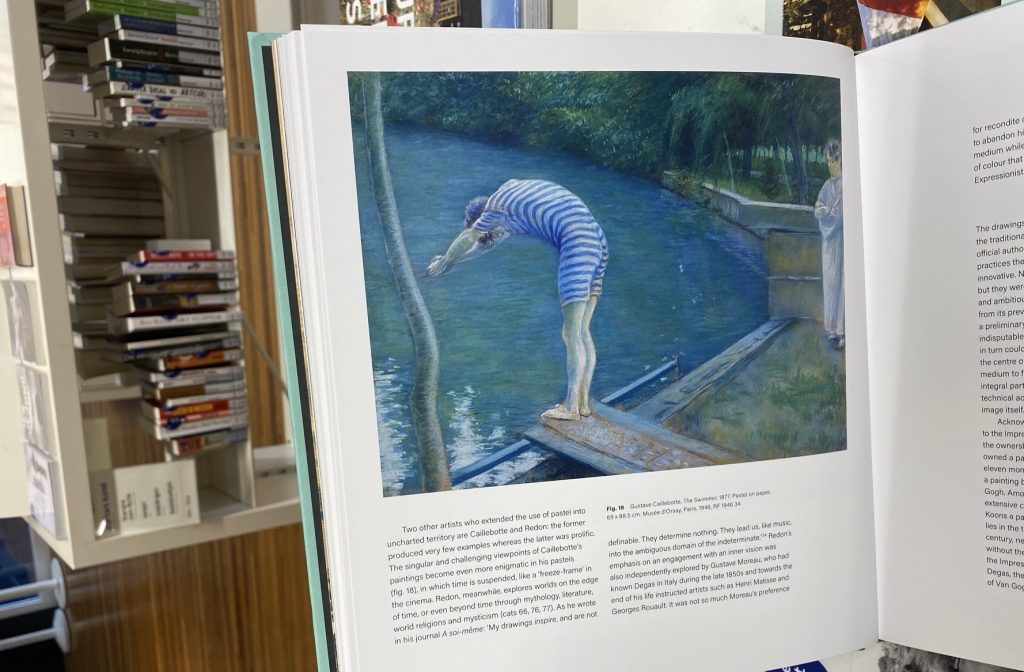
Sometimes the art is in the material. At least this could be a rapid conclusion of the exhibition presented in London at the Royal Academy of Art in 2024-1. From the informative Catalogue the importance of material is demonstrated. The ease of taking your equipment with you, like a sketchbook and out into nature have been an important feature of the impressionists’ movement. With artists challenging traditional techniques of painting and paintings as such even the apparently less noble material as paper had become a statement of being different from the established art academies making use of more noble materials. The impressionists made a convincing point with their additional use of materials accessible to all. Capture the moment and capture your very own impression of it. This is one way to immortalize the emotion and essence of the scene. In the catalogue of the exhibition I spotted “The Swimmer” drawn by Caillebotte with pastel on paper. Freezing the moment, freezing the motion and emotion is evident here, too. Testing different materials is part of the journey to find your artistic impression, expression or materialization of imagination. The ways and means are manifold.

Royal Academy, 2023: Impressionists on Paper. p 32