Metamorphosis

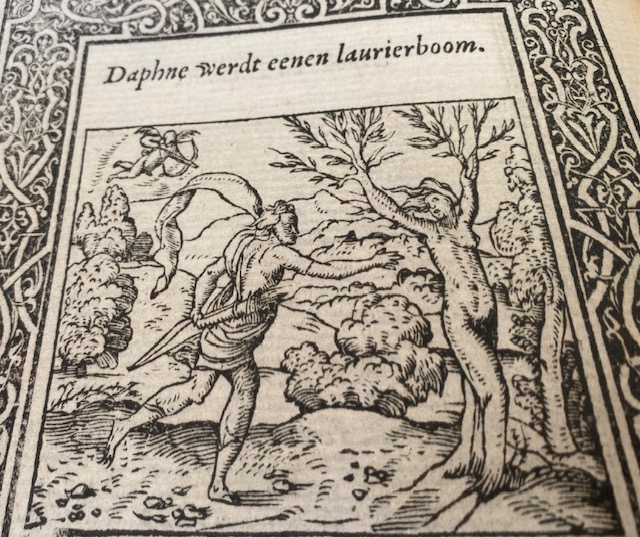
In the antique writings of Ovid “Metamorphosis” there is an extensive description and mystery about the metamorphosis of several characters. The narrative about various forms of metamorphosis has influenced our perception of change as having a mystic component. The arts before the enlightenment have drawn lots of sceneries of metamorphoses across the centuries. Maybe in form of sculpture this narrative has continued to be present even into the 20th century. The exhibition at the Rijksmuseum in Amsterdam and the essays in the catalog testify to this long shadow of Ovid’s original narrative. No need to mention Kafka as another adept of “Verwandlung” or Rodin, who reveals persons as semi-detached from stone. Wood and the return to ashes shows us the come and go of metamorphosis of human beings. Imagining mankind as a sequence of metamorphoses is a metaphysical as well as sociological perspective of our presence on our planet. (Image: Daphne transformed into a Laurel tree, Bernard Salomon, 1557). 

Holistic public health

Based on case study in Queensland Australia, Boocock et al. (2026) propose the wider application of holistic public health laws. Due to effects of global warming the local burden of disease may rise due to larger scale floods and subsequent growth of for example mosquito populations that transmit infectious diseases. It will be necessary for societies to understand the processes behind the growth of mosquito populations and what can be done to prevent and protect oneself from the consequences. This is not only an environmental issue, but also an issue of continuous learning across all strata of society. Neighborhoods tend to suffer the same impact of chemicals used or the spreading of diseases like Dengue or malaria. The case study makes a convincing argument about the intrinsic relationship between the social and environmental processes at work. 

Permanently anxious

„There’s a set of forces that want us to be permanently anxious“, is the phrase chosen by Tony Cokes in the exhibit just outside the „Palais Populaire“ in Berlin in 2025-5. International politics and the economic upheaval caused by Trump’s tariffs contribute to the already existing other sources of anxiety like nuclear energy and warfare. Global warming causing more extreme weather events add more man-made reasons for anxiety. The next generations will have to foot the bills we have left to them unpaid. Our current shortsightedness increases anxieties which previous generations have not known of a similar kind or in that combination. 

Community building and solidarity are ways to overcome such overwhelming anxieties. Supranational organizations like the European Union have an even stronger role to play to reassure its people with credible signs of solidarity. We are not alone in the struggle to overcome the anxiety that is creeping up around us. We are certainly stronger together than individually dealing with unspecified fears. „We shall overcome …“

Hands-on AI

The use of AI in translation and to streamline texts and preparation of communication has become a common experience. The applications in medical fields are less well known. Scans and checking of skin cancer could be a game changer for many who live far away from the next medical doctor. AI assisted brain surgery is another issue, but a very specialized application. The interface of AI and robotics might be another game changer as such applications where you train the robot with for example weight lifting and transportation charges can contribute to alleviate human skeletons. Handheld devices can guide the robot and data from sensors will complement the learning of the tasks through assistance from AI. Applications are manifold and we have not even seen the most promising ones. The application potential in warfare are particularly troublesome as humans do not necessarily enter into the concern of AI-assisted weaponry. In the social sphere trust is a crucial behavioral and ethical concern. These issues AI can only learn from us. Any attempts to do without human input and control is doomed to fail. We are not indispensable yet, we are simply turning more and more into responsible, supervisory roles. 

(Image: Acatech exhibition with hands-on AI applications, Berlin in collaboration with IQZ and DTM, German museum of technology.)

Time Concepts

Tell me about your concept of time. How do you define time? Answers to this question are likely to depend on your upbringing, affinity to a specific scientific discipline or epistemological belief(s). Aristotle defines time to be subordinate to the more basic principle of change. To understand change we need the concept of time. Two points in time define time, intermediate points are possible, which might be interpreted as a precursor of infinitesimally short spells of time. To explain change, Aristotle refers to his concept of time. Other concepts of time build on the notion of succession of events or sequences of events.
Clocks going round in circles have been used to show the progression of time independent of events. Beams of atoms later allowed for more precision of time keeping. The prevalent concept of time still is dominated by the idea of time as an arrow, usually depicted in some diagram resemblance based on the Cartesian coordinate system, but usually starting at 0 or a particular point in time as diagrams in economics.
Following on from the old concept of change and time, we still claim for causality in most day-to-day experiences or for social processes the link to a chronological progression of time. In statistical analyses building on time-stamped occurrences we may use event history analyses or stochastic differential equations to analyze (social) change depending on one or several (earlier) factors. Even the theory of deterministic chaos, which is applied in weather forecasts for example, arises from the sequence of point of measurements.
Mainly since Isaac Newton we cherish the notion of a universal time, which helps us to coordinate different locations on our planet with reference to the Greenwich mean time. Other concepts of time make use of infinity of time and how to deal with this. Life before, or life after death, are human constructs trying to make time understandable or at least manageable for us beyond our own living time. Depictions of time in the arts, paintings or music opens up yet another vast space of thinking about, as well as, experiencing time. We did have and still do have a great time thinking about time.

January Spring

The early signs of spring in Europe usually show up in March. The monthly data from the Copernicus Climate Change Service (C3S) show that „average temperature over European land for January 2025 was 1.80°C, 2.51°C above the 1991-2020 average for January,“ (Link). The warming throughout January has several consequences. Vegetation starts into spring earlier. This means that people with allergies of early flowering suffer earlier during a year. Winter rest in animal lives will be shorter. The risks of droughts in some regions combined with floods in other regions is increased as well. Rockslides in the Alps and flooding in Italy and the Baltic states add to the costs of climate change. 

Western Europe, witnessed a relatively „dry January“, even for those who kept drinking alcohol throughout the month. Heating and heating costs came down a bit and friends of gardening were surprised by some early showings of flowers of spring even in Paris neighborhoods (image below) as early as the first few days in February 2025! Strange new world. It all seems to happen a bit faster than most scientists expected. Time for adaptive behavior is shortened as well.

Happy Employee

The research on happiness, subjective well-being or overall satisfaction with your life is also an empirical question. Analyses of being happy donot only focus of overall happiness, but look much more into the details of happiness. Beyond the tricky longitudinal observations of happiness it is common scientific practice to deal with subdomains of happiness like satisfaction of employees with their job, satisfaction with one’s job beyond the honeymoon and hangover effect, best known from family studies.
Each of those subdomains has a significant effect on overall happiness. The novel “Happy Life” by David Foenkinos is an interesting example which focuses mainly on the subdomains of job satisfaction, satisfaction with private and romantic partners as the major domains of a happy life. As developed in the novel, people make job changes to re-orientate professional careers or reset their private life. A low point on the happiness scale in one domain might be compensated by higher levels in another domain. These impact from one domaine to another might have substantial time lags involved as well. More drastic resets (à la Foenkinos) can be avoided through focus on other subdomains of overall happiness as well.
How happy are you with your housing situation, neighborhood, your pet, your physical health? There a multiple +/-spill-over effects to overall happiness. Reading a novel might be one as well, just take time reserved to yourself.(Image BnF expo “women in sport”, 20024)

Desertification

Since 2018 we have evidence of the progression of desertification into some Member States of the European Union. The mediterranean countries are concerned as well as regions of Bulgaria and Romania near the Black Sea. There are multiple sources of desertification. The 3 main reasons of desertification are soil erosion, loss of soil fertility and loss of natural and desirable vegetation besides wind or water erosion and salinization. We also know that man-made climate change is at the root of the past and recent problems. The statistical indicators of land degradation are collected by the European Joint Research Centre and these data show a dismal picture of land degradation in general and desertification as part of this process. A study by Ilea et al. published in Nature 2024 projects an intensification of extreme weather in the coming years. Higher temperatures will most likely enhance desertification and more frequent flooding will contribute to more soil erosion as well. It is a rather strange process that we know we are creating severe problems for some regions which endanger the roots of their existence and yet we do not act upon those undeniable facts (United Nations SDGs list). The amount and dynamics of land deterioration put the global South under severe pressure, but also the wealthy parts of the Mediterranean basin will be affected. It about time to acknowledge that we are all part of the global changes and challenges. (Image palm tree in Paris, Jardin du Luxembourg, 2024)

Credit donations

“credit” stems from the original latin word “cedere”. In the 1st person you write “credo”, which means I believe. If said in a religious building or church you show with this pronunciation that you believe tbe narrative of the religious community. In the 3rd person “credit” stand for s/he/it believes. In the financial sense it is the receiver of money from your credit card who believes or trusts you that you made an honest payment. Now, banks take commissions from each of these exchanges of trust. You are credit worthy or not. In some churches you now make donations using your credit card to facilitate business. Credit card companies also charge you on your donation. Win win situation we call this. I keep asking myself, whether I still “believe in angles” or only business angles. (Image Église Notre Dame des Victoires Brussels 2024-7)

Adaptive Expectations

In economics it is important to understand the concept of adaptive expectations. We all form expectations about prices and inflation, but there is more than just simple expectations. These expectations guide our behaviors in many domains. If we expect a drastic price change for goods and/or services we shall most likely modify our behavior in response. We might want to advance a purchase to take advantage of currently lower prices in the expectation of higher costs later on. Most people would follow the price changes on a regular basis and adapt their expectations according to the updated information. It is an important process as there are millions of people who do this and this process drives price levels in many countries. In Europe we would like to see not only inflation, but also expectations about inflation to be around the target level of 2% per year. After the high price rises of energy and food (Putin’s war) as well as the disrupted supply chains (Covid-19 crisis) we were unsure, whether we would have to adapt our expectations for the coming years. The credit crunch in the last few years forced people to adapt spending plans and expenditures. We seem to have overcome these major crises due to rapid adaptive expectations. The crucial mechanism to achieve this is a timely and open communication of changes. Media have a role to play to not only spread the information, but to explain underlying reasons. This contributes to a widespread understanding of basic economic principles that helps countries to navigate stormy weather. It is like players of chess who adapt their strategy after the other player has acted or not according to their expectations. It’s simple, isn‘t it?