

Emotions in Politics

Rage or even hate count among the high emotional states in psychology. The presence in politics of these more extreme emotional states has been on the rise since the times of Covid-19 due to the necessary restrictions of the fundamental right of free mobility. A cost of living crisis might lead to similar emotional states as “Angst” about homes, commuting and heating put many people in existential crises. The rise of extreme right parties has gained on the basis of this basic social mechanism using hate speech and a continued rage as driving force. Established political parties across Europe and the Americas have been very slow to react to this. Just providing accurate information and correcting fake news is not enough. More emotions are called upon to counter such aggressive strategies used by political opponents, unfortunately. In the podcast “The 2nd thought” (Der zweite Gedanke in German!) Natscha Freundel together with Justus Bender and Heike Klüver we learn that an emotional response to rise of the extreme right is asked for. It is interesting to witness that 144 years after “Die fröhliche Wissenschaft” we still have not learned the lesson from Book 1 entry 38 by Friedrich Nietzsche: “with reason alone, thou shalt not convince those explosive minds” (own interpretative translation).
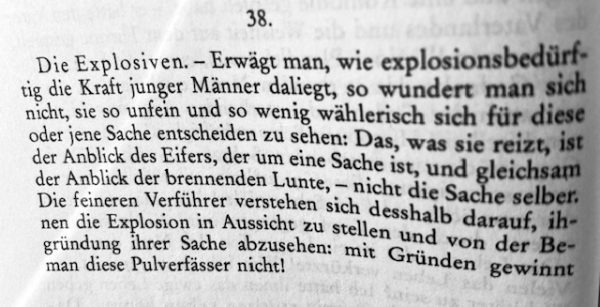

Quotation from Nietzsche Book1 Nr.38: Mit Gründen gewinnt man diese Pulverfässer nicht!

Gay science 2026

This is an intended test of the translation and contextual interpretation competence of various AI-systems in the year 2026. The Anglo-American translation of the “Fröhliche Wissenschaft“ with Gay science could nicely be interpreted as being in line with the original intention by Nietzsche of ambiguity in his aphorisms. Langer (2010) had chosen this translation knowing that in the 21st century the term gay as adjective had shifted from primarily being meaning cheerful, showy, bright or careless to the noun of gay ( mostly men) as a community. In her introduction Langer (2010) discusses the Aphorisms of gay science beyond the simple view of “postcard-like” ephemeral thoughts of a traveler. Whereas Allison (2001) reads the aphorisms as a “dynamic play of multiple and continually changing appearances”. Langer is more inclined to follow Schacht’s (1988) perspective that “we have much more than the disjointed collection of reflections and aphorisms which it may at first glance appear to be”. The art in Nietzsche’s writing is the “surface disorderliness” which “conceals its fundamental coherence” (cited after Langer 2010, pp. xiii-xiv). The contextual interpretation à la Stegmaier (2012) of only the 5th book of the Gay science spans 646 pages in text plus very informative name and concept registers as a blending of mind maps of Nietzsche’s as well as Stegmaier’s contextual and conceptual thinking. Both Stegmaier and Krochmalnik (1997) have contributed individually and jointly to a “rehabilitation” attempt of Nietzsche towards the end of the 20th century and a lasting continuation of “gay science”.

Reading on Nietzsche in 2026 to better understand Gay science

“what” and “how” in consulting

The scope of both “what” and “how” to consult have been considerably enlarged in the 2020s. The rise of the internet and digital formats in consulting have put an indigestible amount of mostly well-intended advice to the public at large. Language barriers are coming down in the digestion of ever broader as well as more interdisciplinary forms of knowledge. The “what” in consulting seems to be endless and yet the expectations on advanced expertise have risen as well. The calls for easy language summaries, as provided and popular with generative AI, pose a challenge to consulting on more interrelated or “messy” problems. The broad availability of AI in our pockets, watches or glasses amplify the potential to address really tough issues in consulting leaving the easy advice to the machines repairing other machines. Consulting may then focus on human interaction which needs to fix norms and guidelines in moral and practical matters. Consulting might take much more the form of interpretation and contextualization of information beyond simple information gathering. The “how” in consulting is conditional on “what” is the issue in question. From the antique dialog over (medieval) confessions (Stegmaier, Fuerst 1993) and book writing, we have moved to digital formats with textual, vocal and visual formats (Image and video). Hybrid formats enrich the consulting experience for the persons asking for advice as well as those offering it. (Image: Consulting on what and how to plant in city streets 2026-8 Paris)

Consulting on what and how to plant in city streets 2026-8 Paris

Philosophy in consulting

What has consulting to do with philosophy? How much philosophy in consulting? If we think of business consulting, there is very little philosophy in most of it. Some ethical considerations might enter the consulting with respect to mass lay-offs, ethical considerations in supply chains or handling waste. The philosophy of consulting, however, deals with one of the oldest philosophical practices (Stegmaier 1993). Since Plato and Socrates the dialogue of persons is at the foundation of philosophy. Throughout the history of philosophy the dialogue as the basis of exchanging ideas and controversies can be regarded as a philosophical practice particularly if it deals with topics beyond daily concerns. The consulting by philosophers has taken the form of speeches as well as book publications. Marc Aurel or Montaigne have written famous accounts of their consulting advice to political leaders. Rousseau for education or Kuhn for science have been influential with their philosophy intended as consulting beyond the inter-individual, dialogue-oriented form. The dialogue with a reader used to be rather exclusive until the invention of the printed press. Apelt introduced the “ethics of discourse” followed by a theory of communicative action (Habermas). Even modern governance structures “incorporate” committees as institutionalized consulting to advice with multiple and at best diverse perspectives as guidelines to persons in leadership positions. In order to counterbalance individual leadership of prime ministers, judges or university presidents, institutionalized internal consulting has been implemented (Stegmaier 1993). Consulting resistant leaders probably had some of the worst fates if we think of Julius Caesar. Seeking advice is only one side of the coin. Giving advice is the other one. Now we leave the “why” of philosophy in consulting and move to the questions of “what” and “how” to consult.

Paris start-up 2026 Station