All electric again

The “all electric society” has been identified by Dan Wang and Arthur Kroeber (2025 p.48) as one of the underlying driving forces of “The real China Model”. Despite the heavy reliance and pollution caused by China’s use of coal, the large share of electricity  (30%) of energy use is unmatched by the rest of the world except Japan. Investment in electricity grids and innovative ways of mobility around electricity will allow China to buzz rather than steam ahead. Solar cells, batteries for electricity storage and innovative ways of distribution of electricity through AI enhanced “learning” devices will widen the gap between China and other countries that suffer from inefficient path dependency.
Taking the advent of the “All electric society” seriously will free resources through the focus on future-proof technologies. We should not be afraid of the sparks of a short-circuited “All electric society”, the environmental challenges ahead for all of us, particularly China, ask to shift to high voltage solutions urgently. 
Unity is key

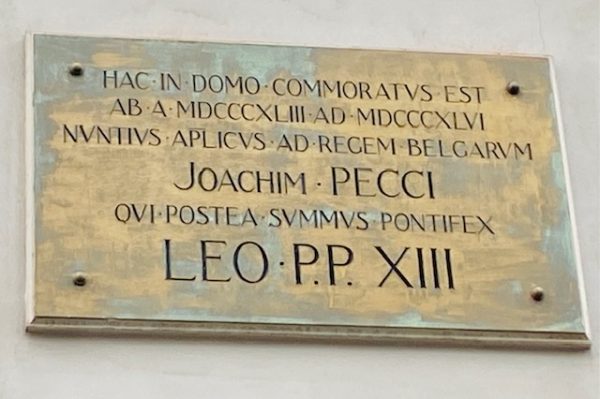
The choice of the motto “In illo uno unum” by the new Pope Leo XIV of the catholic church in 2025  highlights his choice to devote his efforts to the unity of all christian churches on earth. This is a centuries old dream of the diversified interpretations and practices within the christian beliefs and traditions. The inaugural sermon of a Pope therefore takes the form of a high stakes announcement for the coming years (Link). The next document from Leo XIV speaks to the importance to preserve the earth as the creation of God with all its diversity as a whole as well as in its parts. We might translate this back into “In illa uno unum”, where in illa stands for the earth, as a female and nature-turned version of the Pope’s chosen Motto. The choice of the tradition of Popes named Leo, like Leo XIII previously was another matter of signalling to his followers that he is firmly embedded into the Augustine tradition of Christian beliefs and traditions and practice. A concern for unity is necessarily bound to bring together peoples from all corners of the planet on the foundation of equality and a sharing and preservation of the riches of the world. (Image in Brussels, Joachim Pecci as ambassador of Vatican in Belgium before he became Pope Leo XIII). 

Sink / Rise

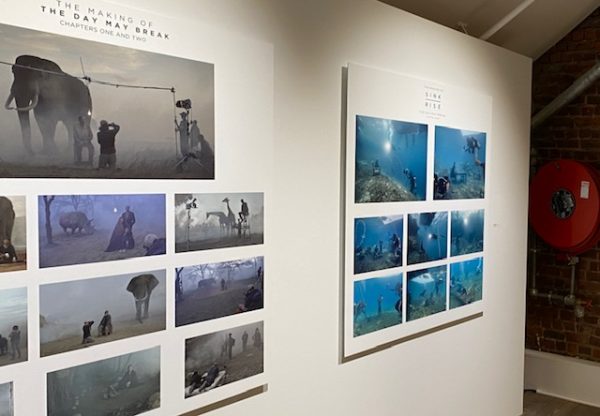
Nick Brandt presented his engaged photographic projects “The day may break” in Brussels at the Hangar Gallery space in Brussels (2025-9-21). The photographic work spans the globe to document and tell the story of a an endangered planet. The environmental and social fabric is at risk of an unprecented scale in the 21st century. Rather than producing hours of documentation, Nick Brandt focuses on images that stick. His “mise en scene” is meant to haunt us. And it succeeds in it. In the best sense of a tradition of a “photographe engagé” he intends to convey messages, even whole narratives to us about and from people in remote places, who are endangered through our inaction or paralysis in front of the challenges posed by global warming and climate change as well as the social and societal consequences.
We can save people from drowning in floods and rising sea levels. The chapter Sink / Rise of this project was produced with people from the Fiji islands who participated in the futuristic scenario of a sunk island. Without accusations, these people question us. Why? How? What for? Where to? – without speaking a word. They spend time in on a sunk island, surrounded, submerged by beautiful, but morbid, turquoise water and the graveyard-like remainders of a broken coral reef. These are photographs not of these people, but about them, about their likely fate, and (very important) produced with them as empowered actors. May they have a chance to rise like a phoenix from the ashes from these photos.
The documentation on the “Making of …” (image below) as part of the same exhibition allows transparency and additional insights into the artist’s work and proceedings.
(Image: Hangar Gallery, Brussels 2025-9-21, On the making of Sink / Rise by Nick Brandt)


Global warming

The annual update of the global warming indicators (source: Earth system science data 2025-6) gives more reasons to worry about the future of our climate. The objective to limit global warming to +1.5°C, established at the Paris climate agreement in 2015, is no longer achievable. This is the hard evidence based on the global network of scientific data collections and their projections. Fossil fuels are a major cause, deforestation and greenhouse gas emissions as well (Forster et al. 2025). As a consequence, human-induced warming of average surface temperatures and flows of heat into oceans continue. The first consequences, we witness in many parts of the world already. France is particularly affected (Le Monde 2025-6-20, p.7). What used to be called “natural disasters” is better described as long-term consequences of human-induced global changes like global warming. About time to take our CO2 footprint even more seriously. The “All electric society” can reduce reliance on fossil fuels considerably, as of now.

Art from India

Indian music, art and performances have had a difficult time in traditional western cultures. Based on the historical collections and donations in the BNF, this WEIRD bias is challenged a bit. The focus on performances and art from India of centuries old traditions of high standards could have been a major source of inspiration to wider audiences already. The narrative language of for example dance as Bharatanatyam is a sophisticated ritual of expression. It appears to us like a spiritual performance which reaches our emotions much like our modern ways of expressing and performing. It seems amazing how the western world has omitted looking and listening to other continents. 

Of course, archers have played an important role in Indian culture as well. Such depictions have been common across cultures in previous times. These images can reflect the shared human heritage and this with a global perspective on art history. Flora Willson (2024 in Die Musikforschung) refers to this Indian cultural heritage in her book review and why Italian Opera never really became popular in India. 

(Image BNF, Paris Richelieu in Rotonde 2025).

Indigenisation

In reading up on the « all electric society » it is useful to see what the international market has to offer in innovation of electronics, but also to understand the potential of mass production. In this little research the came across the „Electronics for you magazine“ (LINK) from India is a great source. Trends of miniaturization of electronics and power savings for consumer products as well as some high tech space and wave technologies receive systematic coverage. 

The November issue 2024 (p. 63) used the term „ Indigenisation“ to refer to the process of a country’s own technological development to ensure independence from being cut off from advanced technologies. Producing in India for Indian use seems to be an answer to economic and technological risks. India‘s space exploration program builds on own supply for civil and probably military purposes as well. Indigenisation of production, therefore, is an adequate term for own indigenous production of specific advanced components. 

Contrary to the trend of globalization, which dominated the 2nd half of the last century, „Indigenisation“ is likely to dominate numerous sectors of the economy in the coming years. Made in India is, of course, a brand. Small countries might find indigenisation more difficult to achieve. It needs to be checked, whether indigenisation or „self-reliance“ (Atmanirhbar Bharat) implies plural societies and identities to the same extent.

Aridification

Man made climate change and local policies increase speed of aridification (Link). It is not only the Sahara desert that is spreading out, but the lake Aral is another horrible example of the disrespect mankind attributes to its own resources of living. As more regions become arid due to our faults and long term consequences of industrialization we provoke human resettlement of an increasing scale. Water resources are and have been for centuries the major reason for people to settle nearby. Aridification of the soil like in California increases the risks of wild fires. The costs associated with aridification are very high and such areas can no longer be insured through normal private insurers. In most cases poor people or countries are affected the most, but we are all likely to bear the consequences in one way or another. We will have to accept that the size of habitable areas on earth decreases while the peek demography of humans is still at least a decade away from now. Not to tackle aridification is not an option. When shall we ever learn? (Image: sketch for Hagar and Ishmael in the desert, by Navez 1819, MRBAB)

Commemoration

In The month of November we commemorate those who died and particularly all those who died in the combat for freedom and democracy. The Russian aggression does not show many signs of ending the killing of soldiers and civilians on both sides. Ukrainian forces struggle to resist the Russian occupation of its territory as Russia is sacrificing thousands of lives for small gains of territory it is unlikely to defend in the coming months if Ukraine possesses longer reach weapons. A new spiral of an apocalypse is most probably the result of the Russian insistence on external aggression to cover up more internal problems. A lost generation of young soldiers who died in combat or suffered mutilation will be the outcome of these atrocities. The inflationary effects of wheat and energy prices globally have caused additional casualties in countries that had absolutely no stakes in this war. Russia is to blame for those additional casualties as well as the adverse effects on the world‘s climate due to the fighting and destroyed materials that need replacing later on. The young Russian generation will have to stand up against Putin‘s call to war and put down their weapons. This is one way to end the spiral toward yet another apocalyptic experience in Europe and the silent killing through hunger beyond Europe. (Image: BNF Paris, Apocalypses 2024)

Olympic Medals

The distribution of Olympic medals across continents reveals the persistent inequality of rewards across the globe. The first African country in the overall ranking of countries by Olympic medals is Kenya on 17th place. All 11 medals including 4 gold medals were obtained in athletics and in running disciplines 800m and more. The financial resources needed to practice running as high level sport are probably the lowest one of all disciplines. Ethiopia is another African country with this tradition of high level long distance runners on the African continent. Equipment and coaching in other disciplines than athletics involves more infrastructure and becomes more costly and the possibility to reserve infrastructure for elite athletes of a country is more difficult if the infrastructure for the population at large is rather limited compared to the population size. Therefore, the Olympic tradition has to confront the challenge of unequal access to many disciplines of the Olympic Games also in Paris 2024. Being a very good athlete is just not enough if you lack the coaches, training and facilities to be able to compete with the well-equipped countries. The knowledge about the best details of a specific technique or optimization potentials are part of the Olympic challenges as well. The Americas, Europe and Asia might be confronted with new forms or another criticism of imperialist strategies, this time in the domain of sport. The winner or medalists take all. Country rankings appear a bit like the football device “money buys goals”. (Image, Fondation Louis Vuitton, Paris, Extrait of Omar Victor Diop “Diaspora” 2014-2015).

Sports International

Beyond the Olympic Games the practice of sport has been widely spread across cultures. The meeting of cultures through athletes is also a worldwide phenomenon. The “Musée du Quai Branly” offers an opportunity to delve into the different cultures of the world. With abundant water resources Oceania has developed boats that ensured survival, work, art and leisure. The image below is a fine piece of art which is exposed in the permanent exhibition of Oceania. Even a turtle appears to be rowing next to the others. Most other depictions or objects with reference to sports have fighting as a feature or refer to it. The Olympic games have similar historical depictions. Martial practices, sometimes also called martial arts, have been the source of decorations and special designs in all cultures. The ethnographic collections of this museum offer a glimpse into the rich cultural heritage of all continents. We have so much in common across continents that it is still hard to see mankind captured in many wars across the world. Paris 2024 Games with the “Musée du Quai Branly Jacques Chirac” give hope that sustainable development (70% of the museum is green space!) and peaceful living together is feasible with a focus on joint cultural heritage with enriching diversity.