
Peak AI

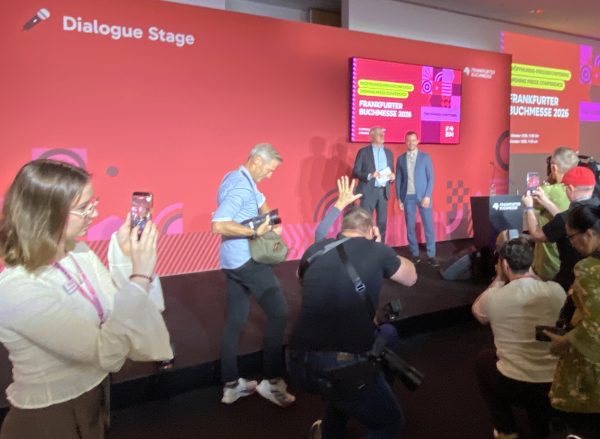
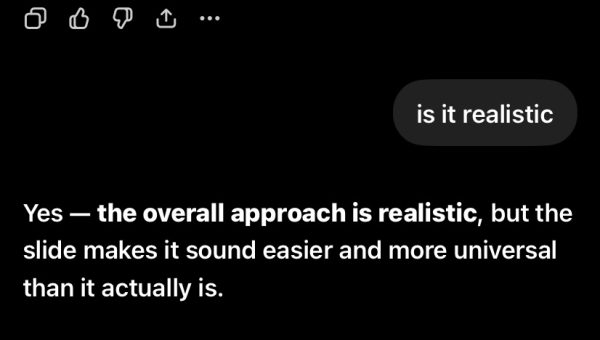
Many scholars, economists and politicians have predicted peak oil production before and were wrong in the estimate of the timing of the turning point. At the occasion of the Frankfurt book fair #fbm26, the sector’s coming to grips with the use of AI is all over the place. AI is the elephant in the room which threatens jobs and complete business models, but also creates new opportunities. On the Global Stage on 2026-10-7 the panel on innovation and experimentation in publishing discussed the issues based on first experiences. When I asked Chat-GPT for an opinion on, whether one of the presenters gave a realistic assessment of the potential of AI in publishing, it came up with a rather  sobering statement (see below). “Yes — the overall approach is realistic, but the slide makes it sound easier and more universal than it actually is.” A great opportunity for AI consulting to the sector subject to rapid change (again). Maybe the AI knows from my track record of prompts that I am a social scientist and favor critical thinking. Pleasing me, it ends by a suggestion that indirectly AI is less universal than is currently the dominant opinion. We might see a reckoning of AI that it (hopes) for its own sake, to be less universal than what the hype suggests. Peak AI could guarantee sufficient margins to survive comfortably, just like other not-so-social or not-so-sustainable sectors and technologies. 
AI on AI - it is not so universal 2026-10
AI on AI – it is not so universal 2026-10

More about books

The Frankfurt book fair opens its books and doors on 2026-10-7. The thousands of authors, publishers, translaters and agents are quite concerned about the amount of infringements that AI has brought to the industry. The market is under increasing pressure to secure intellectual property rights and copyright protections. A flood of AI-produced books shall ruin margins out of which authors are paid as well. The spreading of ideas in form of books across borders is threatened. Sebastian Guggolz from the German book trade association claimed even a double theft, first the books, then the ideas by AI. In order to counteract this, the Frankfurt book fair is continuously expanding is function as a platform of exchange of ideas (Juergen Boos) and face-to-face meetings of all involved in writing, editing, producing, trading, teaching and discussing books in the broadest sense. This discourse about books is the real human added value which AI is lacking so far. In this sense of talking about books, books become a kind of merchandising product of an event or a form of take-home-message to participants. A great and promising forward looking agenda for us rather than the retro-captive approach of AI. 

Frankfurt book fair 2026-10-6 press conference

Gone gliding

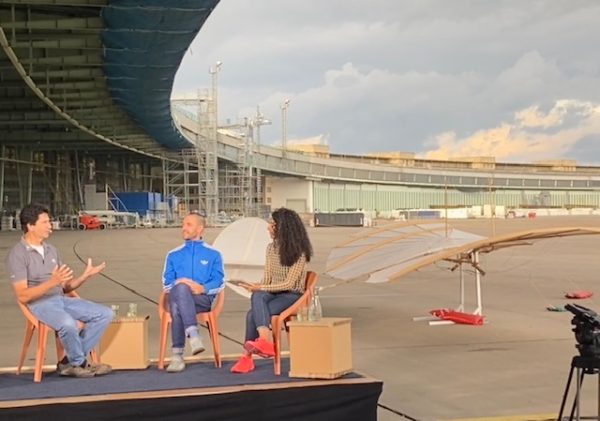
Nowadays gliding in form of hang gliding is a leisurely experience within the reach of almost everyone. The human dream of flying, however, has been shattered by the Icarus narrative, humans aiming too high and too close to the sun. More realistic first experiments were undertaken by Otto Lilienthal, who pioneered the first human built and steered glider based on an innovative concept of the wing at its basis. Aerodynamic construction of the wing with a rounded shape allows air to flow faster on top than below the wing, which lifts the wing and glider upwards. His tragic fatal accident on one of his gliding experiments has been wrongly attributed to a construction default, but recent research has shown that it was most likely due to  bad weather conditions on that particular day (Link Radio3). According to Markus Raffel, Otto Lilienthal was a broadly educated and practicing polymath in addition to his gliding innovations

Science and art Radio3 talk at airport Tempelhof Berlin 2026-9

Interests in failures

Decades or centuries after a successful or unsuccessful innovation, an evaluation of the reasons and circumstances of a temporary or permanent failure is informative. In the energy sector we observe another round of a power play in 2026. The more decentralized energy production and energy consumption models have been quickly put aside shortly after the oil crises of 1973 and 1979. The innovations using wind energy or solar energy of the 1980s have been discarded and were commonly considered as failures to provide cheap and reliable energy. An open international economy with expanding global markets for energy were perceived as a superior conventional solution. A country’s balance sheet of imports of energy and exports of higher value goods and services was the predominant economic rational and standard knowledge of the mainstream theory of trade. Other solutions, like a distributed “prosumer” model of energy might have ecological benefits, but would not show up in national GDP-statistics as a large part is home-produced energy and not accounted for in statistical measures of GDP, just like the home produced meals, health and care provided by mostly women. Societies, however, have a choice and an obligation to evaluate the interests in failures as economic and social development hinges on it in the medium to long run.

Failure as criticism

The production of an object, which does not abide by the norms and conventions of its designated use, can either be considered a failure, a commercial flop or a critical comment on consumerism. In some instances it may even have the intention to produce art rather than a useful product. A tea or coffee pot may serve as such an example of it (see image below). It is designed not to serve tea or coffee in a conventional way. Such an object invites us to think around the corner,  whether we could still use it in the “normal” way. We are forced to innovate as user or we just leave the object aside. The Flops exhibition also included early car examples which used a “Wankel car engine” and the aerodynamic adjusted car model (shape of a peach) of the R14 in its flops collection which were early precursors of a, later on widely followed, car design principle. Such an aerodynamic car design saves energy and therefore increases the reach of the car without refueling or battery charging.

Overall, some supposed failures are more indications that we are not easily prepared to accept behavioral changes or alternative visions of products.

Time dependent failure

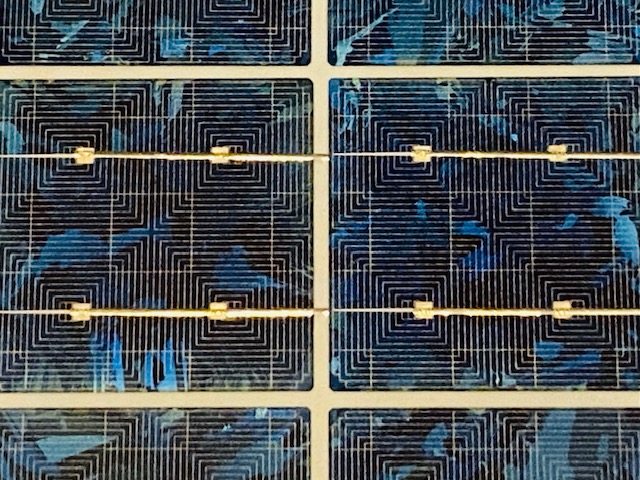
The collection of failures has an ambiguous relationship with time. Some innovations that are celebrated at a specific point in time shall be considered failures at some later point in time. The Musée des Arts et Metiers has an early version of a solar panel on display dating back to 1996 (see image below, Photowatt 1996). This example reflects the cycles of public as well as expert opinions about technical innovations that either are en vogue or at disgrace. Ecological, design and economic considerations enter into the consideration of what constitutes a failure. Claims of European energy sovereignty may additionally enter into the failure equation. The time horizon over which energy savings are generated is yet another element in the judgement. The more general perspective should take sustainability and depreciation of quality of an object into consideration. The Flops exhibition just scratches a bit on the surface of an important and rather complex issue of the relationship of society, technology and innovation.  Surely, there is more to come in terms of flops and failures, and this is okay in most cases. 

Fail collection

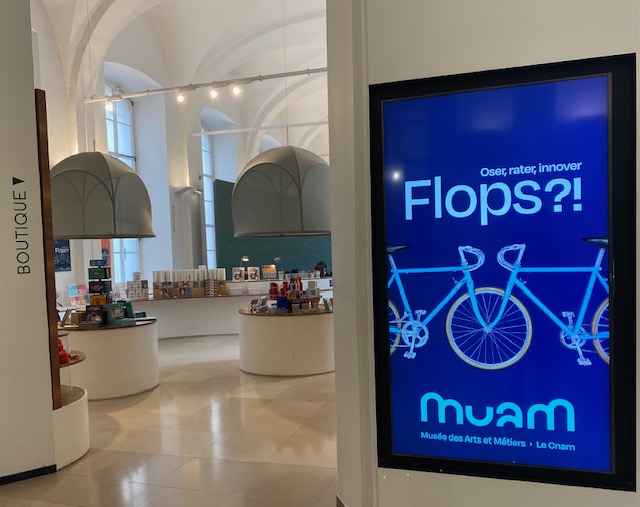
The not-so-social media have been flooded with collections of failures. The success of this short video format is mostly due to its entertainment value. A quick laugh is guaranteed if a certain intention is turned into its opposite. You want to take a witty shortcut but effectively you end up with a lengthy or painful lesson of the opposite. The fail collection of the CNAM in Paris has a similar attraction. The “Flops” exhibition in 2026 exposes a larger number of technical innovations that either did not reach the mass markets or that were “flawed good ideas”. In fact to put an innovative idea or design into practice it takes a lot in addition to engineering intelligence and professional competence and experience. The collection of documentary evidence invites us to explore the topic of what constitutes a failure and why failure is an intrinsic part of the creative process of trial and error, fail, fail again and fail better. (Image Musée Arts et Metiers 2026). 

Quantum battery

The first prototype of a Quantum battery has been successfully tested. The Commonwealth Scientific and Industrial Research Organisation CSIRO with corresponding author James Q. Quach published the paper on the “quantum battery tuned for strong light–matter coupling” (Kieran Hymas et al. 2026) open access. Although there have been close to 20 papers on the theory behind quantum charging already, the demonstration as a proof of concept (in business terminology) has been missing so far. The superextensive charging with photons builds upon “a laser pump pulse with bandwidth ~31 nm and resonant with the LP branch induces excitations in the quantum battery” (Kieran Hymas et al. 2026 p.3). Since batteries need not only be charged, but also discharged in a safe and fast way, the prototype demonstrated also this additional functionality.
This is a huge step towards the feasibility of the “All electric society” as the efficient storage which includes fast charging and discharging beyond storage have been a bottleneck in the wider adoption of the “All electric society”.
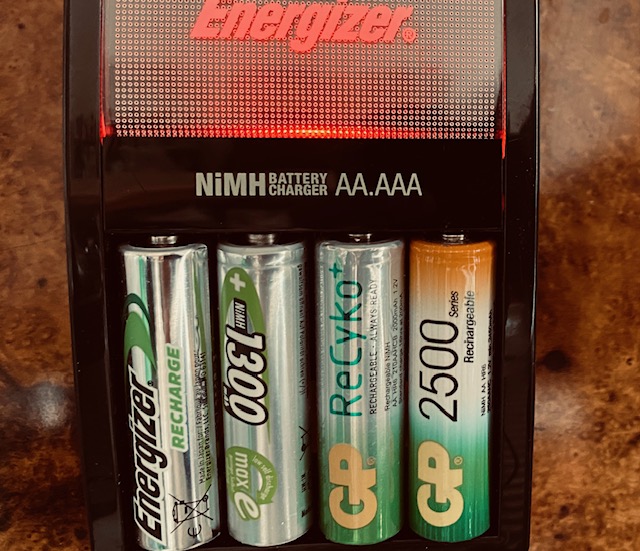
(Image: old fashioned NiMH battery charging at home)

Typewriter history

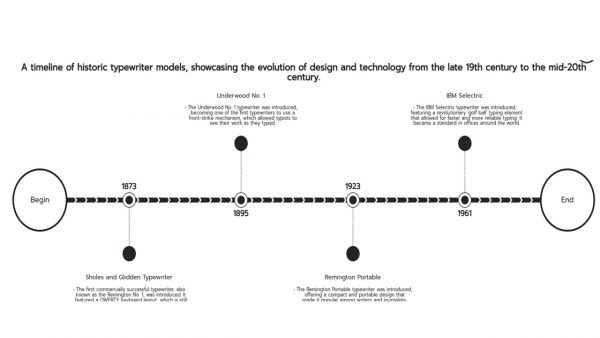
The history of the typewriter and typewriter is comparatively short compared to the history of literature or other technologies as partners in the creative process. With the advent of AI (here as part of infografix, see image below) the skills of using and mastering a typewriter have become almost obsolete. The original design by Remington (timeline below) has dominated for almost 100 years the technology of typewriters. Then came the electronic IBM technique with an automated correction type, which was not only faster, but also more forgiving of “typos”, short for typing errors.
The craft of handwriting had suffered a tough blow, despite its almost intimate touch to it. Knowing the typewriter outline by heart allowed typing with closed eyes or a focus on another text or image as well as a parallel thought process. Scientists and writers (Claude Levi-Strauss) reported on their creative process as intrinsically being linked to their typewriter.
QWERTY outlines for English language typewriters still dominate the keyboard typing today. With the AI interaction on the rise, we might move away from typing as a “Kulturtechnik” a technology of our cultural era and focus more on human-machine interactions via our voice and microphones. The underlying question, however, remains the same: What is the best technology to enhance our thought process? This, in fact, tends to be a very personal human choice, where technology plays only a subsidiary role.

Green trade flows

The statistics on trade flows reported by the UN Department of Economic and Social Affairs have a comprehensive data base in the background. The descriptive inspection of the raw data on trade flows comprising solar panels, batteries and electric vehicles shows a stark imbalance of how future-proof the trade between countries is. The New York Times (David Gelles et al. 2025-6-30) has put this information into an impressive graphical design to show the magnitude of the imbalance of how China trades in green products with the world and how the USA is losing out on future-proof low carbon emission trade. Despite the fact that China is still heavily emitting CO2 today due to burning coal for electrical power, the investments at home and trade with the world is moving into the opposite direction. We have seen many of these industries at risk in Europe, like solar panel production, batteries and increasingly electric vehicles, without the western countries getting organized to address crucial business and economic challenges. Falling behind in these industries and trade will shift global balances in the near future. Renovation through innovation is more promising than holding on for another decade to inefficient and more polluting energy sources. Repairs of homes and buildings have long lasting effects, which we can, nevertheless, change today.