VCs shun SA

Venture Capitalists have an eye on long-term safety of investments. Political upheavals, unrest or instability can deter investments as much as risks to the safety of the workforce. The abbreviation “SA” in Germany has at least 2 meanings. (1) Historically, it refers to the “Sturmabteilung”, which was important in the rise of the Fascist movement and Nazi-terror in the 1920s, 1930s. Foreign investors were right to shun away from investments during the rise of the Fascists in Germany as a total loss of the investment was to be expected. (2) In 2026-8 the abbreviation “SA” in Germany stands also for “Saxony-Anhalt”, one of the Federal States of Eastern Germany, formerly the GDR between 1949-1990.
The “Wallstreet Journal”, which is read by many international investors showed on its title page of WSJ 2026-9-7 a report by Bertrand Benoit on the disastrous election in Saxony-Anhalt giving the extreme right-wing party AfD close to an absolute majority of votes. The abandoned investment by Intel into a chip-production near the capital of SA, Magdeburg, has been in retrospect a rather wise investment decision. The internationality of the employees, who build and operate such plants, might have contributed to them feeling rather unsafe in a hostile environment towards foreign workers.

intel processor logo

Utopian Antifascists

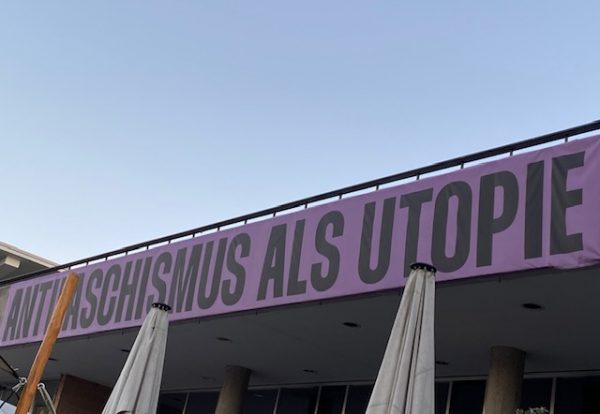
Next to the exhibition on “Global Fascism” in Berlin in 2025-12 there was a banner on the wall, which stated “Antifascism as Utopia” (see image below). This statement invites the question, whether an antithesis can serve as a positive utopian idea guiding large numbers of people. It is certainly necessary that all people who subscribe to democratic principles and human values should be able to unite under the banner of antifascism, but the ways to pursue this goal are manifold. This makes the claim of an utopian objective a bit more obvious and, at the same time, more plausible as a potentially overarching objective. The statement might well turn out to be the defining statement or key visual of the year 2026 with rising nationalist and in some places also fascist ideas and rhetoric. Thoughts and words might be only precursors of more such actions in the coming months. 

Positive negative Utopia

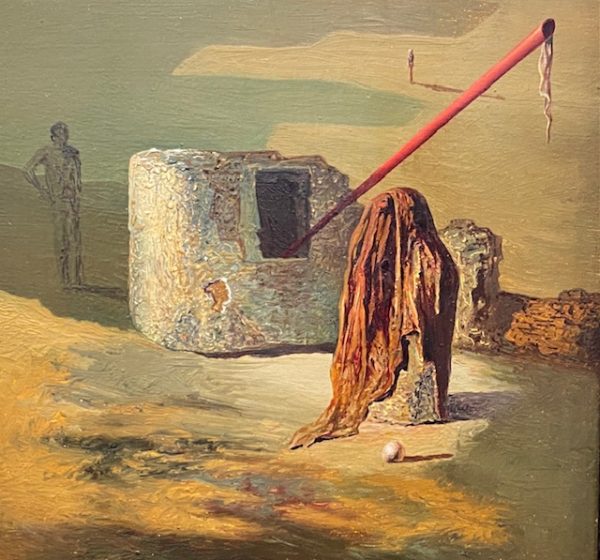
We have been used to distinguish between a positive or a negative utopia. The idea of a paradise is usually associated with a positive utopia, however, from the perspective of mankind being unable to live together without the idea of God being the ultimate arbitrator, this is more like a negative utopia. The industrial revolution and communism as the utopia to spread wealth equally across generations and all people, have been turned into negative utopia by dictatorships and authoritarian regimes. The fascist ideas of superiority of a race has also turned into negative horror and Nazi-terror. Hence, skepticism is in order, if either form of utopia is advocated. There are numerous examples of unintended or not explicitly stated consequences that have to be considered as well. (Image: Extract from Salvador Dali, Looming Danger Alarm, 1934, Neue Nationalgalerie, Stiftung Pietzsch)  

How could this have happened

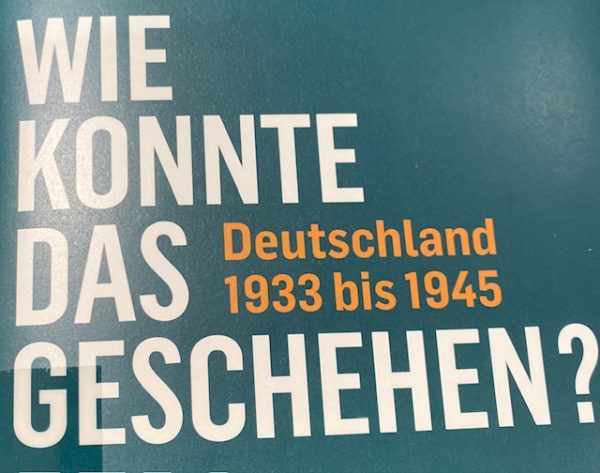
The latest thorough reflection on how the Nazi-terror could have stopped or being prevented remains an important question in our time. The more we see countries descend into the authoritarian regime types, the more we have to know our lessons from previous historical experiences. Götz Aly made a great contribution to this literature. He points our attention to the collective euphoria the Nazis (NSDAP) managed to make people believe, by at the same time blaming others for the past crises. People just wanted to believe the fake narrative of a promising future (p. 175) for a society based on social exclusion. The pattern, unfortunately, seems to find its replication in other parts of the world nowadays. This is a very slippery road which often leads to disaster rather than relief. Easy or catchy answers are preferred by many people rather than the nuances of well-informed differentiated options. Patience in social development is a collective virtue, but often misunderstood as a form of conservatism, which is is something very different.

Margot Friedländer memorial

Berlin has been honored by the return of Margot Friedländer who had survived the Shoa in 2010 at the age of 88. Her whole family was murdered in concentration camps by the Nazis. Ever since her return and especially after her biography had been published she was a restless ambassador in the fight against hate, exclusion and the neo-fascist movements. She has been engaged in interreligious dialogue and even through the ceremony after her death, she tried to bring together different Jewish communities in Berlin.
Irrespective of a person’s background she met everybody on an equal level.
A great example to thousands of people, she managed to meet in her life. Each time she met with pupils or students to speak about her horrific experiences she lived through the same traumatic experiences again and again, but turning this into the strength to “vaccinate” people against the deadly virus of fascism.
The day after she had been buried in her family’s grave in Berlin Weißensee people still had to queue to sign the book in her memory in the Berlin town hall. She will be remembered and missed for her unrivalled humanity and generosity. She became engaged to fight for humanity and remained an activist until her very last day at 103 years of age.

Leber JA

In Berlin Schoeneberg there is a memorial in preparation for the courageous couple of Julius and Annedore Leber. Julius Leber has been incarcerated several times by the Nazi officials, tortured and finally executed in Berlin. A link to the group of people trying to overthrow the NS regime (1944-7-20) caused his arrest and execution in January 1945. His wife Annedore published several accounts of the resistance movements, which existed during the NS regime. These people were aware of the fact that they were risking their life with such activities, but persisted nevertheless. We owe Julius and Annedore Leber a decent commemoration as we need to remember that such courageous examples existed even until the last few months of the NS dictatorship. The site allows for a building and learning center which could serve as an archive and encouragement to fight for democracy. It is less obvious than we thought it would be.

Victims and Perpetrators

In addition to the annually proclaimed “We shall never forget the concentration camps and the murder of 6.000.000 Jews”, we should add: “We shall not be silent”. Silence about a crime can be interpreted as the “latent” continuation of hatred. Silence might just be a pretended ignorance of the genocide and the holocaust. We have to keep very alert amidst the spreading falsification and numerous falsification attempts of historical facts surrounding the ideation about the Nazi-time and Nazi-terror from the 1930s onwards culminating in the Shoa and systematic mass killings of civilians and any actual and deemed opposition.
Particularly in Germany there is a renewed need to go beyond the “Stolperstein-Initiative” and continue also sometimes own personal research of family histories in order to understand the logic and power of perpetrators. Some spectacular legal cases like “Klaus Barbie” or “Rudolf Eichmann” or the Nuremberg trials became historic events, but the crimes of many Nazis during these times remained below the radar of wider public attention.
In view of many disrespectful utterances of some politicians and even some business men the old and new perpetrators of antisemitic propaganda and acts should have to face more fierce opposition. This needs the commitment of the silent and sometimes shamefully indifferent people across the world. (Image: list of concentration camps, sign in Berlin Schöneberg, Richard von Weizäcker Platz).

Holocaust Remembrance

The 80th anniversary of the liberation of the concentration camp Auschwitz-Birkenau marks a very special kind of remembrance. As the number of survivors of Nazi-terror and genocide is shrinking the testimony of survivors is becoming more rare and more precious. According to the “Jerusalem Post” on 2025-1-28 (p. 9) the number of survivors that came back to the site of horrific crime has shrunk from 300 ten years ago to 50 in 2025. The strength and courage to continue to testify amidst having reached 90+ or even 100+ years of age is a “living memorial” of its own kind.
Many television stations across Europe have followed the example set by this special Holocaust remembrance day and focused equally on recorded testimonies or additional live interviews of survivors. Please keep repeating these testimonies to confront people with the outcome of Nazi-terror in Europe. The choice this year was a courageous one. Instead of speeches of sorrow and lip service to fight antisemitism by acting politicians, the focus on the testimony of survivors in public, on TV and to large audiences will encourage others to continue to give testimonial of these horrors.
(Image: extract of Pressreader newspaper titles 2025-1-27)

Screenshot

Career Criminals

From a life course perspective it is not easy to define a colloquial term like career criminal. A person who has been convicted for a single crime and has served his/her sentence should be allowed full integration into society. Even a repeated offender should not be stigmatized or labeled as career criminal. However, this is exactly what the NS-state did (traveling exhibition across Germany and Austria: „Die Verleugneten“). These persons were subject to targeted charges for criminal offenses they „might“ commit eventually. The term „community alien“ or „asocial“ were also used to refer to persons that did not fit into the dominant Nazi doctrine of „Volk“. It took 75 years until these persons could receive a recognition and a recompense for their unfounded discrimination and incarceration. In concentration camps the so-called asocial or career criminals were at the highest risk of further prosecution and death. Great that the stumbling Stones include these victims as well, as a way to remember these crimes against humanity. Beware of definitions of social groups which are based on totalitarian ideologies.

Cumulative Mandates

Since 2010 and with 18 volumes the documentation of perpetrators assistants free riders during the Nazi rule in Germany has been valuable and reliable source of information (Kugelberg Verlag). The book series defines the perpetrators as the persons excuting crimes themselves or were in command of those who committed the crimes or gave orders to do so. It is not surprising to find evidence of many crimes, but rather that it took such a long time until the documents were published and the descendants were confronted with the facts and the difficult heritage. There are still many who undertake all efforts to deny the facts or try to minimize the guilt of perpetrators. With the real dangers of new right-wing extremism on the rise across Europe and even beyond, it becomes more important to uncover the strategies and biographies of the perpetrators. Certainly the members of the SS were executives and in command of atrocities, so-called NSDAP party officials were also mostly convinced followers of Nazi doctrines and instrumental in the implementation of crimes. Additionally, several professions (line soldiers or medical doctors) were key in the process to ensure the power of the totalitarian regime until the final days. Some persons were cumulating roles and became thereby inescapable spiders in a web of control and crimes. The lessons for today consist in hindering excessive cumulation of mandates, political, professional, military and in other work or civil society related functions. Distribution of power is one form to safeguard the survival of democratic structures.