The careers of conductors during the 1930s and 1940s have been propelled by joining the NSDAP on Germany. Even if not too outspoken as conductors on Nazi discriminatory policies many openings arose only due to banning Jewish conductors and musicians from performing in public. The acceptance of vacancies due to such restrictions advanced the careers of Karl Böhm as well as Herbert von Karajan. A theatre play Böhm at the Deutsches Theater in Berlin takes up this topic and puts the professional career in perspective of an anti-humanist leadership style. Karajan has also come into critic, because of his role in selecting musicians who were conform to the prevailing Nazi-antisemitism. It is important to work on these biographies and their implications for hundreds of lives of other musicians. Many careers have been destroyed due to these two prominent conductors ready to do almost anything to advance their careers. It puts their interpretation of music in a different light knowing about their instrumentalist approach to music, their own careers and the disrespectful Nazi doctrines. Image New Berlin Philharmonic, View from Kunstgewerbemuseum 2020. 
Victim Perpetrator
Research on the Shoa and the Nazi crimes has a clear cut separation into millions of victims and millions of perpetrators. There is only a very small group of persons who risked their lives in their attributed or chosen role of perpetrators and saved lives. Most of those persons received recognition later, some decades later. The vast majority of persons were oblivious to their prior roles and some even tried to defend them themselves through a variant of victim blaming in recurrent attempts to reduce their guilt. Another frequent excuse is to recur to a perpetrator’s own experience as a victim of abuse or tough childhood. In a static perspective this might work, but the learning and reflection ability of humans apply to all persons irrespective of age, if they show the willingness to do so. victimization is powerful tool to justify a role as perpetrator later on. Criminal courts assisted by psychologists statements accept guilt reduction. After all those considerations the basic classification into victim or perpetrator remains a valid differentiation, only very few cases allow for a more nuanced assessment of the case. (image extract of Rachel Baes MRBAB Brussels) 
NS München
The documentation centre in Munich of the National Socialist time and crimes has an encompassing collection of documents on display. As the prime centre of the Fascist movement in Germany in the 1920s and early 1930s Munich was the home to party elites from the first months of the movement that became the epicentre of the dehumanizing policies we can follow throughout Europe (Topography of Terror, Berlin). The historical research in both documentation centres complement each other in many respects. Understanding the beginnings of the Fascist movement remains important to today. Fascist movements need to be stopped before terror even against neighbours takes hold. Records of the evolution of membership, men’s and women’s movements later on, attacks of the parliamentary system all have to be taken into account to be able to stem the Fascist tide at that time and today again.
“Materializing” is the current exhibition, which can be visited in part online. How can we deal with the “Shoah“? Polish artist have a long experience to cope and deal with the unimaginable horrors, the Nazis and the “Wehrmacht” committed in Poland.
Memories have to find a place, a piece, a word, a sound or an emotion to materialize. In that sense yesterday joins today and is preserved as learning and warning for tomorrow.
In addition to the much discussed “Wehrmachtsausstellung“, the work by Jochen Böhler provides ample evidence to debunk the myths of war without crime. This holds for the past and for the present. (Source: Böhler, 2019, S. 59-68, Die Wehrmacht und die Verbrechen an der Zivilbevölkerung während des deutschen Überfalls auf Polen 1939, Image below). 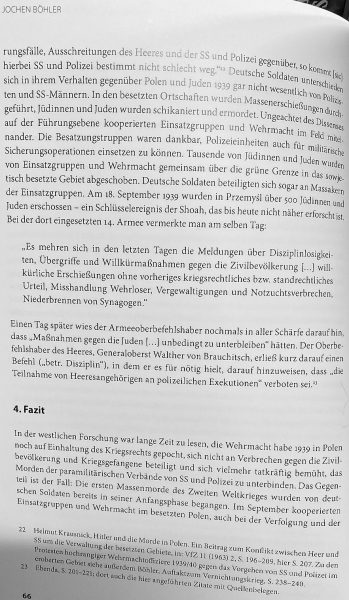
Topography of Terror
The documentation centre “Topography of Terror” in the middle of Berlin is easy to reach. The “Potsdamer Platz” is nearby and so is the “Kulturforum” with its galeries, museums and the “Berliner Philharmonie”. The documentation centre gives easy access to the historical evolution of Nazi-dictatorship from the earl beginnings, the horrific terror spread across Europe and first insights into the prosecution of criminal acts in the immediate post-war period. The Beyond the exhibition with audio-guide there is an easily accessible specialized library for personal or scientific research. The accompanying program of book presentations and discussions (image below) complements the busy show rooms. The external “walk through history” allows to grasp the main proceedings of the terror regime.
For special interest or research questions it is a very useful starting point. Hours in the library have to complement the research. Good to see that so many students walk through the documentation centre not only in groups from the neighbouring schools. The interest to understand when and how the terror started will allow us to better guard against those right-wing extremists who use a lot of techniques of propaganda well known and exposed in this documentation centre of the terror of the Nazi-regime. 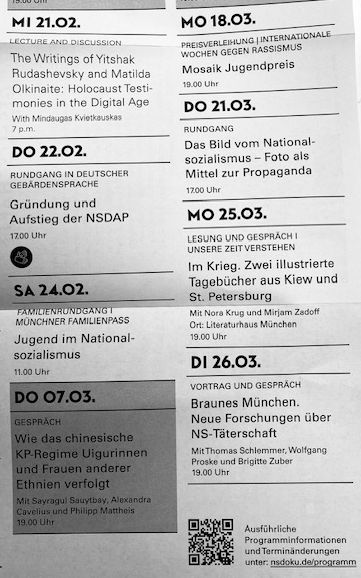
Timeless Values
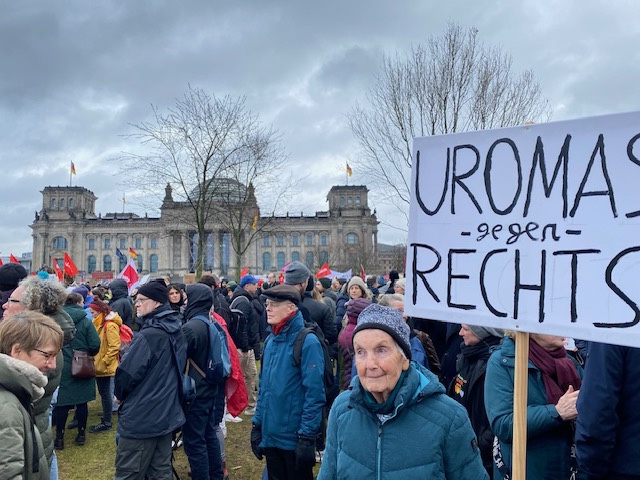
The declaration of human rights is more than 200 years old. However, the need to stand up for the defense of these rights needs many people to act accordingly. Political parties and courts are not strong enough to be the only defendants of democracy and human values. Solidarity across generations is another part of the struggle to defend democracy. In addition to the broad movement of “Omas gegen rechts”, the age distribution has been further enlarged with the “Uromas gegen rechts”. This most likely the generation with first hand life experiences from Nazi Germany and they should have reached an enlightened view of the horrors caused by the Nazi-regime. Unfortunately there are still some who continue to be prisoners in a fascist “brown” cage of mischievous memories. The great grandmother who was present at the demonstration was clear in her statement to stand up against right-wing extremism. (Image: With the permission of the lady I am happy to have evidence of the presence of super-agers at the demonstration in Berlin).
Fighting Fascists
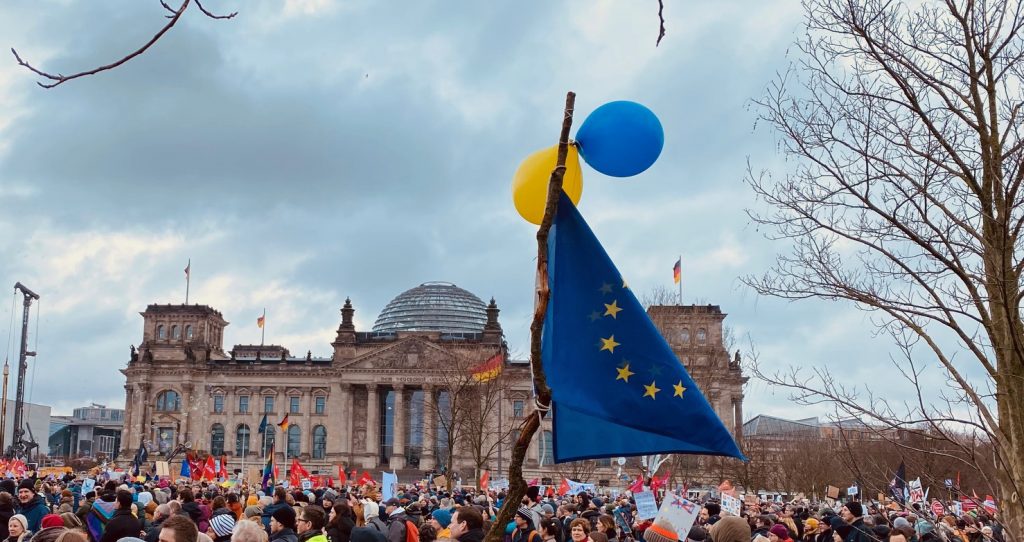
On february 3rd 2024 Berlin has seen the Parliament (Bundestag in the old Reichstag building) surrounded by young and old to raise their voice against the rise of right wing extremism in Germany. The broad alliance against extremism finds grassroots support from a very broad and diverse community. 1700 organizations have joined forces to send a strong signal that they are ready to act against the inhuman propaganda and persistent hate speech. The creativity to express the discontent in clear messages is impressive. Civil society is showing that diversity offers multiple benefits to find new ways to unite people. Great that European flags and balloons in Ukrainian colors where present as well. A movement of solidarity was felt with these people and that provides a strong message for the months ahead with so many elections taking place at the local, regional, national and European levels.
Memory Flashes
The title of the exhibition in the Museum of Photography in Berlin was “Flashes of Memory”. The collaboration of the Kunstbibliothek with the “Yad Vashem – The World Holocaust Remembrance Center” prepared a photographic memorial of the murder of 6 million of human beings with Jewish origin or family ties. The images represented in the exhibition constitute a carefully curated selection of the photos taken as part of Nazi propaganda, the secretly produced photos by inmates and the Sowjet and American soldiers who prepared documentation of the horrors. It becomes clear throughout the different sections of the exhibition that the motivation of the photographer introduces more than just an individual perspective on the scene.
In the age of fake news and fake images it becomes more and more important to be able to read and interpret photos, taking into account the motivation of the photographer and its influence on the photo taken. In order to limit the spread of mischievous representation of the past, it is good to know that the use of AI as image creation does not allow with simple prompts to produce false documentation. It needs more sophistication and more human intervention to trick the algorithms. Additional use of photoshop will, however, increase the risks of abuses. Hence, it will be more important as of now to be able to differentiate images according to sources and authors. Our trust in photos has been shattered, and this is an important lesson in itself. It is a huge task for schools and adult learning to re-build the competence to distrust photos and images at first, then deconstruct the messages and motivations.
“Flashes of memory” is in some way linked to the “struggle of memory” exhibition. Both, obviously deal with the way historical events are and have to be present in our “collective” memory. Memories come back in flashes, sometimes, certainly for victims. Conscious and unconscious selections of images might come back at times and haunt victims for years. The correction of biased messages, is an important task for historians, social scientists and artists alike. It is all too easy and common to forget (Luhmann, 1996 Reality of mass media) and the difference between “Documentation” and “Decoration” (Lewis, 2001) or simply illustration needs to be scrutinised always anew. “Bildung” has some common roots (only four letters really) with “Bilder” in German language. It may be “une liaison dangereuse”, but the spurious link can also be turned into an educational or learning approach.
A permanent exhibition based on the material used in the exhibition would be a real asset to accompany and learn about the flashes of memory. A reading list of literature was also available at the exhibition (see image below) encouraging to dig deeper into this immensely important topic. 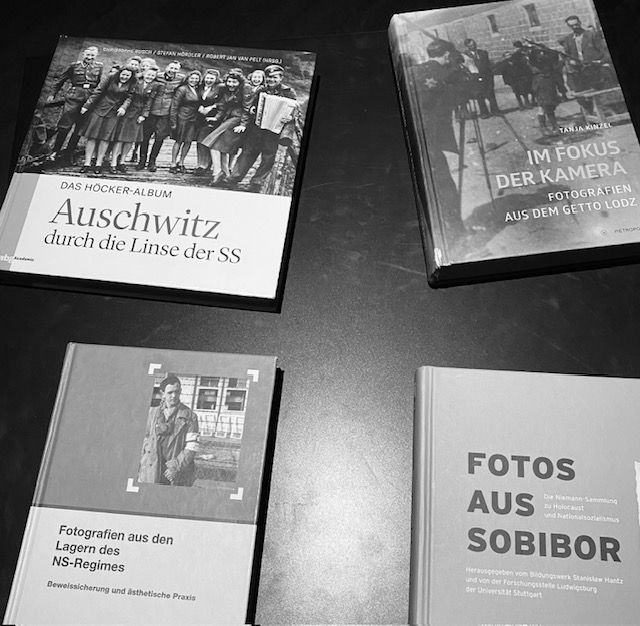
Zwang durch Terror
Durch den Terror der Willkürherrschaft mit rassistischer Doktrin wurde aus Zwangsarbeit eine lebensgefährliche Arbeit. Überzogene Sanktionen bei Diebstahl, Plünderung oder Sabotage wurden von den Nazis mit öffentlichen Hinrichtungen (Erhängen, Gruppenerschießung oder Guillotine) geahndet (siehe Katalog zur Ausstellung Alltag Zwangsarbeit S.44-45). Straflager und Verlegung in Konzentrationslager gehörten ebenfalls zur regelmäßigen Erfahrung.
Die Zwangslage der dort zur Arbeit gezwungenen Menschen ist kaum vorstellbar und fassbar in unserem System der Beschreibung von Arbeit. Totale Subordination kann vielleicht in Ansätzen verdeutlichen wie diese Situation auf die Personen gewirkt haben muss. Fluchtversuche waren fast ausgeschlossen. Selbst die Verbindung zu den meist deutschen Frauen in Fabriken war unter hohe Strafe gestellt und intime Verhältnisse (bezeichnet als Rassenschändung) wurden für beide Seiten lebensbedrohlich oder endeten für die Zwangsarbeiter oft tödlich. Der Terror in dieser Zeit bestand in der kontinuierlichen Gefahr und Angst tatsächlich oder vermeintlich eine Anklage zu erhalten, die unkontrollierbare, weil selbstherrliche, Strafen nach sich ziehen konnte.
Image: Ausstellung Alltag Zwangsarbeit 2024-1 in Dokumentationszentrum NS-Zwangsarbeit, Berlin Schöneweide. 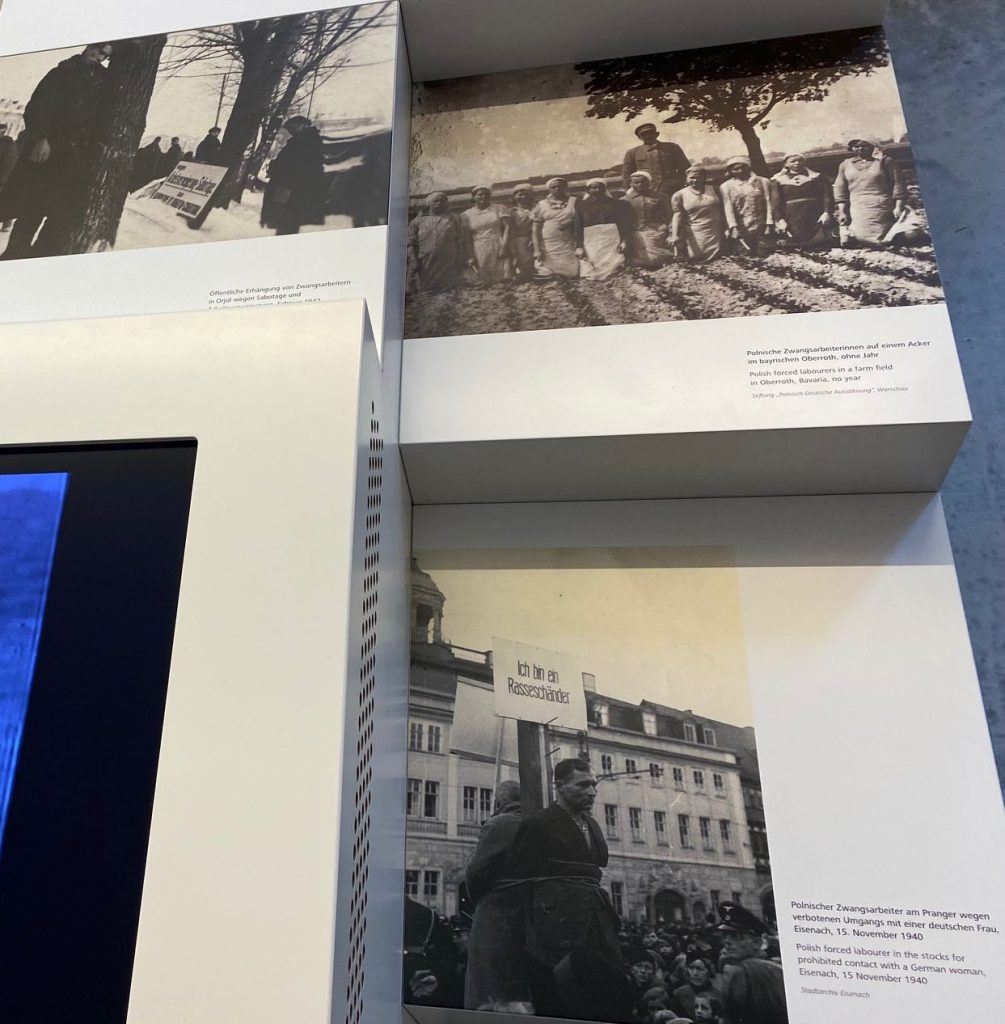
Zwangsarbeit
Die Annäherung an das Thema Zwangsarbeit ist nicht einfach. Auch heute prangern wir zu Recht Zwangsarbeit egal wo auf der Welt an. Die mit weitem Abstand grausamste und umfangreichste Durchführung von Zwangsarbeit haben die Nazis in Deutschland und von ihnen besetzten Gebieten vollzogen. Neben den Schrecken der Konzentrationslager mit dem millionenfachen Mord an Menschen jüdischer Abstammung ist die Aufarbeitung der Verbrechen in Zusammenhang mit der Zwangsarbeit lange in den Hintergrund getreten. Selbst die Zeitzeugen wie Francois Cavanna (2020, S. 10-11) vertraten die Ansicht, dass im Vergleich zu den Ermordungen und Kriegsopfern ihre Erfahrungen und Leiden im Zusammenhang mit der Zwangsarbeit in den Hintergrund traten. („… cela me rendit plus modéré dans l’expression de mes souffrances. … nous ne pouvons que fermer notre gueule. Ce que je fais. »).
Neben der systematischen Ermordungsmaschine der Konzentrationslager in der NS-Zeit verdient das millionenfache Leid und die Terrordrohungen und Anwendungen der Nazi gegenüber den ZwangsarbeiterInnen eine angemessene Bedeutung. Das Dokumentationszentrum NS Zwangsarbeit in Berlin Schöneweide bietet dafür eine hervorragende Ausgangsbasis. Die Ausstellung ist für alle Altersgruppen geeignet. Behutsamer Einstieg für Schulklassen ab der 5. Klasse und zum Nachdenken anregend für Erwachsene mit Informations- und Lerninteresse. Das Ausstellungskonzept mit seinen vielfältigen biografischen Materialien von Zeitzeugen erleichtert, neben der Faktenfülle, einen emotionalen Zugang zum Thema. Online lässt sich beispielsweise die Verteilung der Zwangsrekrutierten die Arbeitsdienst leisten mussten je nach Stadtviertel oder sogar Straße verfolgen (Link Datenbank und Map).
Die Löhne für deutsche ArbeiterInnen und Ost-ArbeiterInnen aus den osteuropäischen besetzten Gebieten waren fast zehnmal höher. Die in westlichen Besatzungsgebieten zwangsverpflichteten Personen oder selbst anfänglich mit scheinbar höheren Löhnen als vor Ort (Organisation Todt) üblich angeworbene Personen erfuhren die spätere Abwertung ihrer Entlohnung. Es bleibt die Betonung auf Zwang, Terror und Einschüchterung bei der Zwangsarbeit meistens in menschenunwürdigen Massenbaracken aus industrieller Massenproduktion. Einstieg in die Erfahrung: NS Zwangsarbeit Dokumenteationszentrum. 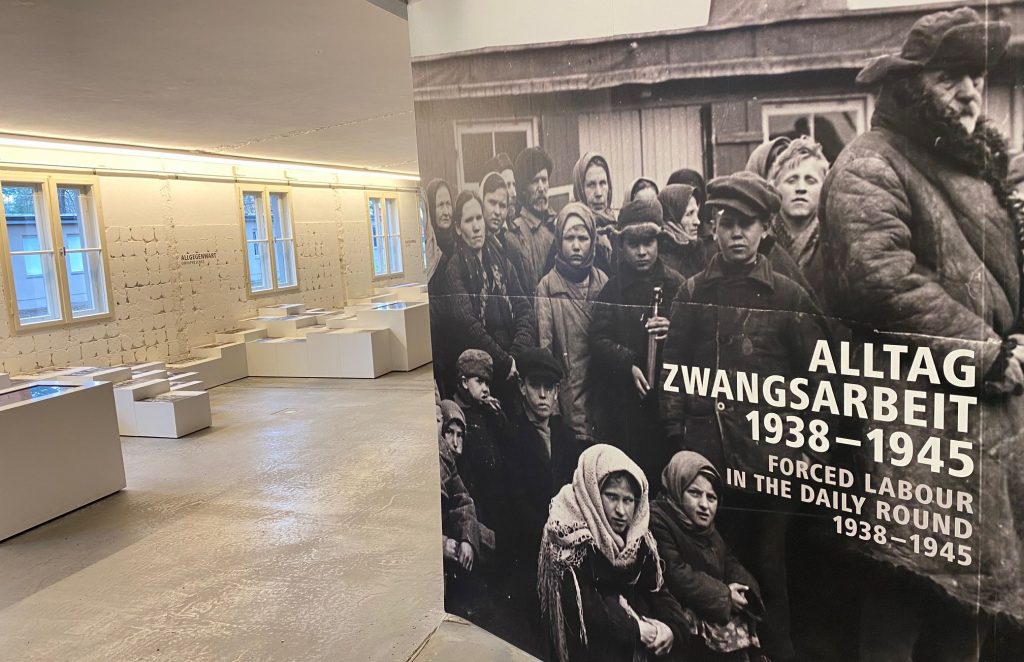
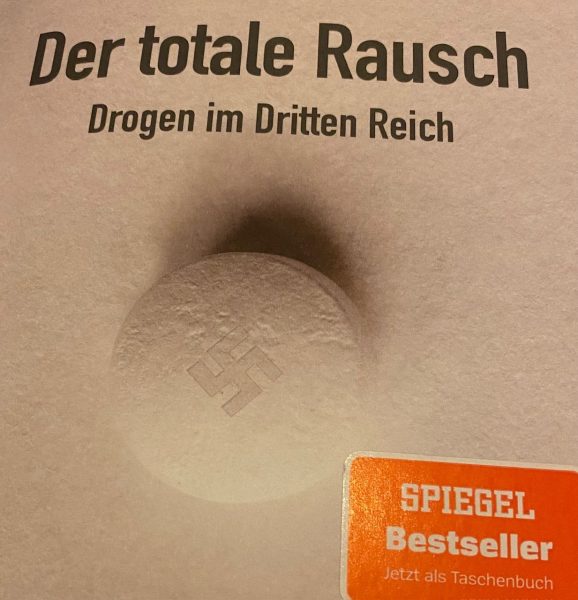
Drogen Rausch
Bereits in 2015 hat Norman Ohler die Ergebnisse seine Recherchen zu Drogen in der Zeit des Nationalsozialismus vorgelegt. Der Spiegel Bestseller liegt in 2023 in der 12. Auflage vor. Methamphetamin war demnach bereits vor dem 2. Weltkrieg eine Volksdroge. Die unter dem Namen Perventin gehandelte Droge war nicht nur unter Medizinstudenten wegen der aufputschenden, wachhaltenden Funktion bekannt. In den ersten beiden Kriegsjahren, oft wegen der schnell voranschreitenden Nazi-truppen, als Blitzkrieg bezeichnet, wurde die Droge gezielt eingesetzt. Abhängigkeiten waren im Anschluss häufig und bereits am 12.6.1941 wurde im Reichsopiumgesetz Perventin als Betäubungsmittel erklärt (Ohler, 2023 S. 137). Die Kontrolle und Verschreibungspflicht wurde demnach erheblich verschärft. Bis in die höchsten Ebenen bestand das Drogenproblem- und die Abhängigkeit von der bewusstseinsverändernden Wirkung. Selbst Hitler wurde damit von seinem Leibarzt versorgt. Um die sich abzeichnende Niederlage, aber dennoch die Motivation der Nazigefolgschaft aufrecht zu halten, kamen weiterhin Drogen zum Einsatz. Drogenkonsum stellt in keinster Weise eine Entschuldigung für die Verbrechen dar. Ohlers betont in seiner Schlussfolgerung (2023, S. 303) „die pervertierte Welt des Dritten Reiches, die so umfassend den Kontakt zu einer lebenswerten Realität verlor und derart viel Leid schaffte“. Wenn nur noch der Rausch durch Drogen als Ausweg dient, dann ist die Menschlichkeit, die in Empfindsamkeit besteht, bereits weitestgehend verloren. Auf viele traf die bekannte „Faustsche Formel“ zu:
„die ich rief, die Geister
Werd’ ich nun nicht los“.