Gentileschi Gentileschi

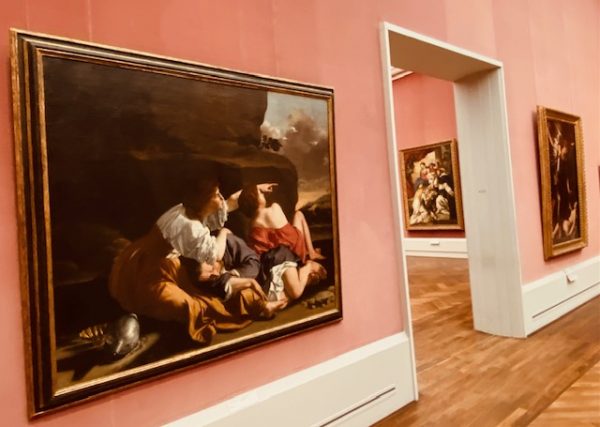
There are 2 Gentileschis that entered the history of art. Orazio the father and his daughter Artemisia. Orazio painted many scenarios based on the bible. The incestuous relationship between Lot and his daughters is difficult one to portray and to do justice to the moral concerns involved. Artemisia, similarly, did not shun away from difficult stories of the bible and added a personal twist to these stories in putting her face into the biblical depiction. The cruelty of the stories become more explicit this way and maybe also her deviant position to the biblical narrative. (Image: Orazio Gentileschi‘ (1622/23) „Lot with his daughters“ Gemäldegalerie Berlin)
Caravaggio Gentileschi

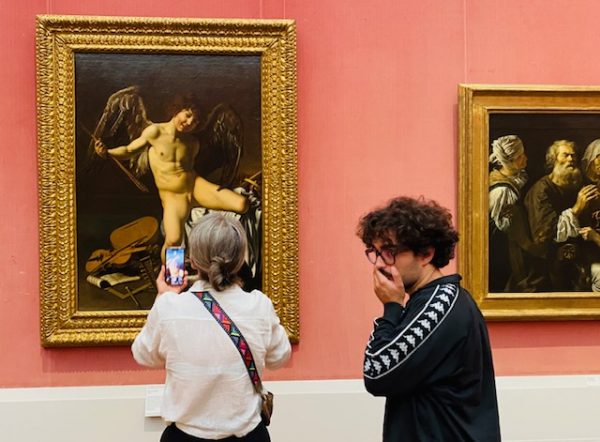
The „Gemäldegalerie“ in Berlin features in the permanent exhibition the famous Caravaggio painting of „Cupid as Victor“ (1601) in the same room with  Orazio Gentileschi‘ (1622/23) „Lot with his daughters“. The paintings show the same technique of painting with the stunning effects of light and shade. Gentileschi‘s own daughter became equally successful as painter applying the same technique and maybe even more recognized as her father. Berlin and Paris jointly allow to trace interesting new perspectives on the history of art from a gender perspective. The male domination in art of the 16th and 17th century was pervasive, but Artemisia Gentileschi a formidable exception. (Image: Caravaggio „Cupid as Victor“, 1601, Gemäldegalerie Berlin)

Le Brun Selfie

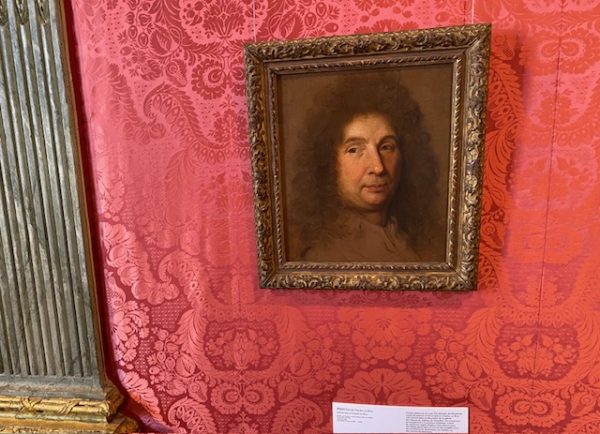
The great painter and decorateur of the French monarch Louis XIV was Charles Le Brun. He was careful about the way he wanted to be remembered in history. His late 17th century self portrait is exposed in the Musée Histoire de Paris Carnavalet. Rightfully put in front of elegant red “tapisserie”, the selfie is remarkable for its attention to details. The hair is drawn with high precision and not a single one seems out of place. The painter does not focus on the person in front of him, but rather on some detail next to or behind the depicted Le Brun. The dress chosen is rather an ordinary person’s one or a person devoted to his work and artistic craftsmanship. No hands, no arms, no shoulders. The sole focus is on the head or should we say the brain and facial expression. Realistic painting is probably the closest you can get to today’s selfie-mania. Le Brun’s decoration and paintings in Versailles and churches ate probably some of the most popular backgrounds of selfiies even in the 21st century.

Gentileschi Iconologia

Ever since the publication of Cesare Ripa’s „Iconologia“ (1593) the codes of art had become subject of a coded production and interpretation of art. Attributes of power or wealth like palms, scepters or crowns, decorated with gold and diamonds spoke a language easily understood by onlookers irrespective of time periods. Orazio and his daughter Artemisia applied this Iconologia throughout their work. The apparently simple depiction of bad weather became a sign of trouble ahead in a person‘s life, office or reign. From the success of Caravaggio‘s paintings, the application of light and shadow became another stylistic feature of especially Artemisia‘s work. Whereas the application of these techniques is a sign of craftsmanship, the own contributions like a more emotional and emancipatory repertoire of Artemisia make her an artist of her own kind. (Image Artemisia Gentileschi, Madelaine pénitante 1625, Musée Jacquemart André“ in Paris 2025-8) 

Women artists

The history of art has been dominated in public opinion for centuries by men. However, recently art historians have drawn our attention to the numerous works of women who took Centre stage with their art during the last 500 years. Flavia Frigeri (2019, 2024) begins her history of women artists with Lavinia Fontana (1552-1614) followed by Artemisia Gentileschi (1593-1652). Both painters produced extraordinary paintings which brought their own touch to the paintings at a time when an independent expression through art was still largely reserved for men. The subjects of Gentileschi were greatly influenced by her experiences as a woman in a male dominated society in the 17th century in Europe. Her choice of subjects for her paintings added a female vision and depiction of biblical and historical narratives that were unique. The „Musée Jacquemart André“ in Paris featured a great retrospective of her art work in 2025. The catalog of the exhibition allows to enter into the art and wit of this early woman artist. 

Zadkine Prax

Ossip Zadkine and Valentine Prax once had their atelier next door to each other at art school. This established a lasting link between the 2. Whereas Zadkine became best known for his sculptures, Prax became famous as a painter. It appears that influences from one to the other are present in the works and several sculptures or preparations for sculptures were collected by Prax and found their way into the permanent exhibition of the museum. Intertwined biographies of artists are an inspiring reminder that art is not created only within a single mind, but many references or inspirations come from joint conversations or just working next to each other for some time. The social part of creating art is visible in this exceptional exhibition. Valentine Prax is honored with a presence in the Zadkine museum as well.

Image: Valentine Prax

Roof under snow

The painter Caillebotte has captured Paris roofs under snow. Hundred years later this will be a rare event. The original painting we can still admire, the original scenario will be a rather rare event. Snow changes city life as everyone walks slowly and traffic as well as other noise is softened by snow as well. Mankind is changing the course of history through global warming while ignoring the consequences for later generations. The links between art and science are closer than we tend to believe.

Climate Awareness

The Musée d’Orsay has prepared a wonderful walk through its permanent exhibition of late 19th and early 20th century installations to reflect upon climate and climate change. Raising awareness about the treasures lost and those we are about to lose in the next few years. Impressionist painters have depicted landscapes, cities and monuments covered in snow, which the next generations will no longer be able to enjoy the same way. The roofs of Paris covered with snow has become a feature of a distant past. Additionally, the impression of the massive steam trains crossing metal bridges appear as the daunting future of technical progress. Mixed feelings of fascination and risk associated with those machines were captured by those painters’ eyes. Nowadays we are aware of the consequences of this technical progress for our planet. The walk through museum with a focus on climate related paintings is eye opening indeed. (Image: Extract of Éduard Veuillard, Le jardin des Tuileries, Musée d’Orsay, Paris) 

Odessa Berlin Odessa

With a sense of partnership, it is possible to travel between Odessa and Berlin in the “Gemäldegalerie” in Berlin 2025. Due to the war of Putin in Ukraine the “Museum of Western and Eastern Art” in Odessa had to relocate its treasures to safe places. The Gemäldegalerie offers a chance to view the splendid collection nevertheless. The curators’ team in a spirit of “art intelligence” propose, in a splendid way, most oeuvres from Odessa next to an example by the same painter from the Berlin collection. The visitor leaves the exhibition enriched by an experience of “jumelage” (engl. sister cities) of partnerships between museums, cities and their people.
In fact, we have shared the same imagery or visual heritage in Europe for centuries . The collections of paintings ranges from the 16th -19th century art  or from Frans Hals to impressionist influences.
We shall cherish the return of the collection to Ukrainian Odessa as soon as possible. The image below shows the places of origin (yellow dots) of the art works of the Odessa collection across centuries (map from the exhibition).

Drawing Drafts

The exhibition “Drafts – From Rubens to Khnopff” at the MRBAB offers an art historian’s view on the role of drafts in the creation of art across centuries. You will not be surprised to discover that drafts played and play a crucial role in creative works. With a restriction to drawings, paintings and sculptures, the exhibition highlights the “creative gesture” originating in a sketch of a detail of a body, a face, the body, compositions of forms or perspectives on space. In some instances, infrared reflectographic camera technology or similar techniques were used to reveal the so-called underdrawing of a painting to allow the comparison of a draft with the “finished” or “published” version as an oil painting. The time span across centuries allows to stress the importance of drafts and drawing rather than the spontaneous creation of a unique piece of art. The 20th and 21st century saw this process of creation challenges by several artists and performative versions of art. The basic creative process, however, remains an important pedagogical access to better understand art and its creation.
The curators of the exhibition Bücken and Maréchal (MRBAB) encourage visitors to use pencils and paper to try out the technique of pencilling or just to try to a sketch of something of interest. This certainly contributes to let the message and encouragement to create yourself sink in to the memories of visitors. All in all a very modern view on old and not so old masters.
(Image: Triple view of Jacques Jordeans, Allegory of fertility of the earth, 1623-25 MRBAB).